Philippines Decorative tile Market Summary
The philippines decorative tile market was estimated at USD 202 Million in 2025 and is projected to reach USD 282 Million by 2032, growing at a CAGR of 5.5% from 2026 to 2032.
Philippines Decorative tile Market Year-wise Growth Rate and Key Drivers
This graph highlights how the Philippines Decorative tile Market has steadily grown over the past five years, supported by major growth factors.
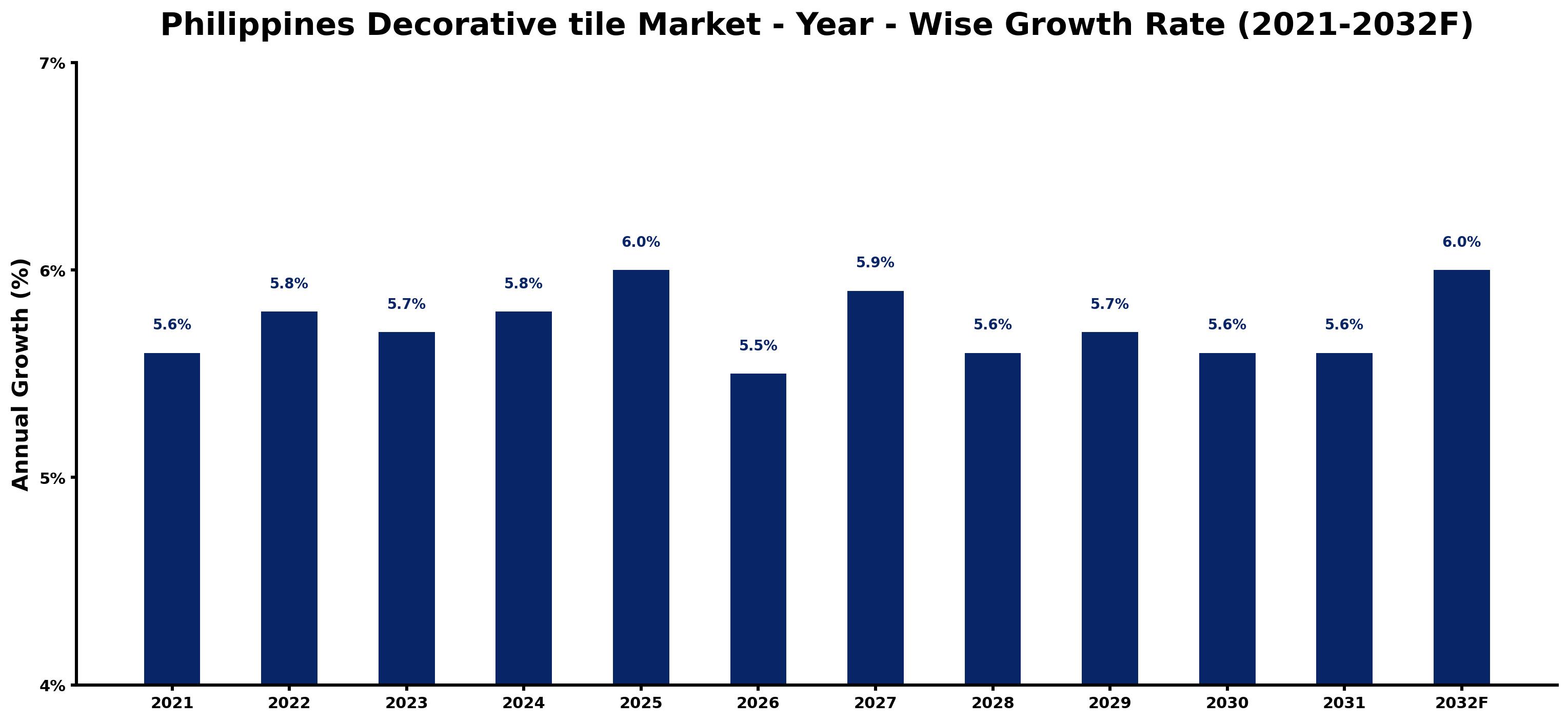
The table below presents the year wise growth rates along with the key drivers influencing the market
| Year | Growth Rate | Major Drivers |
| 2021 | 5.6% | Post-lockdown retail projects accelerated construction activity across residential and commercial sectors. |
| 2022 | 5.8% | Local manufacturers enhanced product quality, catering to diverse consumer aesthetics and preferences. |
| 2023 | 5.7% | Urbanization trends intensified the demand for decorative tiles in residential renovations. |
| 2024 | 5.8% | Sustainable materials gained traction, appealing to environmentally conscious homeowners and builders. |
| 2025 | 6.0% | Digital marketing strategies expanded reach, connecting brands directly with tech-savvy consumers. |
| 2026 | 5.5% | Emergence of e-commerce platforms revolutionized tile distribution, offering greater accessibility nationwide. |
| 2027 | 5.9% | Architectural innovations introduced unique designs, captivating interest among property developers and designers. |
| 2028 | 5.6% | Increased investments in tourism infrastructure boosted demand for decorative tiles in hospitality projects. |
| 2029 | 5.7% | Global design trends influenced local markets, sparking a surge in contemporary tile styles. |
| 2030 | 5.6% | Regional collaborations facilitated the pooling of resources, enhancing production capabilities and distribution. |
| 2031 | 5.6% | Home improvement trends encouraged DIY projects, leading to higher sales of decorative tiles. |
| 2032 | 6.0% | Integration of smart technology in homes prompted interest in tiles with aesthetic and functional appeal. |
Note - Market size estimations and growth projections presented in this report are based on 6Wresearch's advanced forecasting approach, validated with industry datasets as of June 2026.
Philippines Decorative tile Market Synopsis
The Philippines Decorative tile Market is projected to reach 5.5% and witness significant growth during the forecast period (2026-2032). The demand for decorative tiles in the Philippines has risen sharply, particularly as homeowners increasingly look to these products for enhancing their interior spaces. This trend is largely driven by a combination of rising disposable incomes, which make premium products more accessible, and a burgeoning interest in home improvement. Moreover, advancements in tile manufacturing technologies are improving product quality while simultaneously reducing production costs, allowing these decorative tiles to become more affordable for end-users. As urbanization accelerates and infrastructure development projects continue to expand, the decorative tile market is poised for further growth.
Philippines Decorative tile Market Growth Drivers
Several key factors are driving the expansion of the Philippines Decorative tile Market. Firstly, the increasing trend of urbanization plays a crucial role; as more people move into urban centers, the demand for aesthetically pleasing housing options, including decorative tiles, is expected to surge. Secondly, improved housing conditions, supported by various government initiatives, are enhancing the quality of living for many, leading to increased investments in home renovation and decoration.
- Rising disposable incomes allow consumers to invest in higher-end decorative tile options that elevate the aesthetics of their homes.
- Technological advancements in tile production are making it easier to produce high-quality tiles, driving both innovation and affordability.
- With urban infrastructure development on the rise, more residential buildings are being constructed, thereby increasing the potential market for decorative tiles.
- Government-led initiatives aimed at enhancing housing conditions are likely to contribute positively to market growth.
- A growing trend toward sustainable and eco-friendly building materials is leading consumers to seek out decorative tiles that align with their values.
Philippines Decorative tile Market Trends and Opportunities
The Philippines Decorative tile Market is witnessing several notable trends and opportunities that are shaping its future. First, there is a marked shift toward customized and personalized design solutions, as consumers seek to differentiate their living spaces. This trend is encouraging manufacturers to offer a wider array of designs, colors, and finishes to meet diverse consumer preferences. Additionally, the rise of online retail platforms is making it easier for consumers to access a broad range of decorative tiles from the comfort of their homes, further expanding market reach.
- The growing popularity of home improvement television shows and social media influencers is inspiring consumers to undertake DIY projects that include decorative tiling.
- Eco-conscious consumers are increasingly demanding sustainable tile options, leading to an opportunity for companies to innovate with recycled materials.
- Limited-edition collections or collaborations with designers can create buzz and drive demand in the decorative tile segment.
- The pandemic has shifted consumer behavior towards investing in home aesthetics, providing sustained growth opportunities for decorative tile retailers.
- Regions experiencing rapid urban development are likely to see heightened interest in premium decorative tiles, as newly built homes aim for a modern, high-end appearance.
Philippines Decorative tile Market Challenges and Restraints
Despite its growth potential, the Philippines Decorative tile Market faces several challenges that could impede progress. Economic fluctuations, such as inflation or recessions, may lead to decreased consumer spending on luxury items like decorative tiles. Additionally, the market may confront supply chain disruptions, which can affect the availability of raw materials necessary for tile production. Furthermore, competition from alternative flooring and wall covering options can divert consumer attention away from decorative tiles.
- Economic instability could reduce consumer confidence and spending power, making luxury items less attainable.
- Global supply chain issues can impact the consistency and quality of materials used in decorative tile production.
- Increasing competition from alternative home design products may limit market growth and consumer interest in decorative tiles.
- Potential changes in import tariffs and regulations may affect pricing and availability of certain decorative tile imports.
- The need for ongoing innovation in design and manufacturing processes can be resource-intensive, posing a challenge for smaller players in the market.
Philippines Decorative tile Market Government Investment and Initiatives
The Philippine government is actively investing in various initiatives that indirectly bolster the Decorative tile Market. With the aim of enhancing housing quality and standards, public spending on infrastructure developments has surged, paving the way for new residential and commercial projects where decorative tiles are essential. Policies promoting sustainable construction are also encouraging the adoption of eco-friendly materials, including decorative tiles.
- Government initiatives focused on improving housing accessibility increase the market for decorative tiles in both public and private sector projects.
- Public investments in urban infrastructure, including roads and transportation, indirectly influence the housing market, increasing the demand for decorative tiles.
- Policies promoting eco-friendly practices could provide incentives for manufacturers offering sustainable decorative tiling solutions.
- Support for local manufacturing can enhance the availability of decorative tiles in the domestic market, aligning with national development goals.
- Government-sponsored training programs for skills development in tiling and related fields may foster growth in the market by augmenting workforce capabilities.
Philippines Decorative tile Market Latest Developments (May 2025 - June 2026)
In the period spanning May 2025 to June 2026, the Philippines Decorative tile Market has witnessed substantial advancements and changes. The introduction of innovative tiles that incorporate smart technology has started to gain traction, offering consumers modern solutions that blend design with functionality. Moreover, the market has seen an increase in collaborative initiatives between local manufacturers and designers, leading to the creation of unique product lines tailored to contemporary tastes. The ongoing urbanization trend continues to fuel demand, with several new housing projects launched, thus ensuring a steady appetite for decorative tiles. Furthermore, public awareness campaigns focusing on the importance of home aesthetics have resulted in heightened consumer interest in using decorative tiles as a crucial element of home improvement.
Philippines Decorative tile Market - Key Attractiveness of the Report
- 10 Years of Market Numbers
- Historical Data Starting from 2022 to 2025
- Base Year: 2025
- Forecast Data until 2032
- Key Performance Indicators Impacting the Market
- Major Upcoming Developments and Projects
How is the government supporting the decorative tile industry in the Philippines?
What challenges does the Philippines Decorative tile Market face?
What recent developments have occurred in the Philippines Decorative tile Market?
Key Highlights of the Report:
- Philippines Decorative tile Market Outlook
- Market Size of Philippines Decorative tile Market, 2025
- Forecast of Philippines Decorative tile Market, 2032F
- Historical Data and Forecast of Philippines Decorative tile Revenues & Volume for the Period 2022-2032F
- Philippines Decorative tile Market Trend Evolution
- Philippines Decorative tile Market Drivers and Challenges
- Philippines Decorative tile Price Trends
- Philippines Decorative tile Porter's Five Forces
- Philippines Decorative tile Industry Life Cycle
- Historical Data and Forecast of Philippines Decorative tile Market Revenues & Volume By Type for the Period 2022-2032F
- Historical Data and Forecast of Philippines Decorative tile Market Revenues & Volume By Ceramic Wall Tiles for the Period 2022-2032F
- Historical Data and Forecast of Philippines Decorative tile Market Revenues & Volume By Vinyl Wall Tiles for the Period 2022-2032F
- Historical Data and Forecast of Philippines Decorative tile Market Revenues & Volume By Stone Wall Tiles for the Period 2022-2032F
- Historical Data and Forecast of Philippines Decorative tile Market Revenues & Volume By Other Types for the Period 2022-2032F
- Historical Data and Forecast of Philippines Decorative tile Market Revenues & Volume By End-users for the Period 2022-2032F
- Historical Data and Forecast of Philippines Decorative tile Market Revenues & Volume By Residential for the Period 2022-2032F
- Historical Data and Forecast of Philippines Decorative tile Market Revenues & Volume By Commercial for the Period 2022-2032F
- Historical Data and Forecast of Philippines Decorative tile Market Revenues & Volume By Application for the Period 2022-2032F
- Historical Data and Forecast of Philippines Decorative tile Market Revenues & Volume By Flooring for the Period 2022-2032F
- Historical Data and Forecast of Philippines Decorative tile Market Revenues & Volume By Wall Coverings for the Period 2022-2032F
- Historical Data and Forecast of Philippines Decorative tile Market Revenues & Volume By Other Applications for the Period 2022-2032F
- Philippines Decorative tile Import Export Trade Statistics
- Market Opportunity Assessment By Type
- Market Opportunity Assessment By End-users
- Market Opportunity Assessment By Application
- Philippines Decorative tile Top Companies Market Share
- Philippines Decorative tile Competitive Benchmarking By Technical and Operational Parameters
- Philippines Decorative tile Company Profiles
- Philippines Decorative tile Key Strategic Recommendations






































