Philippines Deodorant Market Top 5 Importing Countries and Market Competition (HHI) Analysis
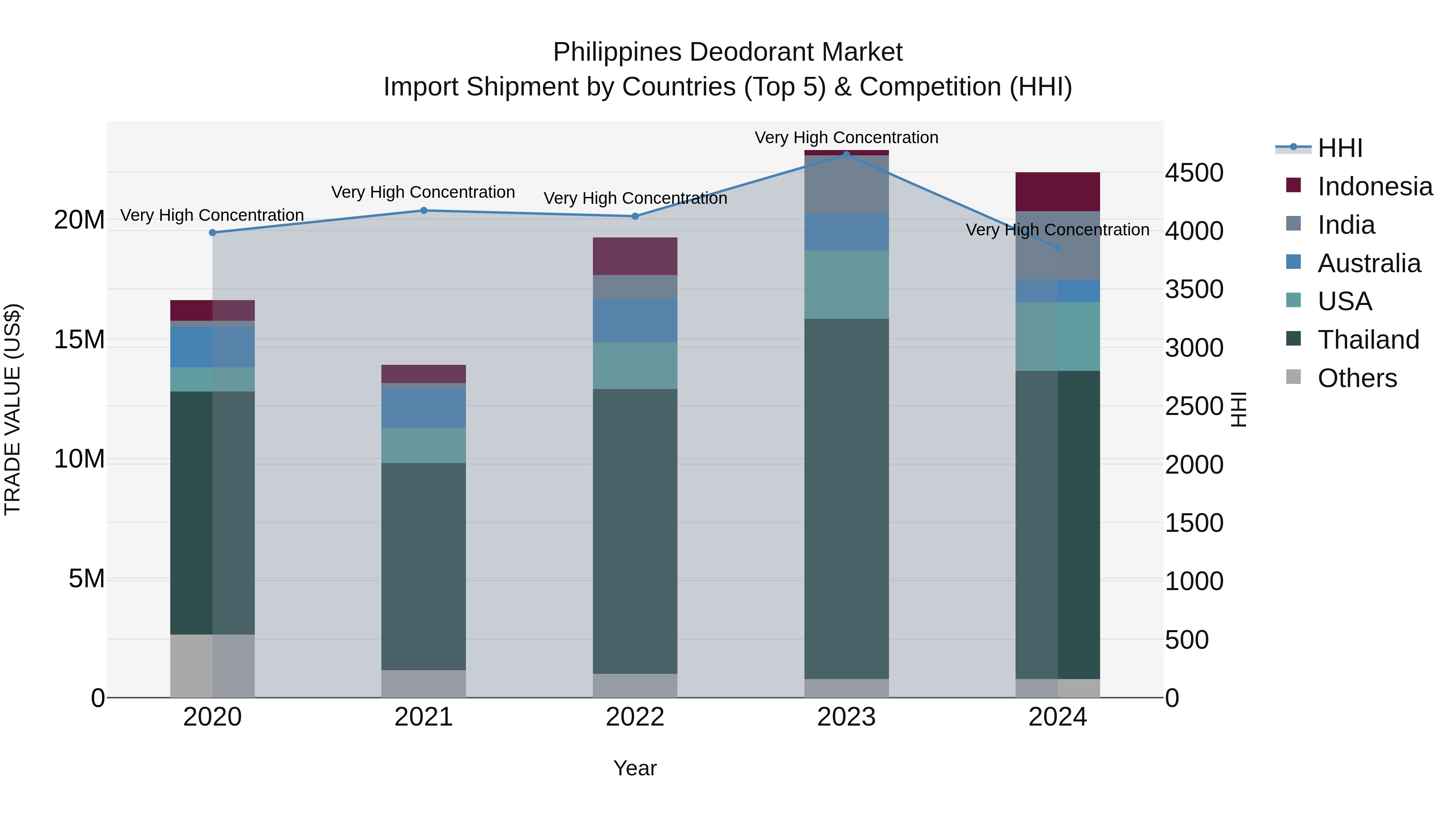
The Philippines deodorant import market in 2024 continued to be dominated by key exporting countries such as Thailand, USA, India, Indonesia, and Australia. Despite a slight decline in growth rate from 2023 to 2024, the market maintained a high concentration with a Herfindahl-Hirschman Index (HHI) indicating strong competition among these major players. With a notable compound annual growth rate (CAGR) of 7.23% from 2020 to 2024, the market is poised for further expansion and innovation in the coming years.
Philippines Deodorant Market Growth Rate
According to 6Wresearch internal database and industry insights, the Philippines Deodorant Market is growing at a compound annual growth rate (CAGR) of 7.4%during the forecast period (2026-2032).
Five-Years Growth Trajectory of the Philippines Deodorant Market with Core Drivers
Below mentioned are the evaluation of year-wise growth rate along with key drivers:
| Years | Est. Annual Growth in % | Growth Drivers |
| 2021 | 4.8% | Increasing awareness of personal hygiene among urban youth. |
| 2022 | 5.2% | Expansion of modern retail formats and convenience stores in key regions. |
| 2023 | 5.9% | Rising working population and grooming trends among millennials. |
| 2024 | 6.6% | Growth of e-commerce platforms and digital marketing outreach. |
| 2025 | 7.1% | Introduction of innovative deodorant products (long-lasting, skin friendly). |
Topics Covered in the Philippines Deodorant Market Report
Philippines Deodorant Market report thoroughly covers the market by product, distribution channel, packaging material, and end user. The market report provides an unbiased and detailed analysis of ongoing market trends, opportunities/high growth areas, and market drivers, which would help stakeholders devise and align their market strategies according to the current and future market dynamics.
Philippines Deodorant Market Highlights
| Report Name | Philippines Deodorant Market |
| Forecast Period | 2026–2032 |
| CAGR | 7.40% |
| Growing Sector | Online Retail |
Philippines Deodorant Market Synopsis
The Philippines deodorant market is growing robustly. The market growth is attributed to increasing urbanization and the growing spending power of consumers. In addition to this, increasing personal grooming awareness among consumers of all age groups is boosting the demand for this industry. Also, demand for effective antiperspirant products due to the country’s hot and humid climate is encouraging market expansion. On top of that, proliferation of organized retail networks and online marketplaces is accelerating market growth.
Evaluation of Growth Drivers in the Philippines Deodorant Market
Below mentioned some growth drivers and their impact on market dynamics:
| Drivers | Primary Segments Affected | Why It Matters |
| Rising Personal Hygiene Awareness | Spray, Roll-On, Creams | Growing hygiene focus increases frequency of deodorant usage across consumers. |
| Retail Network Expansion | Supermarkets/Hypermarkets, Convenience Stores | The retail network provides ease of accessibility and creates impulsive buying. |
| E-commerce Growth | Online Retail | The online retail platforms increase the sales of the market by providing ease of accessibility. |
| Youth & Working Population Growth | Men, Women | There is a higher demand among young generation for grooming products. |
| Product Innovation | Packaging Material (Metal, Plastic) | Innovative formats attract consumers seeking increased performance. |
The Philippines Deodorant Market is projected to grow significantly, with a CAGR of 7.4%during the forecast period of 2026-2032. The market is growing rapidly, driven by rising personal hygiene awareness and increasing grooming habits among urban and young consumers. Also, the demand for antiperspirant products is expected to increase due to the country’s hot and humid climate. Furthermore, increasing modern retail networks, consisting of supermarkets and convenience stores, are expected to drive the industry growth. The increasing growth of online retail platforms is also encouraging the market by providing ease of accessibility and a wide range of product offerings. Other than that, increasing the spending power of consumers and growing urbanization are ensuring the industry's smooth expansion.
Evaluation of Restraints in the Philippines Deodorant Market
Below mentioned are some major restraints and their influence on market dynamics:
| Restraints | Primary Segments Affected | What This Means |
| Price Sensitivity | Premium Sprays, Creams | High prices discourage consumers from shifting to premium deodorant products. |
| Skin Irritation Concerns | Roll-On, Creams | Fear of rashes or allergies reduces repeat purchases and brand loyalty. |
| Intense Competition | All Segments | More competition between local and foreign brands creates instability in the market. |
| Counterfeit Products | Supermarkets, Online Retail | Fake products damage consumer trust and impact sales of genuine brands. |
| Environmental Concerns | Metal Packaging | Increasing preference for sustainability pressure companies to adopt eco-friendly options. |
Philippines Deodorant Market Challenges
The market encounters several challenges. These challenges include strong competition between national and international brands. Other than that, the consumers are increasingly preferring cheap products; thus, demand for the premium segment gets lower. Also, environmental concerns regarding aerosols and metal packaging drive demand for sustainable options in the market. Besides, skin sensitivity associated with certain chemical ingredients poses a challenge for brands targeting health-conscious users. For the continued growth of the market, the companies need to deal with the above challenges.
Philippines Deodorant Market Trends
Some major trends contributing to the Philippines deodorant market growth are:
- Natural & Organic Deodorants: The consumers are increasingly preferring the deodorants that are delicate on the skin and have no toxic chemical properties.
- Whitening & Skin Care Benefits: There is an increasing demand among consumers for underarm brightening and moisturizing deodorants, mainly among the female segment.
- Influencer-Led Digital Marketing: The growing beauty and personal care influencers on social media are also encouraging the demand for deodorants among different age groups.
Investment Opportunities in the Philippines Deodorant Market
Here are some investment opportunities in the Philippines Deodorant Industry:
- Localized Product Development: The investors can increasingly invest in the making of deodorants tailored for tropical weather and according to customer preferences.
- Direct-to-Consumer Online Platforms: The partnerships with online retail platforms are also increasing the sales by providing a varied range of product offerings and home delivery services.
- Eco-Friendly Packaging Solutions: The eco-friendly packaging is increasing the market growth as consumers are increasingly becoming aware of environmental concerns.
Top 5 Leading Players in the Philippines Deodorant Market
Here are some top companies contributing to the Philippines Deodorant Market Share:
Unilever Philippines
| Company Name | Unilever Philippines |
| Headquarter | Bonifacio Global City, Taguig, Philippines |
| Established Year | 1927 |
| Website | Click Here |
Unilever Philippines is a dominant player in the deodorant segment, offering popular brands such as Rexona and Dove. The company focuses on long-lasting protection, skin-friendly formulations, and strong nationwide distribution through supermarkets, convenience stores, and online platforms.
Procter & Gamble Philippines
| Company Name | Procter & Gamble Philippines |
| Headquarter | Makati City, Philippines |
| Established Year | 1935 |
| Website | Click Here |
Procter & Gamble is a leading personal care manufacturer in the Philippines, known for brands like Old Spice and Secret. The company emphasizes product innovation, Odor-fighting technology, and targeted marketing campaigns to strengthen its presence in both men’s and women’s segments.
Colgate-Palmolive Philippines
| Company Name | Colgate-Palmolive Philippines |
| Headquarter | Makati City, Philippines |
| Established Year | 1927 |
| Website | Click Here |
Colgate-Palmolive offers deodorant products under brands such as Palmolive, focusing on gentle formulations and skin-conditioning benefits. The company leverages its strong retail network and brand recognition to maintain steady growth in the deodorant market.
L’Oréal Philippines
| Company Name | L’Oréal Philippines |
| Headquarter | Taguig City, Philippines |
| Established Year | 1994 |
| Website | Click Here |
L’Oréal Philippines participates in the deodorant and personal care category with premium and dermatologically tested products. The company focuses on innovation, beauty science, and premium positioning to cater to urban and higher-income consumers.
Bench (Suyen Corporation)
| Company Name | Bench (Suyen Corporation) |
| Headquarter | Manila, Philippines |
| Established Year | 1987 |
| Website | Click Here |
Bench is a well-known Filipino lifestyle and personal care brand offering affordable deodorants targeted at young consumers. The company utilizes celebrity endorsements, strong brand recall, and wide retail penetration across malls and department stores to expand its market share.
Government Regulations Introduced in the Philippines Deodorant Market
According to Philippine government data, the development of the Philippines Deodorant Market is mainly influenced by regulations from bodies such as the Philippine Food and Drug Administration (PFDA) and the Department of Trade and Industry (DTI). The PFDA makes the safety and labeling standards for cosmetics and personal care products to ensure consumer protection. Furthermore, policies like the DTI’s Go Local Program, pushes local manufacturers to increase competitiveness and access both online and offline retail channels. Additionally, the Cosmetics and Toiletries Regulation Act mandates quality control measures that uphold product safety and instil consumer confidence.
Future Insights of the Philippines Deodorant Market
The Philippines deodorant market is expected to have steady growth during the forecast period. The market growth is driven by increasing spending power of consumers and growing urbanization. Further, the market growth is driven by demand for personal care hygiene products among the younger consumer base. There is a heightened demand for eco-friendly products among consumers due to the increased environmental awareness. The increased collaboration between the local companies of the Philippines and foreign brands encourages the industry expansion. Besides, the regulatory supports also encourage the steady growth of the market.
Market Segmentation Analysis
The report offers a comprehensive study of the subsequent market segments and their leading categories.
Spray to Dominate the Market – By Product
According to Guneet Kaur, Senior Research Analyst, 6Wresearch, spray deodorants dominate the market due to their quick-drying formulation, refreshing feel, and wide fragrance variety. Their convenience, hygienic application, and suitability for humid climates make them highly preferred among young and active consumers.
Online Retail to Dominate the Market – By Distribution Channel
Online retail channel is leading the market. As consumers increasingly prefer convenient purchasing options and home delivery services. Also, they offer discounts, wider product assortment, influencer promotions, and easy comparison of brands encourage buyers to choose online platforms over traditional outlets.
Plastic to Dominate the Market – By Packaging Material
Plastic packaging is leading the market. The market growth due to its lightweight structure, cost-effectiveness, and design flexibility. Further, it allows brands to offer roll-ons and creams in durable, travel-friendly containers while supporting innovative shapes and branding that appeal to mass-market consumers.
Women to Dominate the Market – By End User
This is mainly due to female consumers increasing preference for deodorants having fragrance variety and skin-brightening benefits. Other than that, gentle formulations will also boost the market growth. and higher engagement in personal grooming routines is also expected to increase the market sales.
Key attractiveness of the report
- 10 Years Market Numbers.
- Historical Data Starting from 2022 to 2025.
- Base Year: 2025.
- Forecast Data until 2032.
- Key Performance Indicators Impacting the Market.
- Major Upcoming Developments and Projects.
Key Highlights of the Report:
- Philippines Deodorant Market Outlook
- Market Size of Philippines Deodorant Market, 2025
- Forecast of Philippines Deodorant Market, 2032
- Historical Data and Forecast of Philippines Deodorant Revenues & Volume for the Period 2022 - 2032F
- Philippines Deodorant Market Trend Evolution
- Philippines Deodorant Market Drivers and Challenges
- Philippines Deodorant Price Trends
- Philippines Deodorant Porter's Five Forces
- Philippines Deodorant Industry Life Cycle
- Historical Data and Forecast of Philippines Deodorant Market Revenues & Volume By Product for the Period 2022 - 2032F
- Historical Data and Forecast of Philippines Deodorant Market Revenues & Volume By Spray for the Period 2022 - 2032F
- Historical Data and Forecast of Philippines Deodorant Market Revenues & Volume By Creams for the Period 2022 - 2032F
- Historical Data and Forecast of Philippines Deodorant Market Revenues & Volume By Roll-On for the Period 2022 - 2032F
- Historical Data and Forecast of Philippines Deodorant Market Revenues & Volume By Others for the Period 2022 - 2032F
- Historical Data and Forecast of Philippines Deodorant Market Revenues & Volume By Distribution Channel for the Period 2022 - 2032F
- Historical Data and Forecast of Philippines Deodorant Market Revenues & Volume By Supermarkets/Hypermarkets for the Period 2022 - 2032F
- Historical Data and Forecast of Philippines Deodorant Market Revenues & Volume By Convenience Stores for the Period 2022 - 2032F
- Historical Data and Forecast of Philippines Deodorant Market Revenues & Volume By Pharmacies for the Period 2022 - 2032F
- Historical Data and Forecast of Philippines Deodorant Market Revenues & Volume By Drug Stores for the Period 2022 - 2032F
- Historical Data and Forecast of Philippines Deodorant Market Revenues & Volume By Online Retail for the Period 2022 - 2032F
- Historical Data and Forecast of Philippines Deodorant Market Revenues & Volume By Others for the Period 2022 - 2032F
- Historical Data and Forecast of Philippines Deodorant Market Revenues & Volume By Packaging Material for the Period 2022 - 2032F
- Historical Data and Forecast of Philippines Deodorant Market Revenues & Volume By Metal for the Period 2022 - 2032F
- Historical Data and Forecast of Philippines Deodorant Market Revenues & Volume By Plastic for the Period 2022 - 2032F
- Historical Data and Forecast of Philippines Deodorant Market Revenues & Volume By Others for the Period 2022 - 2032F
- Historical Data and Forecast of Philippines Deodorant Market Revenues & Volume By End User for the Period 2022 - 2032F
- Historical Data and Forecast of Philippines Deodorant Market Revenues & Volume By Men for the Period 2022 - 2032F
- Historical Data and Forecast of Philippines Deodorant Market Revenues & Volume By Women for the Period 2022 - 2032F
- Historical Data and Forecast of Philippines Deodorant Market Revenues & Volume By Others for the Period 2022 - 2032F
- Philippines Deodorant Import Export Trade Statistics
- Market Opportunity Assessment By Product
- Market Opportunity Assessment By Distribution Channel
- Market Opportunity Assessment By Packaging Material
- Market Opportunity Assessment By End User
- Philippines Deodorant Top Companies Market Share
- Philippines Deodorant Competitive Benchmarking By Technical and Operational Parameters
- Philippines Deodorant Company Profiles
- Philippines Deodorant Key Strategic Recommendations
Market covered
The report subsequently covers the market by following segments and subsegments.
By Product
- Spray
- Creams
- Roll-On
- Others
By Distribution Channel
- Supermarkets/Hypermarkets
- Convenience Stores
- Pharmacies
- Drug Stores
- Online Retail
- Others
By Packaging Material
- Metal
- Plastic
- Others
By End User
- Men
- Women
- Others






































