Philippines Dermatology Drugs Market Size, Share & Growth Rate
The Philippines Dermatology Drugs Market was estimated at USD 447 Million in 2025 and is projected to reach USD 621 Million by 2032, growing at a CAGR of 4.8% from 2026 to 2032. This growth trajectory is fueled by rising public awareness surrounding skin health, coupled with an increase in disposable income, which empowers consumers to seek advanced dermatological treatments. Furthermore, the prevalence of skin conditions such as acne, eczema, and psoriasis continues to drive demand for effective pharmaceuticals, prompting ongoing investment from pharmaceutical companies in innovative drug development.
Philippines Dermatology Drugs Market Year-wise Growth Rate and Key Drivers
This graph highlights how the Philippines Dermatology Drugs Market has steadily grown over the years, supported by major growth factors.
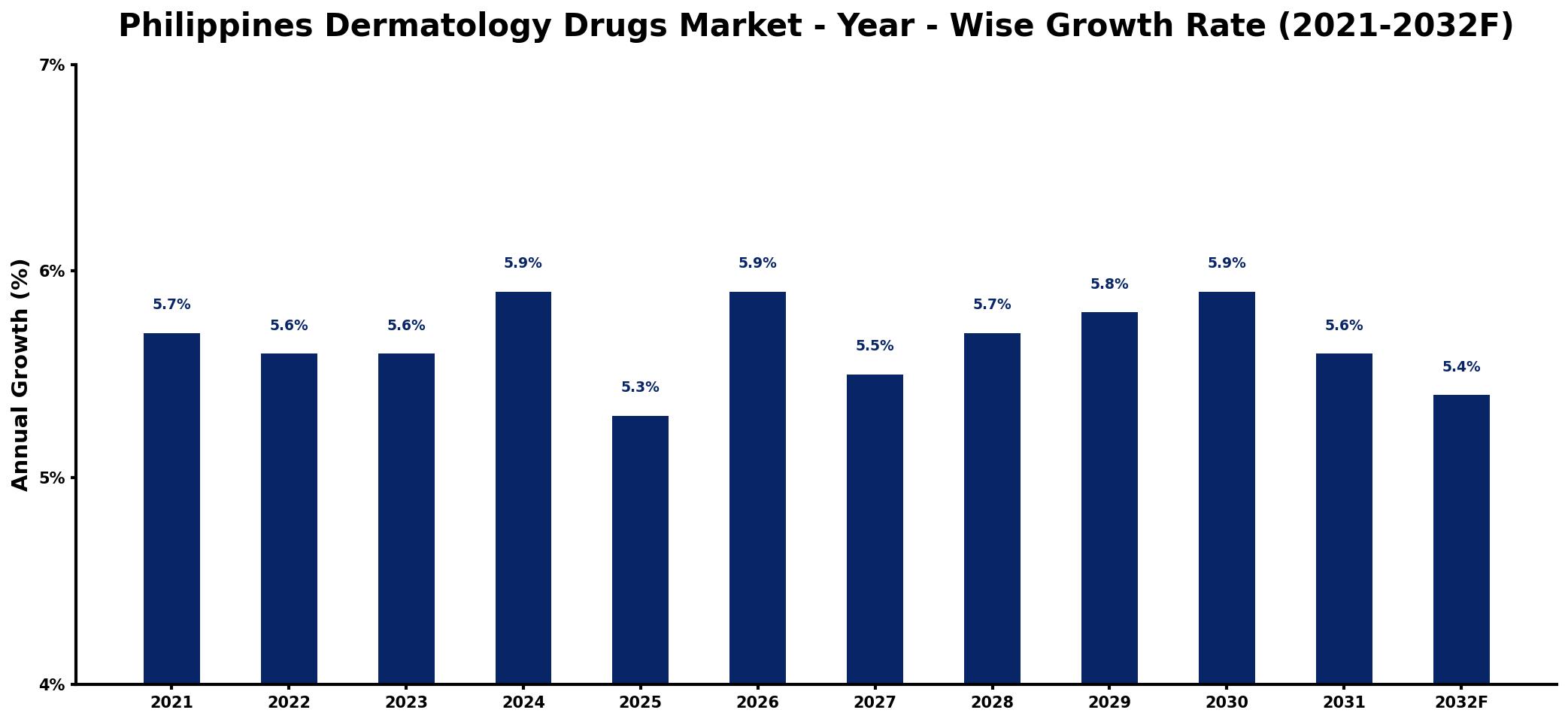
The table below presents the year‑wise growth rates along with the key drivers influencing the market
| Year | Growth Rate | Major Drivers |
| 2021 | 5.7% | increased consumer health awareness |
| 2022 | 5.6% | growing aesthetic treatment popularity |
| 2023 | 5.6% | rising incidence of skin conditions |
| 2024 | 5.9% | expansion of healthcare infrastructure |
| 2025 | 5.3% | increased investment in research |
| 2026 | 5.9% | growing demand for natural solutions |
| 2027 | 5.5% | enhanced regulatory approvals process |
| 2028 | 5.7% | advancements in treatment technologies |
| 2029 | 5.8% | increased overall sector activity |
| 2030 | 5.9% | increased collaboration with influencers |
| 2031 | 5.6% | growing telemedicine adoption rates |
| 2032 | 5.4% | rising consumer spending on wellness |
Note: Market size estimations and growth projections presented in this report are based on 6Wresearch's proprietary forecasting methodology, utilizing the latest available industry data, government publications, and primary research inputs.
Philippines Dermatology Drugs Market Synopsis
The dermatology drugs market in the Philippines has been gaining momentum as skincare takes center stage in consumer health priorities. Recent trends show a significant uptick in individuals proactively seeking treatment for skin conditions, revealing a shift towards preventative healthcare and long-term skin wellness.
As the healthcare landscape evolves, the market is becoming increasingly competitive, with new players emerging to offer cutting-edge solutions. The confluence of lifestyle changes and growing medical awareness is creating a fertile environment for dermatological innovations, making this a dynamic sector ripe for growth.
Philippines Dermatology Drugs Market Key Takeaways
- Continued rise in skin health awareness is driving demand for dermatology drugs.
- Increased disposable income allows more Filipinos to invest in dermatological treatments.
- Pharmaceutical research is actively focused on innovative solutions for prevalent skin conditions.
- The market shows resilience despite challenges related to generic competition.
- Healthcare normalization post-COVID-19 is expected to facilitate market recovery and expansion.
Evaluation of Restraints in Philippines Dermatology Drugs Market
Despite its promising growth, the Philippines dermatology drugs market is restrained by several factors. The dominance of generic drugs poses significant pricing pressure, making it difficult for brand-name drugs to maintain competitive profit margins. Furthermore, dermatological issues often lack the urgency associated with more critical health conditions, resulting in delayed treatment and reduced market potential. Regulatory challenges also complicate the swift introduction of new products, as the rigorous demand for clinical trials can slow down innovation. Overcoming these obstacles requires a concerted effort to raise awareness and educate consumers on the importance of timely dermatological care.
Philippines Dermatology Drugs Market Trends
Emerging trends in the Philippines dermatology drugs market are significantly influenced by advancements in technology and consumer behavior. Digital health platforms and telemedicine are gaining traction, enabling greater access to dermatological consultations and treatments. Additionally, an increasing focus on natural and organic ingredients in skin care products is reshaping consumer preferences. This shift encourages pharmaceutical companies to develop formulations that align with holistic health and wellness trends.
Philippines Dermatology Drugs Market Opportunities
The potential for growth in the Philippines dermatology drugs market is vast, particularly in areas such as research and development. Companies that invest in innovative treatment options, specifically targeting chronic skin conditions, are well-positioned to capitalize on the expanding consumer base. Furthermore, increased collaboration between healthcare providers and pharmaceutical firms can lead to better patient education and product utilization, ultimately driving revenue growth. The rise in personalized medicine also presents opportunities for tailored dermatological treatments that cater to individual patient needs.
Government Initiatives in the Philippines Dermatology Drugs Market
Government initiatives aimed at enhancing public health infrastructure play a crucial role in the dermatology drugs market. Policies promoting awareness of skin health and increased funding for healthcare services can directly impact the accessibility and adoption of dermatological treatments. Public health campaigns focusing on prevention and early intervention in skin conditions further bolster the market potential, as they create an environment conducive to patient engagement and treatment uptake.
Future Insights of the Philippines Dermatology Drugs Market
Looking ahead, the Philippines dermatology drugs market is poised for considerable expansion between 2026 and 2032. As healthcare services normalize post-pandemic, the demand for dermatological treatments is expected to rise sharply. This growth will be driven by ongoing public health campaigns and a societal shift towards preventative care. Companies that prioritize innovation and adapt to changing consumer preferences will likely emerge as leaders in this evolving landscape.
Philippines Dermatology Drugs Market Latest Developments (2025 - 2026)
In recent months, the dermatology drugs market in the Philippines has witnessed a surge in product launches aimed at addressing common skin ailments. Collaborations between various stakeholders, including healthcare providers and pharmaceutical firms, have intensified, promoting the development of more effective treatment modalities. Additionally, the rise of online healthcare platforms has made dermatological consultations more accessible, encouraging broader consumer engagement with skin health issues.
Philippines Dermatology Drugs Market - Key Attractiveness of the Report
- 10 Years of Market Numbers
- Historical Data Starting from 2022 to 2025
- Base Year: 2025
- Forecast Data until 2032
- Key Performance Indicators Impacting the Market
- Major Upcoming Developments and Projects
Key Highlights of the Report:
- Philippines Dermatology Drugs Market Outlook
- Market Size of Philippines Dermatology Drugs Market, 2025
- Forecast of Philippines Dermatology Drugs Market, 2032
- Historical Data and Forecast of Philippines Dermatology Drugs Revenues & Volume for the Period 2022-2032F
- Philippines Dermatology Drugs Market Trend Evolution
- Philippines Dermatology Drugs Market Drivers and Challenges
- Philippines Dermatology Drugs Price Trends
- Philippines Dermatology Drugs Porter's Five Forces
- Philippines Dermatology Drugs Industry Life Cycle
- Historical Data and Forecast of Philippines Dermatology Drugs Market Revenues & Volume By Application for the Period 2022-2032F
- Historical Data and Forecast of Philippines Dermatology Drugs Market Revenues & Volume By Acne for the Period 2022-2032F
- Historical Data and Forecast of Philippines Dermatology Drugs Market Revenues & Volume By Atopic Dermatitis for the Period 2022-2032F
- Historical Data and Forecast of Philippines Dermatology Drugs Market Revenues & Volume By Psoriasis for the Period 2022-2032F
- Historical Data and Forecast of Philippines Dermatology Drugs Market Revenues & Volume By Others for the Period 2022-2032F
- Historical Data and Forecast of Philippines Dermatology Drugs Market Revenues & Volume By Route of Administration for the Period 2022-2032F
- Historical Data and Forecast of Philippines Dermatology Drugs Market Revenues & Volume By Oral for the Period 2022-2032F
- Historical Data and Forecast of Philippines Dermatology Drugs Market Revenues & Volume By Parenteral for the Period 2022-2032F
- Historical Data and Forecast of Philippines Dermatology Drugs Market Revenues & Volume By Topical for the Period 2022-2032F
- Historical Data and Forecast of Philippines Dermatology Drugs Market Revenues & Volume By Distribution Channel for the Period 2022-2032F
- Historical Data and Forecast of Philippines Dermatology Drugs Market Revenues & Volume By Hospital Pharmacy for the Period 2022-2032F
- Historical Data and Forecast of Philippines Dermatology Drugs Market Revenues & Volume By Retail Pharmacy for the Period 2022-2032F
- Historical Data and Forecast of Philippines Dermatology Drugs Market Revenues & Volume By Online Pharmacy for the Period 2022-2032F
- Philippines Dermatology Drugs Import Export Trade Statistics
- Market Opportunity Assessment By Application
- Market Opportunity Assessment By Route of Administration
- Market Opportunity Assessment By Distribution Channel
- Philippines Dermatology Drugs Top Companies Market Share
- Philippines Dermatology Drugs Competitive Benchmarking By Technical and Operational Parameters
- Philippines Dermatology Drugs Company Profiles
- Philippines Dermatology Drugs Key Strategic Recommendations






































