Disposable Cutlery Market: Philippines vs Top 5 Major Economies in 2027 (Asia)
The Disposable Cutlery market in Philippines is projected to grow at a high growth rate of 14.58% by 2027, highlighting the country's increasing focus on advanced technologies within the Asia region, where China holds the dominant position, followed closely by India, Japan, Australia and South Korea, shaping overall regional demand.
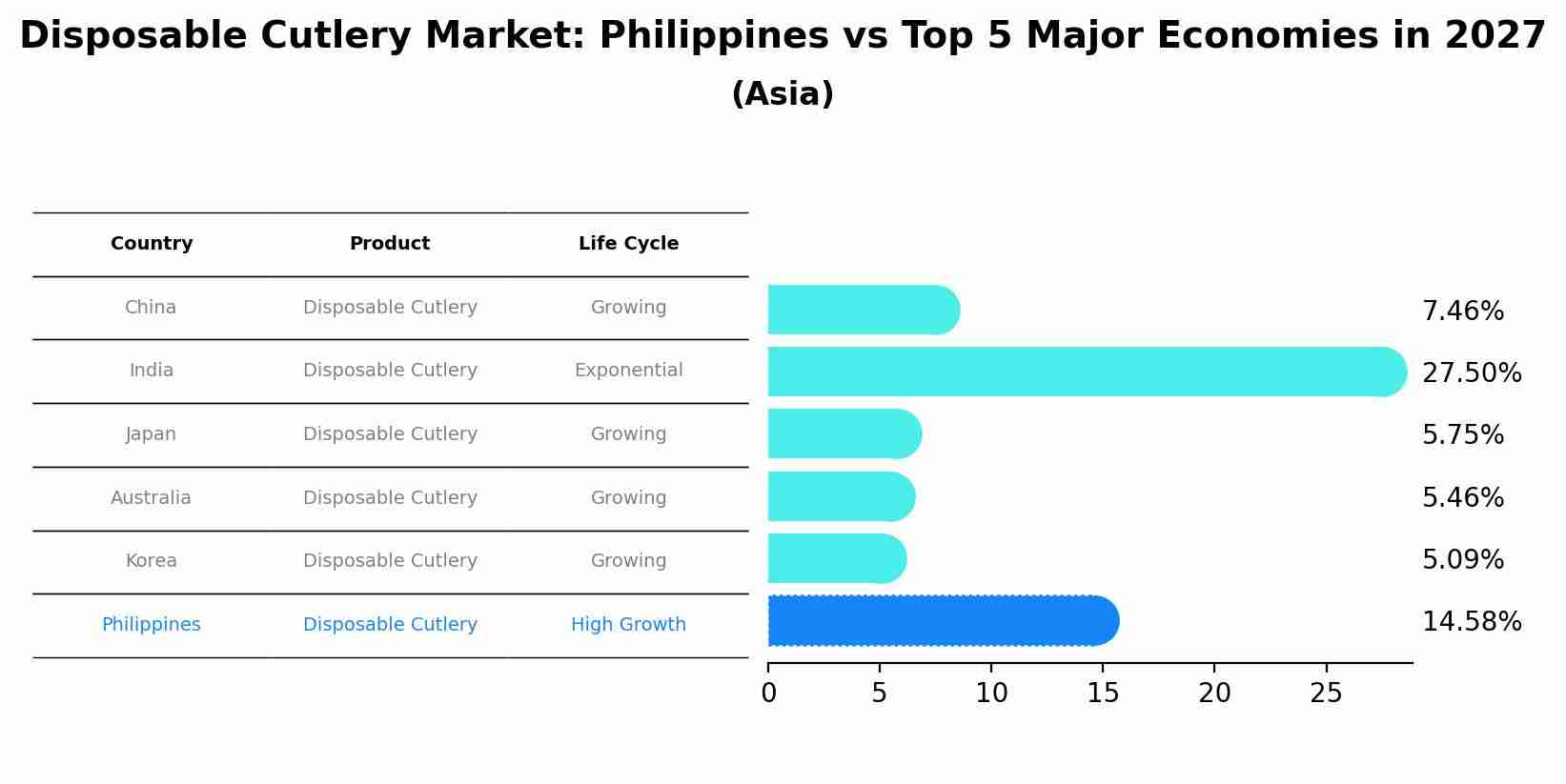
Philippines Disposable Cutlery Market Growth Rate
According to 6Wresearch internal database and industry insights, the Philippines Disposable Cutlery Market is projected to grow at a compound annual growth rate (CAGR) of 7.1% during the forecast period from 2026 to 2032.
Topics Covered in the Philippines Disposable Cutlery Market Report
The Philippines Disposable Cutlery Market report thoroughly covers the market by product type, fabrication process, cutlery type, end-use, and sales channel, providing an unbiased and detailed analysis of ongoing market trends, opportunities, challenges, and market drivers, helping stakeholders align their strategies with current and future market dynamics.
Philippines Disposable Cutlery Market Highlights
| Report Name | Philippines Disposable Cutlery Market |
| Forecast Period | 2026–2032 |
| CAGR | 7.1% |
| Growing Sector |
Disposable Cutlery |
Philippines Disposable Cutlery Market Synopsis
The Philippines Disposable Cutlery Market experiences rapid growth as customers prefer hygienic and convenient single-use dining products. The adoption of products has grown as fast-food chains, food service outlets, e-retail platforms have become more common. Biodegradable and eco-friendly cutlery innovations attract environmentally conscious consumers to the market. Furthermore, the market expansion benefits from increased institutional food services and household demand for products. The Philippines Disposable Cutlery Market develops through these combined forces which create a stable development path for the market.
Evaluation of Growth Drivers in the Philippines Disposable Cutlery Market
Below mentioned are some prominent drivers and their impact on the market dynamics:
| Drivers | Primary Segments Affected | Why It Matters (Evidence) |
| Rising Demand for Hygiene | Food Service Outlets, Household Use | Consumers prefer disposable cutlery for sanitary reasons, especially in dining and take-away scenarios. |
| Eco-Friendly Material Adoption | Spoon, Fork, Knife | Market growth is supported by the rising demand for eco-friendly cutlery options. |
| Expansion of Institutional Services | Institutional Food Services, Catering | A wider selection of disposable utensils are contributing to the advent and flourishing of large-scale industrial food operations. |
| E-commerce and Retail Penetration | Distributors, E-retail | Online availability provides convenient access for both businesses and households, broadening the consumer base. |
| Innovation in Fabrication Process | Thermoforming, Injection Molding | Innovative manufacturing techniques improve the durability, functionality, and sustainability of products. |
The Philippines Disposable Cutlery Market Size is projected to grow at a CAGR of 7.1% from 2026 to 2032. The Philippines Disposable Cutlery Market experiences market growth as people become more aware of hygiene standards, more food service outlets are open and businesses start using environmentally friendly products. The product quality and operational efficiency improves as technological advancements in fabrication processes become available. The market sees higher adoption rates as current trends create convenient sustainable products that people can access through multiple sales channels. The combined effect of these factors leads to higher demand from both individual customers and business clients which results in faster market expansion.
Evaluation of Restraints in the Philippines Disposable Cutlery Market
Below mentioned are some major restraints and their influence on the market dynamics:
| Restraints | Primary Segments Affected | What This Means (Evidence) |
| Price Sensitivity | Household Use, Retailers | Higher costs of biodegradable cutlery may limit adoption among cost-conscious buyers. |
| Limited Awareness | Food Service Outlets | Low knowledge about sustainable cutlery alternatives may restrict market expansion. |
| Regulatory Compliance | All Product Segments | Production expenses may increase due to strict environmental and safety requirements. |
| Competition from Reusables | Household Use, Institutional Services | The transition towards reusable cutlery in homes and eateries might hamper the growth of disposable cutlery. |
| Supply Chain Challenges | Distributors, E-retail | Product availability may be delayed due to distribution inefficiencies. |
Philippines Disposable Cutlery Market Challenges
The Philippines Disposable Cutlery Industry faces challenges which stem from two main factors. The first factor is the high price sensitivity which consumers show towards eco-friendly products. The second factor represents the competition which reusable products create. Supply chain inconsistencies, regulatory compliance, and quality standards create additional hurdles. Furthermore, the market needs to educate consumers about sustainable options while developing affordable biodegradable cutlery products and building better partnerships between manufacturers, distributors and retail channels. The market will experience improved accessibility through these strategies which will also increase market adoption and enable sustainable market expansion.
Philippines Disposable Cutlery Market Trends
Here are some major trends changing the Philippines Disposable Cutlery Market Growth dynamics:
- Growing Preference for Biodegradable Cutlery – People have developed a stronger inclination to use biodegradable cutlery as their understanding of environmental issues has increased. The consumers and businesses show a preference for eco-friendly alternatives instead of using standard plastic products.
- Expansion of Institutional Food Services – The growth of catering services, corporate food delivery and institutional dining operations requires more single-use cutlery products.
- Integration with E-Retail Platforms – Online distribution enables manufacturers and distributors of disposable cutlery products to have access to a higher population of customers and reach more markets.
Investment Opportunities in the Philippines Disposable Cutlery Market
The Philippines Disposable Cutlery Market presents several investment opportunities, including:
- Innovation in Eco-Friendly Materials: Businesses that offer biodegradable, compostable, and plant-based products can appeal to consumers concerned with environmental protection.
- Expansion of E-Commerce Channels: Online platforms create better consumer access while supporting bulk sales and institutional sales.
- Educational Campaigns on Sustainability: The public will become more aware of sustainable cutlery options which will lead to their increased use in homes and restaurants.
Top 5 Leading Players in the Philippines Disposable Cutlery Market
Below is the list of prominent companies leading the Philippines Disposable Cutlery Market Share:
1. Jolly Plastic Products Inc.
| Company Name | Jolly Plastic Products Inc. |
|---|---|
| Established Year | 1980 |
| Headquarters | Manila, Philippines |
| Official Website | Click Here |
Jolly Plastic is one of the most established manufacturers of plastic-based disposable cutlery and food service packaging in the Philippines. The company provides a high-volume supply of spoons, forks, and knives to major fast-food chains and wholesalers, while increasingly incorporating high-heat resistant and recyclable polymers into their product lines.
2. Eco-NEST Philippines
| Company Name | Eco-NEST Philippines |
|---|---|
| Established Year | 2017 |
| Headquarters | Pasig City, Philippines |
| Official Website | Click Here |
Eco-NEST is a leading player in the eco-friendly segment, specializing in biodegradable and compostable cutlery. They are the exclusive distributor of Cassava-based and bagasse-based products, catering to premium hotels, eco-conscious cafes, and corporate events that are transitioning away from single-use plastics in compliance with local government ordinances.
3. D&W World Corp (Donewell)
| Company Name | D&W World Corp (Donewell) |
|---|---|
| Established Year | 1978 |
| Headquarters | Quezon City, Philippines |
| Official Website | Click Here |
Under the "Donewell" brand, this company is a dominant force in the retail and wholesale disposable market. Their cutlery products are widely available in supermarkets and "tiangge" (market) stalls nationwide.
4. Bwayan Green (Bwayan)
| Company Name | Bwayan Green (Bwayan) |
|---|---|
| Established Year | 2019 |
| Headquarters | Laguna, Philippines |
| Official Website | - |
Bwayan is a prominent specialist in the production of high-quality bamboo cutlery. Leveraging the Philippines' local bamboo resources, the company provides a sustainable alternative to plastic.
5. StarchPack Philippines
| Company Name | StarchPack Philippines |
|---|---|
| Established Year | 2018 |
| Headquarters | Manila, Philippines |
| Official Website | - |
StarchPack is a key innovator in the bio-based cutlery market, focusing on products made from cornstarch and other plant-based resins. Their cutlery is designed to be fully compostable and is widely utilized by "Cloud Kitchens" and food delivery platforms that require sturdy, heat-resistant alternatives to traditional plastic without the environmental footprint.
Government Regulations Introduced in the Philippines Disposable Cutlery Market
According to Filipino government data, the Philippines Department of Environment and Natural Resources (DENR) has established regulations which require food service operations to use disposable cutlery that is biodegradable and compostable. The regulations establish compliance requirements which auditors, certifiers and monitoring teams use to track compliance by manufacturers and distributors. The regulations exist to achieve three goals which include sustainability, consumer protection and product quality maintenance. The government authorities need to work together with cutlery manufacturers and distributors to achieve better adoption rates while maintaining high standards for their business operations in the market.
Future Insights of the Philippines Disposable Cutlery Market
The Philippines Disposable Cutlery Market outlook is favourable, driven by rising demand for hygienic and eco-friendly products. The market will continue to grow as institutional food services are expanding and e-commerce channels are developing and biodegradable materials are improving. The market for disposable cutlery will grow as more consumers understand the importance of environmental sustainability and hygiene. The Philippines Disposable Cutlery Market will experience strong growth as these factors create development opportunities for manufacturers, distributors and retailers who want to progress in this market during the next several years.
Market Segmentation Analysis
The report offers a comprehensive study of the following market segments and their leading categories:
By Product Type – Spoon to Dominate the Market
According to Ritika Kalra, Senior Research Analyst, 6Wresearch, Spoons are expected to dominate the Philippines Disposable Cutlery Market due to their frequent use in food service outlets, households, and catering services. Their versatility and ease of manufacturing in biodegradable forms make them the most adopted product.
By Fabrication Process – Thermoforming to Dominate the Market
Thermoforming will become the market leader as it offers lower costs, greater production capacity and delivers uniform high-quality disposable cutlery products which meet mass production requirements.
By Cutlery Type – Wrapped Cutlery to Dominate the Market
Wrapped cutlery is preferred in institutional food services, catering, and food delivery businesses due to hygiene, convenience, and compliance with food safety regulations.
By End-Use – Food Service Outlets to Dominate the Market
Food service outlets dominate consumption due to high footfall, takeaway demand, and integration with delivery platforms, leading to frequent use of disposable cutlery.
By Sales Channel – E-retail to Dominate the Market
E-retail is the leading distribution channel, driven by ease of ordering, bulk purchasing capabilities, and growing online presence of food service businesses and households.
Key Attractiveness of the Report
- 10 Years of Market Numbers
- Historical Data Starting from 2022 to 2025
- Base Year: 2025
- Forecast Data until 2032
- Key Performance Indicators Impacting the Market
- Major Upcoming Developments and Projects
Key Highlights of the Report:
- Philippines Disposable Cutlery Market Outlook
- Market Size of Philippines Disposable Cutlery Market, 2025
- Forecast of Philippines Disposable Cutlery Market, 2032
- Historical Data and Forecast of Philippines Disposable Cutlery Revenues & Volume for the Period 2022-2032
- Philippines Disposable Cutlery Market Trend Evolution
- Philippines Disposable Cutlery Market Drivers and Challenges
- Philippines Disposable Cutlery Price Trends
- Philippines Disposable Cutlery Porter's Five Forces
- Philippines Disposable Cutlery Industry Life Cycle
- Historical Data and Forecast of Philippines Disposable Cutlery Market Revenues & Volume By Product Type for the Period 2022-2032
- Historical Data and Forecast of Philippines Disposable Cutlery Market Revenues & Volume By Spoon for the Period 2022-2032
- Historical Data and Forecast of Philippines Disposable Cutlery Market Revenues & Volume By Fork for the Period 2022-2032
- Historical Data and Forecast of Philippines Disposable Cutlery Market Revenues & Volume By Knife for the Period 2022-2032
- Historical Data and Forecast of Philippines Disposable Cutlery Market Revenues & Volume By Fabrication Process for the Period 2022-2032
- Historical Data and Forecast of Philippines Disposable Cutlery Market Revenues & Volume By Thermoforming for the Period 2022-2032
- Historical Data and Forecast of Philippines Disposable Cutlery Market Revenues & Volume By Die Cutting for the Period 2022-2032
- Historical Data and Forecast of Philippines Disposable Cutlery Market Revenues & Volume By Injection Molding for the Period 2022-2032
- Historical Data and Forecast of Philippines Disposable Cutlery Market Revenues & Volume By Cutlery Type for the Period 2022-2032
- Historical Data and Forecast of Philippines Disposable Cutlery Market Revenues & Volume By Wrapped Cutlery for the Period 2022-2032
- Historical Data and Forecast of Philippines Disposable Cutlery Market Revenues & Volume By Dispensed Cutlery for the Period 2022-2032
- Historical Data and Forecast of Philippines Disposable Cutlery Market Revenues & Volume By End-use for the Period 2022-2032
- Historical Data and Forecast of Philippines Disposable Cutlery Market Revenues & Volume By Food Service Outlets for the Period 2022-2032
- Historical Data and Forecast of Philippines Disposable Cutlery Market Revenues & Volume By Institutional Food Services for the Period 2022-2032
- Historical Data and Forecast of Philippines Disposable Cutlery Market Revenues & Volume By Household Use for the Period 2022-2032
- Historical Data and Forecast of Philippines Disposable Cutlery Market Revenues & Volume By Sales Channel for the Period 2022-2032
- Historical Data and Forecast of Philippines Disposable Cutlery Market Revenues & Volume By Manufacturers (Direct Sales) for the Period 2022-2032
- Historical Data and Forecast of Philippines Disposable Cutlery Market Revenues & Volume By Distributors for the Period 2022-2032
- Historical Data and Forecast of Philippines Disposable Cutlery Market Revenues & Volume By E-retail for the Period 2022-2032
- Historical Data and Forecast of Philippines Disposable Cutlery Market Revenues & Volume By Retailers for the Period 2022-2032
- Philippines Disposable Cutlery Import Export Trade Statistics
- Market Opportunity Assessment By Product Type
- Market Opportunity Assessment By Fabrication Process
- Market Opportunity Assessment By Cutlery Type
- Market Opportunity Assessment By End-use
- Market Opportunity Assessment By Sales Channel
- Philippines Disposable Cutlery Top Companies Market Share
- Philippines Disposable Cutlery Competitive Benchmarking By Technical and Operational Parameters
- Philippines Disposable Cutlery Company Profiles
- Philippines Disposable Cutlery Key Strategic Recommendations
Market Covered
The report offers a comprehensive study of the subsequent market segments:
By Product Type
- Spoon
- Fork
- Knife
By Fabrication Process
- Thermoforming
- Die Cutting
- Injection Molding
By Cutlery Type
- Wrapped Cutlery
- Dispensed Cutlery
By End-use
- Food Service Outlets
- Institutional Food Services
- Household Use
By Sales Channel
- Manufacturers (Direct Sales)
- Distributors
- E-retail
- Retailers






































