Philippines Distilled Water Market Size, Share & Growth Rate
The Philippines Distilled Water Market was estimated at USD 363 Million in 2025 and is projected to reach USD 506 Million by 2032, growing at a CAGR of 4.9% from 2026 to 2032. The market is experiencing robust growth driven by heightened health consciousness among consumers and an increasing preference for bottled water. Additionally, the critical demand for high-purity water in sectors such as pharmaceuticals and electronics underscores the necessity for reliable distilled water supply, propelling the market forward.
Philippines Distilled Water Market Year-wise Growth Rate and Key Drivers
This graph highlights how the Philippines Distilled Water Market has steadily grown over the years, supported by major growth factors.
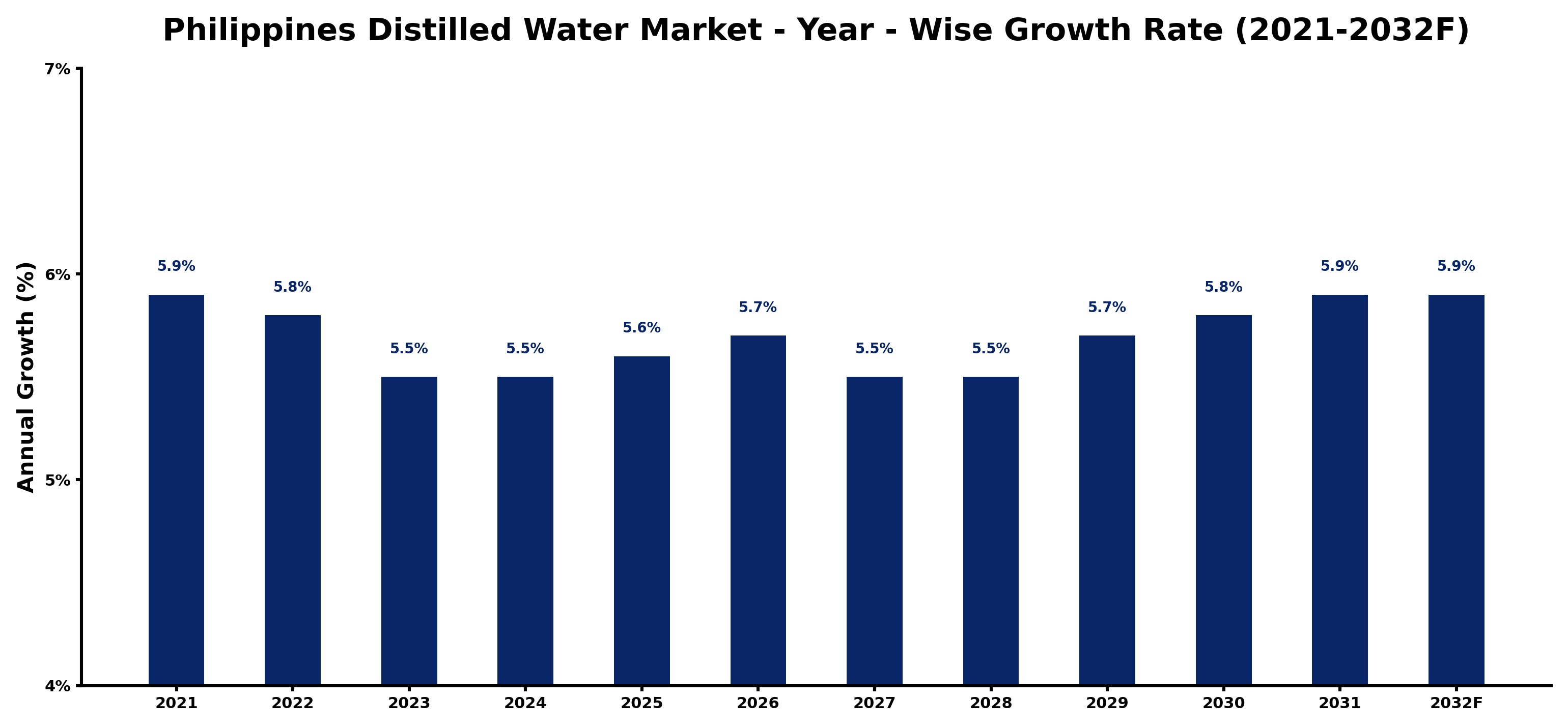
The table below presents the year‑wise growth rates along with the key drivers influencing the market
| Year | Growth Rate | Major Drivers |
| 2021 | 5.9% | Increased health awareness among consumers |
| 2022 | 5.8% | Rising demand for clean water |
| 2023 | 5.5% | Urbanization driving water consumption |
| 2024 | 5.5% | Growth in bottled water market |
| 2025 | 5.6% | Expansion of distribution networks |
| 2026 | 5.7% | Improved water purification technologies |
| 2027 | 5.5% | Increased environmental sustainability focus |
| 2028 | 5.5% | Rising disposable income levels |
| 2029 | 5.7% | Growing preference for convenience products |
| 2030 | 5.8% | Health and wellness trends rising |
| 2031 | 5.9% | Increased product availability online |
| 2032 | 5.9% | Consumer education on hydration benefits |
Note - Market size estimations and growth projections presented in this report are based on 6Wresearch’s advanced forecasting approach, validated with industry datasets as of June 2026.
Philippines Distilled Water Market Synopsis
Recent momentum in the Philippines distilled water market has been notably positive, reflecting a surge in demand stemming from both health concerns and industrial applications. As the market evolves, a strategic focus on innovation in product offerings and distribution methods has emerged, positioning the industry for sustained growth.
Looking ahead, the market is set to capitalize on opportunities presented by advancements in manufacturing techniques and a shift toward eco-friendly packaging solutions. This shift not only aligns with global sustainability trends but also meets the changing preferences of consumers increasingly aware of their ecological footprint.
Philippines Distilled Water Market Key Takeaways
- Rising health consciousness among consumers drives the demand for bottled and distilled water.
- Increasing investment in R&D fosters innovation in product offerings and convenience.
- Key industries such as pharmaceuticals, electronics, and healthcare are significant contributors to market growth.
- Manufacturers are challenged to maintain consistent water quality while managing production costs.
- The ongoing COVID-19 pandemic highlighted the critical role of clean water in sanitation and health.
Evaluation of Restraints in Philippines Distilled Water Market
Despite the promising outlook, the Philippines distilled water market faces significant restraints that could hinder its growth trajectory. One of the main challenges is ensuring consistent water quality throughout the distillation process. This is particularly vital for meeting the stringent requirements of industries such as pharmaceuticals and laboratories. Furthermore, competition from alternative purified water sources puts pressure on manufacturers to adopt more cost-effective production methods, which can sometimes compromise quality. Additionally, navigating the complexities of sustainable sourcing and efficient distribution, while adhering to regulatory requirements, represents an ongoing challenge for the market's stakeholders.
Philippines Distilled Water Market Trends
The distilled water market in the Philippines is currently influenced by several emerging trends that shape both consumer preferences and technological advancements. A notable trend is the increased demand for eco-friendly packaging solutions, as consumers become more environmentally conscious. Concurrently, innovations in distillation technology are enhancing production efficiency and water purity, allowing manufacturers to meet high standards and consumer expectations. The rising trend of home water purification systems also reflects a shift in consumer behavior, as individuals seek reliable and clean water sources at home, further stimulating the market.
Philippines Distilled Water Market Opportunities
Opportunities for growth in the Philippines distilled water market are abundant, particularly in the context of increasing investments in R&D. Companies that can capitalize on technological advancements in purification methods stand to gain a competitive edge. Additionally, expanding into untapped regional markets presents a significant opportunity for business expansion. As health awareness continues to rise, there is also potential for manufacturers to diversify their product lines, introducing new flavors and enhanced hydration options to cater to evolving consumer tastes.
Government Initiatives in the Philippines Distilled Water Market
The Philippine government has recognized the importance of clean water in promoting public health and is actively supporting initiatives aimed at improving water quality and accessibility. Public spending on water purification infrastructure and initiatives designed to promote sustainable practices in water sourcing and packaging are crucial components of current policy. Furthermore, programs to enhance the regulatory framework around water quality standards serve to ensure that both consumers and industries can rely on safe distilled water supplies.
Future Insights of the Philippines Distilled Water Market
Looking toward the future, the Philippines distilled water market is poised for significant expansion from 2026 to 2032. With the intersection of health awareness and technological innovation, the market is likely to see a sustained increase in demand across various sectors. Companies that prioritize sustainability and invest in advanced purification technologies will not only meet regulatory requirements but will also appeal to a growing demographic of environmentally conscious consumers. Overall, the outlook remains positive, underscoring the importance of strategic planning and adaptability within the industry.
Philippines Distilled Water Market Latest Developments (May 2025 - June 2026)
The distilled water market in the Philippines has been navigating a dynamic landscape, with recent developments focusing on enhancing production capabilities and addressing environmental concerns. Companies are increasingly adopting advanced filtration technologies and eco-friendly packaging solutions to align with consumer preferences. Additionally, collaborative efforts between manufacturers and regulatory bodies have intensified, aiming to streamline compliance with water quality standards while ensuring sustainability in production practices. As the market adapts, these developments are indicative of a broader trend toward innovation and responsibility.
Philippines Distilled Water Market - Key Attractiveness of the Report
- 10 Years of Market Numbers
- Historical Data Starting from 2022 to 2025
- Base Year: 2025
- Forecast Data until 2032
- Key Performance Indicators Impacting the Market
- Major Upcoming Developments and Projects
Key Highlights of the Report:
- Philippines Distilled Water Market Outlook
- Market Size of Philippines Distilled Water Market, 2025
- Forecast of Philippines Distilled Water Market, 2032
- Historical Data and Forecast of Philippines Distilled Water Revenues & Volume for the Period 2022-2032F
- Philippines Distilled Water Market Trend Evolution
- Philippines Distilled Water Market Drivers and Challenges
- Philippines Distilled Water Price Trends
- Philippines Distilled Water Porter's Five Forces
- Philippines Distilled Water Industry Life Cycle
- Historical Data and Forecast of Philippines Distilled Water Market Revenues & Volume By Types for the Period 2022-2032F
- Historical Data and Forecast of Philippines Distilled Water Market Revenues & Volume By Pharmaceutical Grade for the Period 2022-2032F
- Historical Data and Forecast of Philippines Distilled Water Market Revenues & Volume By Industrial Grade for the Period 2022-2032F
- Historical Data and Forecast of Philippines Distilled Water Market Revenues & Volume By Applications for the Period 2022-2032F
- Historical Data and Forecast of Philippines Distilled Water Market Revenues & Volume By Drinking for the Period 2022-2032F
- Historical Data and Forecast of Philippines Distilled Water Market Revenues & Volume By Chemical and Biological Laboratories for the Period 2022-2032F
- Historical Data and Forecast of Philippines Distilled Water Market Revenues & Volume By Automotive Cooling Systems and Batteries for the Period 2022-2032F
- Historical Data and Forecast of Philippines Distilled Water Market Revenues & Volume By Medical for the Period 2022-2032F
- Historical Data and Forecast of Philippines Distilled Water Market Revenues & Volume By Others for the Period 2022-2032F
- Philippines Distilled Water Import Export Trade Statistics
- Market Opportunity Assessment By Types
- Market Opportunity Assessment By Applications
- Philippines Distilled Water Top Companies Market Share
- Philippines Distilled Water Competitive Benchmarking By Technical and Operational Parameters
- Philippines Distilled Water Company Profiles
- Philippines Distilled Water Key Strategic Recommendations






































