Philippines Electric Hair Clipper & Trimmer Market Size, Share & Growth Rate
The Philippines Electric Hair Clipper & Trimmer Market was estimated at USD 726 Million in 2025 and is projected to reach USD 1265 Million by 2032, growing at a CAGR of 8.3% from 2026 to 2032. This growth trajectory is primarily driven by the increasing grooming consciousness among the Filipino population and the rising popularity of DIY grooming solutions. Additionally, innovations in product design and technology, alongside the proliferation of e-commerce platforms, are contributing to the market's robust expansion.
Philippines Electric Hair Clipper & Trimmer Market Year-wise Growth Rate and Key Drivers
This graph highlights how the Philippines Electric Hair Clipper & Trimmer Market has steadily grown over the years, supported by major growth factors.
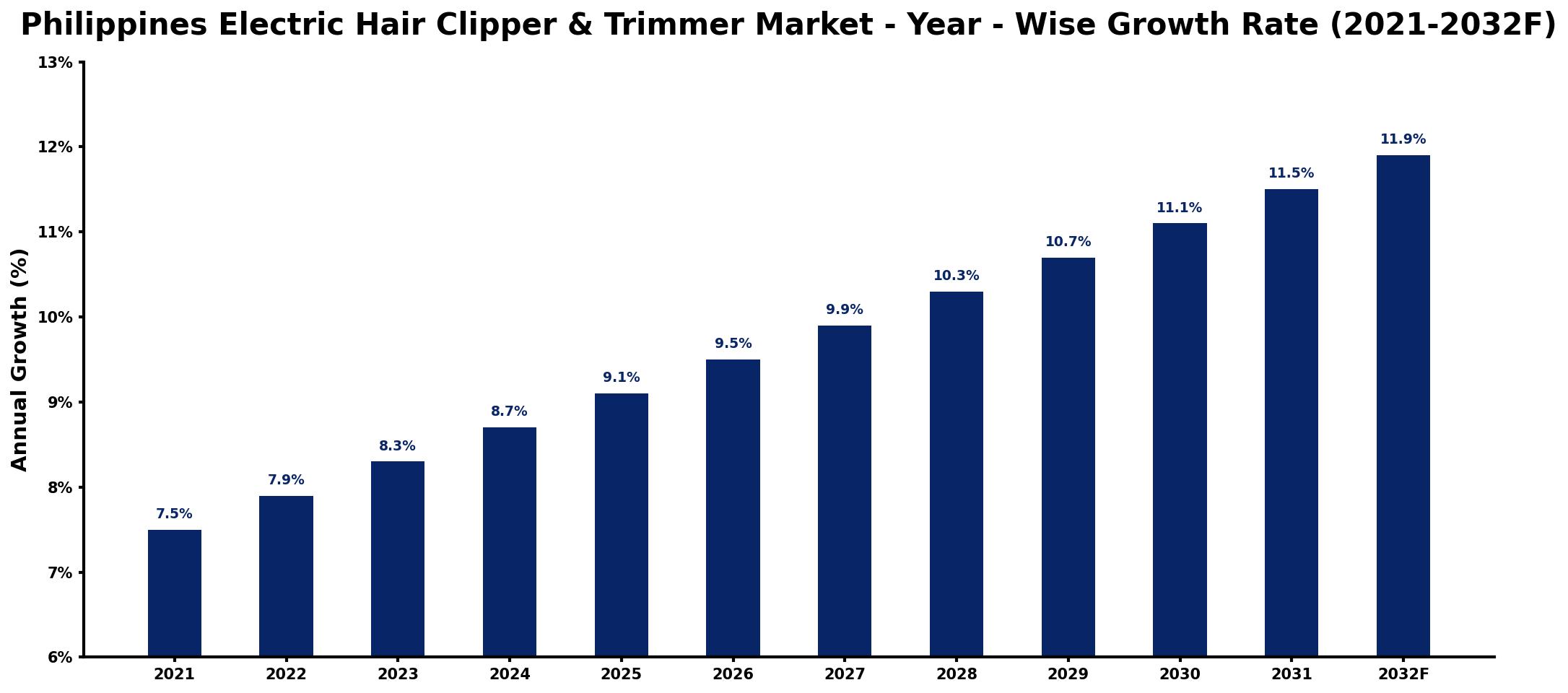
The table below presents the year‑wise growth rates along with the key drivers influencing the market
| Year | Growth Rate | Major Drivers |
| 2021 | 7.5% | Rising grooming awareness among consumers |
| 2022 | 7.9% | Increased demand for personal care |
| 2023 | 8.3% | Growth in online retail channels |
| 2024 | 8.7% | Surge in beauty industry investments |
| 2025 | 9.1% | Emergence of innovative grooming solutions |
| 2026 | 9.5% | Expansion of lifestyle influencer marketing |
| 2027 | 9.9% | Higher disposable income among consumers |
| 2028 | 10.3% | Growing trend of home grooming |
| 2029 | 10.7% | Increased focus on self-care routines |
| 2030 | 11.1% | Development of eco-friendly alternatives |
| 2031 | 11.5% | Rise in subscription-based services |
| 2032 | 11.9% | Wider availability of grooming products |
Note: Market size estimations and growth projections presented in this report are based on 6Wresearch's proprietary forecasting methodology, utilizing the latest available industry data, government publications, and primary research inputs.
Philippines Electric Hair Clipper & Trimmer Market Synopsis
The Philippines Electric Hair Clipper & Trimmer Market has recently experienced significant momentum, reflecting a shift towards more personal grooming solutions. As consumer preferences lean towards convenience and versatility in grooming products, the market is poised for continued growth, driven by both urbanization and rising disposable incomes.
Looking ahead, the market's expansion is set to accelerate as technology continues to advance. The introduction of cordless, rechargeable models with enhanced battery life, as well as ergonomic designs, are set to attract a broader customer base, further driving sales and market growth.
- Increasing awareness of personal grooming is driving consumer demand for electric hair clippers & trimmers.
- Technological innovations are enhancing product performance and user experience.
- Growth in e-commerce is facilitating wider access to diverse grooming products.
- Urbanization and rising disposable incomes are contributing to market expansion.
- DIY grooming trends are reshaping consumer preferences and habits.
Despite the positive growth trajectory, the market for electric hair clippers and trimmers in the Philippines faces several restraints. A significant challenge is the perception of high upfront costs associated with premium products, which may deter budget-conscious consumers. Additionally, the presence of low-cost, less reliable alternatives in the market can impact brand loyalty and consumer trust. Ensuring product durability and customer satisfaction will be critical for manufacturers aiming to establish a foothold in this competitive landscape.
Current trends indicate a marked shift toward eco-friendly materials and sustainable production processes. Consumers are becoming increasingly aware of environmental impacts, prompting manufacturers to innovate with biodegradable components and energy-efficient designs. Furthermore, the rise of social media influencers in the beauty and grooming sectors is significantly shaping consumer preferences, highlighting the importance of effective branding and marketing strategies.
The electric hair clipper and trimmer market in the Philippines presents numerous growth opportunities. Expanding e-commerce channels allow brands to reach remote areas, capturing a wider audience. Additionally, collaborations with local salons and grooming professionals can enhance brand credibility. Theres also a burgeoning market for premium, specialized products targeting niche segments, such as professional stylists, which offers lucrative avenues for investment and growth.
The Philippine government has shown support for the grooming and personal care sector through various policies promoting entrepreneurship and local manufacturing. Initiatives aimed at enhancing the capabilities of small and medium-sized enterprises (SMEs) in the beauty sector are expected to foster innovation and growth. Furthermore, training programs aimed at improving local skill sets in beauty and grooming professions contribute to overall market development.
From 2026 to 2032, the Philippines Electric Hair Clipper & Trimmer Market is set to evolve significantly. The anticipated integration of smart technologies, such as app connectivity and personalized grooming solutions, will redefine consumer experiences. Moreover, as the trend of at-home grooming solidifies, we can expect a more robust demand for user-friendly products designed for various hair types and styles, catering to a diverse and expanding customer base.
Recent developments in the electric hair clipper and trimmer market highlight a surge in product innovation, including the introduction of advanced blade technologies and noise-reduction features. There has also been a notable increase in marketing strategies focusing on influencer partnerships to reach younger demographics. As supply chains adapt to post-pandemic dynamics, companies are enhancing their distribution networks to ensure product availability across both traditional retail and e-commerce platforms.
- 10 Years of Market Numbers
- Historical Data Starting from 2022 to 2025
- Base Year: 2025
- Forecast Data until 2032
- Key Performance Indicators Impacting the Market
- Major Upcoming Developments and Projects
Key Highlights of the Report:
- Philippines Electric Hair Clipper & Trimmer Market Outlook
- Market Size of Philippines Electric Hair Clipper & Trimmer Market, 2025
- Forecast of Philippines Electric Hair Clipper & Trimmer Market, 2032
- Historical Data and Forecast of Philippines Electric Hair Clipper & Trimmer Revenues & Volume for the Period 2022-2032F
- Philippines Electric Hair Clipper & Trimmer Market Trend Evolution
- Philippines Electric Hair Clipper & Trimmer Market Drivers and Challenges
- Philippines Electric Hair Clipper & Trimmer Price Trends
- Philippines Electric Hair Clipper & Trimmer Porter's Five Forces
- Philippines Electric Hair Clipper & Trimmer Industry Life Cycle
- Historical Data and Forecast of Philippines Electric Hair Clipper & Trimmer Market Revenues & Volume By Product for the Period 2022-2032F
- Historical Data and Forecast of Philippines Electric Hair Clipper & Trimmer Market Revenues & Volume By Corded for the Period 2022-2032F
- Historical Data and Forecast of Philippines Electric Hair Clipper & Trimmer Market Revenues & Volume By Cordless for the Period 2022-2032F
- Historical Data and Forecast of Philippines Electric Hair Clipper & Trimmer Market Revenues & Volume By Distribution Channel for the Period 2022-2032F
- Historical Data and Forecast of Philippines Electric Hair Clipper & Trimmer Market Revenues & Volume By Offline for the Period 2022-2032F
- Historical Data and Forecast of Philippines Electric Hair Clipper & Trimmer Market Revenues & Volume By Online for the Period 2022-2032F
- Philippines Electric Hair Clipper & Trimmer Import Export Trade Statistics
- Market Opportunity Assessment By Product
- Market Opportunity Assessment By Distribution Channel
- Philippines Electric Hair Clipper & Trimmer Top Companies Market Share
- Philippines Electric Hair Clipper & Trimmer Competitive Benchmarking By Technical and Operational Parameters
- Philippines Electric Hair Clipper & Trimmer Company Profiles
- Philippines Electric Hair Clipper & Trimmer Key Strategic Recommendations






































