Philippines Electric lighting equipment Market Summary
The philippines electric lighting equipment market was estimated at USD 1446 Million in 2025 and is projected to reach USD 2066 Million by 2032, growing at a CAGR of 5.8% from 2026 to 2032.
Philippines Electric lighting equipment Market Year-wise Growth Rate and Key Drivers
This graph highlights how the Philippines Electric lighting equipment Market has steadily grown over the past five years, supported by major growth factors.
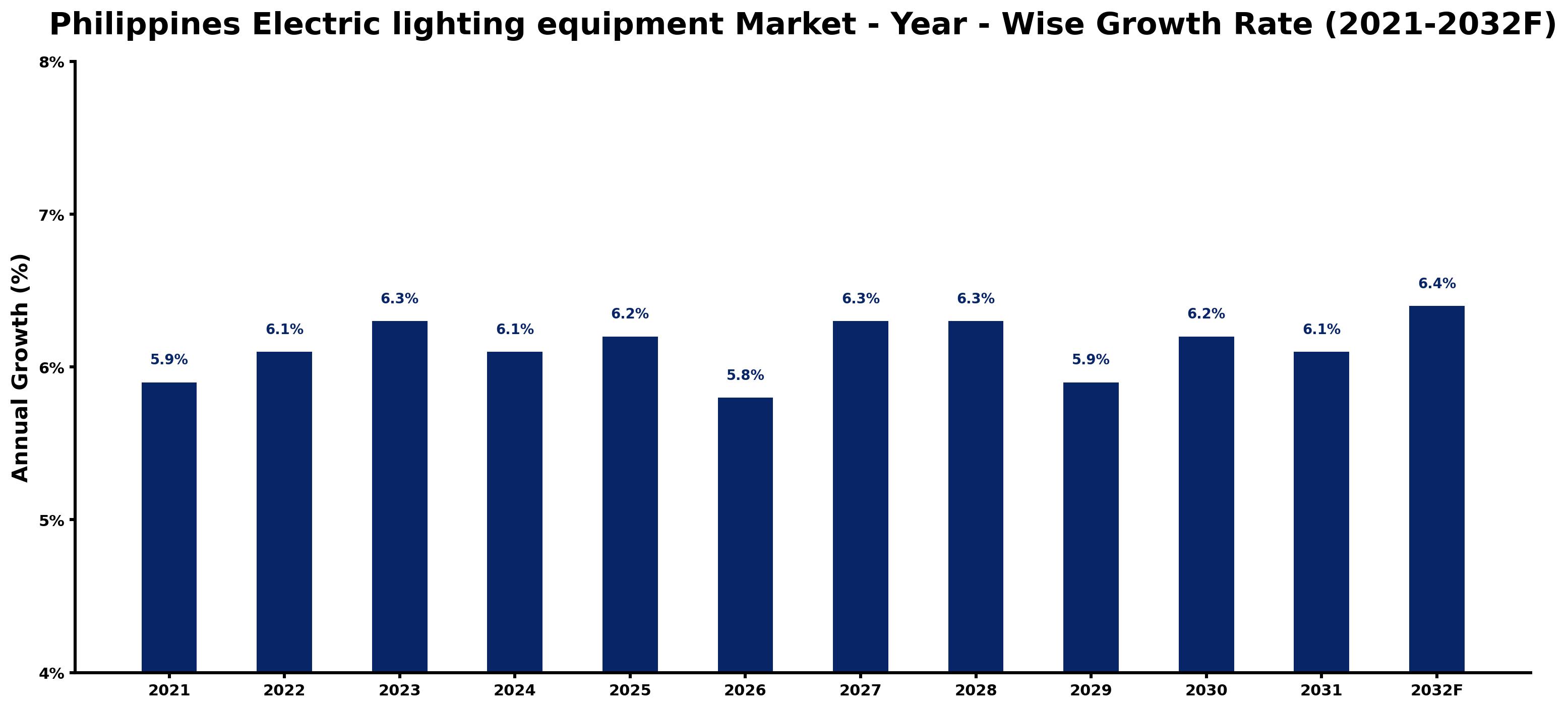
The table below presents the year wise growth rates along with the key drivers influencing the market
| Year | Growth Rate | Major Drivers |
| 2021 | 5.9% | Post-lockdown retail projects spurred the need for enhanced lighting solutions nationwide. |
| 2022 | 6.1% | Sustainability awareness shifted preferences toward energy-efficient lighting technologies among consumers. |
| 2023 | 6.3% | Infrastructure investments increased demand for reliable electric lighting in urban developments. |
| 2024 | 6.1% | Legacy copper grid failures highlighted the necessity for resilient electrical systems in cities. |
| 2025 | 6.2% | Smart city projects incorporated advanced lighting systems to optimize urban energy usage. |
| 2026 | 5.8% | Corporate budgets prioritized sustainability initiatives, amplifying investments in eco-friendly lighting. |
| 2027 | 6.3% | Rural electrification efforts focused on solar-powered lighting, benefiting remote communities significantly. |
| 2028 | 6.3% | Technological innovations introduced new compact LED solutions, appealing to cost-conscious buyers. |
| 2029 | 5.9% | Consumer trends leaned towards aesthetic designs, merging functionality with home decor. |
| 2030 | 6.2% | Local manufacturing capabilities improved, reducing costs and increasing availability of lighting products. |
| 2031 | 6.1% | Increased competition among suppliers forced prices down while enhancing product quality. |
| 2032 | 6.4% | Diversification in lighting applications expanded, including outdoor, industrial, and smart solutions. |
Note - Market size estimations and growth projections presented in this report are based on 6Wresearch's advanced forecasting approach, validated with industry datasets as of June 2026.
Philippines Electric lighting equipment Market Synopsis
The Philippines Electric lighting equipment Market is projected to reach 5.8% and witness significant growth during the forecast period (2026-2032). This anticipated growth is primarily fueled by rapid urbanization trends and increasing investments in both residential and commercial infrastructure, particularly concentrated in Metro Manila and other urban centers. The growing demand for energy-efficient lighting, notably LEDs, aligns with government initiatives promoting renewable energy sources. Furthermore, as disposable incomes rise, consumers are becoming more inclined to upgrade their lifestyles, selecting lighting solutions that are not only reliable and safe but also cost-effective. The aftermath of the COVID-19 pandemic has also contributed to an uptick in demand for electric lighting products, driven by the necessity for enhanced lighting solutions in digital and remote work settings.
Philippines Electric lighting equipment Market Growth Drivers
Several key factors are propelling growth in the Philippines Electric lighting equipment Market. One of the principal drivers is the rapid urbanization occurring across various regions, which is catalyzing significant investments in infrastructure development.
- Urbanization is leading to the construction of new residential and commercial buildings, resulting in a corresponding increase in the demand for electric lighting equipment.
- The shift from traditional incandescent lighting to energy-efficient LED solutions is gaining momentum, as consumers and businesses alike seek to reduce energy consumption and costs.
- Government policies supporting renewable energy initiatives have created a favorable environment for the adoption of solar-powered lighting solutions.
- Increased awareness of energy-saving technologies is encouraging consumers to invest in modern lighting systems, further stimulating market growth.
- Consumer preferences are evolving towards smart lighting solutions that offer convenience and automation, thereby enhancing the overall user experience.
Philippines Electric lighting equipment Market Trends and Opportunities
The Philippines Electric lighting equipment Market is witnessing several transformative trends that represent substantial opportunities. The surge in the adoption of smart home technology is one such trend, which integrates various electronic systems to provide greater control over lighting.
- Smart lighting systems facilitate remote access and control via smartphones and tablets, making them increasingly popular among tech-savvy consumers.
- The integration of connected devices within lighting setups allows for real-time monitoring of energy consumption, enabling consumers to optimize their usage.
- Brands are beginning to offer customizable lighting solutions that cater to individual consumer needs, enhancing market competitiveness.
- As the market matures, advancements in lighting technology continue to emerge, opening avenues for innovative products and applications.
- Renewable energy lighting solutions are becoming more mainstream, particularly as government initiatives promote sustainable practices.
Philippines Electric lighting equipment Market Challenges and Restraints
Despite the promising growth trajectory, the Philippines Electric lighting equipment Market faces several challenges that could impede its expansion. One of the most significant hurdles is the high installation cost associated with modern lighting systems.
- The initial investment required for advanced electric lighting systems can deter consumers, particularly in rural areas where budgets are tighter.
- Lack of technical awareness among younger demographics may pose challenges in market penetration, as not all consumers are familiar with the benefits of modern lighting solutions.
- In regions with inadequate infrastructure, the reliability of electric supply can limit the effectiveness and appeal of advanced lighting products.
- Competitive pressure from low-cost alternatives may lead to pricing challenges for quality products, impacting market dynamics.
- Regulatory hurdles related to environmental compliance may also slow down the adoption of certain high-tech lighting solutions.
Philippines Electric lighting equipment Market Government Investment and Initiatives
The Philippine government has shown a strong commitment to fostering the growth of the electric lighting equipment market through various investment initiatives and policies. Significant public spending is being directed towards infrastructure development aimed at enhancing urban lighting.
- Government programs promoting renewable energy sources have instigated a shift towards solar lighting technologies, thus improving market viability.
- Investment in energy-efficient public lighting systems reflects a broader strategy to enhance sustainability and reduce carbon footprints.
- Public awareness campaigns aimed at promoting energy-saving technologies have been implemented to educate consumers about the benefits of advanced lighting solutions.
- The introduction of incentives for businesses investing in energy-efficient equipment is anticipated to increase market growth potential.
- Government collaborations with private firms to facilitate the deployment of smart lighting solutions are enhancing infrastructure capabilities across urban areas.
Philippines Electric lighting equipment Market Latest Developments (May 2025 - June 2026)
As of May 2025 to June 2026, the Philippines Electric lighting equipment Market has experienced a series of notable developments. The trend toward smart lighting is accelerating, with various manufacturers launching innovative products that integrate IoT capabilities to provide enhanced user experiences.
- Continued investment in smart city projects is expected to augment demand for modern electric lighting solutions equipped with advanced technology.
- Companies are increasingly partnering to develop comprehensive lighting solutions that incorporate renewable energy and energy-efficient technologies.
- Public and private sectors have initiated collaborations aimed at standardizing lighting technologies for better energy management.
- Research and development initiatives have been bolstered, leading to innovations that cater to consumer preferences for more customizable lighting options.
- The fallout from global supply chain disruptions is being addressed, with industries focusing on local sourcing to mitigate potential shortages in lighting components.
Philippines Electric lighting equipment Market - Key Attractiveness of the Report
- 10 Years of Market Numbers
- Historical Data Starting from 2022 to 2025
- Base Year: 2025
- Forecast Data until 2032
- Key Performance Indicators Impacting the Market
- Major Upcoming Developments and Projects
Key Highlights of the Report:
- Philippines Electric lighting equipment Market Outlook
- Market Size of Philippines Electric lighting equipment Market, 2025
- Forecast of Philippines Electric lighting equipment Market, 2032
- Historical Data and Forecast of Philippines Electric lighting equipment Revenues & Volume for the Period 2022-2032F
- Philippines Electric lighting equipment Market Trend Evolution
- Philippines Electric lighting equipment Market Drivers and Challenges
- Philippines Electric lighting equipment Price Trends
- Philippines Electric lighting equipment Porter's Five Forces
- Philippines Electric lighting equipment Industry Life Cycle
- Historical Data and Forecast of Philippines Electric lighting equipment Market Revenues & Volume By Type for the Period 2022-2032F
- Historical Data and Forecast of Philippines Electric lighting equipment Market Revenues & Volume By General Lighting for the Period 2022-2032F
- Historical Data and Forecast of Philippines Electric lighting equipment Market Revenues & Volume By Automotive Lighting for the Period 2022-2032F
- Historical Data and Forecast of Philippines Electric lighting equipment Market Revenues & Volume By Back Lighting for the Period 2022-2032F
- Historical Data and Forecast of Philippines Electric lighting equipment Market Revenues & Volume By Application for the Period 2022-2032F
- Historical Data and Forecast of Philippines Electric lighting equipment Market Revenues & Volume By Residential for the Period 2022-2032F
- Historical Data and Forecast of Philippines Electric lighting equipment Market Revenues & Volume By Commercial for the Period 2022-2032F
- Historical Data and Forecast of Philippines Electric lighting equipment Market Revenues & Volume By Automotive for the Period 2022-2032F
- Historical Data and Forecast of Philippines Electric lighting equipment Market Revenues & Volume By Others for the Period 2022-2032F
- Historical Data and Forecast of Philippines Electric lighting equipment Market Revenues & Volume By Sales Channel for the Period 2022-2032F
- Historical Data and Forecast of Philippines Electric lighting equipment Market Revenues & Volume By OEM for the Period 2022-2032F
- Historical Data and Forecast of Philippines Electric lighting equipment Market Revenues & Volume By Aftermarket? for the Period 2022-2032F
- Historical Data and Forecast of Philippines Electric lighting equipment Market Revenues & Volume By Mode for the Period 2022-2032F
- Historical Data and Forecast of Philippines Electric lighting equipment Market Revenues & Volume By Offline for the Period 2022-2032F
- Historical Data and Forecast of Philippines Electric lighting equipment Market Revenues & Volume By Online for the Period 2022-2032F
- Philippines Electric lighting equipment Import Export Trade Statistics
- Market Opportunity Assessment By Type
- Market Opportunity Assessment By Application
- Market Opportunity Assessment By Sales Channel
- Market Opportunity Assessment By Mode
- Philippines Electric lighting equipment Top Companies Market Share
- Philippines Electric lighting equipment Competitive Benchmarking By Technical and Operational Parameters
- Philippines Electric lighting equipment Company Profiles
- Philippines Electric lighting equipment Key Strategic Recommendations






































