Philippines Electric Locomotives Market Size, Share & Growth Rate
The Philippines Electric Locomotives Market was estimated at USD 1015 Million in 2025 and is projected to reach USD 1467 Million by 2032, growing at a CAGR of 5.4% from 2026 to 2032. This growth trajectory is primarily fueled by the government's ambitious infrastructure initiatives, particularly the "Build Build Build" program, which emphasizes expanding and modernizing the country's railway network. The increasing need for environmentally friendly transport options further drives the shift towards electric locomotives, as they present significant fuel savings and reduced operational costs in the long run.
Philippines Electric Locomotives Market Year-wise Growth Rate and Key Drivers
This graph highlights how the Philippines Electric Locomotives Market has steadily grown over the years, supported by major growth factors.
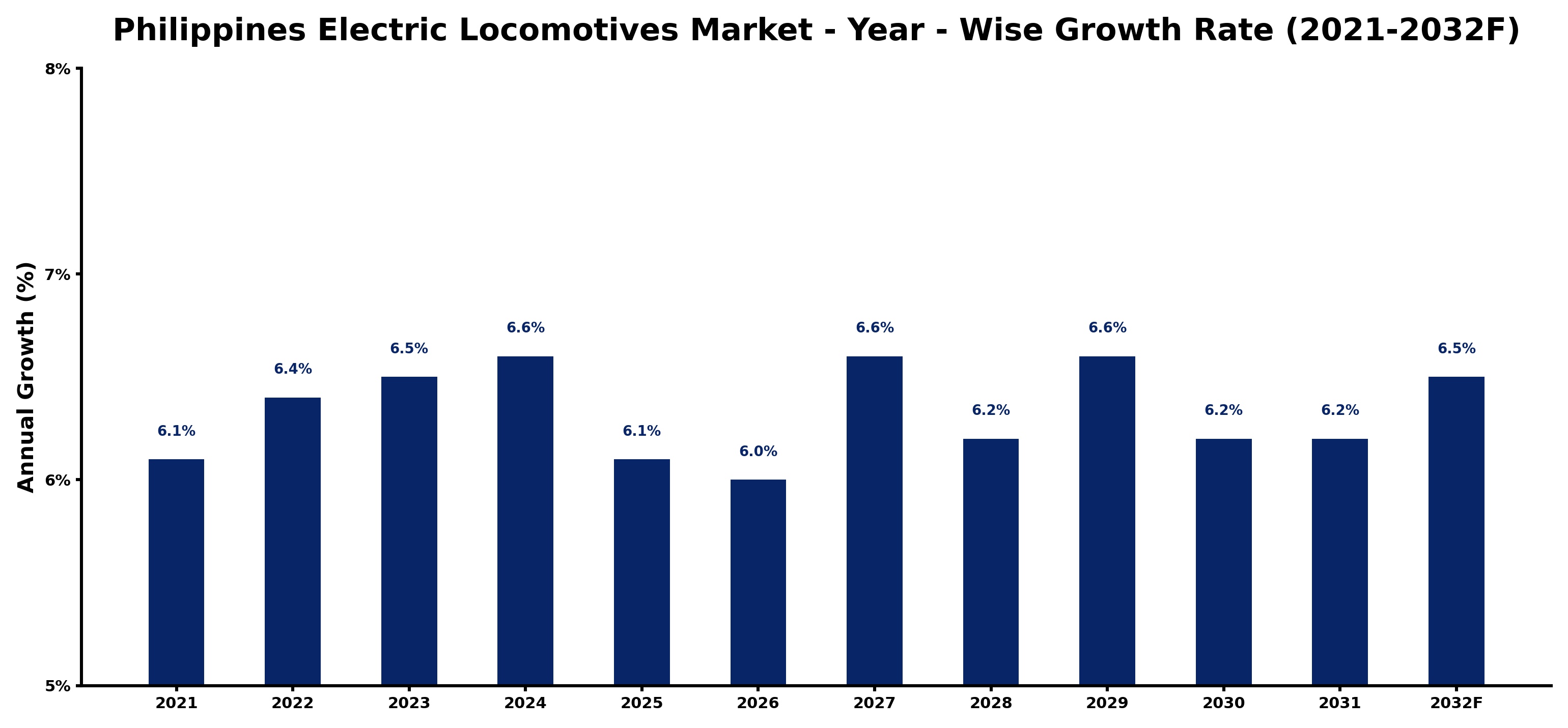
The table below presents the year‑wise growth rates along with the key drivers influencing the market
| Year | Growth Rate | Major Drivers |
| 2021 | 6.1% | Growing renewable energy integration projects |
| 2022 | 6.4% | Expansion of transportation and logistics networks |
| 2023 | 6.5% | Increasing industrial automation investments |
| 2024 | 6.6% | Increasing smart city development projects |
| 2025 | 6.1% | Growing renewable energy integration projects |
| 2026 | 6.0% | Growing urbanization and commercial development |
| 2027 | 6.6% | Increasing industrial infrastructure investments |
| 2028 | 6.2% | Expansion of commercial construction activities |
| 2029 | 6.6% | Increasing industrial automation investments |
| 2030 | 6.2% | Growing renewable energy integration projects |
| 2031 | 6.2% | Rapid growth in telecom and data center sectors |
| 2032 | 6.5% | Rising electricity demand across industries |
Note - Market size estimations and growth projections presented in this report are based on 6Wresearch’s advanced forecasting approach, validated with industry datasets as of June 2026.
Philippines Electric Locomotives Market Synopsis
The Philippines is currently experiencing a transformational phase in its railway sector, with electric locomotives at the forefront of this evolution. Enhanced efficiency and sustainability attributes make these locomotives increasingly preferred over traditional diesel models, aligning with global trends towards greener transport solutions.
As the nation navigates urbanization and heightened freight transport demands, electric locomotives emerge as pivotal assets in ensuring reliable and efficient logistics. This is particularly crucial for the industrial sector, where timely and cost-effective movement of goods is essential for economic growth and competitiveness.
Philippines Electric Locomotives Market Key Takeaways
- The market is poised for robust growth fueled by significant government infrastructure investments.
- Electric locomotives are increasingly favored for their efficiency and reduced carbon footprint.
- Modernization of the railway network is essential for improving connectivity and service quality.
- Technological advancements in electric propulsion are enhancing locomotive reliability and performance.
- International partnerships may play a critical role in overcoming local manufacturing challenges.
Evaluation of Restraints in Philippines Electric Locomotives Market
Despite promising growth prospects, the Philippines Electric Locomotives Market encounters several constraints that could impact its potential. Key among these is the substantial capital investment required for developing robust electrified rail infrastructure. This includes the installation of overhead lines, substations, and efficient power supply systems. Furthermore, ensuring the electric locomotives meet stringent safety and operational standards adds to the complexity. The evolving landscape of transportation preferences, driven by urbanization, poses additional challenges in aligning rail services with current market demands.
Philippines Electric Locomotives Market Trends
A noticeable trend in the Philippines Electric Locomotives Market is the increasing emphasis on sustainability, which is reshaping both passenger and freight transport dynamics. The integration of advanced technologies such as automated systems and energy-efficient designs is becoming prevalent. Additionally, collaboration with international manufacturers for technology transfer is on the rise, enhancing local capabilities in electric locomotive production. The push for improved urban rail connectivity and high-speed services is also contributing significantly to the demand for electric solutions.
Philippines Electric Locomotives Market Opportunities
The Philippines presents various investment opportunities within the electric locomotives sector, particularly as the government continues to prioritize infrastructure development. Collaborations with private sectors and foreign investors could lead to the establishment of local manufacturing facilities. This would not only cater to domestic needs but also position the Philippines as a regional hub for electric locomotive production. The anticipated expansion of urban rail networks offers another lucrative avenue for growth, particularly in metropolitan areas where demand for efficient public transport is soaring.
Government Initiatives in the Philippines Electric Locomotives Market
The Philippine government has embarked on several initiatives aimed at enhancing the electric locomotives market as part of its broader infrastructure strategy. Notably, the "Build Build Build" program encompasses numerous railway projects that emphasize modern electrification efforts. These initiatives are designed to facilitate enhanced connectivity across regions, optimize transportation efficiency, and reduce environmental impacts associated with fossil fuel consumption. Continued public spending and support for electrified rail systems are expected to be cornerstones of national transport policy.
Future Insights of the Philippines Electric Locomotives Market
Looking ahead, the Philippines Electric Locomotives Market is set to evolve significantly between 2026 and 2032. As infrastructure projects gain momentum, there will be an increasing reliance on electric solutions to meet burgeoning freight and passenger demands. The focus on sustainability will likely catalyze further investments in modern electric technology and support systems, while regulatory frameworks will continue to adapt to encourage greener transportation methods. With strategic planning and effective partnerships, the market has the potential to achieve unprecedented growth.
Philippines Electric Locomotives Market Latest Developments (May 2025 - June 2026)
Recent developments in the Philippines Electric Locomotives Market indicate a heightened interest in sustainable transport solutions. Infrastructure projects initiated by the government are gaining traction, focusing on electrification as a key component of modern railway systems. Public-private partnerships are becoming increasingly common, fostering innovation and boosting local manufacturing capabilities. Furthermore, advancements in technology and increased regulatory support are laying the groundwork for a more efficient rail transport ecosystem.
Philippines Electric Locomotives Market - Key Attractiveness of the Report
- 10 Years of Market Numbers
- Historical Data Starting from 2022 to 2025
- Base Year: 2025
- Forecast Data until 2032
- Key Performance Indicators Impacting the Market
- Major Upcoming Developments and Projects
Key Highlights of the Report:
- Philippines Electric Locomotives Market Outlook
- Market Size of Philippines Electric Locomotives Market, 2025
- Forecast of Philippines Electric Locomotives Market, 2032
- Historical Data and Forecast of Philippines Electric Locomotives Revenues & Volume for the Period 2022-2032F
- Philippines Electric Locomotives Market Trend Evolution
- Philippines Electric Locomotives Market Drivers and Challenges
- Philippines Electric Locomotives Price Trends
- Philippines Electric Locomotives Porter's Five Forces
- Philippines Electric Locomotives Industry Life Cycle
- Historical Data and Forecast of Philippines Electric Locomotives Market Revenues & Volume By Energy Transfer for the Period 2022-2032F
- Historical Data and Forecast of Philippines Electric Locomotives Market Revenues & Volume By Overhead Lines for the Period 2022-2032F
- Historical Data and Forecast of Philippines Electric Locomotives Market Revenues & Volume By Third Rail for the Period 2022-2032F
- Historical Data and Forecast of Philippines Electric Locomotives Market Revenues & Volume By On-board Energy Storage for the Period 2022-2032F
- Historical Data and Forecast of Philippines Electric Locomotives Market Revenues & Volume By Technology for the Period 2022-2032F
- Historical Data and Forecast of Philippines Electric Locomotives Market Revenues & Volume By IGBT Module for the Period 2022-2032F
- Historical Data and Forecast of Philippines Electric Locomotives Market Revenues & Volume By GTO Thyristor for the Period 2022-2032F
- Historical Data and Forecast of Philippines Electric Locomotives Market Revenues & Volume By SiC Module for the Period 2022-2032F
- Historical Data and Forecast of Philippines Electric Locomotives Market Revenues & Volume By Traction Units for the Period 2022-2032F
- Historical Data and Forecast of Philippines Electric Locomotives Market Revenues & Volume By AC Traction Units for the Period 2022-2032F
- Historical Data and Forecast of Philippines Electric Locomotives Market Revenues & Volume By DC Traction Units for the Period 2022-2032F
- Historical Data and Forecast of Philippines Electric Locomotives Market Revenues & Volume By Multi System Units for the Period 2022-2032F
- Historical Data and Forecast of Philippines Electric Locomotives Market Revenues & Volume By Application for the Period 2022-2032F
- Historical Data and Forecast of Philippines Electric Locomotives Market Revenues & Volume By Passenger Transport for the Period 2022-2032F
- Historical Data and Forecast of Philippines Electric Locomotives Market Revenues & Volume By Freight Transport for the Period 2022-2032F
- Philippines Electric Locomotives Import Export Trade Statistics
- Market Opportunity Assessment By Energy Transfer
- Market Opportunity Assessment By Technology
- Market Opportunity Assessment By Traction Units
- Market Opportunity Assessment By Application
- Philippines Electric Locomotives Top Companies Market Share
- Philippines Electric Locomotives Competitive Benchmarking By Technical and Operational Parameters
- Philippines Electric Locomotives Company Profiles
- Philippines Electric Locomotives Key Strategic Recommendations






































