Philippines Electric tapping Machine Market Summary
The philippines electric tapping machine market was estimated at USD 269 Million in 2025 and is projected to reach USD 380 Million by 2032, growing at a CAGR of 6.0% from 2026 to 2032.
Philippines Electric tapping Machine Market Year-wise Growth Rate and Key Drivers
This graph highlights how the Philippines Electric tapping Machine Market has steadily grown over the past five years, supported by major growth factors.
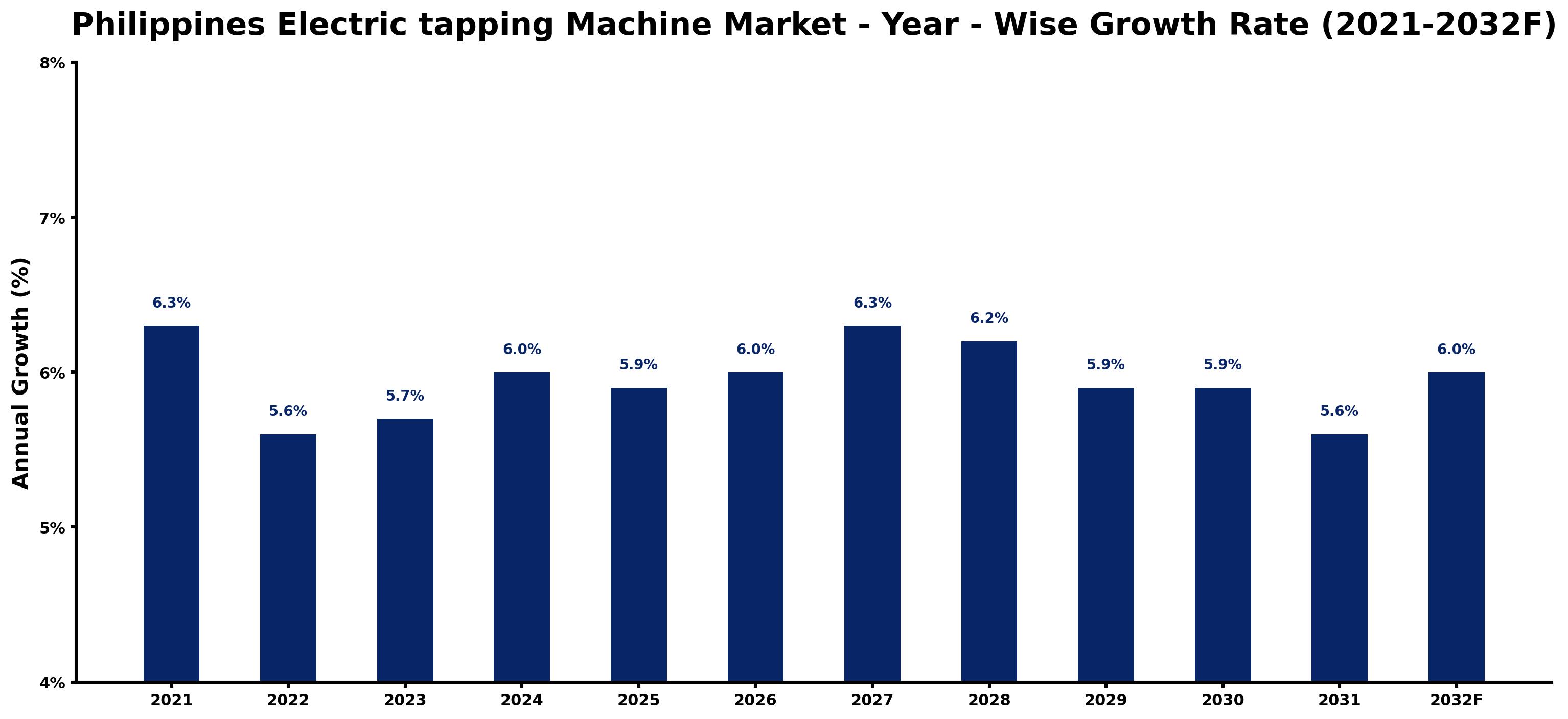
The table below presents the year wise growth rates along with the key drivers influencing the market
| Year | Growth Rate | Major Drivers |
| 2021 | 6.3% | Domestic manufacturing sectors increasingly require efficient electric tapping machines for production. |
| 2022 | 5.6% | Key players are focusing on enhancing product durability to withstand harsh conditions. |
| 2023 | 5.7% | Electric tapping machines are gaining traction among small-scale manufacturers for cost reduction. |
| 2024 | 6.0% | Urban construction projects amplify the need for reliable electrical infrastructure solutions. |
| 2025 | 5.9% | Investment in renewable energy sources showcases electric tapping machines' essential role. |
| 2026 | 6.0% | Technological innovations are transforming tapping machines into versatile manufacturing tools. |
| 2027 | 6.3% | Local startups emerge, driving competition and innovation within the electric tapping market. |
| 2028 | 6.2% | Rural electrification initiatives create opportunities for tapping machines in underserved areas. |
| 2029 | 5.9% | Partnerships between tech firms and traditional industries foster new market growth avenues. |
| 2030 | 5.9% | Consumer preference shifts towards energy-efficient machines, drawing investment and development. |
| 2031 | 5.6% | Electric tapping machines diversify applications, appealing to various industries beyond manufacturing. |
| 2032 | 6.0% | Sustainability concerns influence product designs, aligning with global environmental standards. |
Note - Market size estimations and growth projections presented in this report are based on 6Wresearch's advanced forecasting approach, validated with industry datasets as of June 2026.
Philippines Electric tapping Machine Market Synopsis
The Philippines Electric tapping Machine Market is projected to reach 6.0% and witness significant growth during the forecast period (2026-2032). The anticipated compound annual growth rate (CAGR) of 4.1% reflects the increasing demand for advanced machinery driven by factors such as accelerated industrialization and enhanced automation in various sectors. Government investments in infrastructure continue to bolster the industry, promoting a favorable environment for the adoption of electric tapping machines.
Philippines Electric tapping Machine Market Growth Drivers
A range of factors contributes to the robust growth of the Philippines Electric tapping Machine Market, making it essential for stakeholders to understand these dynamics:
- The fast-paced industrialization across the Philippines has led to a surge in demand for efficient automated machinery, driving the adoption of electric tapping machines in various sectors.
- Enhanced automation initiatives, particularly in the manufacturing sector, are pushing industries towards investing in advanced equipment that can improve productivity and reduce operational costs.
- Government initiatives aimed at bolstering manufacturing capabilities, such as the Make in India plan, have been pivotal in increasing the demand for electric tapping machines, particularly in high-potential sectors like automotive manufacturing.
- Technological advancements, notably in energy efficiency and high-speed operations, have made electric tapping machines more appealing, reducing the total cost of ownership and enhancing their operational capabilities.
- Low maintenance costs associated with these machines further encourage their adoption, particularly among larger manufacturing enterprises looking to optimize their operational budgets.
Philippines Electric tapping Machine Market Challenges and Restraints
Despite the promising growth trajectory, the Philippines Electric tapping Machine Market faces significant challenges that could impede its expansion:
- The high initial investment costs related to the purchase and installation of electric tapping machines may deter small and medium-sized enterprises, which are often constrained by limited budgets.
- Concerns regarding the maintenance of advanced machinery and the requisite technical knowledge can pose barriers for smaller players in the market.
- Supply chain disruptions, exacerbated by the COVID-19 pandemic, have impacted the availability of raw materials and components necessary for manufacturing electric tapping machines.
- Market participants may struggle with adapting to rapid technological changes, which can render existing machinery obsolete if not updated timely.
- Fluctuations in government policy and investment levels could create uncertainty in the market, affecting long-term strategic planning for manufacturers and buyers alike.
Philippines Electric tapping Machine Market Government Investment and Initiatives
The Philippine government has recognized the importance of advancing the industrial sector through increased investments and targeted initiatives. Key aspects include:
- The government's infrastructure development plans aim to improve logistics and connectivity, creating a favorable environment for manufacturers to thrive.
- Public spending on industrial modernization encourages stakeholders to adopt advanced technologies, fostering innovation in manufacturing processes.
- Incentives for local manufacturing, including tax breaks and subsidies for acquiring modern machinery, play a crucial role in stimulating demand for electric tapping machines.
- Strategic partnerships between the government and private sectors aim to enhance workforce skills, ensuring that workers are equipped to handle new technologies, including electric tapping machines.
- Long-term plans focusing on sustainability and energy-efficient technologies align well with the growing appeal of electric tapping machines, which are designed to reduce energy consumption.
Philippines Electric tapping Machine Market Latest Developments (May 2025 - June 2026)
Recent developments in the Philippines Electric tapping Machine Market from May 2025 to June 2026 indicate a proactive response from industry players as they navigate recovery and growth:
- Industry leaders are increasingly focusing on enhancing machine capabilities to meet the demands of modern manufacturing processes, such as improved automation and precision.
- The ongoing integration of IoT technologies into electric tapping machines has gained traction, allowing for better system monitoring and predictive maintenance.
- Initiatives to streamline supply chains have been implemented to mitigate the disruptions caused by the COVID-19 pandemic, facilitating smoother operations for manufacturers.
- Collaboration between local manufacturers and international technology providers is on the rise, leading to the introduction of more innovative and efficient electric tapping solutions.
- Training programs conducted by various industry associations aim to equip the workforce with the skills necessary to operate and maintain advanced tapping machines effectively.
Philippines Electric tapping Machine Market - Key Attractiveness of the Report
- 10 Years of Market Numbers
- Historical Data Starting from 2022 to 2025
- Base Year: 2025
- Forecast Data until 2032
- Key Performance Indicators Impacting the Market
- Major Upcoming Developments and Projects
Key Highlights of the Report:
- Philippines Electric tapping Machine Market Outlook
- Market Size of Philippines Electric tapping Machine Market, 2025
- Forecast of Philippines Electric tapping Machine Market, 2032
- Historical Data and Forecast of Philippines Electric tapping Machine Revenues & Volume for the Period 2022-2032F
- Philippines Electric tapping Machine Market Trend Evolution
- Philippines Electric tapping Machine Market Drivers and Challenges
- Philippines Electric tapping Machine Price Trends
- Philippines Electric tapping Machine Porter's Five Forces
- Philippines Electric tapping Machine Industry Life Cycle
- Historical Data and Forecast of Philippines Electric tapping Machine Market Revenues & Volume By Types for the Period 2022-2032F
- Historical Data and Forecast of Philippines Electric tapping Machine Market Revenues & Volume By Fully Automatic for the Period 2022-2032F
- Historical Data and Forecast of Philippines Electric tapping Machine Market Revenues & Volume By Semi-Automatic for the Period 2022-2032F
- Historical Data and Forecast of Philippines Electric tapping Machine Market Revenues & Volume By Technology for the Period 2022-2032F
- Historical Data and Forecast of Philippines Electric tapping Machine Market Revenues & Volume By Hydraulic for the Period 2022-2032F
- Historical Data and Forecast of Philippines Electric tapping Machine Market Revenues & Volume By Pneumatic for the Period 2022-2032F
- Historical Data and Forecast of Philippines Electric tapping Machine Market Revenues & Volume By Magnetic for the Period 2022-2032F
- Historical Data and Forecast of Philippines Electric tapping Machine Market Revenues & Volume By Application for the Period 2022-2032F
- Historical Data and Forecast of Philippines Electric tapping Machine Market Revenues & Volume By Automotive Parts for the Period 2022-2032F
- Historical Data and Forecast of Philippines Electric tapping Machine Market Revenues & Volume By Rolling Mill for the Period 2022-2032F
- Historical Data and Forecast of Philippines Electric tapping Machine Market Revenues & Volume By Power Press for the Period 2022-2032F
- Historical Data and Forecast of Philippines Electric tapping Machine Market Revenues & Volume By Paper Mill for the Period 2022-2032F
- Historical Data and Forecast of Philippines Electric tapping Machine Market Revenues & Volume By Steel Plants for the Period 2022-2032F
- Historical Data and Forecast of Philippines Electric tapping Machine Market Revenues & Volume By Extrusion for the Period 2022-2032F
- Philippines Electric tapping Machine Import Export Trade Statistics
- Market Opportunity Assessment By Types
- Market Opportunity Assessment By Technology
- Market Opportunity Assessment By Application
- Philippines Electric tapping Machine Top Companies Market Share
- Philippines Electric tapping Machine Competitive Benchmarking By Technical and Operational Parameters
- Philippines Electric tapping Machine Company Profiles
- Philippines Electric tapping Machine Key Strategic Recommendations






































