Philippines Electric Vehicle (EV)ECU Market Size, Share & Growth Rate
The Philippines Electric Vehicle (EV)ECU Market was estimated at USD 1241 Million in 2025 and is projected to reach USD 2127 Million by 2032, growing at a CAGR of 8.0% from 2026 to 2032. This growth trajectory can be attributed to a confluence of factors including rising electric vehicle sales, supportive governmental policies, and increasing awareness of environmental concerns among consumers. Furthermore, the evolution of technology surrounding electronic control units (ECUs) is enhancing performance and efficiency, thereby attracting a broader demographic towards EV adoption.
Philippines Electric Vehicle (EV)ECU Market Year-wise Growth Rate and Key Drivers
This graph highlights how the Philippines Electric Vehicle (EV)ECU Market has steadily grown over the years, supported by major growth factors.
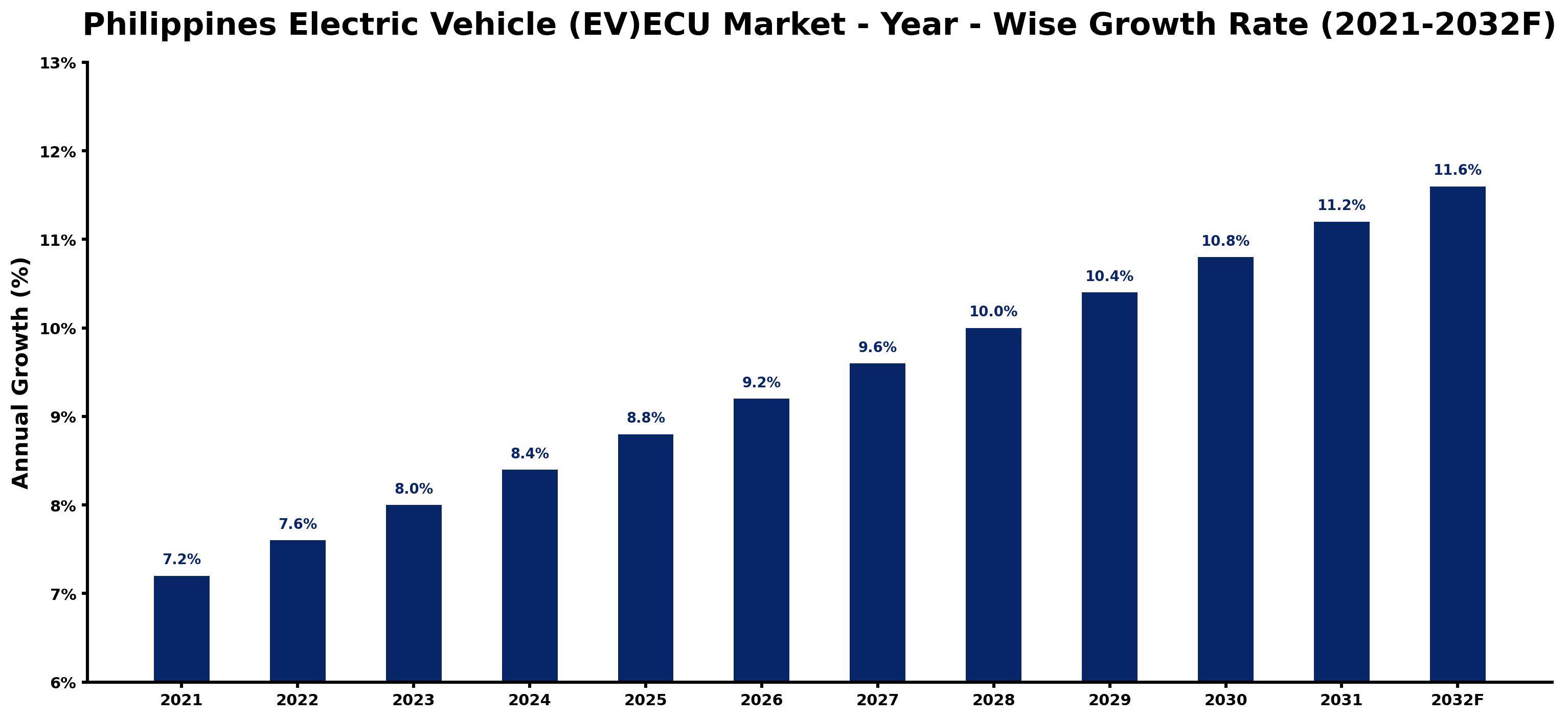
The table below presents the year‑wise growth rates along with the key drivers influencing the market
| Year | Growth Rate | Major Drivers |
| 2021 | 7.2% | Increasing industrial infrastructure investments |
| 2022 | 7.6% | Increasing industrial automation investments |
| 2023 | 8.0% | Growing renewable energy integration projects |
| 2024 | 8.4% | Expansion of commercial construction activities |
| 2025 | 8.8% | Increasing industrial automation investments |
| 2026 | 9.2% | Expansion of manufacturing activities |
| 2027 | 9.6% | Expansion of manufacturing activities |
| 2028 | 10.0% | Expansion of transportation and logistics networks |
| 2029 | 10.4% | Government infrastructure modernization initiatives |
| 2030 | 10.8% | Increasing industrial automation investments |
| 2031 | 11.2% | Rapid growth in telecom and data center sectors |
| 2032 | 11.6% | Increasing industrial automation investments |
Note - Market size estimations and growth projections presented in this report are based on 6Wresearch’s advanced forecasting approach, validated with industry datasets as of June 2026.
Philippines Electric Vehicle (EV)ECU Market Synopsis
In recent years, the Philippines has shown a marked shift towards electric mobility, as evidenced by a significant rise in the demand for electric vehicles. This trend is prompting a parallel increase in the need for advanced electronic control units, which are critical for the optimized operation of EVs.
However, challenges such as insufficient charging infrastructure continue to hinder widespread adoption. Moreover, the initial costs associated with electric vehicles remain a barrier for many potential buyers, particularly in the emerging economy landscape of the Philippines.
Philippines Electric Vehicle (EV)ECU Market Key Takeaways
- Growing demand for electric vehicles is elevating the need for advanced electronic control units in the Philippines.
- Government policies and incentives are becoming increasingly supportive of EV adoption.
- Consumer awareness regarding environmental issues is a significant driver behind the surge in EV sales.
- High initial costs and lack of charging infrastructure are notable barriers to market growth.
- Strategic partnerships among major players are enhancing competitive advantages within the industry.
Evaluation of Restraints in Philippines Electric Vehicle (EV)ECU Market
Despite the evident potential for growth, the Philippines Electric Vehicle (EV)ECU Market faces several tangible restraints that stymie broader acceptance of EV technology. The scarcity of robust charging infrastructure in many regions complicates the daily use of electric vehicles, limiting consumer confidence and ultimately affecting sales. In addition, the high initial purchasing cost associated with electric vehicles, often seen as a luxury investment, continues to deter average consumers, especially in a developing economy where affordability is a crucial factor. Until these barriers are effectively addressed, the market's growth trajectory could experience significant limitations.
Philippines Electric Vehicle (EV)ECU Market Trends
Emerging trends in the Philippines Electric Vehicle (EV)ECU Market indicate a strong push towards integration of smart technologies within electric vehicles. This includes advancements in connectivity and automation, with manufacturers emphasizing features that enhance user experience and operational efficiency. Additionally, the shift towards eco-friendly transportation is driving demand for more sustainable and energy-efficient electronic control units. Increased collaboration between tech companies and automotive manufacturers is further fostering innovation in this space.
Philippines Electric Vehicle (EV)ECU Market Opportunities
As the market evolves, significant growth and investment opportunities lie in the development of charging infrastructure and battery management systems. Companies focusing on improving the accessibility and reliability of charging stations stand to benefit immensely as consumer confidence grows. Furthermore, investment in research and development aimed at creating cost-effective, advanced electronic control units will also be crucial. With governmental support and a rising consumer base, the groundwork is laid for numerous business ventures targeting the EV segment.
Government Initiatives in the Philippines Electric Vehicle (EV)ECU Market
The Philippine government is actively promoting electric mobility through various initiatives aimed at reducing carbon emissions and fostering sustainable development. Policymakers are introducing supportive regulations and incentives designed to encourage both local and foreign investments in the EV sector. This includes tax breaks, grants, and the establishment of EV-friendly infrastructure projects. As public interest in green technologies rises, such governmental support will play a pivotal role in catalyzing market growth.
Future Insights of the Philippines Electric Vehicle (EV)ECU Market
Looking ahead to the period from 2026 to 2032, the Philippines Electric Vehicle (EV)ECU Market is poised for transformative growth, driven by continued technological advancements and enhanced government backing. The expected increase in the number of electric vehicles on the roads will necessitate sophisticated electronic control systems, paving the way for innovations that improve the overall EV experience. As infrastructure challenges are addressed and consumer education improves, the market is likely to witness a significant uptick in adoption rates and investment opportunities.
Philippines Electric Vehicle (EV)ECU Market Latest Developments (May 2025 - June 2026)
Recent developments in the Philippines Electric Vehicle (EV)ECU Market indicate a growing emphasis on collaborations aimed at enhancing charging infrastructure. Industry stakeholders are increasingly forming alliances to boost EV adoption rates through technological advancements and improved service offerings. Additionally, innovations in electronic control units are being prioritized to further streamline and optimize vehicle performance, enhancing consumer appeal and accessibility.
Philippines Electric Vehicle (EV)ECU Market - Key Attractiveness of the Report
- 10 Years of Market Numbers
- Historical Data Starting from 2022 to 2025
- Base Year: 2025
- Forecast Data until 2032
- Key Performance Indicators Impacting the Market
- Major Upcoming Developments and Projects
Key Highlights of the Report:
- Philippines Electric Vehicle (EV)ECU Market Outlook
- Market Size of Philippines Electric Vehicle (EV)ECU Market, 2025
- Forecast of Philippines Electric Vehicle (EV)ECU Market, 2032
- Historical Data and Forecast of Philippines Electric Vehicle (EV)ECU Revenues & Volume for the Period 2022-2032F
- Philippines Electric Vehicle (EV)ECU Market Trend Evolution
- Philippines Electric Vehicle (EV)ECU Market Drivers and Challenges
- Philippines Electric Vehicle (EV)ECU Price Trends
- Philippines Electric Vehicle (EV)ECU Porter's Five Forces
- Philippines Electric Vehicle (EV)ECU Industry Life Cycle
- Historical Data and Forecast of Philippines Electric Vehicle (EV)ECU Market Revenues & Volume By ECU Type for the Period 2022-2032F
- Historical Data and Forecast of Philippines Electric Vehicle (EV)ECU Market Revenues & Volume By Body Control Module for the Period 2022-2032F
- Historical Data and Forecast of Philippines Electric Vehicle (EV)ECU Market Revenues & Volume By Motor Control Unit for the Period 2022-2032F
- Historical Data and Forecast of Philippines Electric Vehicle (EV)ECU Market Revenues & Volume By Battery ECU for the Period 2022-2032F
- Historical Data and Forecast of Philippines Electric Vehicle (EV)ECU Market Revenues & Volume By Transmission ECU for the Period 2022-2032F
- Historical Data and Forecast of Philippines Electric Vehicle (EV)ECU Market Revenues & Volume By Infotainment ECU for the Period 2022-2032F
- Historical Data and Forecast of Philippines Electric Vehicle (EV)ECU Market Revenues & Volume By Others for the Period 2022-2032F
- Historical Data and Forecast of Philippines Electric Vehicle (EV)ECU Market Revenues & Volume By EV Type for the Period 2022-2032F
- Historical Data and Forecast of Philippines Electric Vehicle (EV)ECU Market Revenues & Volume By Hybrid Electric Vehicle (HEV) for the Period 2022-2032F
- Historical Data and Forecast of Philippines Electric Vehicle (EV)ECU Market Revenues & Volume By Plug-in Hybrid Electric Vehicle (PHEV) for the Period 2022-2032F
- Historical Data and Forecast of Philippines Electric Vehicle (EV)ECU Market Revenues & Volume By Battery Electric Vehicle (BEV) for the Period 2022-2032F
- Philippines Electric Vehicle (EV)ECU Import Export Trade Statistics
- Market Opportunity Assessment By ECU Type
- Market Opportunity Assessment By EV Type
- Philippines Electric Vehicle (EV)ECU Top Companies Market Share
- Philippines Electric Vehicle (EV)ECU Competitive Benchmarking By Technical and Operational Parameters
- Philippines Electric Vehicle (EV)ECU Company Profiles
- Philippines Electric Vehicle (EV)ECU Key Strategic Recommendations






































