Philippines Electrical Testing Equipment Market Size, Share & Growth Rate
The Philippines Electrical Testing Equipment Market was estimated at USD 1363 Million in 2025 and is projected to reach USD 1946 Million by 2032, growing at a CAGR of 5.2% from 2026 to 2032. This growth trajectory is primarily propelled by the burgeoning energy sector and the increasing demand for reliable energy distribution systems. Moreover, the emphasis on safety compliance and quality assurance in industries such as manufacturing and power generation fuels further investments in advanced electrical testing technologies.
Philippines Electrical Testing Equipment Market Year-wise Growth Rate and Key Drivers
This graph highlights how the Philippines Electrical Testing Equipment Market has steadily grown over the years, supported by major growth factors.
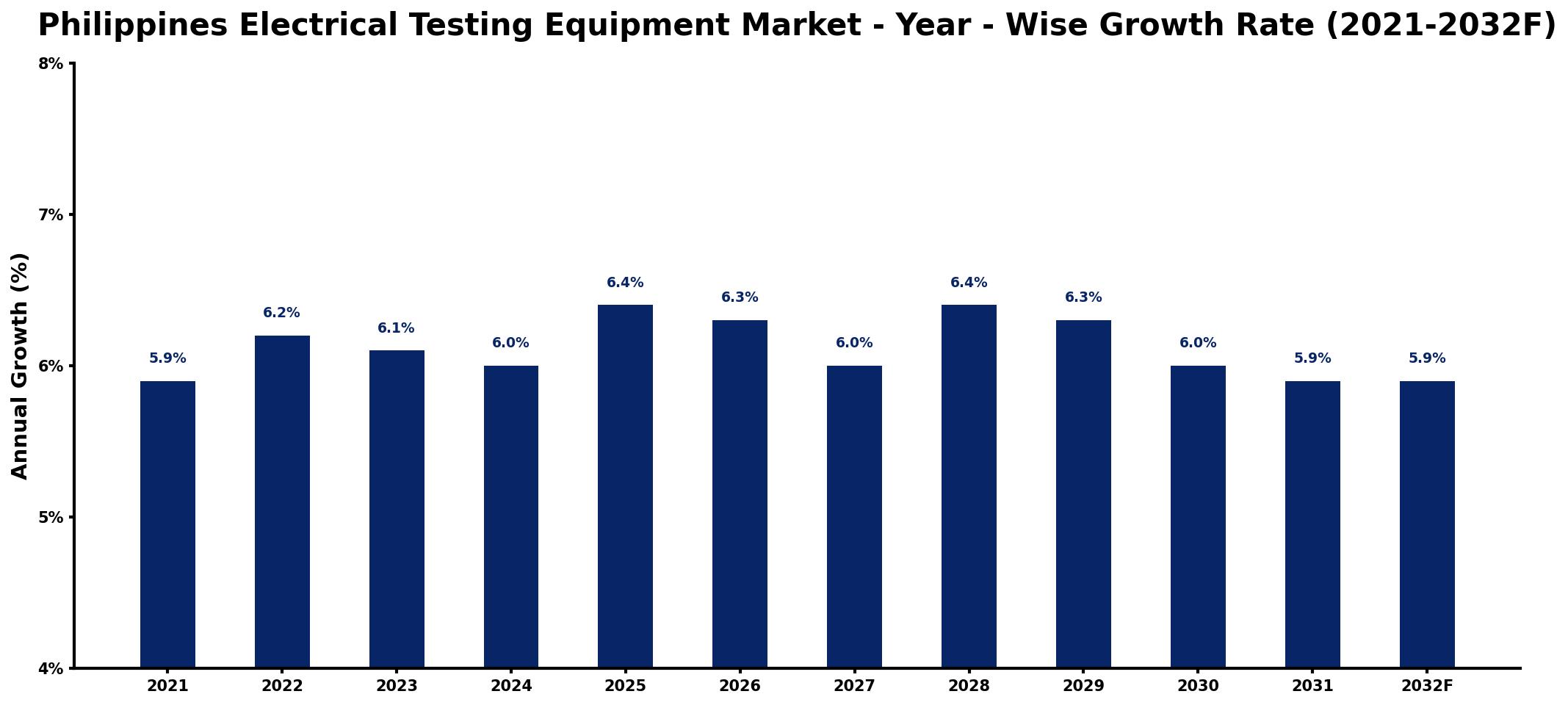
The table below presents the year‑wise growth rates along with the key drivers influencing the market
| Year | Growth Rate | Major Drivers |
| 2021 | 5.9% | Increased infrastructure development projects |
| 2022 | 6.2% | Growing renewable energy investments |
| 2023 | 6.1% | Rising industrial automation adoption |
| 2024 | 6.0% | Expansion of manufacturing facilities |
| 2025 | 6.4% | Surge in construction activities |
| 2026 | 6.3% | Higher demand for safety compliance |
| 2027 | 6.0% | Investment in smart city initiatives |
| 2028 | 6.4% | Growth in telecommunications sector |
| 2029 | 6.3% | Increasing focus on energy efficiency |
| 2030 | 6.0% | Development of electric vehicle infrastructure |
| 2031 | 5.9% | Rise in government regulatory standards |
| 2032 | 5.9% | Boost in research and innovation |
Note: Market size estimations and growth projections presented in this report are based on 6Wresearch's proprietary forecasting methodology, utilizing the latest available industry data, government publications, and primary research inputs.
Philippines Electrical Testing Equipment Market Synopsis
The Philippines electrical testing equipment market has witnessed significant momentum, driven by a surge in industrial and infrastructural activities. As the country modernizes its energy infrastructure, the need for cutting-edge testing equipment becomes paramount. Looking ahead, this momentum is expected to continue, supported by stringent regulations and the integration of renewable energy sources.
This market's evolution reflects a broader commitment to enhancing electrical safety and efficiency across various sectors. The increasing complexity of electrical systems demands sophisticated testing solutions, making it imperative for companies to invest in state-of-the-art equipment to ensure reliability and compliance with international standards.
Philippines Electrical Testing Equipment Market Key Takeaways
- The market is experiencing robust growth due to heightened awareness of electrical safety and regulatory compliance.
- Investment in renewable energy technologies and smart grid solutions is reshaping the demand landscape for testing equipment.
- Ongoing innovation is essential to adapt testing solutions to varying voltage levels and applications.
- The need for reliable diagnostics and maintenance strategies is driving demand for advanced electrical testing solutions.
- Counterfeit products pose a challenge, emphasizing the need for vigilance in procurement practices.
Evaluation of Restraints in Philippines Electrical Testing Equipment Market
While the Philippines electrical testing equipment market is on an upward trajectory, certain constraints hinder its full potential. A key limitation lies in the necessity for continual innovation to adapt testing technologies to diverse voltage levels and equipment types. Moreover, ensuring precise measurements and instrument calibration while adhering to international standards is an ongoing challenge for manufacturers and users alike. Additionally, the prevalent issues surrounding technical expertise and the existence of counterfeit products in the market necessitate strategic approaches to maintain integrity and reliability within the industry.
Philippines Electrical Testing Equipment Market Trends
A notable trend shaping the Philippines electrical testing equipment market is the increasing incorporation of digital technologies and smart systems. As industries transition towards automation and smart grids, the demand for innovative testing solutions that can offer real-time monitoring and diagnostics is surging. Furthermore, the rise of renewable energy sources is prompting manufacturers to develop equipment tailored to specific renewable technologies, enhancing efficiency and sustainability. Overall, the convergence of technological advancements and regulatory pressures is redefining the landscape of electrical testing equipment in the Philippines.
Philippines Electrical Testing Equipment Market Opportunities
The market offers substantial growth and investment opportunities, particularly in the realm of renewable energy. As the Philippines prioritizes sustainability, there is a pressing demand for testing equipment that can ensure the reliability of solar, wind, and other alternative energy sources. Additionally, the burgeoning industrial sector, driven by increasing construction activities, presents avenues for suppliers to expand their offerings. Companies that can deliver innovative, reliable, and customized testing solutions are well-positioned to capitalize on these emerging opportunities.
Government Initiatives in the Philippines Electrical Testing Equipment Market
The Philippine government has implemented several initiatives aimed at enhancing electrical safety and efficiency within various sectors. These include policies promoting infrastructure development and investment in the energy sector. Public spending on energy modernization projects, along with incentives for industries that prioritize safety compliance and energy efficiency, play a crucial role in driving the demand for electrical testing equipment. Furthermore, training programs to develop technical expertise in the workforce are vital in supporting the market's growth and ensuring adherence to international standards.
Future Insights of the Philippines Electrical Testing Equipment Market
Looking ahead to 2026-2032, the Philippines electrical testing equipment market is poised for sustained growth, driven by ongoing modernization efforts and an emphasis on energy efficiency. The integration of smart technologies and an increased focus on renewable energy will further shape the market landscape. As industries seek reliable and advanced testing solutions to navigate the complexities of modern electrical systems, demand will escalate. This presents a promising future for stakeholders invested in the electrical testing equipment sector.
Philippines Electrical Testing Equipment Market Latest Developments (2025 - 2026)
Recent developments in the Philippines electrical testing equipment market reveal a trend towards greater adoption of digital solutions. Companies are increasingly leveraging technology to enhance remote monitoring capabilities, thereby improving efficiency in testing processes. Additionally, collaborations among various stakeholders are emerging, aimed at addressing common challenges related to safety standards and equipment reliability. This collaborative approach is expected to foster innovation and ensure that testing solutions meet the evolving demands of the industry.
Philippines Electrical Testing Equipment Market - Key Attractiveness of the Report
- 10 Years of Market Numbers
- Historical Data Starting from 2022 to 2025
- Base Year: 2025
- Forecast Data until 2032
- Key Performance Indicators Impacting the Market
- Major Upcoming Developments and Projects
Key Highlights of the Report:
- Philippines Electrical Testing Equipment Market Outlook
- Market Size of Philippines Electrical Testing Equipment Market, 2025
- Forecast of Philippines Electrical Testing Equipment Market, 2032
- Historical Data and Forecast of Philippines Electrical Testing Equipment Revenues & Volume for the Period 2022-2032F
- Philippines Electrical Testing Equipment Market Trend Evolution
- Philippines Electrical Testing Equipment Market Drivers and Challenges
- Philippines Electrical Testing Equipment Price Trends
- Philippines Electrical Testing Equipment Porter's Five Forces
- Philippines Electrical Testing Equipment Industry Life Cycle
- Historical Data and Forecast of Philippines Electrical Testing Equipment Market Revenues & Volume By Service Type for the Period 2022-2032F
- Historical Data and Forecast of Philippines Electrical Testing Equipment Market Revenues & Volume By Electrical Testing Equipment Calibration Services for the Period 2022-2032F
- Historical Data and Forecast of Philippines Electrical Testing Equipment Market Revenues & Volume By Electrical Testing Equipment Repair Services or After Sales Services for the Period 2022-2032F
- Historical Data and Forecast of Philippines Electrical Testing Equipment Market Revenues & Volume By Product Type for the Period 2022-2032F
- Historical Data and Forecast of Philippines Electrical Testing Equipment Market Revenues & Volume By General Purpose Electrical Testing Equipment for the Period 2022-2032F
- Historical Data and Forecast of Philippines Electrical Testing Equipment Market Revenues & Volume By Mechanical Electrical Test Equipment for the Period 2022-2032F
- Historical Data and Forecast of Philippines Electrical Testing Equipment Market Revenues & Volume By End User for the Period 2022-2032F
- Historical Data and Forecast of Philippines Electrical Testing Equipment Market Revenues & Volume By Aerospace and Defense for the Period 2022-2032F
- Historical Data and Forecast of Philippines Electrical Testing Equipment Market Revenues & Volume By Telecommunications for the Period 2022-2032F
- Historical Data and Forecast of Philippines Electrical Testing Equipment Market Revenues & Volume By Semiconductor and Electronics for the Period 2022-2032F
- Philippines Electrical Testing Equipment Import Export Trade Statistics
- Market Opportunity Assessment By Service Type
- Market Opportunity Assessment By Product Type
- Market Opportunity Assessment By End User
- Philippines Electrical Testing Equipment Top Companies Market Share
- Philippines Electrical Testing Equipment Competitive Benchmarking By Technical and Operational Parameters
- Philippines Electrical Testing Equipment Company Profiles
- Philippines Electrical Testing Equipment Key Strategic Recommendations






































