Philippines Electrohydraulic Pumps Market Size, Share & Growth Rate
The Philippines Electrohydraulic Pumps Market was estimated at USD 480 Million in 2025 and is projected to reach USD 650 Million by 2032, growing at a CAGR of 4.4% from 2026 to 2032. This growth trajectory is primarily driven by the rising demand for automation and efficiency across diverse industries, particularly in construction and manufacturing. As sectors embrace advanced hydraulic technologies, the need for reliable and efficient electrohydraulic pumps is poised for significant escalation.
Philippines Electrohydraulic Pumps Market Year-wise Growth Rate and Key Drivers
This graph highlights how the Philippines Electrohydraulic Pumps Market has steadily grown over the years, supported by major growth factors.
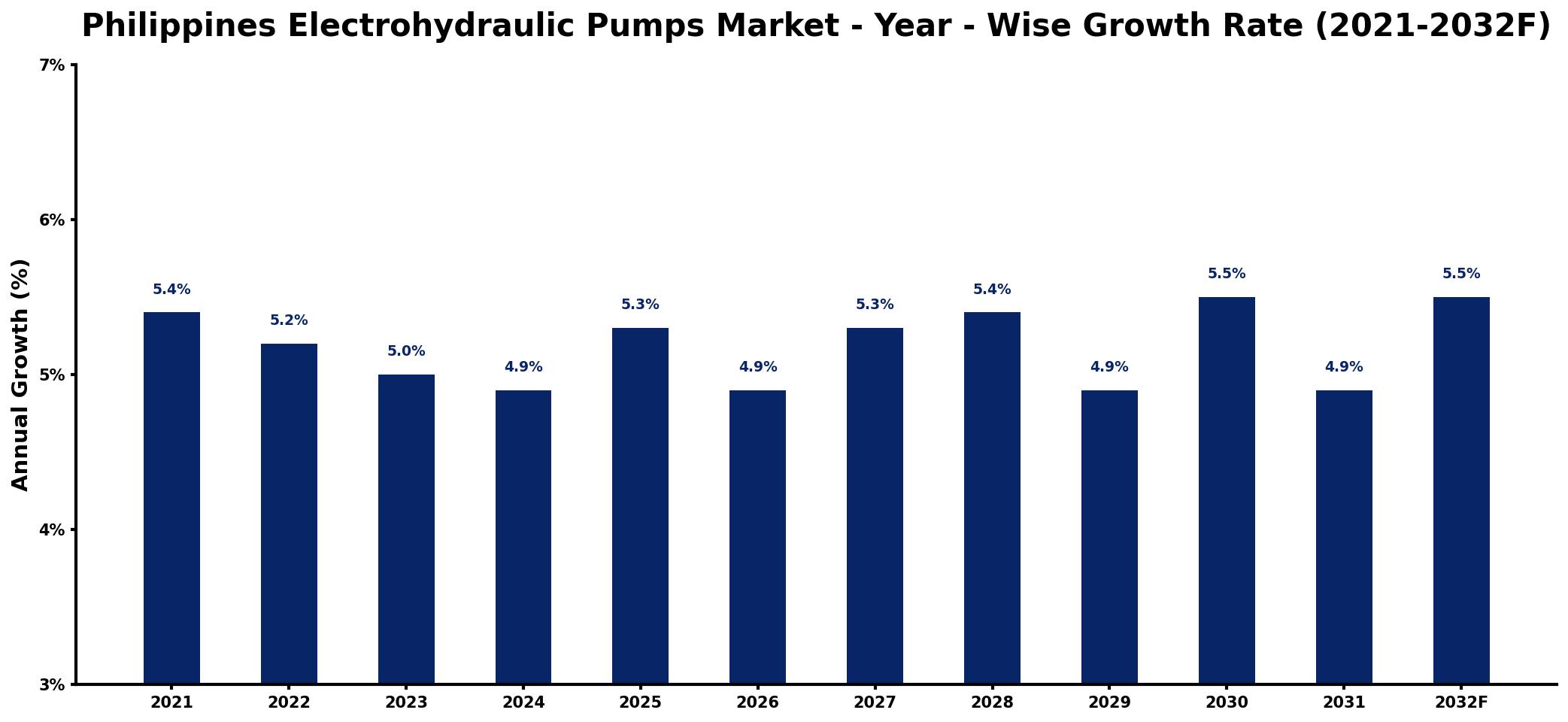
The table below presents the year‑wise growth rates along with the key drivers influencing the market
| Year | Growth Rate | Major Drivers |
| 2021 | 5.4% | Rising construction project investments |
| 2022 | 5.2% | Increased manufacturing sector demand |
| 2023 | 5.0% | Growth in renewable energy projects |
| 2024 | 4.9% | Expansion of infrastructure development |
| 2025 | 5.3% | Surge in agricultural automation needs |
| 2026 | 4.9% | Advancements in industrial automation technology |
| 2027 | 5.3% | Boost in mining exploration activities |
| 2028 | 5.4% | Growing offshore oil exploration initiatives |
| 2029 | 4.9% | Rising demand in marine applications |
| 2030 | 5.5% | Increased focus on energy efficiency |
| 2031 | 4.9% | expanding industrial usage applications |
| 2032 | 5.5% | enhanced product quality standards |
Note: Market size estimations and growth projections presented in this report are based on 6Wresearch's proprietary forecasting methodology, utilizing the latest available industry data, government publications, and primary research inputs.
Philippines Electrohydraulic Pumps Market Synopsis
The electrohydraulic pumps market in the Philippines has gained momentum in recent years, driven by robust industrial activity and advancements in machinery. With increasing recognition of the benefits offered by electrohydraulic systems, the market is expected to transition from strength to strength, capitalizing on technological innovations.
As the demand for precision and energy-efficient solutions grows, industries are investing heavily in upgrading their hydraulic systems. This shift not only enhances operational performance but also aligns with global sustainability goals. The future of the market looks bright, with numerous opportunities for both established players and new entrants.
Philippines Electrohydraulic Pumps Market Key Takeaways
- The market is projected to experience a steady CAGR of 4.4% from 2026 to 2032.
- Technological advancements are driving the adoption of electrohydraulic pumps across various industries.
- Energy efficiency and precision control are critical factors influencing market growth.
- Investment in research and development is essential to overcome energy efficiency challenges.
- The post-pandemic recovery in construction and industrial sectors will further bolster market prospects.
Evaluation of Restraints in Philippines Electrohydraulic Pumps Market
Despite its promising growth outlook, the Philippines electrohydraulic pumps market faces several constraints. One major concern is the need for energy efficiency, as industries strive to lower their carbon footprints. Companies are under pressure to develop innovative solutions that strike a balance between performance and sustainability. Additionally, the integration of advanced technologies, such as IoT for predictive maintenance, presents a challenge due to the need for compatibility across diverse applications and existing systems.
Philippines Electrohydraulic Pumps Market Trends
Current trends in the Philippines electrohydraulic pumps market are heavily influenced by the demand for automation and enhanced performance. The integration of smart technologies into hydraulic systems is on the rise, as companies seek to leverage data analytics for improved efficiency. Moreover, sustainability is becoming a focal point, leading to a push for pumps that minimize energy consumption while maximizing output.
Philippines Electrohydraulic Pumps Market Opportunities
There are significant growth opportunities in the Philippines electrohydraulic pumps market, particularly as industries continue to prioritize automation and energy efficiency. Investment in research and development can lead to innovative products that cater to specific industry needs. Furthermore, the expansion of the construction and agriculture sectors presents a fertile ground for market players to establish a stronger presence.
Government Initiatives in the Philippines Electrohydraulic Pumps Market
The Philippine government is increasingly focused on enhancing industrial capabilities, which includes support for technologies that improve efficiency and sustainability. Various initiatives promote the use of energy-efficient systems, thereby creating a favorable environment for the electrohydraulic pumps market. Public spending on infrastructure projects also paves the way for heightened demand for advanced hydraulic solutions.
Future Insights of the Philippines Electrohydraulic Pumps Market
Looking ahead to the period from 2026 to 2032, the Philippines electrohydraulic pumps market is likely to witness transformative changes. The ongoing drive for industrial automation, coupled with a growing emphasis on sustainability, will shape the market landscape. Innovations aimed at enhancing pump efficiency and integrating smart technologies will be key to maintaining competitiveness and meeting the evolving needs of various sectors.
Philippines Electrohydraulic Pumps Market Latest Developments (2025 - 2026)
Recent developments in the electrohydraulic pumps market reflect a collective shift towards integrating smart technologies. Manufacturers are increasingly focusing on creating IoT-enabled systems for better monitoring and predictive maintenance. Additionally, the recent uptick in public infrastructure projects signals a revival of demand, prompting companies to ramp up production and innovate their offerings.
Philippines Electrohydraulic Pumps Market - Key Attractiveness of the Report
- 10 Years of Market Numbers
- Historical Data Starting from 2022 to 2025
- Base Year: 2025
- Forecast Data until 2032
- Key Performance Indicators Impacting the Market
- Major Upcoming Developments and Projects
Key Highlights of the Report:
- Philippines Electrohydraulic Pumps Market Outlook
- Market Size of Philippines Electrohydraulic Pumps Market, 2025
- Forecast of Philippines Electrohydraulic Pumps Market, 2032
- Historical Data and Forecast of Philippines Electrohydraulic Pumps Revenues & Volume for the Period 2022-2032F
- Philippines Electrohydraulic Pumps Market Trend Evolution
- Philippines Electrohydraulic Pumps Market Drivers and Challenges
- Philippines Electrohydraulic Pumps Price Trends
- Philippines Electrohydraulic Pumps Porter's Five Forces
- Philippines Electrohydraulic Pumps Industry Life Cycle
- Historical Data and Forecast of Philippines Electrohydraulic Pumps Market Revenues & Volume By Type for the Period 2022-2032F
- Historical Data and Forecast of Philippines Electrohydraulic Pumps Market Revenues & Volume By Wound Field Motors for the Period 2022-2032F
- Historical Data and Forecast of Philippines Electrohydraulic Pumps Market Revenues & Volume By Permanent Magnet Motors for the Period 2022-2032F
- Historical Data and Forecast of Philippines Electrohydraulic Pumps Market Revenues & Volume By End User for the Period 2022-2032F
- Historical Data and Forecast of Philippines Electrohydraulic Pumps Market Revenues & Volume By Electric power steering for the Period 2022-2032F
- Historical Data and Forecast of Philippines Electrohydraulic Pumps Market Revenues & Volume By Electro-Hydraulic system and circuits. for the Period 2022-2032F
- Historical Data and Forecast of Philippines Electrohydraulic Pumps Market Revenues & Volume By Application for the Period 2022-2032F
- Historical Data and Forecast of Philippines Electrohydraulic Pumps Market Revenues & Volume By Buses and coaches and Vocational vehicles for the Period 2022-2032F
- Historical Data and Forecast of Philippines Electrohydraulic Pumps Market Revenues & Volume By Construction for the Period 2022-2032F
- Historical Data and Forecast of Philippines Electrohydraulic Pumps Market Revenues & Volume By Agricultural equipment for the Period 2022-2032F
- Philippines Electrohydraulic Pumps Import Export Trade Statistics
- Market Opportunity Assessment By Type
- Market Opportunity Assessment By End User
- Market Opportunity Assessment By Application
- Philippines Electrohydraulic Pumps Top Companies Market Share
- Philippines Electrohydraulic Pumps Competitive Benchmarking By Technical and Operational Parameters
- Philippines Electrohydraulic Pumps Company Profiles
- Philippines Electrohydraulic Pumps Key Strategic Recommendations






































