Philippines Electroluminescent (EL) Panels Market Size, Share & Growth Rate
The Philippines Electroluminescent (EL) Panels Market was estimated at USD 229 Million in 2025 and is projected to reach USD 306 Million by 2032, growing at a CAGR of 4.2% from 2026 to 2032. This growth trajectory is driven by the increasing emphasis on energy-efficient solutions and the rising popularity of unique lighting applications across various industries. As businesses and consumers alike seek innovative and sustainable lighting options, the versatility of EL panels becomes increasingly appealing.
Philippines Electroluminescent (EL) Panels Market Year-wise Growth Rate and Key Drivers
This graph highlights how the Philippines Electroluminescent (EL) Panels Market has steadily grown over the years, supported by major growth factors.
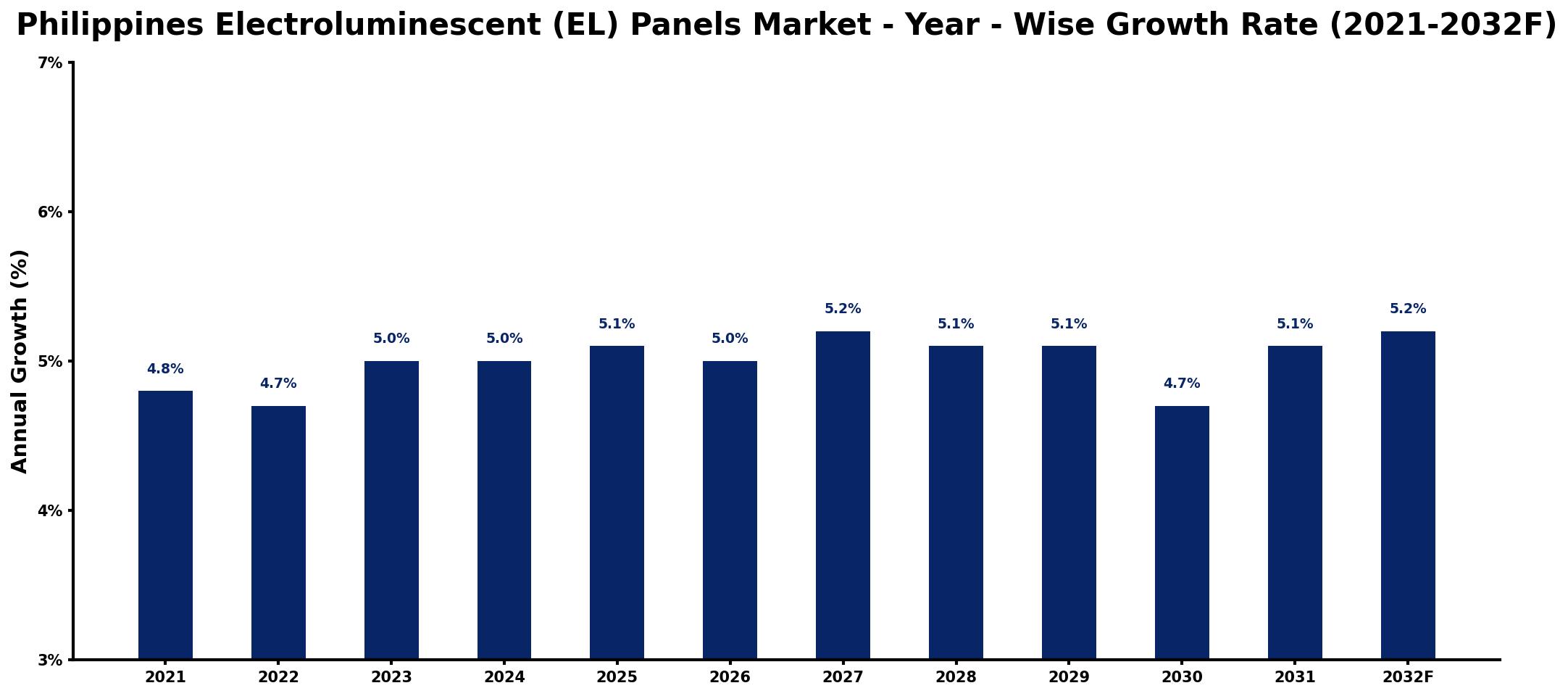
The table below presents the year‑wise growth rates along with the key drivers influencing the market
| Year | Growth Rate | Major Drivers |
| 2021 | 4.8% | Rising demand for innovative lighting |
| 2022 | 4.7% | Increased investments in advertising technology |
| 2023 | 5.0% | Growing popularity in automotive applications |
| 2024 | 5.0% | Expansion of retail display solutions |
| 2025 | 5.1% | Surge in smart city initiatives |
| 2026 | 5.0% | expanding healthcare application demand |
| 2027 | 5.2% | Enhanced focus on sustainable solutions |
| 2028 | 5.1% | Growing adoption in consumer electronics |
| 2029 | 5.1% | Increased utilization in home decor |
| 2030 | 4.7% | rising end-use demand growth |
| 2031 | 5.1% | Rising interest in artistic installations |
| 2032 | 5.2% | Increased integration with IoT technologies |
Note: Market size estimations and growth projections presented in this report are based on 6Wresearch's proprietary forecasting methodology, utilizing the latest available industry data, government publications, and primary research inputs.
Philippines Electroluminescent (EL) Panels Market Synopsis
The Philippines Electroluminescent (EL) panels market has carved a niche in the local lighting industry, emphasizing energy efficiency and innovative design. With applications ranging from advertising to architecture, these panels represent a forward-thinking approach to illumination that resonates with both businesses and consumers looking for sustainable solutions.
The growing interest in EL panels aligns with global trends towards sustainability, as these products consume significantly less energy than traditional lighting. Additionally, ongoing technological advancements continue to expand the potential uses of EL panels, making them a sought-after choice for modern designs and displays.
Philippines Electroluminescent (EL) Panels Market Key Takeaways
- The market is projected to witness steady growth driven by rising energy efficiency awareness.
- Advancements in EL technology are enhancing the versatility and application of these panels.
- Consumer education regarding the advantages of EL panels remains a key focus area.
- There is a growing need for aesthetically pleasing yet durable lighting solutions in various industries.
- The resilience of the market post-COVID-19 highlights the adaptability of EL panels in changing circumstances.
Evaluation of Restraints in Philippines Electroluminescent (EL) Panels Market
Despite its growth potential, the Philippines EL panels market faces specific restraints that may hinder its development. Key among these is the challenge of balancing aesthetics with durability, as businesses seek attractive yet long-lasting lighting options. Furthermore, the need for consistent brightness and performance can complicate manufacturing processes, leading to potential supply chain issues. Educating consumers about the distinct advantages of EL panels—compared to traditional lighting solutions—remains imperative to boost market penetration. Navigating these restraints while fostering innovation will be crucial for sustained growth in this dynamic market.
Philippines Electroluminescent (EL) Panels Market Trends
Current trends in the Philippines EL panels market indicate a shift towards customized lighting solutions. Companies are increasingly demanding personalized shapes, sizes, and designs that reflect their brand identities. Additionally, the rise of smart technology integration, wherein EL panels are paired with IoT devices, is shaping future applications. The continued exploration of environmentally friendly materials also aligns with the global push for sustainability and energy conservation, which is critical for the market's evolution.
Philippines Electroluminescent (EL) Panels Market Opportunities
Significant growth opportunities lie within the Philippines EL panels market, especially as urbanization and infrastructure projects accelerate. Industries such as retail, automotive, and architecture are poised to benefit from enhanced lighting solutions that improve aesthetics while promoting energy savings. Collaborations between technology firms and lighting manufacturers can also spark innovation, opening new application avenues for EL panels. Furthermore, expanding awareness of the environmental benefits associated with energy-efficient lighting solutions presents an ideal landscape for investment.
Government Initiatives in the Philippines Electroluminescent (EL) Panels Market
The Philippine government is actively promoting energy efficiency and sustainability through various policies and initiatives that indirectly support the EL panels market. Incentives for the adoption of energy-efficient technologies in commercial and residential sectors are paving the way for increased EL panel utilization. Additionally, public spending on infrastructure projects that emphasize modern, sustainable designs creates a favorable environment for the growth of innovative lighting solutions.
Future Insights of the Philippines Electroluminescent (EL) Panels Market
Looking ahead to 2026-2032, the Philippines EL panels market is expected to continue evolving, driven by technological advancements and increasing consumer demand for sustainable solutions. As industries embrace new lighting technologies, the versatility of EL panels will be critical in redefining how spaces are illuminated. The incorporation of smart technologies, along with continued emphasis on design and functionality, will significantly shape the future landscape of the market, enhancing its appeal across various sectors.
Philippines Electroluminescent (EL) Panels Market Latest Developments (2025 - 2026)
In recent months, the Philippines EL panels market has seen notable advancements, including increased investment in research and development to refine panel technology and enhance durability. Manufacturers are focusing on expanding their product lines to offer a wider variety of designs suitable for modern applications, such as smart homes and corporate branding. Furthermore, trade shows and exhibitions have highlighted innovative applications of EL technology, attracting interest from various industries seeking unique lighting solutions.
Philippines Electroluminescent (EL) Panels Market - Key Attractiveness of the Report
- 10 Years of Market Numbers
- Historical Data Starting from 2022 to 2025
- Base Year: 2025
- Forecast Data until 2032
- Key Performance Indicators Impacting the Market
- Major Upcoming Developments and Projects
Key Highlights of the Report:
- Philippines Electroluminescent (EL) Panels Market Outlook
- Market Size of Philippines Electroluminescent (EL) Panels Market, 2025
- Forecast of Philippines Electroluminescent (EL) Panels Market, 2032
- Historical Data and Forecast of Philippines Electroluminescent (EL) Panels Revenues & Volume for the Period 2022-2032F
- Philippines Electroluminescent (EL) Panels Market Trend Evolution
- Philippines Electroluminescent (EL) Panels Market Drivers and Challenges
- Philippines Electroluminescent (EL) Panels Price Trends
- Philippines Electroluminescent (EL) Panels Porter's Five Forces
- Philippines Electroluminescent (EL) Panels Industry Life Cycle
- Historical Data and Forecast of Philippines Electroluminescent (EL) Panels Market Revenues & Volume By Shape for the Period 2022-2032F
- Historical Data and Forecast of Philippines Electroluminescent (EL) Panels Market Revenues & Volume By Rectangle for the Period 2022-2032F
- Historical Data and Forecast of Philippines Electroluminescent (EL) Panels Market Revenues & Volume By Square for the Period 2022-2032F
- Historical Data and Forecast of Philippines Electroluminescent (EL) Panels Market Revenues & Volume By Strip for the Period 2022-2032F
- Historical Data and Forecast of Philippines Electroluminescent (EL) Panels Market Revenues & Volume By Round for the Period 2022-2032F
- Historical Data and Forecast of Philippines Electroluminescent (EL) Panels Market Revenues & Volume By Others for the Period 2022-2032F
- Historical Data and Forecast of Philippines Electroluminescent (EL) Panels Market Revenues & Volume By Colour for the Period 2022-2032F
- Historical Data and Forecast of Philippines Electroluminescent (EL) Panels Market Revenues & Volume By White for the Period 2022-2032F
- Historical Data and Forecast of Philippines Electroluminescent (EL) Panels Market Revenues & Volume By Blue for the Period 2022-2032F
- Historical Data and Forecast of Philippines Electroluminescent (EL) Panels Market Revenues & Volume By Green for the Period 2022-2032F
- Historical Data and Forecast of Philippines Electroluminescent (EL) Panels Market Revenues & Volume By Red for the Period 2022-2032F
- Historical Data and Forecast of Philippines Electroluminescent (EL) Panels Market Revenues & Volume By Others for the Period 2022-2032F
- Philippines Electroluminescent (EL) Panels Import Export Trade Statistics
- Market Opportunity Assessment By Shape
- Market Opportunity Assessment By Colour
- Philippines Electroluminescent (EL) Panels Top Companies Market Share
- Philippines Electroluminescent (EL) Panels Competitive Benchmarking By Technical and Operational Parameters
- Philippines Electroluminescent (EL) Panels Company Profiles
- Philippines Electroluminescent (EL) Panels Key Strategic Recommendations






































