Philippines Email Encryption Market Size & Growth Rate (2026-2032)
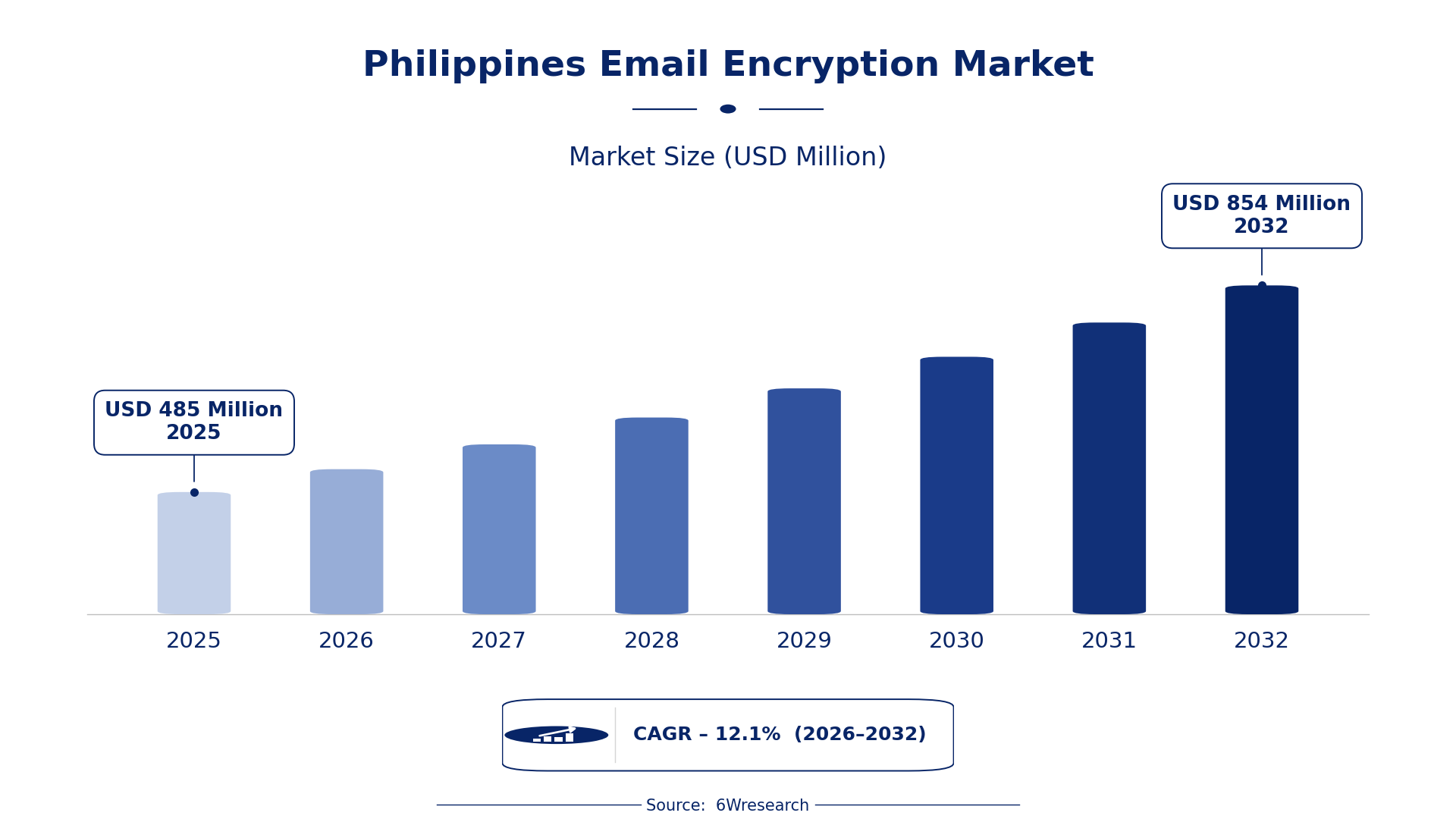
The Philippines Email Encryption Market was estimated at USD 485 Million in 2025 and is projected to reach USD 854 Million by 2032, growing at a CAGR of 12.1% from 2026 to 2032.
Philippines Email Encryption Market Synopsis
The driving force in the Philippines Email Encryption Market is the increasing awareness surrounding data privacy and security. As email remains a critical communication tool for businesses and individuals alike, the urgency to protect sensitive information against cyber threats cannot be overstated.
Organizations are actively seeking encryption solutions to ensure compliance with various regulations and to safeguard proprietary data. As the digital landscape evolves, the necessity for robust email security protocols is becoming non-negotiable for businesses aiming to maintain trust and integrity in their communications.
Philippines Email Encryption Market Year-wise Growth Rate and Key Drivers
This graph illustrates the annual growth rates of the Philippines Email Encryption Market from 2021 to 2032, highlighting a steady upward trajectory and projected expansion over the forecast period.

The table below presents the year‑wise growth rates along with the key drivers influencing the market
| Year | Growth Rate | Major Drivers |
| 2021 | 7.7% | Data Privacy Act enforcement increases encryption adoption urgency. |
| 2022 | 8.1% | Government cybersecurity framework enhances corporate email protection measures. |
| 2023 | 8.5% | Rising cyber threats push businesses to secure email communications. |
| 2024 | 8.9% | Local financial regulations mandate enhanced data protection strategies. |
| 2025 | 9.3% | Growing e-commerce sector drives demand for secure transactions. |
| 2026 | 9.7% | Increased remote work accelerates need for secure email solutions. |
| 2027 | 10.1% | Public sector initiatives prioritize data confidentiality in communications. |
| 2028 | 10.5% | Corporate compliance requirements boost investment in email encryption. |
| 2029 | 10.9% | Expanding tech startups foster innovation in email security tools. |
| 2030 | 11.3% | Digital transformation initiatives lead to greater security awareness. |
| 2031 | 11.7% | Evolving threat landscape necessitates advanced encryption technologies. |
| 2032 | 12.1% | Local education programs emphasize data security in business curricula. |
Note: Market size estimations and growth projections presented in this report are based on 6Wresearch's proprietary forecasting methodology, utilizing the latest available industry data, government publications, and primary research inputs.
Philippines Email Encryption Market Key Takeaways
Below are some of the specific key takeaways from the market, including:
- The growing emphasis on data privacy is accelerating the adoption of email encryption solutions.
- Cybersecurity threats are prompting businesses to invest more heavily in email security technologies.
- Remote work trends, heightened by the pandemic, have intensified the demand for secure email communications.
- Regulatory frameworks are increasingly requiring encryption as a standard practice for data protection.
Evaluation of Restraints in Philippines Email Encryption Market
Despite the growth trajectory, the Philippines Email Encryption Market faces notable limitations, particularly around user resistance to adopting these solutions. Many organizations struggle with perceived complexities associated with implementing encryption protocols. Additionally, a lack of understanding about the benefits often deters decision-makers from investing in these crucial technologies. Training and awareness programs are essential to overcome these barriers, yet they require time and resources that not all companies are willing to allocate.
Philippines Email Encryption Market Trends
As businesses adapt to a more remote working environment, the trend towards integrated email security solutions is becoming more pronounced. Many organizations are looking for encryption options that seamlessly integrate with existing email platforms, enhancing usability without compromising security. on top of that, the emergence of AI-driven security features is beginning to shape the future of email encryption, offering proactive threat detection alongside traditional encryption methods.
Philippines Email Encryption Market Opportunities
Opportunities in the Philippines Email Encryption Market are centered around the increasing demand for compliance with international and local data protection regulations. Companies that can offer user-friendly encryption solutions will likely capture a significant share of the market. Additionally, partnerships between encryption service providers and local IT firms can facilitate wider adoption. Focused investment in education and support services will also play a crucial role in overcoming barriers to entry for potential users.
Government Initiatives in the Philippines Email Encryption Market
The Philippine government is increasingly prioritizing data security through various initiatives aimed at enhancing email encryption standards across industries. With the rising tide of cyber threats, governmental bodies are keen on establishing regulatory frameworks that promote data protection compliance. These policies not only create a safer digital environment but also encourage businesses to adopt robust email encryption technologies.
- A national digital infrastructure upgrade programme launched in early 2024 emphasizes enhanced cybersecurity measures, including email encryption.
- Current initiatives focus on awareness campaigns aimed at educating businesses about data privacy laws, running through 2025.
- A regulatory framework mandating data protection protocols is planned for rollout in 2026, requiring encryption in business communications.
Future Insights of the Philippines Email Encryption Market
Looking ahead to 2026-2032, the Philippines Email Encryption Market is set to experience continued expansion driven by evolving regulatory requirements and heightened cybersecurity concerns. As more organizations understand the critical role of secure communications, the demand for advanced encryption solutions will only increase. Technological advancements will likely contribute to the development of more intuitive encryption services, making it easier for users to adopt these necessary protections.
Philippines Email Encryption Market Latest Developments
Recent activities in the Philippines Email Encryption Market indicate a strong push towards enhancing email security frameworks. Companies are rolling out innovative solutions that address the growing need for comprehensive protection against cyber threats. This surge in interest reflects the urgent requirement for businesses to secure sensitive communications in a rapidly evolving digital environment.
- A leading technology vendor launched a cutting-edge email encryption service in early 2024, designed to integrate seamlessly with popular email clients.
- In mid-2024, a major cybersecurity firm commenced an ongoing initiative focused on providing businesses with tailored email security assessments.
- A planned public-private partnership expected to begin in late 2025 aims to enhance educational resources for organizations regarding data encryption best practices.
Philippines Email Encryption Market - Key Attractiveness of the Report
- 10 Years of Market Numbers
- Historical Data Starting from 2022 to 2025
- Base Year: 2025
- Forecast Data until 2032
- Key Performance Indicators Impacting the Market
- Major Upcoming Developments and Projects
Key Highlights of the Report:
- Philippines Email Encryption Market Outlook
- Market Size of Philippines Email Encryption Market, 2025
- Forecast of Philippines Email Encryption Market, 2032
- Historical Data and Forecast of Philippines Email Encryption Revenues & Volume for the Period 2022-2032F
- Philippines Email Encryption Market Trend Evolution
- Philippines Email Encryption Market Drivers and Challenges
- Philippines Email Encryption Price Trends
- Philippines Email Encryption Porter's Five Forces
- Philippines Email Encryption Industry Life Cycle
- Historical Data and Forecast of Philippines Email Encryption Market Revenues & Volume By Component for the Period 2022-2032F
- Historical Data and Forecast of Philippines Email Encryption Market Revenues & Volume By Solutions for the Period 2022-2032F
- Historical Data and Forecast of Philippines Email Encryption Market Revenues & Volume By Services for the Period 2022-2032F
- Historical Data and Forecast of Philippines Email Encryption Market Revenues & Volume By Type for the Period 2022-2032F
- Historical Data and Forecast of Philippines Email Encryption Market Revenues & Volume By End-to-End for the Period 2022-2032F
- Historical Data and Forecast of Philippines Email Encryption Market Revenues & Volume By Gateway for the Period 2022-2032F
- Historical Data and Forecast of Philippines Email Encryption Market Revenues & Volume By Hybrid for the Period 2022-2032F
- Historical Data and Forecast of Philippines Email Encryption Market Revenues & Volume By Client Plugins for the Period 2022-2032F
- Historical Data and Forecast of Philippines Email Encryption Market Revenues & Volume By Deployment Mode for the Period 2022-2032F
- Historical Data and Forecast of Philippines Email Encryption Market Revenues & Volume By On-premises for the Period 2022-2032F
- Historical Data and Forecast of Philippines Email Encryption Market Revenues & Volume By Cloud for the Period 2022-2032F
- Historical Data and Forecast of Philippines Email Encryption Market Revenues & Volume By Verticals for the Period 2022-2032F
- Historical Data and Forecast of Philippines Email Encryption Market Revenues & Volume By BFSI for the Period 2022-2032F
- Historical Data and Forecast of Philippines Email Encryption Market Revenues & Volume By IT & ITeS for the Period 2022-2032F
- Historical Data and Forecast of Philippines Email Encryption Market Revenues & Volume By Telecom for the Period 2022-2032F
- Philippines Email Encryption Import Export Trade Statistics
- Market Opportunity Assessment By Component
- Market Opportunity Assessment By Type
- Market Opportunity Assessment By Deployment Mode
- Market Opportunity Assessment By Verticals
- Philippines Email Encryption Top Companies Market Share
- Philippines Email Encryption Competitive Benchmarking By Technical and Operational Parameters
- Philippines Email Encryption Company Profiles
- Philippines Email Encryption Key Strategic Recommendations






































