Philippines Energy Efficient Lighting Market Size, Share & Growth Rate
The Philippines Energy Efficient Lighting Market was estimated at USD 173 Million in 2025 and is projected to reach USD 227 Million by 2032, growing at a CAGR of 4.0% from 2026 to 2032. This growth trajectory is primarily driven by the increasing awareness of energy conservation among consumers and businesses alike, along with government initiatives aimed at promoting energy efficiency. Furthermore, the rapid urbanization and expansion of residential and commercial infrastructures further bolster the demand for energy-efficient lighting solutions.
Philippines Energy Efficient Lighting Market Year-wise Growth Rate and Key Drivers
This graph highlights how the Philippines Energy Efficient Lighting Market has steadily grown over the years, supported by major growth factors.
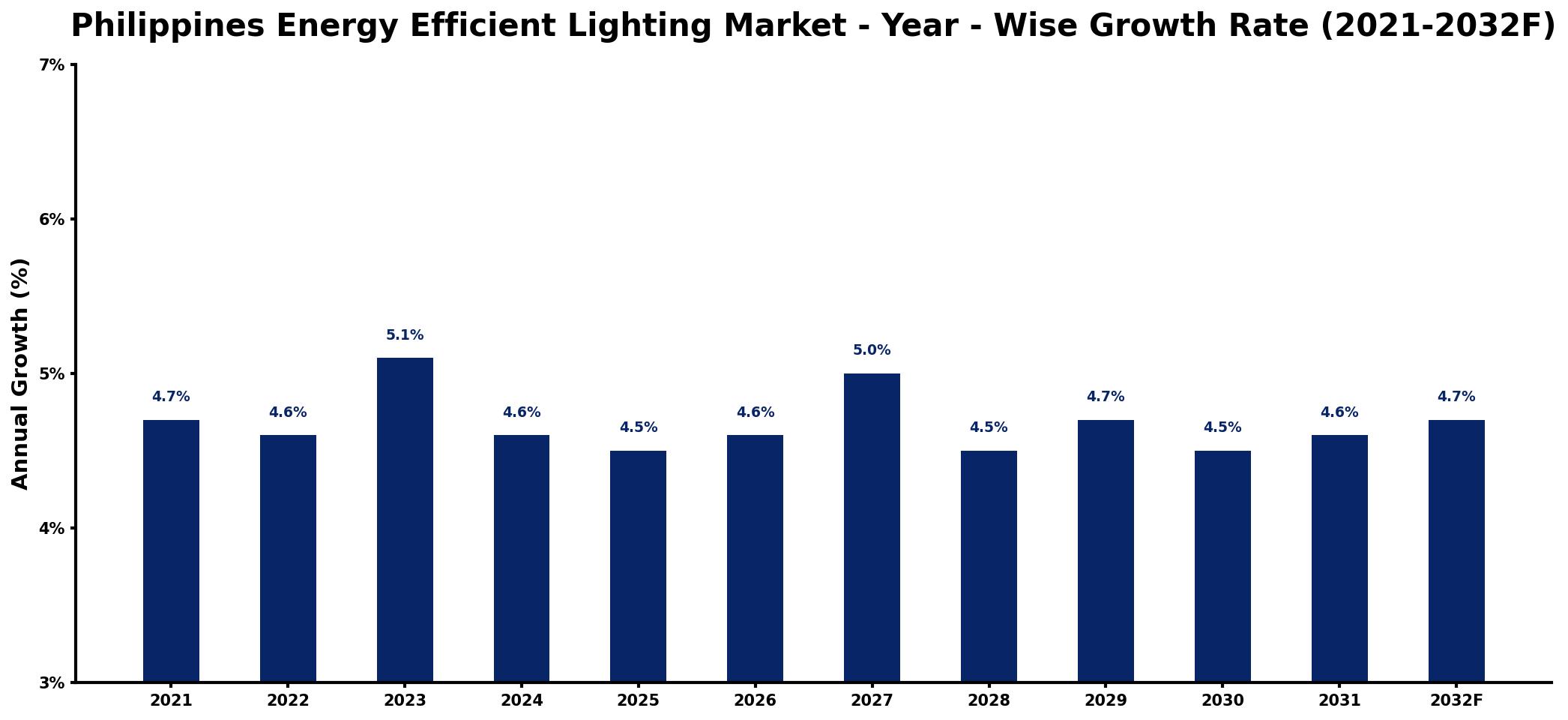
The table below presents the year‑wise growth rates along with the key drivers influencing the market
| Year | Growth Rate | Major Drivers |
| 2021 | 4.7% | Rising consumer awareness sustainability |
| 2022 | 4.6% | Government incentives for renewable projects |
| 2023 | 5.1% | Increased urbanization driving demand |
| 2024 | 4.6% | Expansion of green building initiatives |
| 2025 | 4.5% | Technological advancements enhancing performance |
| 2026 | 4.6% | Corporate responsibility initiatives gaining traction |
| 2027 | 5.0% | Growing popularity smart home solutions |
| 2028 | 4.5% | Investment in infrastructure modernization projects |
| 2029 | 4.7% | Partnerships fostering innovation collaboration |
| 2030 | 4.5% | Shift towards eco-friendly products |
| 2031 | 4.6% | Regulatory frameworks supporting sustainability |
| 2032 | 4.7% | Increased focus on long-term savings |
Note: Market size estimations and growth projections presented in this report are based on 6Wresearch's proprietary forecasting methodology, utilizing the latest available industry data, government publications, and primary research inputs.
Philippines Energy Efficient Lighting Market Synopsis
The most significant force shaping the Philippines Energy Efficient Lighting Market today is the governments commitment to sustainable energy practices. Legislative support, including tax incentives and funding for green technology projects, is encouraging a shift towards energy-saving lighting solutions in both urban and rural areas.
Consumer behavior is also evolving, with an increasing preference for LED and other energy-efficient lighting products. This shift not only reflects a desire to reduce energy bills but also aligns with broader environmental goals, creating a favorable climate for market growth.
Philippines Energy Efficient Lighting Market Key Takeaways
- The market is poised for steady growth, driven by government initiatives and consumer demand for sustainable solutions.
- Technological advancements in lighting solutions are enhancing efficiency and performance.
- Urbanization is accelerating the shift towards energy-efficient lighting in residential and commercial sectors.
- Increased environmental awareness is influencing purchasing decisions, favoring eco-friendly products.
- Investment in renewable energy initiatives further complements the demand for energy-efficient lighting.
Evaluation of Restraints in Philippines Energy Efficient Lighting Market
Despite the favorable outlook, several restraints are impacting the Philippines Energy Efficient Lighting Market. A significant concern lies in the initial cost of upgrading to energy-efficient systems, which can deter small businesses and low-income households from making the transition. Moreover, a lack of widespread education on the long-term benefits of energy-efficient lighting hampers consumer adoption. Lastly, challenges in supply chain logistics can lead to availability issues, further limiting market expansion.
Philippines Energy Efficient Lighting Market Trends
The trend towards smart lighting solutions is gaining momentum within the Philippines Energy Efficient Lighting Market. Home automation and energy management systems are increasingly being integrated into lighting solutions, offering consumers improved control over energy usage. Additionally, the rise of sustainable building practices is pushing developers to prioritize energy-efficient lighting in new construction projects, which will likely contribute to the market's expansion. The ongoing innovation in light quality, including color temperature and dimmability, is also enhancing user experience and satisfaction.
Philippines Energy Efficient Lighting Market Opportunities
Several avenues for growth are emerging within the Philippines Energy Efficient Lighting Market. As the government continues to promote energy efficiency, there are ample opportunities for investment in retrofitting existing infrastructures with modern lighting solutions. Furthermore, educational campaigns aimed at raising awareness about the benefits of energy-efficient lighting can drive consumer adoption. The rise of e-commerce platforms also presents an opportunity for companies to reach a broader audience and facilitate access to energy-efficient products.
Government Initiatives in the Philippines Energy Efficient Lighting Market
The Philippine government is actively supporting the transition to energy-efficient lighting through various initiatives and policies. Programs promoting energy conservation and subsidies for energy-efficient products are part of a broader strategy aimed at achieving sustainability goals. Additionally, collaborations with private sector stakeholders have been established to enhance public awareness of energy-efficient solutions, facilitating greater market adoption.
Future Insights of the Philippines Energy Efficient Lighting Market
Looking ahead to the years 2026-2032, the Philippines Energy Efficient Lighting Market is expected to continue its upward trajectory. The convergence of technological advancements and a strengthening regulatory environment will likely catalyze further growth. As consumer preferences increasingly favor sustainability, demand for energy-efficient lighting solutions is expected to rise. This market is poised to benefit from innovations that improve efficiency and reduce overall costs, making energy-efficient solutions more accessible to a wider demographic.
Philippines Energy Efficient Lighting Market Latest Developments (2025 - 2026)
Recent developments in the Philippines Energy Efficient Lighting Market showcase a heightened focus on integrating smart technology into lighting systems. There has been a noticeable increase in pilot projects aimed at deploying energy-efficient street lighting in urban areas. Furthermore, various stakeholders are actively participating in international forums to share best practices and technological advancements, ensuring the market remains competitive and informed about global trends.
Philippines Energy Efficient Lighting Market - Key Attractiveness of the Report
- 10 Years of Market Numbers
- Historical Data Starting from 2022 to 2025
- Base Year: 2025
- Forecast Data until 2032
- Key Performance Indicators Impacting the Market
- Major Upcoming Developments and Projects
Key Highlights of the Report:
- Philippines Energy Efficient Lighting Market Outlook
- Market Size of Philippines Energy Efficient Lighting Market, 2025
- Forecast of Philippines Energy Efficient Lighting Market, 2032
- Historical Data and Forecast of Philippines Energy Efficient Lighting Revenues & Volume for the Period 2022-2032F
- Philippines Energy Efficient Lighting Market Trend Evolution
- Philippines Energy Efficient Lighting Market Drivers and Challenges
- Philippines Energy Efficient Lighting Price Trends
- Philippines Energy Efficient Lighting Porter's Five Forces
- Philippines Energy Efficient Lighting Industry Life Cycle
- Historical Data and Forecast of Philippines Energy Efficient Lighting Market Revenues & Volume By Product Type for the Period 2022-2032F
- Historical Data and Forecast of Philippines Energy Efficient Lighting Market Revenues & Volume By Incandescent Lamp for the Period 2022-2032F
- Historical Data and Forecast of Philippines Energy Efficient Lighting Market Revenues & Volume By Light Emitting Diode for the Period 2022-2032F
- Historical Data and Forecast of Philippines Energy Efficient Lighting Market Revenues & Volume By Arc Lamp for the Period 2022-2032F
- Historical Data and Forecast of Philippines Energy Efficient Lighting Market Revenues & Volume By Gas Discharge Lamps for the Period 2022-2032F
- Historical Data and Forecast of Philippines Energy Efficient Lighting Market Revenues & Volume By Application for the Period 2022-2032F
- Historical Data and Forecast of Philippines Energy Efficient Lighting Market Revenues & Volume By Commercial for the Period 2022-2032F
- Historical Data and Forecast of Philippines Energy Efficient Lighting Market Revenues & Volume By Residential for the Period 2022-2032F
- Historical Data and Forecast of Philippines Energy Efficient Lighting Market Revenues & Volume By Government for the Period 2022-2032F
- Historical Data and Forecast of Philippines Energy Efficient Lighting Market Revenues & Volume By Correlated Color Temperature for the Period 2022-2032F
- Historical Data and Forecast of Philippines Energy Efficient Lighting Market Revenues & Volume By 2700K-3000K for the Period 2022-2032F
- Historical Data and Forecast of Philippines Energy Efficient Lighting Market Revenues & Volume By 3500K??4000K for the Period 2022-2032F
- Historical Data and Forecast of Philippines Energy Efficient Lighting Market Revenues & Volume By 4000K-5000K for the Period 2022-2032F
- Historical Data and Forecast of Philippines Energy Efficient Lighting Market Revenues & Volume By 5000K-6500K for the Period 2022-2032F
- Historical Data and Forecast of Philippines Energy Efficient Lighting Market Revenues & Volume By More Than 6500K for the Period 2022-2032F
- Philippines Energy Efficient Lighting Import Export Trade Statistics
- Market Opportunity Assessment By Product Type
- Market Opportunity Assessment By Application
- Market Opportunity Assessment By Correlated Color Temperature
- Philippines Energy Efficient Lighting Top Companies Market Share
- Philippines Energy Efficient Lighting Competitive Benchmarking By Technical and Operational Parameters
- Philippines Energy Efficient Lighting Company Profiles
- Philippines Energy Efficient Lighting Key Strategic Recommendations






































