Philippines Enterprise AI Market Size & Growth Rate (2026-2032)
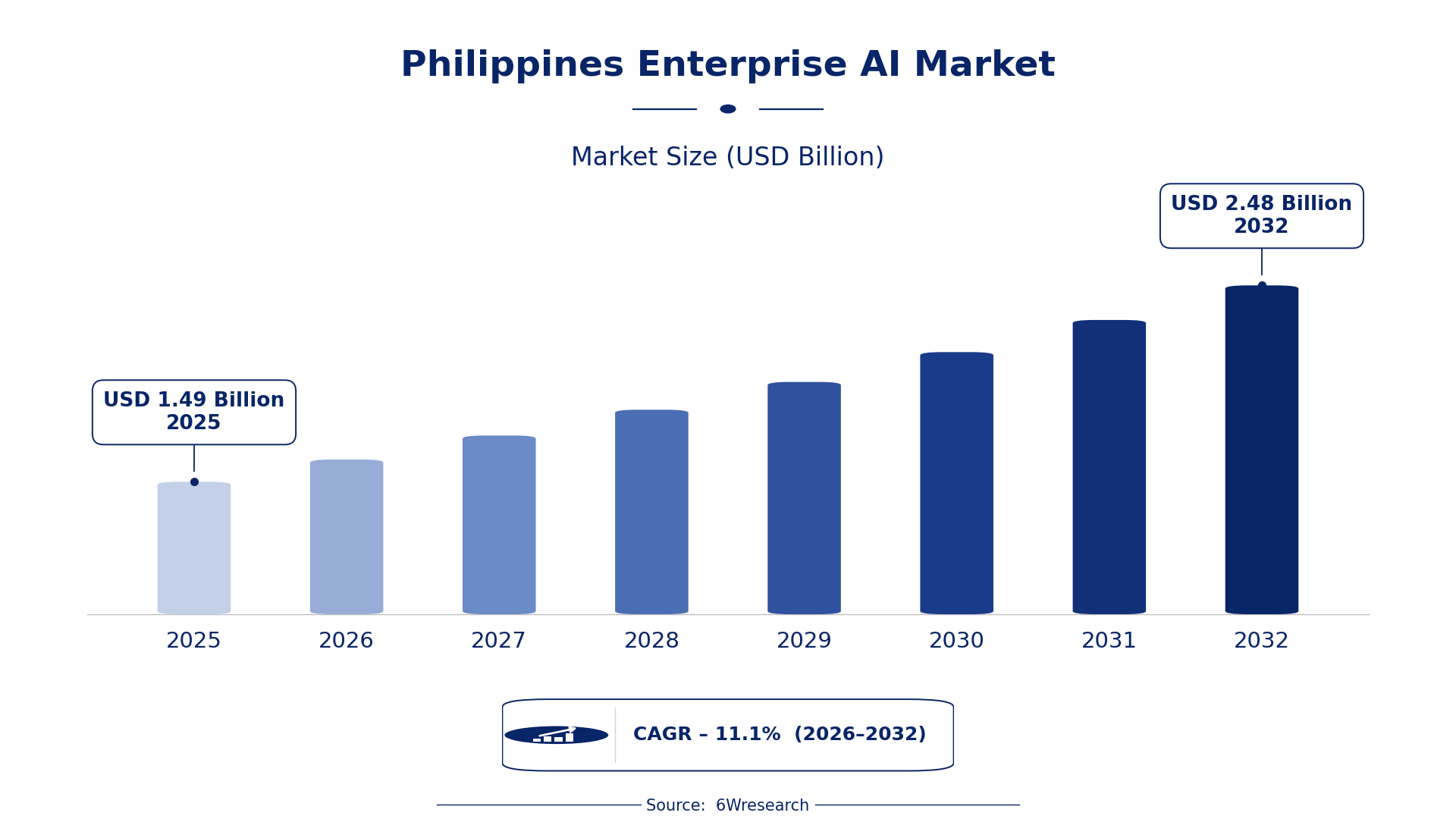
The Philippines Enterprise AI Market was estimated at USD 1485 Million in 2025 and is projected to reach USD 2476 Million by 2032, growing at a CAGR of 11.1% from 2026 to 2032.
Philippines Enterprise AI Market Synopsis
The Philippines is witnessing a surge in enterprise AI adoption, a trend driven by organizations eager to improve operational efficiency and customer engagement. This momentum is set against a backdrop of growing investment in digital transformation and data-driven decision-making.
Looking ahead, the market's trajectory appears promising, with anticipated advancements in AI technologies and an expanding range of applications. As industries become more reliant on AI for insights and automation, the Philippines Enterprise AI Market is on the brink of significant evolution.
Philippines Enterprise AI Market Year-wise Growth Rate and Key Drivers
This graph illustrates the annual growth rates of the Philippines Enterprise AI Market from 2021 to 2032, highlighting a steady upward trajectory and projected expansion over the forecast period.
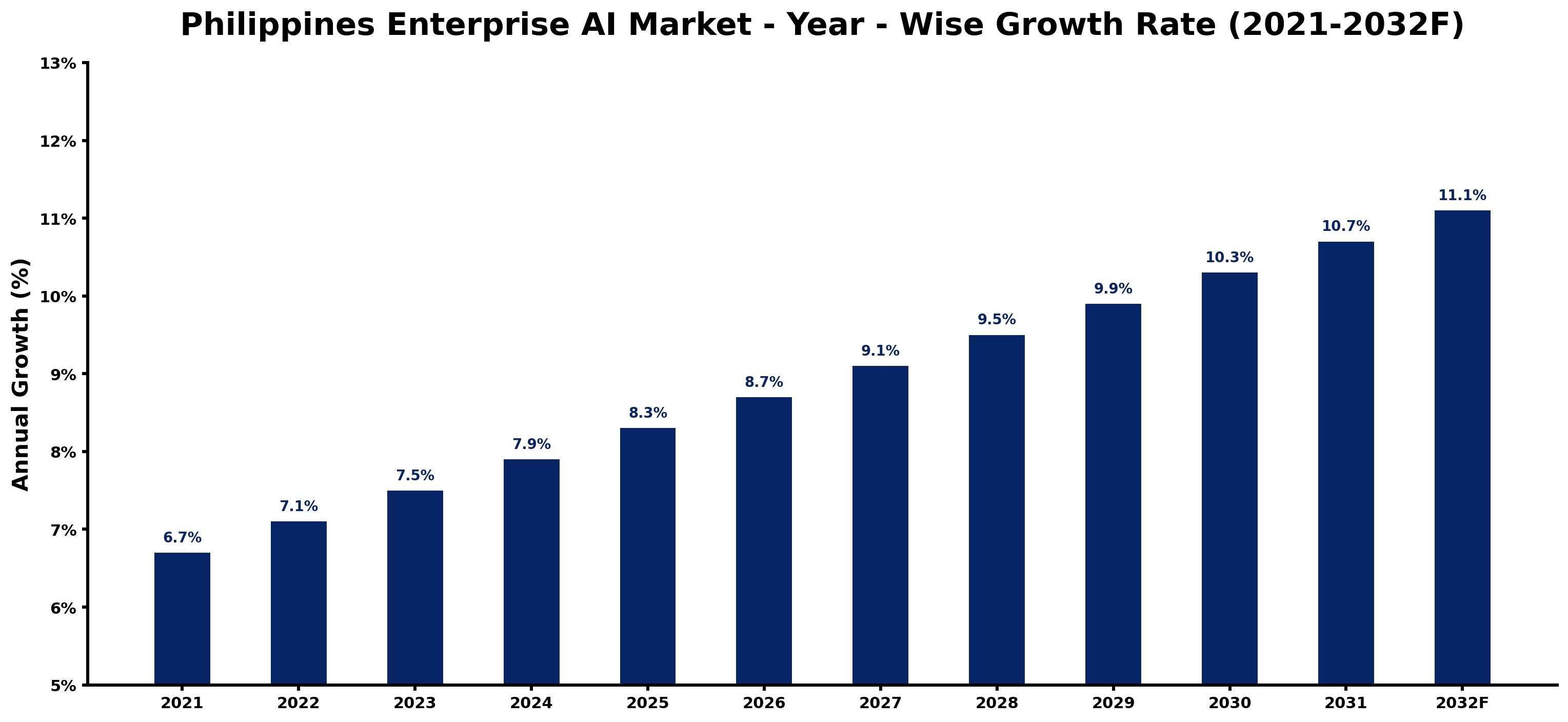
The table below presents the year‑wise growth rates along with the key drivers influencing the market
| Year | Growth Rate | Major Drivers |
| 2021 | 6.7% | Rise in AI adoption amongst local telecommunication firms. |
| 2022 | 7.1% | Increased private sector investment in digital transformation. |
| 2023 | 7.5% | Implementation of Philippine AI Roadmap by DICT. |
| 2024 | 7.9% | Emerging startups focusing on AI-driven healthcare solutions. |
| 2025 | 8.3% | Adoption of AI in local e-commerce platforms speedily. |
| 2026 | 8.7% | Demand for AI analytics in agricultural innovations. |
| 2027 | 9.1% | Partnerships with foreign tech firms for AI expertise. |
| 2028 | 9.5% | Local universities expanding AI curriculum and research initiatives. |
| 2029 | 9.9% | Teleworking trends boosting AI tools for remote collaboration. |
| 2030 | 10.3% | Rising consumer expectations for personalized AI experiences. |
| 2031 | 10.7% | Government policies incentivizing AI utilization in SMEs. |
| 2032 | 11.1% | Collaborations with ASEAN nations for AI technology sharing. |
Note: Market size estimations and growth projections presented in this report are based on 6Wresearch's proprietary forecasting methodology, utilizing the latest available industry data, government publications, and primary research inputs.
Philippines Enterprise AI Market Key Takeaways
Below are some of the specific key takeaways from the market, including:
- The rise of AI-driven solutions is reshaping customer service and operational processes across various sectors.
- Large enterprises are leading the charge in AI adoption, while small and medium-sized businesses face unique challenges.
- Ethical considerations and data privacy issues are becoming increasingly important in AI deployment.
- Ongoing pandemic effects continue to fuel demand for AI solutions that enhance operational resilience.
- Government initiatives are expected to bolster the growth of AI technologies in the public and private sectors.
Evaluation of Restraints in Philippines Enterprise AI Market
Despite the rapid growth of the Philippines Enterprise AI Market, several restraints hinder its potential. The high costs associated with implementing and maintaining AI systems can be daunting, particularly for small and medium enterprises (SMEs). Many SMEs may lack the necessary resources to invest in advanced AI technologies, limiting their competitive edge. Additionally, concerns around data privacy and ethics create barriers to wider adoption, as organizations grapple with how to responsibly utilize AI.
Philippines Enterprise AI Market Trends
Several key trends are influencing the Philippines Enterprise AI Market. Firstly, the integration of AI with existing systems is gaining traction, allowing businesses to enhance efficiency without overhauling their infrastructure. The adoption of predictive analytics is also rising, enabling companies to make informed decisions based on data insights. Lastly, the push towards ethical AI practices is shaping how organizations approach AI development and deployment.
Philippines Enterprise AI Market Opportunities
Opportunities abound in the Philippines Enterprise AI Market, particularly in sectors like healthcare, finance, and retail. Organizations are increasingly looking for AI solutions to streamline operations and enhance customer experiences. on top of that, investments in AI education and training present a chance for local talent to emerge as leaders in the industry, fostering innovation and growth.
Government Initiatives in the Philippines Enterprise AI Market
The Philippine government is actively shaping the Enterprise AI Market through various initiatives aimed at fostering innovation and technological advancement. These efforts reflect a commitment to creating a favorable environment for AI development, which is crucial for the country's economic growth.
- A recently launched national digital infrastructure upgrade program aims to enhance connectivity and support AI applications across industries.
- Current initiatives focus on developing AI-related skills among the workforce, ensuring that local talent can meet industry demands.
- A planned public-private partnership is expected to support the establishment of AI research and development centers by 2027.
- The government is also working on regulatory frameworks to ensure ethical AI deployment and data privacy protection.
- Ongoing collaborations with international tech firms aim to bring cutting-edge AI solutions to the Philippine market.
Future Insights of the Philippines Enterprise AI Market
From 2026 to 2032, the Philippines Enterprise AI Market is expected to evolve significantly. As organizations become more comfortable with AI technologies, the focus will shift from basic automation to advanced applications that drive strategic decision-making. By investing in infrastructure and talent, the Philippines can position itself as a regional hub for AI innovation, attracting both local and foreign investments.
Philippines Enterprise AI Market Latest Developments
Recent months have seen a flurry of activity in the Philippines Enterprise AI Market. Companies are increasingly investing in AI technologies to streamline operations and enhance service delivery. This trend reflects a broader acknowledgment of AI's potential to transform business processes.
- A major technology vendor announced the rollout of an AI-powered analytics platform in early 2025, aimed at improving decision-making for local businesses.
- In Q3 2025, a leading regional operator began implementing AI-driven chatbots to enhance customer support services.
- A public-private initiative focused on developing AI training programs is currently underway, aiming to bolster local expertise in the field.
- A planned launch of an AI research center is expected by late 2026, with a focus on advancing AI applications in agriculture.
- In mid-2025, a consortium of companies launched a collaborative project to develop ethical guidelines for AI usage in the Philippines.
Philippines Enterprise AI Market - Key Attractiveness of the Report
- 10 Years of Market Numbers
- Historical Data Starting from 2022 to 2025
- Base Year: 2025
- Forecast Data until 2032
- Key Performance Indicators Impacting the Market
- Major Upcoming Developments and Projects
Key Highlights of the Report:
- Philippines Enterprise AI Market Outlook
- Market Size of Philippines Enterprise AI Market, 2025
- Forecast of Philippines Enterprise AI Market, 2032
- Historical Data and Forecast of Philippines Enterprise AI Revenues & Volume for the Period 2022-2032F
- Philippines Enterprise AI Market Trend Evolution
- Philippines Enterprise AI Market Drivers and Challenges
- Philippines Enterprise AI Price Trends
- Philippines Enterprise AI Porter's Five Forces
- Philippines Enterprise AI Industry Life Cycle
- Historical Data and Forecast of Philippines Enterprise AI Market Revenues & Volume By Component for the Period 2022-2032F
- Historical Data and Forecast of Philippines Enterprise AI Market Revenues & Volume By Solution for the Period 2022-2032F
- Historical Data and Forecast of Philippines Enterprise AI Market Revenues & Volume By Services for the Period 2022-2032F
- Historical Data and Forecast of Philippines Enterprise AI Market Revenues & Volume By Technology for the Period 2022-2032F
- Historical Data and Forecast of Philippines Enterprise AI Market Revenues & Volume By Machine learning and deep learning for the Period 2022-2032F
- Historical Data and Forecast of Philippines Enterprise AI Market Revenues & Volume By Natural Language Processing (NLP) for the Period 2022-2032F
- Historical Data and Forecast of Philippines Enterprise AI Market Revenues & Volume By Application Area for the Period 2022-2032F
- Historical Data and Forecast of Philippines Enterprise AI Market Revenues & Volume By Security and risk management for the Period 2022-2032F
- Historical Data and Forecast of Philippines Enterprise AI Market Revenues & Volume By Marketing management for the Period 2022-2032F
- Historical Data and Forecast of Philippines Enterprise AI Market Revenues & Volume By Customer support and experience for the Period 2022-2032F
- Historical Data and Forecast of Philippines Enterprise AI Market Revenues & Volume By Human resource and recruitment management for the Period 2022-2032F
- Historical Data and Forecast of Philippines Enterprise AI Market Revenues & Volume By Analytics application for the Period 2022-2032F
- Historical Data and Forecast of Philippines Enterprise AI Market Revenues & Volume By Process automation for the Period 2022-2032F
- Historical Data and Forecast of Philippines Enterprise AI Market Revenues & Volume By Deployment Type for the Period 2022-2032F
- Historical Data and Forecast of Philippines Enterprise AI Market Revenues & Volume By Cloud for the Period 2022-2032F
- Historical Data and Forecast of Philippines Enterprise AI Market Revenues & Volume By On-premises for the Period 2022-2032F
- Historical Data and Forecast of Philippines Enterprise AI Market Revenues & Volume By Organization Size for the Period 2022-2032F
- Historical Data and Forecast of Philippines Enterprise AI Market Revenues & Volume By Small and Medium-sized Businesses (SMBs) for the Period 2022-2032F
- Historical Data and Forecast of Philippines Enterprise AI Market Revenues & Volume By Large enterprises for the Period 2022-2032F
- Philippines Enterprise AI Import Export Trade Statistics
- Market Opportunity Assessment By Component
- Market Opportunity Assessment By Technology
- Market Opportunity Assessment By Application Area
- Market Opportunity Assessment By Deployment Type
- Market Opportunity Assessment By Organization Size
- Philippines Enterprise AI Top Companies Market Share
- Philippines Enterprise AI Competitive Benchmarking By Technical and Operational Parameters
- Philippines Enterprise AI Company Profiles
- Philippines Enterprise AI Key Strategic Recommendations






































