Philippines Enterprise Firewall Market Size & Growth Rate (2026-2032)
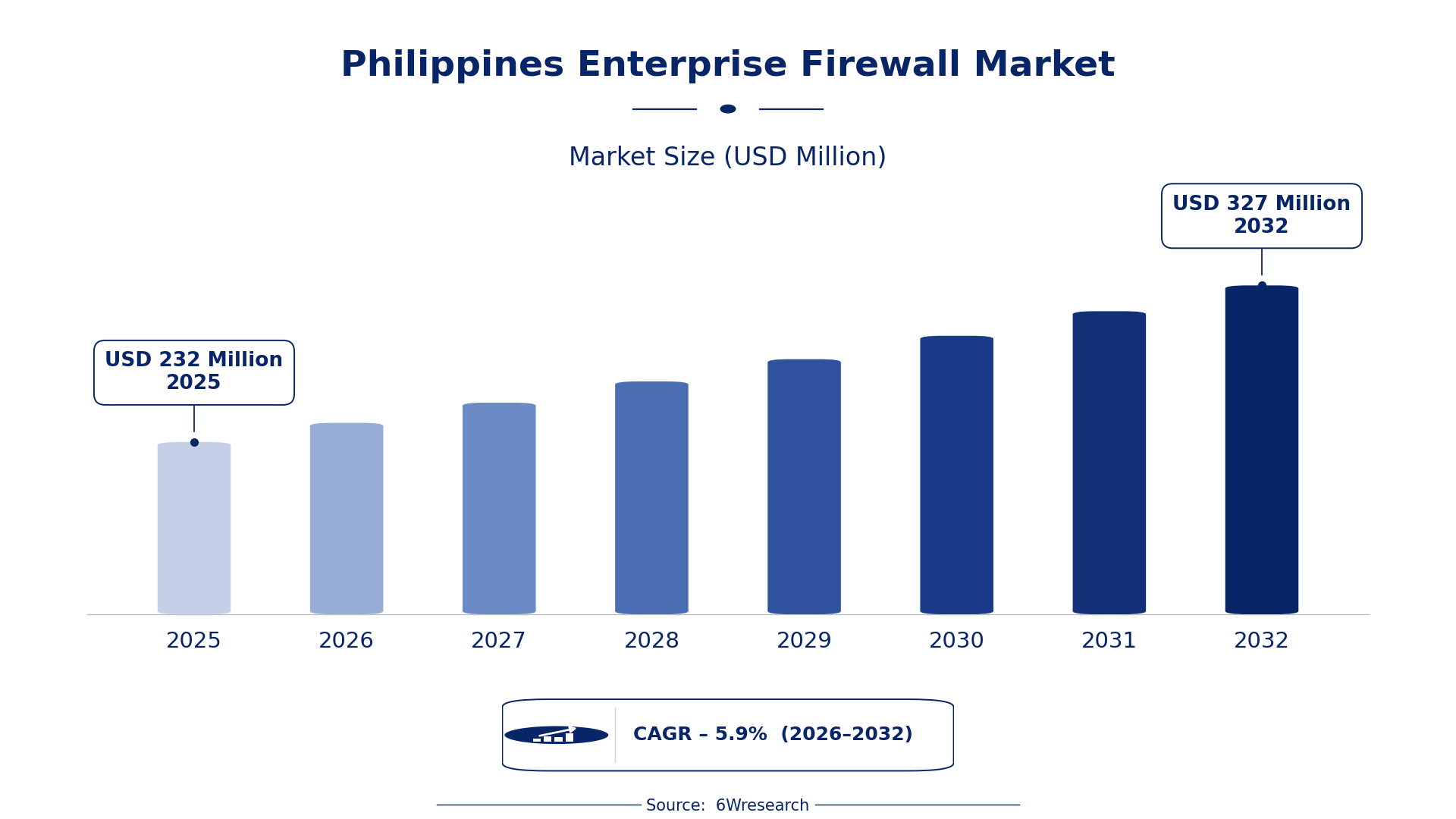
The Philippines Enterprise Firewall Market was estimated at USD 232 Million in 2025 and is projected to reach USD 327 Million by 2032, growing at a CAGR of 5.9% from 2026 to 2032.
Philippines Enterprise Firewall Market Synopsis
The escalating cybersecurity threats are the main driving force behind the Philippines Enterprise Firewall Market. As organizations increasingly turn to digital operations, the demand for advanced firewall solutions continues to surge.
Recent shifts towards remote work and cloud applications have amplified the need for robust network security. Enterprises recognize that investing in high-quality firewall solutions is no longer optional, but essential for protecting sensitive data.
Philippines Enterprise Firewall Market Year-wise Growth Rate and Key Drivers
This graph illustrates the annual growth rates of the Philippines Enterprise Firewall Market from 2021 to 2032, highlighting a steady upward trajectory and projected expansion over the forecast period.
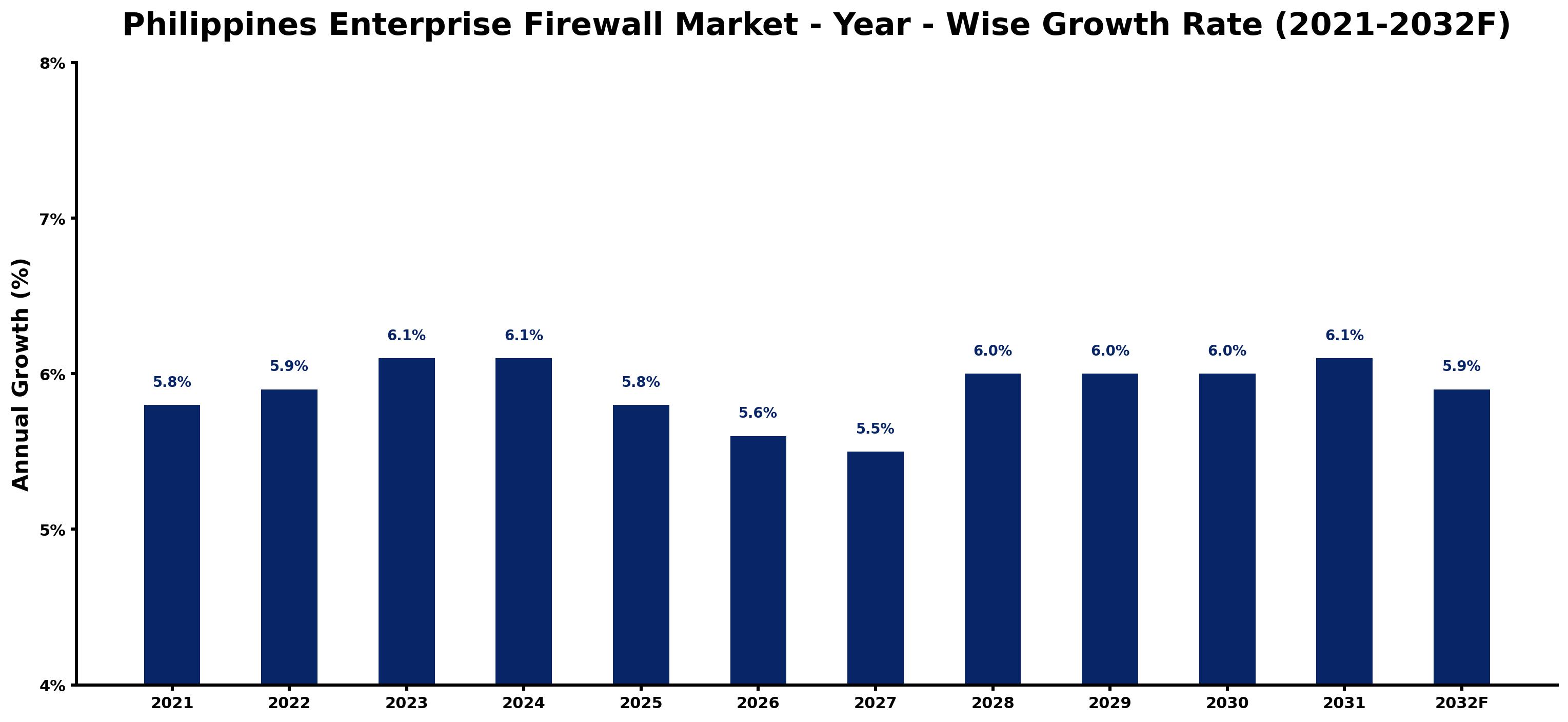
The table below presents the year‑wise growth rates along with the key drivers influencing the market
| Year | Growth Rate | Major Drivers |
| 2021 | 5.8% | Cybersecurity push by DICT for digital transformation |
| 2022 | 5.9% | Increased cyber threats driving enterprise security investments |
| 2023 | 6.1% | Adoption of remote work necessitating enhanced firewall solutions |
| 2024 | 6.1% | Strengthening data privacy laws under the DPA |
| 2025 | 5.8% | Growth in SMEs emphasizing cybersecurity compliance |
| 2026 | 5.6% | Government initiatives promoting digital security awareness |
| 2027 | 5.5% | Rise in e-commerce fueling firewall demand |
| 2028 | 6.0% | Cloud service adoption increasing firewall deployment needs |
| 2029 | 6.0% | Surge in mobile banking boosting cybersecurity measures |
| 2030 | 6.0% | Regulatory requirements for data protection creating demand |
| 2031 | 6.1% | Launch of 5G enhancing network security concerns |
| 2032 | 5.9% | Growing digital ecosystem requiring robust firewall solutions |
Note: Market size estimations and growth projections presented in this report are based on 6Wresearch's proprietary forecasting methodology, utilizing the latest available industry data, government publications, and primary research inputs.
Philippines Enterprise Firewall Market Key Takeaways
Below are some of the specific key takeaways from the market, including:
- Strong growth driven by increasing cybersecurity threats and digital transformation.
- Next-generation firewalls are in demand due to the sophistication of modern cyberattacks.
- The COVID-19 pandemic accelerated investment in firewall technologies as remote work became the norm.
- Local providers are carving out a niche amid competition from major international players.
- Organizations must prioritize security to comply with emerging regulatory frameworks.
Evaluation of Restraints in Philippines Enterprise Firewall Market
The Philippines Enterprise Firewall Market faces several challenges that could hinder its growth. A primary concern is the increasing sophistication of cyber threats, which traditional firewalls struggle to combat. Organizations may be hesitant to invest in next-generation solutions, given budget constraints and the complexity of integrating new technologies with existing infrastructure. Additionally, the shortage of skilled cybersecurity professionals complicates implementation and maintenance, leaving many enterprises vulnerable.
Philippines Enterprise Firewall Market Trends
Several trends are shaping the Philippines Enterprise Firewall Market, significantly influencing demand. The rapid migration to cloud-based services necessitates advanced security solutions that can effectively monitor and protect data traffic across multiple environments. Increased regulatory scrutiny around data privacy is also pushing enterprises to enhance their security measures, including adopting firewalls with comprehensive features like intrusion prevention and advanced threat detection.
on top of that, the rise of automation and artificial intelligence in cybersecurity is revolutionizing firewall capabilities, allowing for smarter, more adaptive systems that can respond in real-time to threats. As organizations become more aware of these advancements, the pressure to upgrade existing systems intensifies.
Philippines Enterprise Firewall Market Opportunities
There are promising growth opportunities within the Philippines Enterprise Firewall Market. With the government pushing for digital transformation initiatives, companies can expect more public sector contracts for network security solutions. The demand for customized firewall solutions tailored to specific industry needs presents a lucrative avenue for providers. on top of that, businesses looking to comply with data protection regulations will continue to drive the need for advanced firewall technologies. Investments in training programs to upskill cybersecurity professionals also present a chance to address talent shortages while fostering innovation in this space.
Government Initiatives in the Philippines Enterprise Firewall Market
Government policies are increasingly shaping the dynamics of the Philippines Enterprise Firewall Market. The regulatory environment is focused on enhancing cybersecurity protocols across all sectors, making compliance a priority for enterprises. Recent initiatives show a clear intention to bolster digital infrastructure, which inherently includes stricter standards for network security.
- A regulatory framework introduced in 2025 mandating enhanced data protection measures for businesses.
- A national digital infrastructure upgrade programme now in its rollout phase, emphasizing cybersecurity enhancements.
- Ongoing public-private partnerships aimed at providing resources and training for cybersecurity professionals.
- Plans for a national cybersecurity awareness campaign set to launch in 2026 to educate organizations on best practices.
- A recent government initiative focusing on small and medium-sized enterprises (SMEs) to facilitate access to advanced firewall technologies.
Future Insights of the Philippines Enterprise Firewall Market
Looking ahead to the period between 2026 and 2032, the Philippines Enterprise Firewall Market is expected to continue its growth trajectory. Organizations will increasingly seek to adopt innovative firewall solutions to enhance their security posture. The persistent threat of cyberattacks, coupled with rising compliance demands, will reinforce the importance of investing in advanced technologies. Companies that prioritize cybersecurity will not only protect their assets but will also gain a competitive edge in an increasingly digital economy.
Philippines Enterprise Firewall Market Latest Developments
The last year has witnessed significant developments in the Philippines Enterprise Firewall Market. Organizations are realizing the urgent need for upgraded firewall solutions to address escalating cyber threats. As a result, investment in advanced technologies has accelerated, with several companies actively seeking partnerships to enhance their cybersecurity posture.
- A major technology vendor launched a new AI-powered firewall solution in Q2 2025, aiming to provide better threat detection and response capabilities.
- An initiative to expand cybersecurity training programs for professionals in the sector began in early 2025 and remains ongoing.
- A local provider secured a significant contract with a government agency to implement advanced firewall systems by late 2025.
- A planned rollout of a cloud-based firewall service is expected to begin in Q3 2026, targeting SMEs looking for scalable solutions.
- A collaboration between leading enterprises and the government to develop cybersecurity standards is currently underway and anticipated to conclude by mid-2026.
Philippines Enterprise Firewall Market - Key Attractiveness of the Report
- 10 Years of Market Numbers
- Historical Data Starting from 2022 to 2025
- Base Year: 2025
- Forecast Data until 2032
- Key Performance Indicators Impacting the Market
- Major Upcoming Developments and Projects
Key Highlights of the Report:
- Philippines Enterprise Firewall Market Outlook
- Market Size of Philippines Enterprise Firewall Market, 2025
- Forecast of Philippines Enterprise Firewall Market, 2032
- Historical Data and Forecast of Philippines Enterprise Firewall Revenues & Volume for the Period 2022-2032F
- Philippines Enterprise Firewall Market Trend Evolution
- Philippines Enterprise Firewall Market Drivers and Challenges
- Philippines Enterprise Firewall Price Trends
- Philippines Enterprise Firewall Porter's Five Forces
- Philippines Enterprise Firewall Industry Life Cycle
- Historical Data and Forecast of Philippines Enterprise Firewall Market Revenues & Volume By Types for the Period 2022-2032F
- Historical Data and Forecast of Philippines Enterprise Firewall Market Revenues & Volume By Next Generation for the Period 2022-2032F
- Historical Data and Forecast of Philippines Enterprise Firewall Market Revenues & Volume By Application for the Period 2022-2032F
- Historical Data and Forecast of Philippines Enterprise Firewall Market Revenues & Volume By Conventional for the Period 2022-2032F
- Historical Data and Forecast of Philippines Enterprise Firewall Market Revenues & Volume By Industry vertical for the Period 2022-2032F
- Historical Data and Forecast of Philippines Enterprise Firewall Market Revenues & Volume By Government & Public Utilities for the Period 2022-2032F
- Historical Data and Forecast of Philippines Enterprise Firewall Market Revenues & Volume By Healthcare for the Period 2022-2032F
- Historical Data and Forecast of Philippines Enterprise Firewall Market Revenues & Volume By Telecommunication for the Period 2022-2032F
- Historical Data and Forecast of Philippines Enterprise Firewall Market Revenues & Volume By Education for the Period 2022-2032F
- Historical Data and Forecast of Philippines Enterprise Firewall Market Revenues & Volume By Retail for the Period 2022-2032F
- Historical Data and Forecast of Philippines Enterprise Firewall Market Revenues & Volume By Entertainment & Media for the Period 2022-2032F
- Historical Data and Forecast of Philippines Enterprise Firewall Market Revenues & Volume By Manufacturing for the Period 2022-2032F
- Historical Data and Forecast of Philippines Enterprise Firewall Market Revenues & Volume By Education for the Period 2022-2032F
- Historical Data and Forecast of Philippines Enterprise Firewall Market Revenues & Volume By Organization Size for the Period 2022-2032F
- Historical Data and Forecast of Philippines Enterprise Firewall Market Revenues & Volume By Small and Medium Sized Enterprises (SMBs) for the Period 2022-2032F
- Historical Data and Forecast of Philippines Enterprise Firewall Market Revenues & Volume By Large Enterprises for the Period 2022-2032F
- Philippines Enterprise Firewall Import Export Trade Statistics
- Market Opportunity Assessment By Types
- Market Opportunity Assessment By Industry vertical
- Market Opportunity Assessment By Organization Size
- Philippines Enterprise Firewall Top Companies Market Share
- Philippines Enterprise Firewall Competitive Benchmarking By Technical and Operational Parameters
- Philippines Enterprise Firewall Company Profiles
- Philippines Enterprise Firewall Key Strategic Recommendations






































