Philippines Estradiol Market Size, Share & Growth Rate
The Philippines Estradiol Market was estimated at USD 461 Million in 2025 and is projected to reach USD 607 Million by 2032, growing at a CAGR of 4.0% from 2026 to 2032. This growth is primarily fueled by an increasing prevalence of menopause-related conditions and a broader awareness of women's health issues. Additionally, advancements in healthcare and a growing aging population are bolstering the demand for effective hormone replacement therapies, solidifying estradiol's role in therapeutic practices.
Philippines Estradiol Market Year-wise Growth Rate and Key Drivers
This graph highlights how the Philippines Estradiol Market has steadily grown over the years, supported by major growth factors.
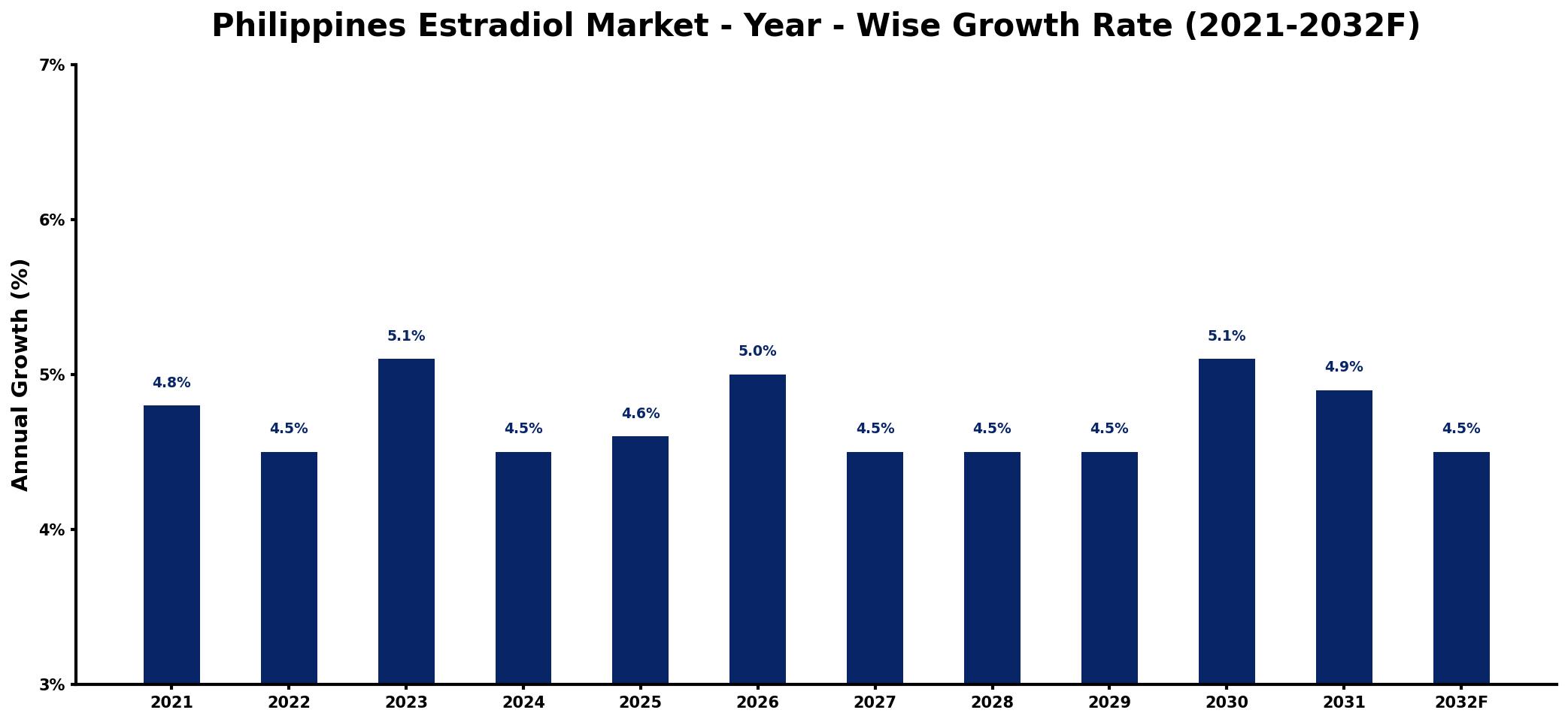
The table below presents the year‑wise growth rates along with the key drivers influencing the market
| Year | Growth Rate | Major Drivers |
| 2021 | 4.8% | Rising healthcare investments and funding |
| 2022 | 4.5% | Increased awareness of hormonal therapies |
| 2023 | 5.1% | Growing prevalence of menopause treatments |
| 2024 | 4.5% | Expansion of healthcare facilities nationwide |
| 2025 | 4.6% | expanding healthcare application demand |
| 2026 | 5.0% | Development of advanced pharmaceutical technologies |
| 2027 | 4.5% | Strengthening partnerships with healthcare providers |
| 2028 | 4.5% | Surge in health insurance coverage |
| 2029 | 4.5% | Growing demand for personalized medicine |
| 2030 | 5.1% | Emergence of telehealth services |
| 2031 | 4.9% | Rising public health initiatives focus |
| 2032 | 4.5% | Increased collaboration with research institutions |
Note: Market size estimations and growth projections presented in this report are based on 6Wresearch's proprietary forecasting methodology, utilizing the latest available industry data, government publications, and primary research inputs.
Philippines Estradiol Market Synopsis
The strongest force shaping the Philippines Estradiol Market today is the rising demand for hormone replacement therapies among the aging population. With women in the menopausal age bracket seeking relief from symptoms, estradiol has become integral in ensuring quality of life during this transitional phase.
Another significant factor is the ongoing research and advancements in pharmaceuticals that emphasize the importance of hormonal treatments. Regulatory measures are being enhanced to guarantee that estradiol products are both safe and efficacious, guiding healthcare providers in their prescribing practices.
Philippines Estradiol Market Key Takeaways
- The market is heavily influenced by the increasing awareness of womens health and the specific needs of menopausal women.
- Advancements in healthcare technology are contributing to improved treatment options and patient outcomes.
- Regulatory oversight ensures safety and effectiveness, directly impacting the growth trajectory of estradiol use.
- The aging population is creating a burgeoning demand for estradiol in hormone replacement therapies.
- Supply chain disruptions faced during the COVID-19 pandemic have since been addressed, leading to a recovering market environment.
Evaluation of Restraints in Philippines Estradiol Market
Despite the favorable growth outlook, several restraints are at play within the Philippines Estradiol Market. The complexities of safely prescribing hormonal medications remain a crucial challenge, as healthcare providers must navigate the intricate balance of benefits versus potential side effects. Issues of prescription accuracy, monitoring, and patient compliance are pivotal in ensuring safe usage. Regulatory authorities continue to grapple with establishing and enforcing guidelines that cater to the unique dynamics of hormonal therapies, adding another layer of complexity to the market landscape.
Philippines Estradiol Market Trends
Current trends in the Philippines Estradiol Market highlight a notable shift towards personalized medicine. Healthcare providers are increasingly focusing on individualized treatment plans that align with each patients unique hormonal needs. Additionally, there is a growing trend towards the use of transdermal patches and other innovative delivery systems, which offer convenience and potentially fewer side effects. The integration of telehealth services is also on the rise, facilitating better access to hormonal treatments for women across various demographics.
Philippines Estradiol Market Opportunities
Opportunities within the Philippines Estradiol Market lie in the expansion of educational initiatives aimed at raising awareness about menopause and related health issues. There is also potential for growth in the development of new estradiol formulations that provide improved efficacy and safety profiles. Collaborations between pharmaceutical companies and healthcare providers can enhance outreach and foster a supportive environment for women seeking hormone replacement therapies. Furthermore, investment in local manufacturing capabilities can help streamline supply chains and reduce costs.
Government Initiatives in the Philippines Estradiol Market
The Philippine government is increasingly recognizing the importance of women's health issues, leading to initiatives aimed at improving access to hormonal therapies. Public health campaigns focused on education about menopause and reproductive health are gaining traction, helping to demystify hormone replacement therapy. Regulatory bodies are actively reviewing and updating guidelines for the safe use of estradiol, ensuring that healthcare providers have the necessary framework to effectively support their patients.
Future Insights of the Philippines Estradiol Market
Looking ahead to 2026-2032, the Philippines Estradiol Market is poised for a period of robust growth. With an anticipated rise in the aging demographic, coupled with a sustained focus on womens health, demand for estradiol will likely continue to escalate. Innovations in treatment options and delivery systems will further enhance the market landscape, catering to evolving patient needs. The ongoing emphasis on regulatory compliance and safety will also play a crucial role in shaping future trends, ensuring that the estradiol market remains dynamic and responsive.
Philippines Estradiol Market Latest Developments (2025 - 2026)
The period from & to June 2026 has seen a notable shift in the Philippines Estradiol Market, with several pharmaceutical companies introducing advanced formulations designed for better patient adherence. Regulatory authorities have also intensified efforts to streamline approval processes for new estradiol products, encouraging innovation. Moreover, healthcare providers are increasingly adopting telehealth practices, ensuring more consistent monitoring and support for patients undergoing hormone replacement therapy.
Philippines Estradiol Market - Key Attractiveness of the Report
- 10 Years of Market Numbers
- Historical Data Starting from 2022 to 2025
- Base Year: 2025
- Forecast Data until 2032
- Key Performance Indicators Impacting the Market
- Major Upcoming Developments and Projects
Key Highlights of the Report:
- Philippines Estradiol Market Outlook
- Market Size of Philippines Estradiol Market, 2025
- Forecast of Philippines Estradiol Market, 2032
- Historical Data and Forecast of Philippines Estradiol Revenues & Volume for the Period 2022-2032F
- Philippines Estradiol Market Trend Evolution
- Philippines Estradiol Market Drivers and Challenges
- Philippines Estradiol Price Trends
- Philippines Estradiol Porter's Five Forces
- Philippines Estradiol Industry Life Cycle
- Historical Data and Forecast of Philippines Estradiol Market Revenues & Volume By Product Type for the Period 2022-2032F
- Historical Data and Forecast of Philippines Estradiol Market Revenues & Volume By a-Estradiol for the Period 2022-2032F
- Historical Data and Forecast of Philippines Estradiol Market Revenues & Volume By End-User for the Period 2022-2032F
- Historical Data and Forecast of Philippines Estradiol Market Revenues & Volume By Pharmaceutical for the Period 2022-2032F
- Historical Data and Forecast of Philippines Estradiol Market Revenues & Volume By Biological Research for the Period 2022-2032F
- Historical Data and Forecast of Philippines Estradiol Market Revenues & Volume By Others for the Period 2022-2032F
- Philippines Estradiol Import Export Trade Statistics
- Market Opportunity Assessment By Product Type
- Market Opportunity Assessment By End-User
- Philippines Estradiol Top Companies Market Share
- Philippines Estradiol Competitive Benchmarking By Technical and Operational Parameters
- Philippines Estradiol Company Profiles
- Philippines Estradiol Key Strategic Recommendations






































