Philippines Fashion Accessories Market Top 5 Importing Countries and Market Competition (HHI) Analysis
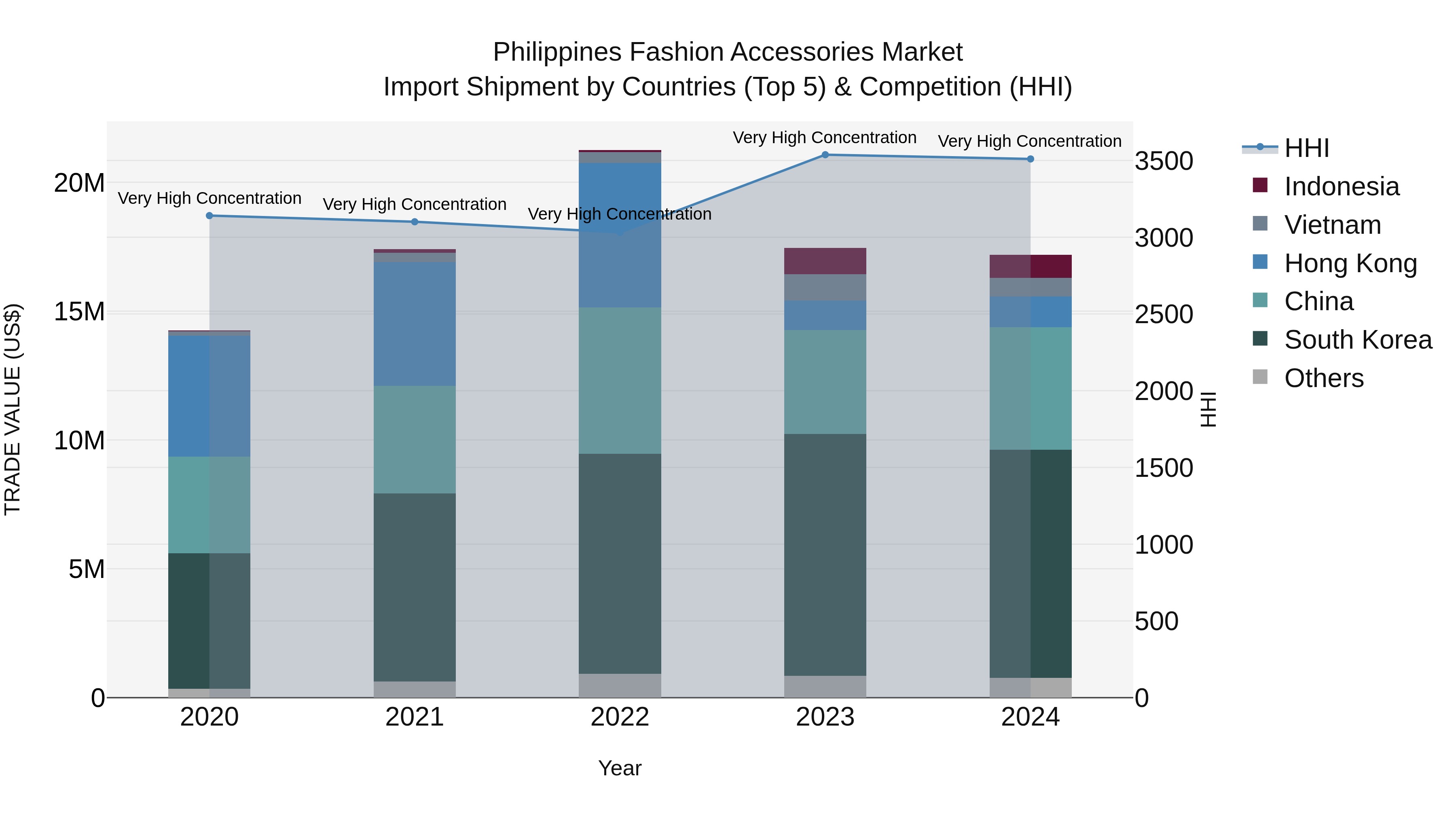
Philippines continues to be a key destination for fashion accessories imports, with South Korea, China, Hong Kong, Indonesia, and Vietnam leading the way in 2024. Despite a slight decline in growth rate from 2023 to 2024, the industry has maintained a steady Compound Annual Growth Rate (CAGR) of 4.81% over the period of 2020-2024. The High Herfindahl-Hirschman Index (HHI) indicates a high level of concentration among the top exporting countries, highlighting the competitive landscape in the market.
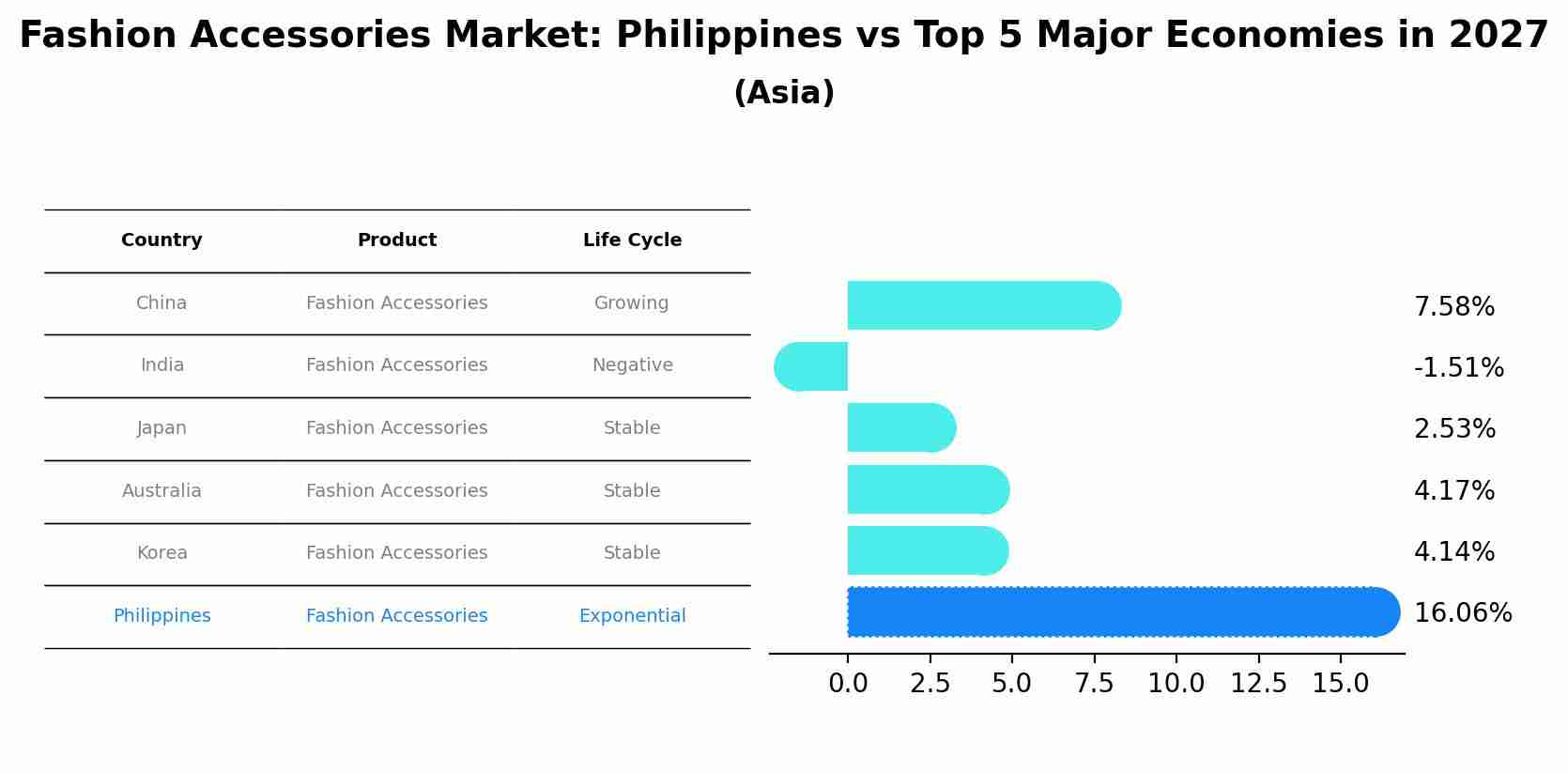
Fashion Accessories Market: Philippines vs Top 5 Major Economies in 2027 (Asia)
The Fashion Accessories market in Philippines is projected to grow at a exponential growth rate of 16.06% by 2027, within the Asia region led by China, along with other countries like India, Japan, Australia and South Korea, collectively shaping a dynamic and evolving market environment driven by innovation and increasing adoption of emerging technologies.
Philippines Fashion Accessories Market Growth Rate
According to 6Wresearch internal database and industry insights,the Philippines Fashion Accessories Market is projected to grow at a compound annual growth rate (CAGR) of 12.3% during the forecast period (2026–2032).
Topics Covered in the Philippines Fashion Accessories Market Report
Philippines Fashion Accessories Market report thoroughly covers the market by product type, distribution channel, and end user. The report provides a detailed analysis of ongoing market trends, opportunities, high-growth areas, and market drivers that will help stakeholders align strategies based on current and future market dynamics.
Philippines Fashion Accessories Market Highlights
| Report Name | Philippines Fashion Accessories Market |
| Forecast Period | 2026–2032 |
| CAGR | 12.3% |
| Growing Sector |
Footwear and Apparel |
Philippines Fashion Accessories Market Synopsis
The Philippines Fashion Accessories Market is projected to attain enormous expansion in the coming years on the back of demographic shift toward a younger, brand-conscious population. The popularity of online shopping platforms is rapidly increasing, especially for millennials and Gen Z consumers, driving the demand for both local and international fashion accessory brands. Besides, the modernization of retail hubs in Metro Manila and the emergence of luxury enclaves in secondary cities have created high-spend environments, making fashion accessories a favored choice for aspirational middle-class consumers.
Evaluation of Growth Drivers in Philippines Fashion Accessories Market
Below are some key drivers and their influence on the market dynamics:
| Drivers | Primary Segments Affected | Why It Matters |
| Increasing Disposable Income | By End User (Men, Women, Kids) | Increased purchasing power in urban areas enables consumers to indulge in fashion accessories to a major extent. |
| Evolution of Online Retail | By Distribution Channel (Online) | E-commerce platforms provide an opportune avenue for consumers to purchase fashion accessories at any time. |
| Social Media Influence | By Product Type (Watches, Handbags, Footwear) | Increasing influencer marketing promotes fashion accessories through Instagram, YouTube, and other platforms. |
| Massive Urbanization | By End User (Women, Unisex) | As more people move to cities, there is a nascent market for fashion accessories in metropolitan areas. |
| Brand Consciousness Among Individuals | By Product Type (Apparel, Wallets, Shoes) | Increasing consumer awareness and demand for international and luxury brands is shaping the market. |
Philippines Fashion Accessories Market is expected to gain traction, reaching a CAGR of approximately 12.3% during the forecast period (2026-2032). Growth is underpinned by changing consumer preferences, rise in purchasing power, and massive digital transformation across retail channels. Apart from this, the expansion of e-commerce platforms and the explosion of social media-driven fashion trends have led consumers to access diverse accessory choices which ranges from casual everyday wear to premium and luxury segments. In urban centers such as Metro Manila, Cebu, and Davao, increasing fashion consciousness among youth and working professionals has stimulated demand for a wide range of accessories such as footwear, handbags, watches, wallets, and tech-infused wearables.
Evaluation of Restraints in Philippines Fashion Accessories Market
Below are some major restraints and their influence on the market dynamics:
| Restraints | Primary Segments Affected | What This Means |
| Regulatory Barriers | By End User (Retail) | Local regulations and tariffs on imported goods can curb the availability and affordability of foreign brands. |
| Presence of Counterfeit Products | By Product Type (Handbags, Watches) | The growing incidence of counterfeit products may impact the reputation of the brand. |
| Increased Cost of Imported Brands | By Product Type (Footwear, Watches) | Imported brands have premium pricing, and their products may not be affordable to many. |
| Supply Chain Disturbances | By End User (Kids, Women) | The disturbances in the supply chain may be due to the problems faced in the import market. |
| Limited Standardization | By Format (Retailers) | Inappropriate uniform standards across retailers affects quality control and consumer confidence. |
Philippines Fashion Accessories Market Challenges
The Philippines Fashion Accessories Market growth is expected to continue its upward momentum during the forecast period. However, the issue of counterfeit products remains a significant challenge as the market is experiencing record-breaking seizures of counterfeit products bearing the brand. In addition, the issue of regulations regarding the acquisition of LGU permits for the expansion of the retail operations may cause delays. Also, there is a lack of standardized logistics infrastructure in remote island provinces, which makes maintaining a consistent omnichannel experience difficult for emerging digital-first brands.
Philippines Fashion Accessories Market Trends
The following key developments are actively transforming the market dynamics for accessories in the Philippines.
- Rising Trend of Sustainable Fashion Accessories: With surging eco-consciousness among consumers, the demand for sustainable and ethically made accessories are proliferating to a certain extent. Brands are now offering products made from recycled materials, promoting environmental awareness.
- Customization & Personalization into Accessories: Personalized fashion accessories such as engraved jewelry and custom-designed footwear are becoming increasingly popular.
- Tech-Driven Accessories: The rise of smartwatches, fitness bands, and Bluetooth-enabled accessories is shaping consumer preferences in wearable accessories.
Investment Opportunities in the Philippines Fashion Accessories Market
Below is an evaluation of the most lucrative investment prospects in the Philippines Fashion Accessories Market:
- Development into Emerging Cities: As Metro Manila reaches saturation, there is potential for expansion in Tier-2 cities such as Cebu, Davao, and Iloilo.
- Luxury & Designer Brands: Upsurging demand for premium and luxury accessories, particularly among young professionals offers opportunities for international brands to enter the booming Philippines Fashion Accessories Industry.
- Advent of E-commerce Platforms: Increasing online shopping in the Philippines provides opportunities for brands to tap into the bourgeoning online fashion accessory market.
Top 5 Leading Players in the Philippines Fashion Accessories Market
Below is a list of prominent companies leading the Philippines Fashion Accessories Market:
1. Penshoppe (Golden ABC, Inc.)
| Company Name | Penshoppe (Golden ABC, Inc.) |
|---|---|
| Established Year | 1986 |
| Headquarters | Quezon City, Philippines |
| Official Website | Click Here |
Penshoppe is a casual fashion brand from the Philippines offering clothing and accessories including shirts, trousers, shoes, bags, caps, wallets, and other lifestyle accessories. It began in Cebu and expanded nationwide with over hundreds of stores. Known for youth centric and trendy styles, it also operates internationally across Southeast Asia and the Middle East.
2. Bench (Suyen Corporation)
| Company Name | Bench (Suyen Corporation) |
|---|---|
| Established Year | 1987 |
| Headquarters | Taguig City (Bench Tower), Metro Manila, Philippines |
| Official Website | Click Here |
Bench is one of the Philippines’ most iconic lifestyle and fashion brands, originally starting as a small T shirt shop and growing into a full retail brand offering apparel, footwear, accessories, fragrances, and more. Under Suyen Corporation led by founder Ben Chan, the brand has expanded to international markets and diversified its product range.
3. H&M (Hennes & Mauritz AB)
| Company Name | H&M (Hennes & Mauritz AB) |
|---|---|
| Established Year | 1947 |
| Headquarters | Stockholm, Sweden |
| Official Website | Click Here |
H&M is a global fast fashion retailer offering a wide range of clothing and accessories for men, women, teens, and children. It is known for fashion and quality at competitive prices, with a growing presence across the Philippines, promoting both trend focused products and sustainability initiatives.
4. Zara (Inditex)
| Company Name | Zara (Inditex) |
|---|---|
| Established Year | 1975 |
| Headquarters | Spain |
| Official Website | Click Here |
Zara is a leading global fashion retailer under the Inditex group, offering apparel, accessories, and footwear. It is renowned for its fast fashion model, rapid design cycles, and trend responsive collections. In the Philippines, Zara has established stores in major shopping malls and supports online shopping options tailored for local consumers.
Government Regulations in the Philippines Fashion Accessories Market
The Philippine government provides support to the fashion accessories sector through various programs, and these programs are contributing to the growth of the business and the inflow of foreign investments. Some of the programs implemented by the Philippine government to support the fashion accessories business include:
- Philippine Development Plan (PDP): This plan by the Philippine government provides support to the fashion accessories business by focusing on the development of a competitive manufacturing sector, enhancing local production of fashion accessories, and refining the country’s retail infrastructure.
- National Retail Trade Liberalization Act (RLTLA): This program by the Philippine government provides support to the fashion accessories business by encouraging foreign investments, especially foreign fashion accessory brands, by rationalizing the regulations on foreign ownership of retail enterprises
Future Insights of the Philippines Fashion Accessories Market
In the upcoming years, the future of the Philippines fashion accessories industry is expected to transform on account of changing preferences of individuals toward clothing and accessories, the widespread adoption of e-commerce, and advancements in technology integration for fashion accessories (augmented reality (AR) "virtual try-ons). Apart from this, rapid urbanization and expansion of middle-income consumers have further propelled the demand for premium and designer accessories.
Market Segmentation Analysis
The report offers a comprehensive study of the following market segments and their leading categories:
By Product Type – Footwear to Lead the Market
The footwear segment is anticipated to dominate the Philippines Fashion Accessories Market share, with increasing consumer preference for branded shoes, sandals, and boots across all age groups. High-income consumers, especially in urban areas, are shifting towards premium and designer footwear brands, contributing to the growth of this segment.
By End User – Women to Lead the Market
According to Mohit, Senior Research Analyst, 6Wresearch, Women are expected to drive the demand in the Philippines Fashion Accessories Market due to their higher purchasing power and fashion-conscious attitudes. Women’s fashion accessories, particularly handbags, jewelry, and watches, will continue to be a primary category driving market growth.
Key Attractiveness of the Report
- 10 Years of Market Numbers
- Historical Data Starting from 2022 to 2025
- Base Year: 2025
- Forecast Data until 2032
- Key Performance Indicators Impacting the Market
- Major Upcoming Developments and Projects
Key Highlights of the Report:
- Philippines Fashion Accessories Market Outlook
- Market Size of Philippines Fashion Accessories Market, 2025
- Forecast of Philippines Fashion Accessories Market, 2032
- Historical Data and Forecast of Philippines Fashion Accessories Revenues & Volume for the Period 2022-2032
- Philippines Fashion Accessories Market Trend Evolution
- Philippines Fashion Accessories Market Drivers and Challenges
- Philippines Fashion Accessories Price Trends
- Philippines Fashion Accessories Porter's Five Forces
- Philippines Fashion Accessories Industry Life Cycle
- Historical Data and Forecast of Philippines Fashion Accessories Market Revenues & Volume By Product Type for the Period 2022-2032
- Historical Data and Forecast of Philippines Fashion Accessories Market Revenues & Volume By Footwear for the Period 2022-2032
- Historical Data and Forecast of Philippines Fashion Accessories Market Revenues & Volume By Apparel for the Period 2022-2032
- Historical Data and Forecast of Philippines Fashion Accessories Market Revenues & Volume By Wallets for the Period 2022-2032
- Historical Data and Forecast of Philippines Fashion Accessories Market Revenues & Volume By Handbags for the Period 2022-2032
- Historical Data and Forecast of Philippines Fashion Accessories Market Revenues & Volume By Watches for the Period 2022-2032
- Historical Data and Forecast of Philippines Fashion Accessories Market Revenues & Volume By Other for the Period 2022-2032
- Historical Data and Forecast of Philippines Fashion Accessories Market Revenues & Volume By End-User for the Period 2022-2032
- Historical Data and Forecast of Philippines Fashion Accessories Market Revenues & Volume By Men for the Period 2022-2032
- Historical Data and Forecast of Philippines Fashion Accessories Market Revenues & Volume By Women for the Period 2022-2032
- Historical Data and Forecast of Philippines Fashion Accessories Market Revenues & Volume By Kids/Children for the Period 2022-2032
- Historical Data and Forecast of Philippines Fashion Accessories Market Revenues & Volume By Unisex for the Period 2022-2032
- Historical Data and Forecast of Philippines Fashion Accessories Market Revenues & Volume By Distribution Channel for the Period 2022-2032
- Historical Data and Forecast of Philippines Fashion Accessories Market Revenues & Volume By Offline channel for the Period 2022-2032
- Historical Data and Forecast of Philippines Fashion Accessories Market Revenues & Volume By Online channel for the Period 2022-2032
- Philippines Fashion Accessories Import Export Trade Statistics
- Market Opportunity Assessment By Product Type
- Market Opportunity Assessment By End-User
- Market Opportunity Assessment By Distribution Channel
- Philippines Fashion Accessories Top Companies Market Share
- Philippines Fashion Accessories Competitive Benchmarking By Technical and Operational Parameters
- Philippines Fashion Accessories Company Profiles
- Philippines Fashion Accessories Key Strategic Recommendations
Market Covered
The report offers a comprehensive study of the following market segments:
By Product Type
- Footwear
- Apparel (Belts, Scarves, etc.)
- Wallets
- Handbags
- Watches
- Others
By End-User
- Men
- Women
- Kids/Children
- Unisex
By Distribution Channel
- Offline Channel
- Online Channel






































