Philippines Film Dubbing Market Size, Share & Growth Rate
The Philippines Film Dubbing Market was estimated at USD 1409 Million in 2025 and is projected to reach USD 2060 Million by 2032, growing at a CAGR of 5.6% from 2026 to 2032. This robust growth trajectory is driven by an expanding local film and entertainment industry, alongside an increasing demand for localized content from video streaming platforms. The rising preference among the Philippine population for audio content in their native languages further supports this upward trend, creating a strong market environment.
Philippines Film Dubbing Market Year-wise Growth Rate and Key Drivers
This graph highlights how the Philippines Film Dubbing Market has steadily grown over the years, supported by major growth factors.
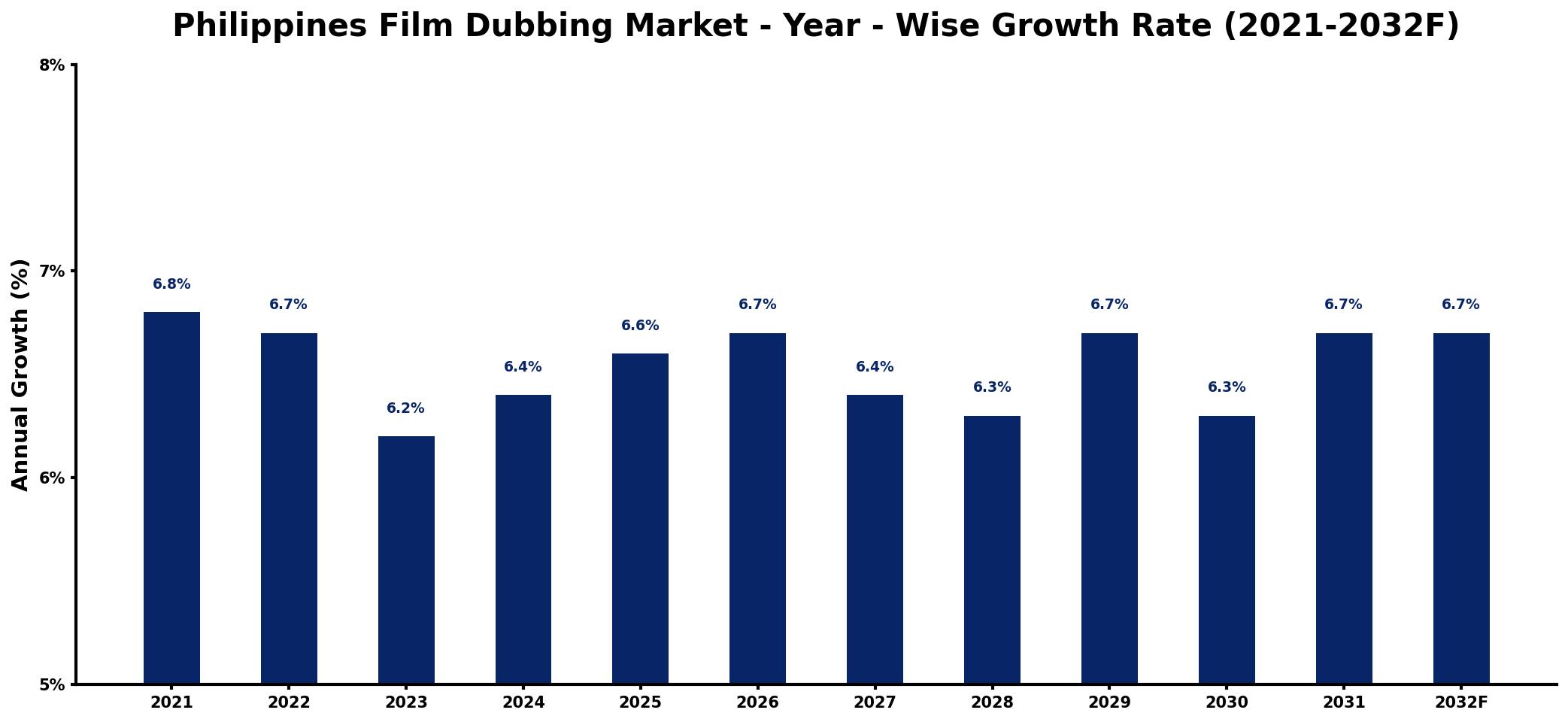
The table below presents the year‑wise growth rates along with the key drivers influencing the market
| Year | Growth Rate | Major Drivers |
| 2021 | 6.8% | Rising demand for localized content |
| 2022 | 6.7% | Increased investment in media production |
| 2023 | 6.2% | Growing popularity of streaming platforms |
| 2024 | 6.4% | Expansion of entertainment distribution channels |
| 2025 | 6.6% | Higher consumer spending on entertainment |
| 2026 | 6.7% | Emergence of new content creators |
| 2027 | 6.4% | Strengthening partnerships with global studios |
| 2028 | 6.3% | Advancements in voice technology applications |
| 2029 | 6.7% | Demand for multilingual content solutions |
| 2030 | 6.3% | Increased collaboration with regional artists |
| 2031 | 6.7% | Growth in audience engagement metrics |
| 2032 | 6.7% | Rising interest in cultural storytelling |
Note: Market size estimations and growth projections presented in this report are based on 6Wresearch's proprietary forecasting methodology, utilizing the latest available industry data, government publications, and primary research inputs.
Philippines Film Dubbing Market Synopsis
The Philippines film dubbing market has recently experienced notable momentum, fueled by a combination of local film production and international collaborations. As the demand for high-quality dubbing services escalates, particularly for films and television programs, the market is poised for a promising future. With the influence of streaming platforms and an increasing appetite for localized content, the growth potential appears significant.
Despite the current upward trajectory, the market's future will hinge on overcoming specific challenges, particularly concerning cultural authenticity in dubbing practices. The ability to balance the art of dubbing with the intricacies of language and culture will be crucial as the sector moves forward, seeking to enhance the viewing experience for diverse audiences.
Philippines Film Dubbing Market Key Takeaways
- The market is fueled by an expanding local film industry and increased international collaborations.
- Growing demand for streaming services is driving the need for high-quality dubbing in local languages.
- Investment in marketing campaigns for film releases is creating favorable conditions for industry growth.
- The market faces challenges related to cultural authenticity and the shortage of skilled dubbing professionals.
- Adaptation to post-pandemic production norms is essential for the markets recovery and future growth.
Evaluation of Restraints in Philippines Film Dubbing Market
While the Philippines film dubbing market is on a growth trajectory, several restraints present challenges that could affect its overall development. One significant concern lies in maintaining linguistic and cultural authenticity when localizing foreign content, which can impact audience reception and satisfaction. Additionally, the industry faces a shortage of skilled dubbing professionals capable of delivering the high-quality standards increasingly demanded by clients. Tight production schedules, compounded by the effects of the COVID-19 pandemic, also hinder the timely execution of dubbing projects, limiting the market's potential for expansion.
Philippines Film Dubbing Market Trends
Key trends shaping the Philippines film dubbing market include the increasing integration of advanced technology in dubbing processes. Innovations such as artificial intelligence and machine learning are being explored to streamline workflows and enhance audio quality. Furthermore, the demand for original content on streaming platforms is prompting studios to invest in high-caliber dubbing services that reflect local nuances, fostering a deeper connection with viewers. The rise of regional films and collaborations is also becoming prevalent, amplifying the need for localized dubbing to cater to diverse demographics across the archipelago.
Philippines Film Dubbing Market Opportunities
Significant growth and investment opportunities lie within the Philippines film dubbing market, driven by rising consumer preferences for local language content. The flourishing video streaming sector presents a lucrative avenue for dubbing services, as companies seek to localize international films and series to capture a wider audience. Additionally, collaborations between local and international film producers can stimulate demand for professional dubbing services. Expanding marketing initiatives and promotional campaigns for new movie releases will also enhance visibility and generate revenue, creating further opportunities for stakeholders.
Government Initiatives in the Philippines Film Dubbing Market
The Philippine government has introduced several initiatives aimed at bolstering the local film industry, which indirectly supports the film dubbing market. Through public funding programs and incentives for film production, the government encourages the creation of diverse content that requires dubbing. Furthermore, initiatives aimed at promoting Filipino culture and language in media align with the industry's need for localized content. Such policies create a favorable ecosystem for dubbing services, reinforcing the market's potential for growth.
Future Insights of the Philippines Film Dubbing Market
Looking ahead to the years 2026-2032, the Philippines film dubbing market is expected to evolve significantly. As international content continues to flood local platforms, the demand for skilled dubbing will intensify, emphasizing quality and cultural relevancy. The incorporation of technology in dubbing processes will likely lead to enhanced efficiency and product quality. Furthermore, as the industry adapts to changing consumer preferences, particularly among younger audiences, the diversification of dubbing services will emerge as a key strategy for success. Overall, this market stands poised to thrive as it leverages its unique cultural position and growing demand for local content.
Philippines Film Dubbing Market Latest Developments (2025 - 2026)
In recent months, the Philippines film dubbing market has witnessed notable developments, reflecting an industry increasingly focused on enhancing content localization. Production companies are prioritizing the recruitment of skilled dubbing artists to meet heightened quality standards demanded by audiences. Additionally, collaborations between local and international studios have been gaining traction, leading to a surge in high-profile projects requiring sophisticated dubbing services. The adaptation to new production norms post-COVID-19 continues to reshape the workflow and project timelines, emphasizing flexibility in the dubbing process.
Philippines Film Dubbing Market - Key Attractiveness of the Report
- 10 Years of Market Numbers
- Historical Data Starting from 2022 to 2025
- Base Year: 2025
- Forecast Data until 2032
- Key Performance Indicators Impacting the Market
- Major Upcoming Developments and Projects
Key Highlights of the Report:
- Philippines Film Dubbing Market Outlook
- Market Size of Philippines Film Dubbing Market, 2025
- Forecast of Philippines Film Dubbing Market, 2032
- Historical Data and Forecast of Philippines Film Dubbing Revenues & Volume for the Period 2022-2032F
- Philippines Film Dubbing Market Trend Evolution
- Philippines Film Dubbing Market Drivers and Challenges
- Philippines Film Dubbing Price Trends
- Philippines Film Dubbing Porter's Five Forces
- Philippines Film Dubbing Industry Life Cycle
- Historical Data and Forecast of Philippines Film Dubbing Market Revenues & Volume By Type for the Period 2022-2032F
- Historical Data and Forecast of Philippines Film Dubbing Market Revenues & Volume By Native Language Dubbing for the Period 2022-2032F
- Historical Data and Forecast of Philippines Film Dubbing Market Revenues & Volume By Foreign Language Dubbing for the Period 2022-2032F
- Historical Data and Forecast of Philippines Film Dubbing Market Revenues & Volume By Minority Language Dubbing for the Period 2022-2032F
- Historical Data and Forecast of Philippines Film Dubbing Market Revenues & Volume By Special Language Dubbing for the Period 2022-2032F
- Historical Data and Forecast of Philippines Film Dubbing Market Revenues & Volume By Application for the Period 2022-2032F
- Historical Data and Forecast of Philippines Film Dubbing Market Revenues & Volume By Drama for the Period 2022-2032F
- Historical Data and Forecast of Philippines Film Dubbing Market Revenues & Volume By Comedy for the Period 2022-2032F
- Historical Data and Forecast of Philippines Film Dubbing Market Revenues & Volume By Horror Movie for the Period 2022-2032F
- Historical Data and Forecast of Philippines Film Dubbing Market Revenues & Volume By Romance for the Period 2022-2032F
- Historical Data and Forecast of Philippines Film Dubbing Market Revenues & Volume By Action Movie for the Period 2022-2032F
- Historical Data and Forecast of Philippines Film Dubbing Market Revenues & Volume By Other for the Period 2022-2032F
- Philippines Film Dubbing Import Export Trade Statistics
- Market Opportunity Assessment By Type
- Market Opportunity Assessment By Application
- Philippines Film Dubbing Top Companies Market Share
- Philippines Film Dubbing Competitive Benchmarking By Technical and Operational Parameters
- Philippines Film Dubbing Company Profiles
- Philippines Film Dubbing Key Strategic Recommendations






































