Philippines Firewall as a Service Market Size & Growth Rate (2026-2032)
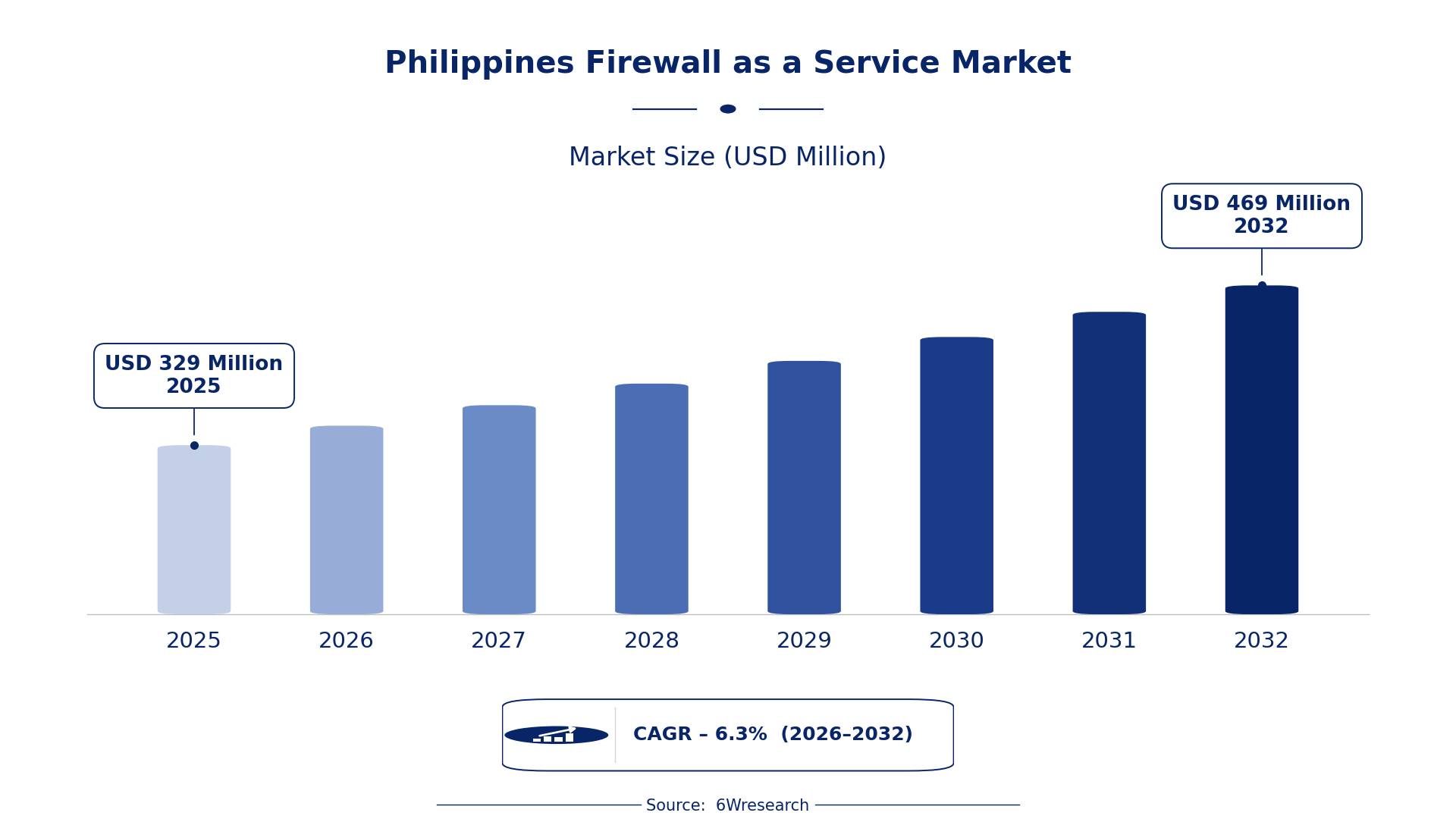
The Philippines Firewall as a Service Market was estimated at USD 329 Million in 2025 and is projected to reach USD 469 Million by 2032, growing at a CAGR of 6.3% from 2026 to 2032.
Philippines Firewall as a Service Market Synopsis
The demand for Firewall as a Service (FWaaS) in the Philippines is escalating rapidly as organizations recognize the necessity of protecting their networks from rising cyber threats. With a shift toward cloud-based solutions, companies are opting for scalable and efficient firewall services that can adapt to their changing security needs.
As remote work continues to be prevalent, the importance of robust cybersecurity measures has grown. Businesses are investing heavily in FWaaS to ensure their data remains secure and compliance with regulations is maintained, fueling market growth.
Philippines Firewall as a Service Market Year-wise Growth Rate and Key Drivers
This graph illustrates the annual growth rates of the Philippines Firewall as a Service Market from 2021 to 2032, highlighting a steady upward trajectory and projected expansion over the forecast period.
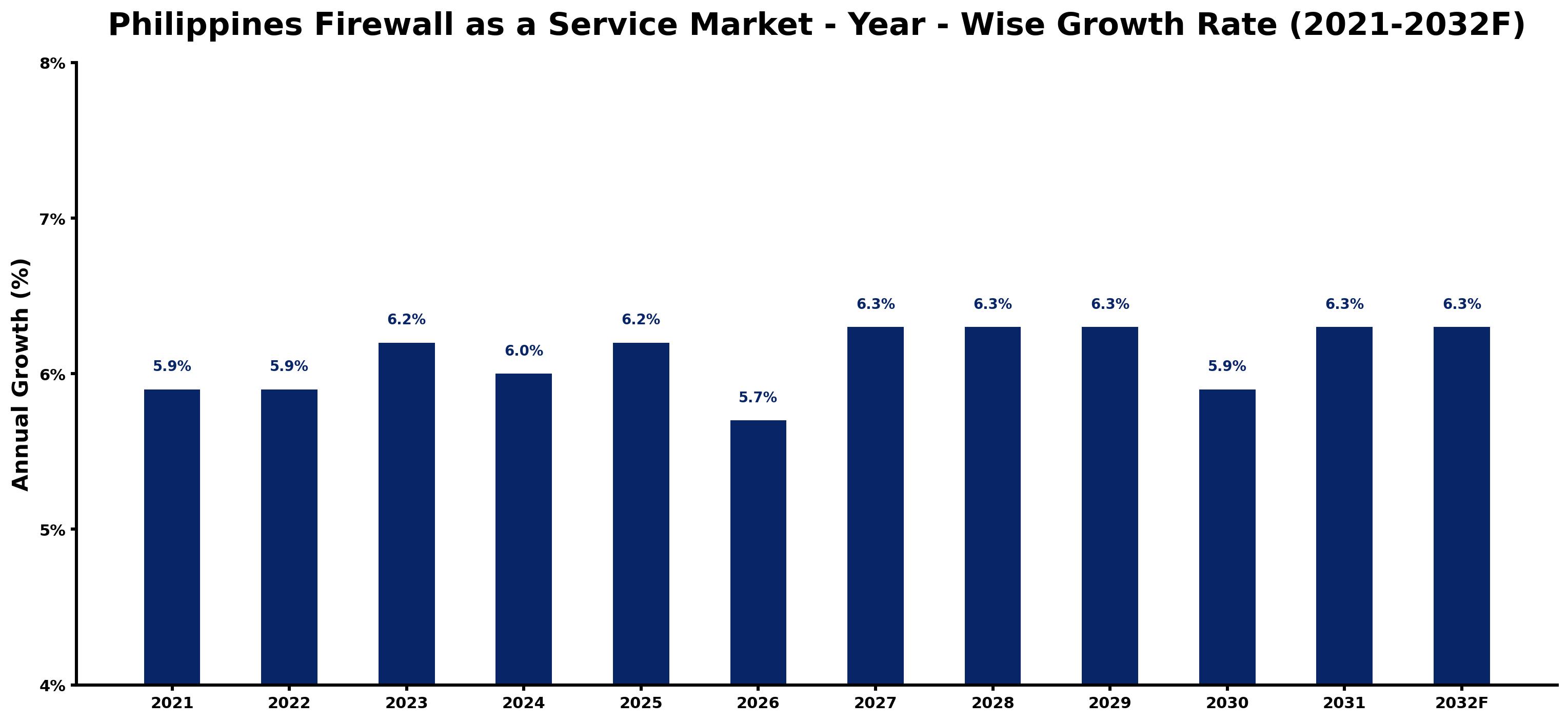
The table below presents the year‑wise growth rates along with the key drivers influencing the market
| Year | Growth Rate | Major Drivers |
| 2021 | 5.9% | Cybersecurity Act implementation boosting compliance investments. |
| 2022 | 5.9% | Increase in remote work heightening need for secure access. |
| 2023 | 6.2% | Emergence of e-commerce driving demand for online security. |
| 2024 | 6.0% | Government push for digital transformation enhancing cybersecurity needs. |
| 2025 | 6.2% | Rise in cyber threats prompting businesses to invest seriously. |
| 2026 | 5.7% | National Privacy Commission regulations enforcing stricter data protection. |
| 2027 | 6.3% | Booming fintech sector increasing requirement for robust firewalls. |
| 2028 | 6.3% | Growing awareness of cybersecurity risks among small businesses. |
| 2029 | 6.3% | Educational institutions adopting digital platforms requiring enhanced security. |
| 2030 | 5.9% | Policy incentives encouraging investments in cloud security solutions. |
| 2031 | 6.3% | Increased smartphone penetration correlating with higher cyber risk. |
| 2032 | 6.3% | Development of smart cities necessitating advanced firewall applications. |
Note: Market size estimations and growth projections presented in this report are based on 6Wresearch's proprietary forecasting methodology, utilizing the latest available industry data, government publications, and primary research inputs.
Philippines Firewall as a Service Market Key Takeaways
Below are some of the specific key takeaways from the market, including:
- The increasing sophistication of cyber threats necessitates advanced security solutions.
- Organizations are increasingly adopting cloud-based firewall services for their flexibility and scalability.
- Regulatory compliance is driving investment in Firewall as a Service offerings.
- Remote work trends have spurred demand for effective cybersecurity measures.
- The market is witnessing significant investments from businesses prioritizing cybersecurity.
Evaluation of Restraints in Philippines Firewall as a Service Market
Despite its growth potential, the Philippines Firewall as a Service market faces notable restraints. A primary concern is the fast-changing nature of cyber threats, which challenges service providers to continuously update their security measures. Additionally, the lack of skilled cybersecurity professionals poses a significant hurdle, as organizations struggle to implement and manage these sophisticated solutions effectively. Budget constraints in smaller enterprises further limit the adoption of comprehensive firewall services, creating a disparity in market readiness.
Philippines Firewall as a Service Market Trends
Several trends are shaping the Philippines Firewall as a Service market. The shift towards Zero Trust security models is gaining traction, with organizations adopting a more stringent approach to verifying access requests. Integration of artificial intelligence and machine learning into firewall services is enhancing threat detection and response capabilities. Additionally, as more organizations embrace hybrid cloud environments, the demand for adaptable and integrated firewall solutions is increasing, driving innovation within the sector.
Philippines Firewall as a Service Market Opportunities
The market presents several growth opportunities for stakeholders. As awareness of cybersecurity grows, businesses are seeking tailored FWaaS solutions that cater to specific industry needs. There’s also a notable opportunity for service providers to expand their offerings through partnerships and collaborations with technology vendors. The ongoing digital transformation initiatives in various sectors present a fertile ground for innovative firewall solutions that align with evolving compliance and regulatory requirements.
Government Initiatives in the Philippines Firewall as a Service Market
Government initiatives play a crucial role in shaping the Firewall as a Service market in the Philippines. The regulatory framework is becoming increasingly supportive of cybersecurity advancements, emphasizing the need for comprehensive protection against cyber threats. As the government pushes for digital transformation, public-sector priorities are aligning with the need for enhanced cybersecurity measures, which directly impacts the demand for FWaaS.
- A national cybersecurity strategy was launched in 2023, aiming to strengthen the country’s defenses against cyber threats.
- Currently, a public-private partnership initiative is underway to enhance cybersecurity infrastructure across government agencies.
- Upcoming regulations expected in 2025 will mandate stricter compliance for organizations regarding data protection and network security.
- The Department of Information and Communications Technology is conducting workshops to educate businesses on implementing effective cybersecurity measures.
- A digital infrastructure upgrade program initiated in 2024 focuses on improving connectivity and security measures nationwide.
Future Insights of the Philippines Firewall as a Service Market
Looking ahead, the Philippines Firewall as a Service market is set to expand significantly between 2026 and 2032. As cyber threats grow in complexity, organizations will increasingly seek out advanced firewall solutions that offer dynamic protection capabilities. The integration of cutting-edge technologies, such as AI-driven threat analysis, will redefine the service landscape. on top of that, as remote work becomes a permanent fixture, the demand for flexible and responsive security solutions will only intensify, positioning FWaaS as a critical component of organizational cybersecurity strategies.
Philippines Firewall as a Service Market Latest Developments
Recent developments within the Philippines Firewall as a Service market indicate a strong commitment to enhancing cybersecurity measures across various sectors. Companies are actively pursuing innovative solutions to address the growing threats posed by cybercriminals.
- A major technology vendor launched a new cloud-based firewall solution in Q2 2023, designed to provide enhanced threat protection for small to medium-sized enterprises.
- An ongoing initiative initiated in early 2023 aims to implement advanced firewall solutions for public sector organizations, enhancing their cybersecurity posture.
- A collaborative project between industry leaders is set to begin in late 2024, focusing on developing integrated security platforms for hybrid cloud environments.
- A service upgrade announced in mid-2023 includes the incorporation of AI capabilities to improve threat detection accuracy.
- By early 2025, a national campaign will be launched to promote awareness of cybersecurity best practices among local businesses.
Philippines Firewall as a Service Market - Key Attractiveness of the Report
- 10 Years of Market Numbers
- Historical Data Starting from 2022 to 2025
- Base Year: 2025
- Forecast Data until 2032
- Key Performance Indicators Impacting the Market
- Major Upcoming Developments and Projects
Key Highlights of the Report:
- Philippines Firewall as a Service Market Outlook
- Market Size of Philippines Firewall as a Service Market, 2025
- Forecast of Philippines Firewall as a Service Market, 2032
- Historical Data and Forecast of Philippines Firewall as a Service Revenues & Volume for the Period 2022-2032F
- Philippines Firewall as a Service Market Trend Evolution
- Philippines Firewall as a Service Market Drivers and Challenges
- Philippines Firewall as a Service Price Trends
- Philippines Firewall as a Service Porter's Five Forces
- Philippines Firewall as a Service Industry Life Cycle
- Historical Data and Forecast of Philippines Firewall as a Service Market Revenues & Volume By Service Type for the Period 2022-2032F
- Historical Data and Forecast of Philippines Firewall as a Service Market Revenues & Volume By Traffic monitoring and control for the Period 2022-2032F
- Historical Data and Forecast of Philippines Firewall as a Service Market Revenues & Volume By Compliance and audit management for the Period 2022-2032F
- Historical Data and Forecast of Philippines Firewall as a Service Market Revenues & Volume By Reporting and log management for the Period 2022-2032F
- Historical Data and Forecast of Philippines Firewall as a Service Market Revenues & Volume By Automation and orchestration for the Period 2022-2032F
- Historical Data and Forecast of Philippines Firewall as a Service Market Revenues & Volume By Security management for the Period 2022-2032F
- Historical Data and Forecast of Philippines Firewall as a Service Market Revenues & Volume By Managed services for the Period 2022-2032F
- Historical Data and Forecast of Philippines Firewall as a Service Market Revenues & Volume By Professional services for the Period 2022-2032F
- Historical Data and Forecast of Philippines Firewall as a Service Market Revenues & Volume By Organization Size for the Period 2022-2032F
- Historical Data and Forecast of Philippines Firewall as a Service Market Revenues & Volume By Large enterprises for the Period 2022-2032F
- Historical Data and Forecast of Philippines Firewall as a Service Market Revenues & Volume By Small and Medium-sized Enterprises (SMEs) for the Period 2022-2032F
- Historical Data and Forecast of Philippines Firewall as a Service Market Revenues & Volume By Service Model for the Period 2022-2032F
- Historical Data and Forecast of Philippines Firewall as a Service Market Revenues & Volume By Infrastructure-as-a-Service (IaaS) for the Period 2022-2032F
- Historical Data and Forecast of Philippines Firewall as a Service Market Revenues & Volume By Platform-as-a-Service (PaaS) for the Period 2022-2032F
- Historical Data and Forecast of Philippines Firewall as a Service Market Revenues & Volume By Software-as-a-Service (SaaS) for the Period 2022-2032F
- Historical Data and Forecast of Philippines Firewall as a Service Market Revenues & Volume By Deployment Model for the Period 2022-2032F
- Historical Data and Forecast of Philippines Firewall as a Service Market Revenues & Volume By Public cloud for the Period 2022-2032F
- Historical Data and Forecast of Philippines Firewall as a Service Market Revenues & Volume By Private cloud for the Period 2022-2032F
- Historical Data and Forecast of Philippines Firewall as a Service Market Revenues & Volume By Hybrid cloud for the Period 2022-2032F
- Historical Data and Forecast of Philippines Firewall as a Service Market Revenues & Volume By Vertical for the Period 2022-2032F
- Historical Data and Forecast of Philippines Firewall as a Service Market Revenues & Volume By Banking, Financial Services, and Insurance (BFSI) for the Period 2022-2032F
- Historical Data and Forecast of Philippines Firewall as a Service Market Revenues & Volume By Education for the Period 2022-2032F
- Historical Data and Forecast of Philippines Firewall as a Service Market Revenues & Volume By Energy and utilities for the Period 2022-2032F
- Historical Data and Forecast of Philippines Firewall as a Service Market Revenues & Volume By Government and public sector for the Period 2022-2032F
- Historical Data and Forecast of Philippines Firewall as a Service Market Revenues & Volume By Healthcare and life sciences for the Period 2022-2032F
- Historical Data and Forecast of Philippines Firewall as a Service Market Revenues & Volume By Manufacturing for the Period 2022-2032F
- Historical Data and Forecast of Philippines Firewall as a Service Market Revenues & Volume By Retail and eCommerce for the Period 2022-2032F
- Historical Data and Forecast of Philippines Firewall as a Service Market Revenues & Volume By Telecommunication, and IT and ITES for the Period 2022-2032F
- Philippines Firewall as a Service Import Export Trade Statistics
- Market Opportunity Assessment By Service Type
- Market Opportunity Assessment By Organization Size
- Market Opportunity Assessment By Service Model
- Market Opportunity Assessment By Deployment Model
- Market Opportunity Assessment By Vertical
- Philippines Firewall as a Service Top Companies Market Share
- Philippines Firewall as a Service Competitive Benchmarking By Technical and Operational Parameters
- Philippines Firewall as a Service Company Profiles
- Philippines Firewall as a Service Key Strategic Recommendations






































