Philippines Fleet Management Market Size & Growth Rate (2026-2032)
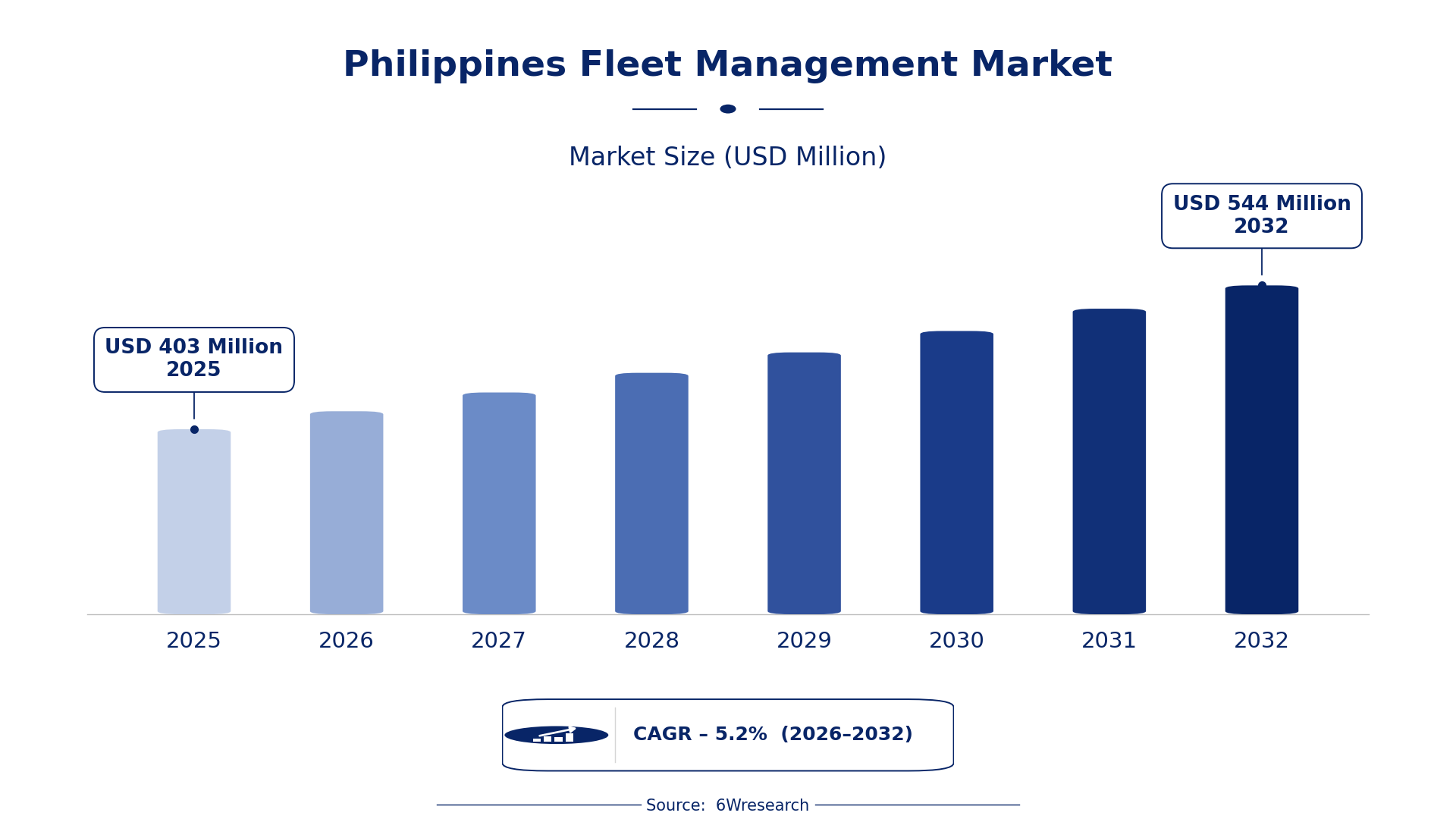
The Philippines Fleet Management Market was estimated at USD 403 Million in 2025 and is projected to reach USD 544 Million by 2032, growing at a CAGR of 5.2% from 2026 to 2032.
Philippines Fleet Management Market Synopsis
The increasing demand for efficient logistics and transportation management is the primary force driving the Philippines Fleet Management Market. Businesses are prioritizing solutions that allow for real-time tracking and optimization of vehicle operations, enabling them to reduce costs and enhance productivity.
In response to the complexities brought on by rapid urbanization and traffic congestion, fleet management solutions are becoming indispensable. Companies are now focusing on integrating advanced technologies, such as telematics and IoT, to streamline operations and improve driver safety.
Philippines Fleet Management Market Year-wise Growth Rate and Key Drivers
This graph illustrates the annual growth rates of the Philippines Fleet Management Market from 2021 to 2032, highlighting a steady upward trajectory and projected expansion over the forecast period.
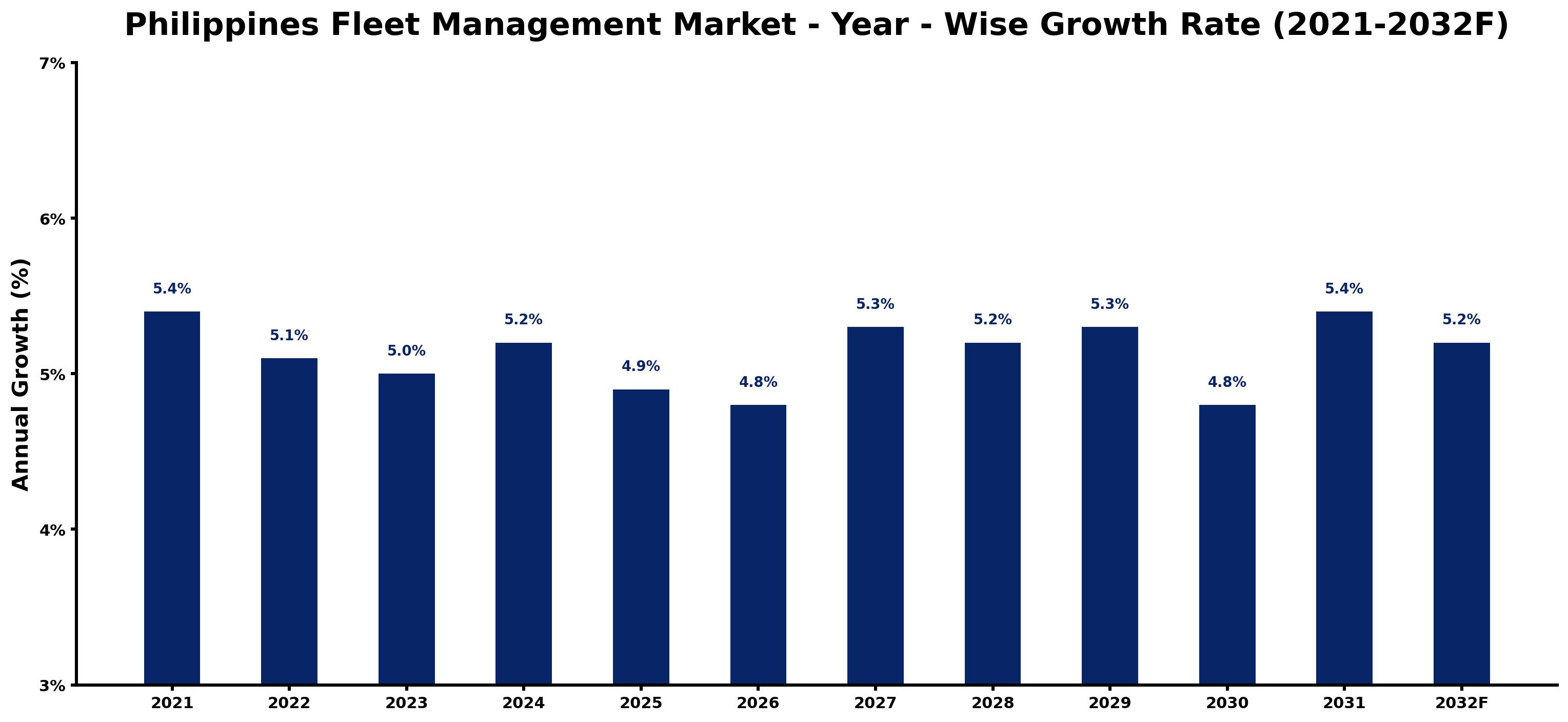
The table below presents the year‑wise growth rates along with the key drivers influencing the market
| Year | Growth Rate | Major Drivers |
| 2021 | 5.4% | COVID-19 recovery boosts e-commerce and logistics demands. |
| 2022 | 5.1% | Department of Transportation's regulatory reforms enhance operational efficiency. |
| 2023 | 5.0% | Increased online shopping drives demand for efficient fleets. |
| 2024 | 5.2% | Government push for logistics digitalization accelerates market adoption. |
| 2025 | 4.9% | Fuel price volatility stimulates demand for fleet monitoring solutions. |
| 2026 | 4.8% | Adoption of telematics driven by rising transport safety concerns. |
| 2027 | 5.3% | Infrastructural improvements facilitate fleet management technology integration. |
| 2028 | 5.2% | Growing urban population necessitates optimized delivery fleet operations. |
| 2029 | 5.3% | Green initiatives mandate fuel-efficient fleet management solutions. |
| 2030 | 4.8% | Rising logistics costs spur demand for automated fleet systems. |
| 2031 | 5.4% | Government incentives promote smart fleet technologies adoption. |
| 2032 | 5.2% | Growing environmental regulations push fleet toward sustainability practices. |
Note: Market size estimations and growth projections presented in this report are based on 6Wresearch's proprietary forecasting methodology, utilizing the latest available industry data, government publications, and primary research inputs.
Philippines Fleet Management Market Key Takeaways
Below are some of the specific key takeaways from the market, including:
- The market is experiencing a robust shift towards integrated digital solutions for fleet management.
- Telematics technology is increasingly adopted for improved vehicle monitoring and driver behavior analysis.
- Government initiatives are enhancing the regulatory environment and infrastructure for fleet operations.
- Demand is growing for sustainability-focused fleet solutions to comply with environmental standards.
- Partnerships between technology providers and logistics companies are on the rise, driving innovation.
Evaluation of Restraints in Philippines Fleet Management Market
The Philippines Fleet Management Market faces several constraints that hinder its full potential. Challenges related to inadequate road infrastructure and persistent traffic congestion complicate efficient route planning and monitoring. Additionally, the high cost of vehicle maintenance and the lack of skilled personnel in fleet management practices can restrict operational efficiency. These factors necessitate continuous improvement in both technology and logistics strategies to overcome existing limitations.
Philippines Fleet Management Market Trends
A notable trend in the Philippines Fleet Management Market is the growing emphasis on data analytics. Companies are investing in analytical tools that provide insights into vehicle performance and operational efficiency. This shift enables businesses to make informed decisions that enhance productivity and reduce costs.
Another emerging trend is the push for sustainability. Fleet operators are increasingly adopting eco-friendly practices, such as transitioning to electric vehicles and optimizing routes to decrease fuel consumption. This trend aligns with global sustainability goals and reflects a shift in consumer preferences towards greener solutions.
Philippines Fleet Management Market Opportunities
The market presents ample opportunities for growth, particularly in the areas of technological innovation and sustainable practices. Companies can capitalize on advancements in telematics and AI-driven analytics to enhance fleet efficiency. Additionally, as businesses face pressure to comply with environmental regulations, there is a growing market for eco-friendly fleet solutions that reduce emissions and fuel costs.
Government Initiatives in the Philippines Fleet Management Market
Government policy plays a crucial role in shaping the Philippines Fleet Management Market. The administration is focused on improving transportation infrastructure and promoting efficient logistics operations. Regulatory frameworks aimed at enhancing vehicle safety and environmental compliance are also being established, driving the market towards modernization.
- A recently completed initiative to upgrade road infrastructure is expected to enhance connectivity for logistics operations.
- A current program focused on implementing digital tracking systems for public transportation is underway.
- Plans for a future regulatory framework to encourage the adoption of electric vehicles are expected to roll out by 2027.
- A public-private partnership aimed at developing smart transportation solutions is currently being negotiated.
- The government is actively working on policies that promote transparency in fleet management practices, set to launch in 2026.
Future Insights of the Philippines Fleet Management Market
Looking ahead to 2026-2032, the Philippines Fleet Management Market is set to undergo substantial changes driven by technology and regulatory advancements. The integration of AI and machine learning in fleet operations will likely enhance decision-making capabilities, optimizing route planning and resource allocation. As sustainability becomes a focal point, companies that invest in green technologies will likely gain a competitive edge in this evolving market.
Philippines Fleet Management Market Latest Developments
Over the past 12-14 months, the Philippines Fleet Management Market has seen a surge in activity, largely driven by technological advancements and government initiatives. Companies are increasingly focusing on integrating new technologies to enhance their operations while aligning with regulatory expectations.
- A major technology vendor launched a comprehensive fleet management platform in Q1 2025, integrating telematics and driver behavior monitoring features.
- An initiative that began in early 2025 focuses on the deployment of electric vehicles across government fleets, promoting sustainability.
- A leading regional operator has partnered with a logistics technology firm to enhance its fleet tracking capabilities, currently underway since mid-2025.
- A planned rollout of a nationwide digital infrastructure upgrade is expected to enhance communication networks for fleet management by late 2026.
- A service upgrade for existing fleet management software was completed in Q2 2025, incorporating advanced analytics and reporting tools.
Philippines Fleet Management Market - Key Attractiveness of the Report
- 10 Years of Market Numbers
- Historical Data Starting from 2022 to 2025
- Base Year: 2025
- Forecast Data until 2032
- Key Performance Indicators Impacting the Market
- Major Upcoming Developments and Projects
Key Highlights of the Report:
- Philippines Fleet Management Market Outlook
- Market Size of Philippines Fleet Management Market, 2025
- Forecast of Philippines Fleet Management Market, 2032
- Historical Data and Forecast of Philippines Fleet Management Revenues & Volume for the Period 2022-2032F
- Philippines Fleet Management Market Trend Evolution
- Philippines Fleet Management Market Drivers and Challenges
- Philippines Fleet Management Price Trends
- Philippines Fleet Management Porter's Five Forces
- Philippines Fleet Management Industry Life Cycle
- Historical Data and Forecast of Philippines Fleet Management Market Revenues & Volume By Solution for the Period 2022-2032F
- Historical Data and Forecast of Philippines Fleet Management Market Revenues & Volume By Operations Management for the Period 2022-2032F
- Historical Data and Forecast of Philippines Fleet Management Market Revenues & Volume By Vehicle Maintenance and Diagnostics for the Period 2022-2032F
- Historical Data and Forecast of Philippines Fleet Management Market Revenues & Volume By Fleet Analytics and Reporting for the Period 2022-2032F
- Historical Data and Forecast of Philippines Fleet Management Market Revenues & Volume By Deployment Type for the Period 2022-2032F
- Historical Data and Forecast of Philippines Fleet Management Market Revenues & Volume By Cloud for the Period 2022-2032F
- Historical Data and Forecast of Philippines Fleet Management Market Revenues & Volume By On-premises for the Period 2022-2032F
- Historical Data and Forecast of Philippines Fleet Management Market Revenues & Volume By Fleet Type for the Period 2022-2032F
- Historical Data and Forecast of Philippines Fleet Management Market Revenues & Volume By Commercial Fleets for the Period 2022-2032F
- Historical Data and Forecast of Philippines Fleet Management Market Revenues & Volume By Passenger Cars for the Period 2022-2032F
- Historical Data and Forecast of Philippines Fleet Management Market Revenues & Volume By Service for the Period 2022-2032F
- Historical Data and Forecast of Philippines Fleet Management Market Revenues & Volume By Professional Services for the Period 2022-2032F
- Historical Data and Forecast of Philippines Fleet Management Market Revenues & Volume By Managed Services for the Period 2022-2032F
- Historical Data and Forecast of Philippines Fleet Management Market Revenues & Volume By Vertical for the Period 2022-2032F
- Historical Data and Forecast of Philippines Fleet Management Market Revenues & Volume By Retail for the Period 2022-2032F
- Historical Data and Forecast of Philippines Fleet Management Market Revenues & Volume By Healthcare and Pharmaceutical for the Period 2022-2032F
- Historical Data and Forecast of Philippines Fleet Management Market Revenues & Volume By Construction for the Period 2022-2032F
- Historical Data and Forecast of Philippines Fleet Management Market Revenues & Volume By Transportation and Logistics for the Period 2022-2032F
- Historical Data and Forecast of Philippines Fleet Management Market Revenues & Volume By Utilities for the Period 2022-2032F
- Historical Data and Forecast of Philippines Fleet Management Market Revenues & Volume By Oil, Gas, and Mining for the Period 2022-2032F
- Historical Data and Forecast of Philippines Fleet Management Market Revenues & Volume By Government for the Period 2022-2032F
- Historical Data and Forecast of Philippines Fleet Management Market Revenues & Volume By Other Verticals for the Period 2022-2032F
- Philippines Fleet Management Import Export Trade Statistics
- Market Opportunity Assessment By Solution
- Market Opportunity Assessment By Deployment Type
- Market Opportunity Assessment By Fleet Type
- Market Opportunity Assessment By Service
- Market Opportunity Assessment By Vertical
- Philippines Fleet Management Top Companies Market Share
- Philippines Fleet Management Competitive Benchmarking By Technical and Operational Parameters
- Philippines Fleet Management Company Profiles
- Philippines Fleet Management Key Strategic Recommendations






































