Philippines Flooring and Carpets Market Size, Share & Growth Rate
The Philippines Flooring and Carpets Market was estimated at USD 428 Million in 2025 and is projected to reach USD 618 Million by 2032, growing at a CAGR of 5.4% from 2026 to 2032. This growth is fueled by the nation's rapid urbanization and an expanding real estate sector, which is increasingly prioritizing modern and durable flooring solutions. Moreover, with the rise of consumer awareness regarding aesthetics and functionality in interior design, the demand for innovative flooring options continues to surge.
Philippines Flooring and Carpets Market Year-wise Growth Rate and Key Drivers
This graph highlights how the Philippines Flooring and Carpets Market has steadily grown over the years, supported by major growth factors.
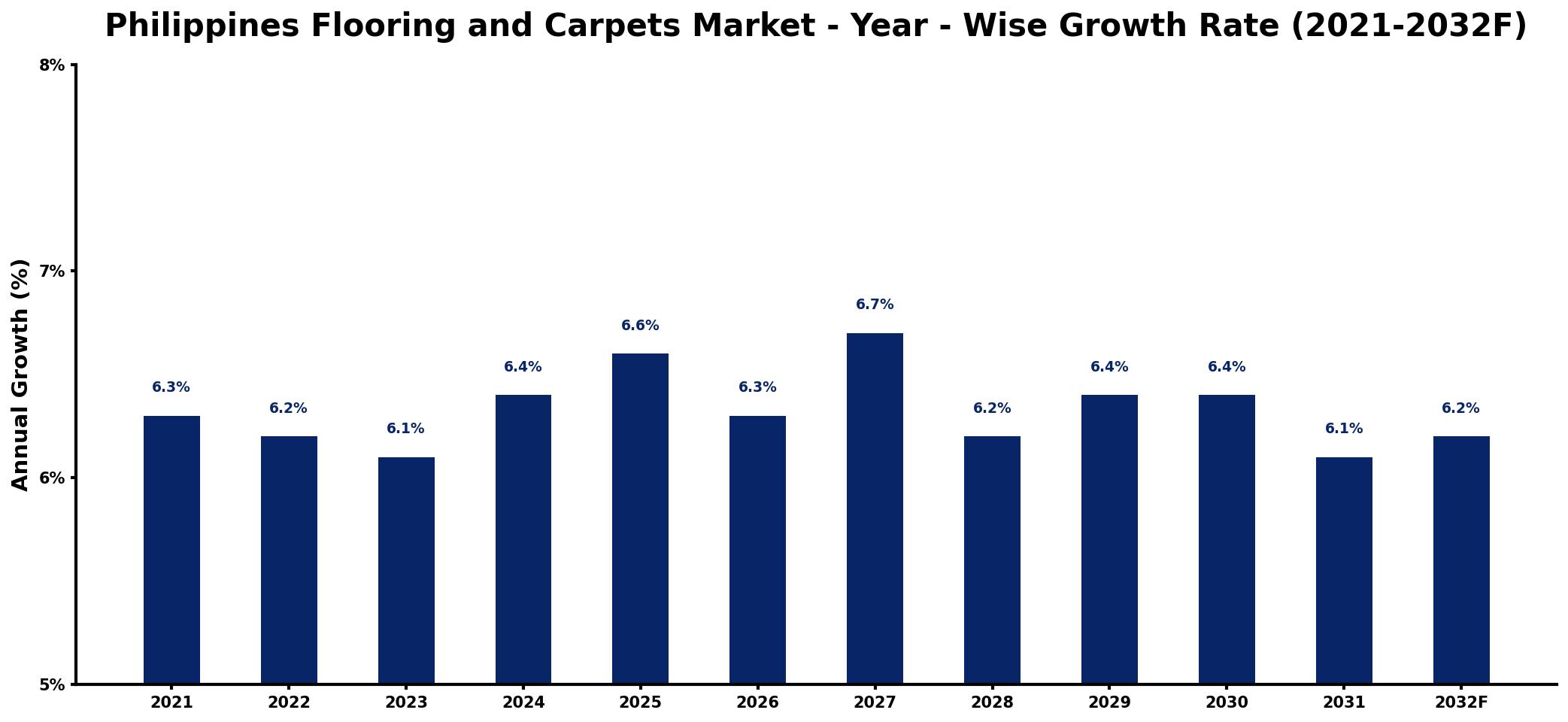
The table below presents the year‑wise growth rates along with the key drivers influencing the market
| Year | Growth Rate | Major Drivers |
| 2021 | 6.3% | Rising construction sector activity |
| 2022 | 6.2% | Increased residential renovation projects |
| 2023 | 6.1% | Growing demand for sustainable materials |
| 2024 | 6.4% | Expansion of urban development initiatives |
| 2025 | 6.6% | Surge in home improvement investments |
| 2026 | 6.3% | Increased public infrastructure spending |
| 2027 | 6.7% | Growth in commercial real estate |
| 2028 | 6.2% | Rising consumer disposable income |
| 2029 | 6.4% | Higher demand for luxury interiors |
| 2030 | 6.4% | stronger distribution network expansion |
| 2031 | 6.1% | Increased focus on interior design |
| 2032 | 6.2% | increased production capacity utilization |
Note: Market size estimations and growth projections presented in this report are based on 6Wresearch's proprietary forecasting methodology, utilizing the latest available industry data, government publications, and primary research inputs.
Philippines Flooring and Carpets Market Synopsis
As urban landscapes evolve, the flooring and carpets market in the Philippines is undergoing a significant transformation. Recent years have seen robust growth, propelled by burgeoning construction activities and a focus on interior decor that appeals to a more discerning consumer base.
The market reflects a blend of traditional preferences and modern trends, where materials and styles are continually adapted to meet the needs of a diverse population. This evolving landscape highlights the dual importance of functionality and design, ensuring that flooring solutions remain a pivotal aspect of residential and commercial spaces alike.
Philippines Flooring and Carpets Market Key Takeaways
- The Philippine flooring and carpets market is projected to maintain a solid growth trajectory, largely driven by urbanization and increased construction activities.
- Consumer preferences are shifting towards eco-friendly and aesthetically appealing flooring solutions, influencing purchasing decisions significantly.
- The market is anticipated to recover steadily post-COVID-19, as housing and interior projects resume and consumers reinvest in their living spaces.
- Rising disposable incomes among the middle class are expanding the market for premium flooring options, including carpets.
- Innovations in flooring technology are likely to reshape offerings, emphasizing durability and sustainability in production processes.
Evaluation of Restraints in Philippines Flooring and Carpets Market
Despite the promising growth prospects of the Philippines flooring and carpets market, several constraints persist. A key concern revolves around the necessity for sustainable materials and practices as consumer awareness about environmental issues increases. This has prompted a shift in demand toward eco-friendly products, compelling manufacturers to reassess their supply chains and production methodologies. The transition to greener practices can pose challenges in terms of costs and resource availability, potentially impacting profit margins. Additionally, competition from imported goods and fluctuating material costs can further constrain domestic manufacturers' ability to thrive in this evolving landscape.
Philippines Flooring and Carpets Market Trends
Current trends in the Philippines flooring and carpets market reveal a noticeable shift towards eco-conscious products that cater to environmentally aware consumers. Additionally, the integration of advanced technologies in flooring materials, such as water-resistant and anti-microbial features, is gaining traction. The rise of online retailing also plays a significant role in transforming how consumers purchase flooring products, making it easier to access a wider variety of styles and prices. This fusion of technology with design not only enhances the consumer experience but also positions the market for future advancements.
Philippines Flooring and Carpets Market Opportunities
As the demand for home improvement escalates, opportunities abound in the Philippines flooring and carpets market. The expansion of e-commerce platforms presents a unique chance for brands to reach untapped segments across the archipelago. Moreover, partnerships with real estate developers to supply flooring solutions for new residential and commercial projects can drive growth. The increasing popularity of custom flooring solutions tailored to specific consumer needs also paves the way for niche markets focused on personalized designs, enhancing customer satisfaction and loyalty.
Government Initiatives in the Philippines Flooring and Carpets Market
The Philippine government is actively promoting infrastructure development and urban renewal projects, aiming to bolster the construction industry. These initiatives include various programs that facilitate investments in real estate, aimed at improving living conditions. Incentives for sustainable practices in manufacturing are also being explored, aligning with global sustainability goals. Such policies not only foster growth within the flooring and carpets market but also encourage environmentally responsible production methodologies.
Future Insights of the Philippines Flooring and Carpets Market
Looking ahead to the period from 2026 to 2032, the Philippines flooring and carpets market is set to navigate an era characterized by innovation and sustainability. As construction activities increase in urban centers and a younger demographic enters the housing market, the demand for stylish, functional flooring solutions will rise. The market is likely to see advancements in smart flooring technologies, which could integrate features that enhance both user experience and environmental sustainability. This forward momentum will redefine industry standards and consumer expectations alike.
Philippines Flooring and Carpets Market Latest Developments (2025 - 2026)
In the recent months, the flooring and carpets market has experienced significant shifts influenced by changing consumer preferences and increased focus on home aesthetics. Companies are expanding their product lines to include more sustainable options and custom designs. The industry is also witnessing a rise in digital marketing efforts to better connect with customers, particularly through social media and online retail channels. Additionally, collaborations with interior designers are becoming more common as brands seek to align their products with current trends in home décor.
Philippines Flooring and Carpets Market - Key Attractiveness of the Report
- 10 Years of Market Numbers
- Historical Data Starting from 2022 to 2025
- Base Year: 2025
- Forecast Data until 2032
- Key Performance Indicators Impacting the Market
- Major Upcoming Developments and Projects
Key Highlights of the Report:
- Philippines Flooring and Carpets Market Outlook
- Market Size of Philippines Flooring and Carpets Market, 2025
- Forecast of Philippines Flooring and Carpets Market, 2032
- Historical Data and Forecast of Philippines Flooring and Carpets Revenues & Volume for the Period 2022-2032F
- Philippines Flooring and Carpets Market Trend Evolution
- Philippines Flooring and Carpets Market Drivers and Challenges
- Philippines Flooring and Carpets Price Trends
- Philippines Flooring and Carpets Porter's Five Forces
- Philippines Flooring and Carpets Industry Life Cycle
- Historical Data and Forecast of Philippines Flooring and Carpets Market Revenues & Volume By Flooring Type for the Period 2022-2032F
- Historical Data and Forecast of Philippines Flooring and Carpets Market Revenues & Volume By Carpets for the Period 2022-2032F
- Historical Data and Forecast of Philippines Flooring and Carpets Market Revenues & Volume By Rugs for the Period 2022-2032F
- Historical Data and Forecast of Philippines Flooring and Carpets Market Revenues & Volume By Artificial Grass for the Period 2022-2032F
- Historical Data and Forecast of Philippines Flooring and Carpets Market Revenues & Volume By Carpet Tiles for the Period 2022-2032F
- Historical Data and Forecast of Philippines Flooring and Carpets Market Revenues & Volume By Vinyl Flooring for the Period 2022-2032F
- Historical Data and Forecast of Philippines Flooring and Carpets Market Revenues & Volume By Laminate Parquet Flooring for the Period 2022-2032F
- Historical Data and Forecast of Philippines Flooring and Carpets Market Revenues & Volume By Material Type for the Period 2022-2032F
- Historical Data and Forecast of Philippines Flooring and Carpets Market Revenues & Volume By Polypropylene for the Period 2022-2032F
- Historical Data and Forecast of Philippines Flooring and Carpets Market Revenues & Volume By Nylon for the Period 2022-2032F
- Historical Data and Forecast of Philippines Flooring and Carpets Market Revenues & Volume By Polyester for the Period 2022-2032F
- Historical Data and Forecast of Philippines Flooring and Carpets Market Revenues & Volume By Others for the Period 2022-2032F
- Historical Data and Forecast of Philippines Flooring and Carpets Market Revenues & Volume By Application for the Period 2022-2032F
- Historical Data and Forecast of Philippines Flooring and Carpets Market Revenues & Volume By Residential for the Period 2022-2032F
- Historical Data and Forecast of Philippines Flooring and Carpets Market Revenues & Volume By Commercial Offices for the Period 2022-2032F
- Historical Data and Forecast of Philippines Flooring and Carpets Market Revenues & Volume By Hospitality for the Period 2022-2032F
- Historical Data and Forecast of Philippines Flooring and Carpets Market Revenues & Volume By Healthcare and Hospitals for the Period 2022-2032F
- Historical Data and Forecast of Philippines Flooring and Carpets Market Revenues & Volume By Educational Institutes for the Period 2022-2032F
- Historical Data and Forecast of Philippines Flooring and Carpets Market Revenues & Volume By Automotive for the Period 2022-2032F
- Historical Data and Forecast of Philippines Flooring and Carpets Market Revenues & Volume By Industrial for the Period 2022-2032F
- Historical Data and Forecast of Philippines Flooring and Carpets Market Revenues & Volume By Others for the Period 2022-2032F
- Philippines Flooring and Carpets Import Export Trade Statistics
- Market Opportunity Assessment By Flooring Type
- Market Opportunity Assessment By Material Type
- Market Opportunity Assessment By Application
- Philippines Flooring and Carpets Top Companies Market Share
- Philippines Flooring and Carpets Competitive Benchmarking By Technical and Operational Parameters
- Philippines Flooring and Carpets Company Profiles
- Philippines Flooring and Carpets Key Strategic Recommendations






































