Philippines Food & Beverages Processing Equipment Market Summary
The philippines food & beverages processing equipment market was estimated at USD 1428 Million in 2025 and is projected to reach USD 2571 Million by 2032, growing at a CAGR of 10.1% from 2026 to 2032.
Philippines Food & Beverages Processing Equipment Market Year-wise Growth Rate and Key Drivers
This graph highlights how the Philippines Food & Beverages Processing Equipment Market has steadily grown over the past five years, supported by major growth factors.
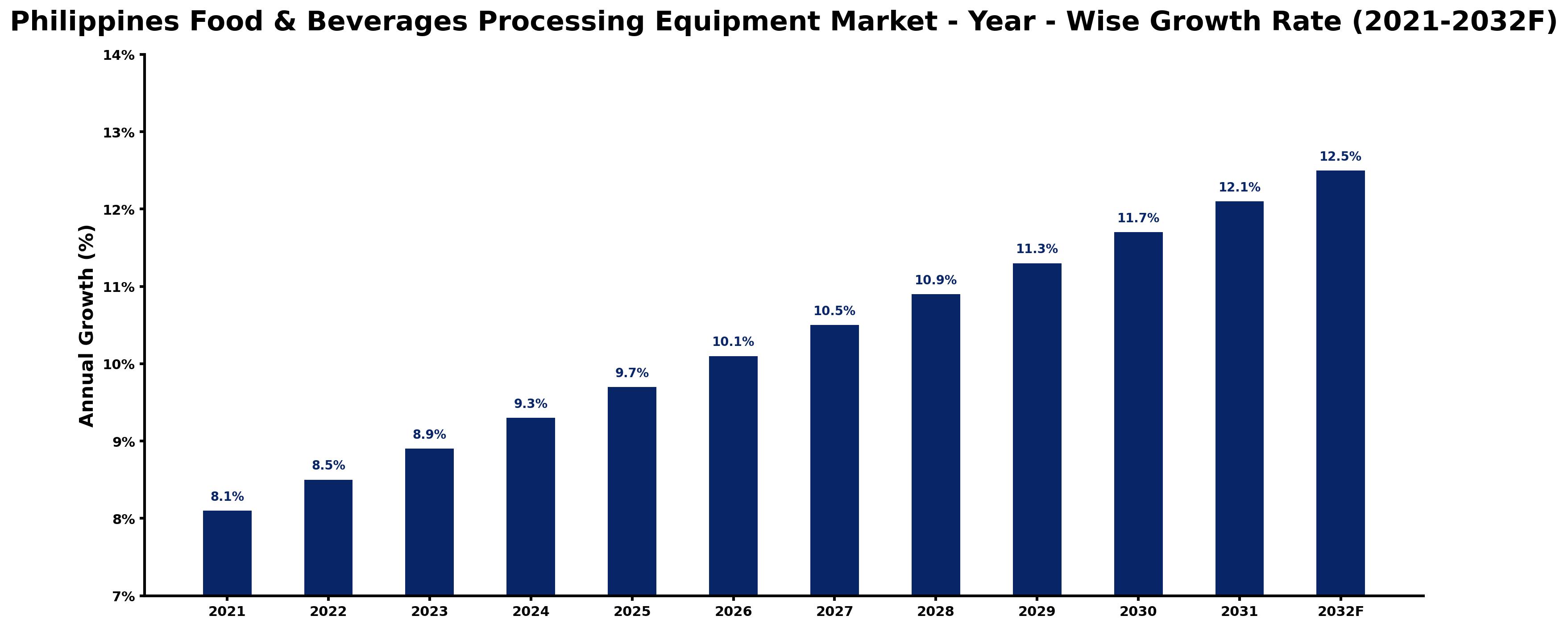
The table below presents the year wise growth rates along with the key drivers influencing the market
| Year | Growth Rate | Major Drivers |
| 2021 | 8.1% | Post-lockdown retail projects increased focus on food safety and hygiene standards. |
| 2022 | 8.5% | Technological upgrades in processing equipment improved production efficiency across various sectors. |
| 2023 | 8.9% | Local manufacturers began investing in sustainable practices to attract environmentally conscious consumers. |
| 2024 | 9.3% | E-commerce growth led to higher demand for packaged and processed food products. |
| 2025 | 9.7% | Rising disposable incomes encouraged consumers to seek premium food and beverage options. |
| 2026 | 10.1% | Increased urbanization spurred the establishment of more food processing facilities in major cities. |
| 2027 | 10.5% | Emerging trends in plant-based diets shifted equipment demand toward processing for alternative proteins. |
| 2028 | 10.9% | Collaboration with international firms introduced advanced processing technologies to the local market. |
| 2029 | 11.3% | Consumer preferences towards convenience foods surged, necessitating innovative processing solutions. |
| 2030 | 11.7% | Infrastructure improvements supported the expansion of distribution networks for processed food products. |
| 2031 | 12.1% | Market players began emphasizing automation technologies to reduce labor costs and enhance productivity. |
| 2032 | 12.5% | Sustainability regulations prompted investments in eco-friendly processing equipment and practices. |
Note - Market size estimations and growth projections presented in this report are based on 6Wresearch's advanced forecasting approach, validated with industry datasets as of June 2026.
Philippines Food & Beverages Processing Equipment Market Synopsis
The Philippines Food Beverages Processing Equipment Market is projected to reach 10.1% and witness significant growth during the forecast period (2026-2032). This growth is largely driven by a combination of factors including the increasing demand for processed foods, a growing population, rising disposable incomes, and evolving consumer lifestyles. The landscape of the market has also been shaped by an uptick in the number of food companies entering the sector, leading to heightened investments in processing technologies and equipment.
Philippines Food & Beverages Processing Equipment Market Trends and Opportunities
The Philippines food and beverages processing equipment market is significantly influenced by emerging consumer trends. The growing preference for convenience food products such as ready-to-eat meals and frozen snacks is a major driver of market growth. Consumers are increasingly seeking products that simplify meal preparation, thus boosting demand for innovative processing solutions. Moreover, heightened awareness regarding the health benefits associated with fresh and healthy food options has led consumers towards packaged goods, necessitating efficient and sustainable packaging solutions.
- The rising trend of health-conscious eating habits is propelling manufacturers to invest in equipment that facilitates the production of healthier food options.
- Technological advancements such as automation and robotics are being integrated into processing equipment to increase efficiency and lower operational costs.
- There is a growing focus on sustainable practices within the food processing sector, promoting the use of energy-efficient machinery that aligns with environmental regulations.
- The demand for diverse flavors and ethnic foods is encouraging innovations in processing techniques and equipment, catering to a wider consumer base.
- As online grocery shopping becomes more prevalent, manufacturers are focusing on packaging solutions that preserve product quality during transport and storage.
Philippines Food & Beverages Processing Equipment Market Growth Drivers
The growth trajectory of the Philippines food and beverages processing equipment market is reinforced by several key drivers. One of the primary factors is the substantial increase in the consumption of processed foods. These products offer convenience and are readily available at competitive prices, appealing to a large segment of the population. Additionally, the integration of innovative technologies into existing processing machines has significantly enhanced operational efficiency, contributing to the growth of the sector in recent years.
- Accessibility to processed foods has improved due to the expansion of distribution channels, facilitating easier consumer access.
- Increasing income levels among consumers are enabling them to spend more on processed food products, further driving demand.
- Investment in research and development is fostering advancements in processing technology, leading to better quality products.
- Rising international food safety standards are prompting local manufacturers to upgrade their processing equipment to meet compliance requirements.
- Growth in the tourism sector is increasing demand for processed food products, particularly in urban areas where food safety and quality are prioritized.
Philippines Food & Beverages Processing Equipment Market Challenges and Restraints
Despite the promising outlook, the Philippines food and beverages processing equipment market faces several challenges that could hinder growth. Stricter government regulations regarding energy consumption during machine operations may lead to increased operational costs for manufacturers. These escalating costs could limit the expansion capabilities of producers, particularly smaller companies that may struggle to adapt to compliance demands. Additionally, fluctuating raw material prices could impact overall production costs and margins.
- The market is subject to significant competition from imported equipment, which may offer advanced features at competitive prices.
- Supply chain disruptions, particularly in raw material procurement, can lead to delays in production and increased costs.
- Varying consumer preferences may necessitate frequent adjustments in production lines, adding to operational complexities.
- Technological upgrades require significant investment; therefore, companies may face budget constraints in adopting the latest machinery.
- Market players must navigate the challenges posed by climate change which can disrupt agricultural production and affect raw materials for food processing.
Philippines Food & Beverages Processing Equipment Market Government Investment and Initiatives
The Philippine government is actively supporting the food and beverages processing sector through various initiatives and investments aimed at enhancing the industry's infrastructure. Policies aimed at improving food safety standards and regulations are being implemented to ensure compliance and promote consumer confidence. Additionally, public spending on agricultural development supports the overall supply chain, facilitating a better environment for food processing companies. Incentives such as tax breaks for local manufacturers and grants for technological innovation are in place to encourage investments in new processing equipment and sustainable practices within the sector.
Philippines Food & Beverages Processing Equipment Market Latest Developments (May 2025 - June 2026)
Recent developments in the Philippines food and beverages processing equipment market indicate a shift towards greater automation and efficiency. Companies are increasingly investing in advanced processing technologies that offer enhanced production capabilities and flexibility. Furthermore, there has been a noticeable movement towards sustainable practices, with businesses exploring energy-efficient machines to meet growing environmental concerns. The focus on maintaining high food safety standards has prompted manufacturers to upgrade their processing equipment to ensure compliance with international regulations. Research and development efforts are intensifying, leading to innovations that cater to evolving consumer demands.
Philippines Food & Beverages Processing Equipment Market - Key Attractiveness of the Report
- 10 Years of Market Numbers
- Historical Data Starting from 2022 to 2025
- Base Year: 2025
- Forecast Data until 2032
- Key Performance Indicators Impacting the Market
- Major Upcoming Developments and Projects
Q1: What are the primary factors driving growth in the Philippines food and beverages processing equipment market?A1: Key drivers include the increasing demand for processed foods, rising disposable incomes, and advancements in technology that enhance production efficiency.
Q2: What challenges does the market face?A2: Challenges include strict government regulations, fluctuating raw material prices, and competition from imported equipment, all of which may hinder market expansion.
Q3: What role does the government play in supporting the food and beverages processing industry?A3: The government supports the industry through initiatives aimed at improving infrastructure, providing incentives for local manufacturers, and implementing safety regulations.
Q4: How important is technological innovation in this market?A4: Technological innovation is crucial, as it drives efficiency and productivity, enabling companies to meet consumer demands and adhere to regulatory standards.
Key Highlights of the Report:
- Philippines Food & Beverages Processing Equipment Market Outlook
- Market Size of Philippines Food & Beverages Processing Equipment Market, 2025
- Forecast of Philippines Food & Beverages Processing Equipment Market, 2032
- Historical Data and Forecast of Philippines Food & Beverages Processing Equipment Revenues & Volume for the Period 2022-2032F
- Philippines Food & Beverages Processing Equipment Market Trend Evolution
- Philippines Food & Beverages Processing Equipment Market Drivers and Challenges
- Philippines Food & Beverages Processing Equipment Price Trends
- Philippines Food & Beverages Processing Equipment Porter's Five Forces
- Philippines Food & Beverages Processing Equipment Industry Life Cycle
- Historical Data and Forecast of Philippines Food & Beverages Processing Equipment Market Revenues & Volume By Types for the Period 2022-2032F
- Historical Data and Forecast of Philippines Food & Beverages Processing Equipment Market Revenues & Volume By Pre-processing Equipment for the Period 2022-2032F
- Historical Data and Forecast of Philippines Food & Beverages Processing Equipment Market Revenues & Volume By Sorting & Grading for the Period 2022-2032F
- Historical Data and Forecast of Philippines Food & Beverages Processing Equipment Market Revenues & Volume By Processing Equipment for the Period 2022-2032F
- Historical Data and Forecast of Philippines Food & Beverages Processing Equipment Market Revenues & Volume By Mode of Operations for the Period 2022-2032F
- Historical Data and Forecast of Philippines Food & Beverages Processing Equipment Market Revenues & Volume By Automatic for the Period 2022-2032F
- Historical Data and Forecast of Philippines Food & Beverages Processing Equipment Market Revenues & Volume By Semi-Automatic for the Period 2022-2032F
- Historical Data and Forecast of Philippines Food & Beverages Processing Equipment Market Revenues & Volume By Forms for the Period 2022-2032F
- Historical Data and Forecast of Philippines Food & Beverages Processing Equipment Market Revenues & Volume By Liquid for the Period 2022-2032F
- Historical Data and Forecast of Philippines Food & Beverages Processing Equipment Market Revenues & Volume By Solid for the Period 2022-2032F
- Historical Data and Forecast of Philippines Food & Beverages Processing Equipment Market Revenues & Volume By Semi-Solid for the Period 2022-2032F
- Historical Data and Forecast of Philippines Food & Beverages Processing Equipment Market Revenues & Volume By Applications for the Period 2022-2032F
- Historical Data and Forecast of Philippines Food & Beverages Processing Equipment Market Revenues & Volume By Bakery & Confectionery Products for the Period 2022-2032F
- Historical Data and Forecast of Philippines Food & Beverages Processing Equipment Market Revenues & Volume By Meat & Poultry Products for the Period 2022-2032F
- Historical Data and Forecast of Philippines Food & Beverages Processing Equipment Market Revenues & Volume By Fish & Sea food for the Period 2022-2032F
- Historical Data and Forecast of Philippines Food & Beverages Processing Equipment Market Revenues & Volume By Dairy Products for the Period 2022-2032F
- Historical Data and Forecast of Philippines Food & Beverages Processing Equipment Market Revenues & Volume By Alcoholic Beverages for the Period 2022-2032F
- Historical Data and Forecast of Philippines Food & Beverages Processing Equipment Market Revenues & Volume By Non-Alcoholic Beverages for the Period 2022-2032F
- Historical Data and Forecast of Philippines Food & Beverages Processing Equipment Market Revenues & Volume By Others for the Period 2022-2032F
- Philippines Food & Beverages Processing Equipment Import Export Trade Statistics
- Market Opportunity Assessment By Types
- Market Opportunity Assessment By Mode of Operations
- Market Opportunity Assessment By Forms
- Market Opportunity Assessment By Applications
- Philippines Food & Beverages Processing Equipment Top Companies Market Share
- Philippines Food & Beverages Processing Equipment Competitive Benchmarking By Technical and Operational Parameters
- Philippines Food & Beverages Processing Equipment Company Profiles
- Philippines Food & Beverages Processing Equipment Key Strategic Recommendations






































