Philippines Food Dehydrators Market Size, Share & Growth Rate
The Philippines Food Dehydrators Market was estimated at USD 279 Million in 2025 and is projected to reach USD 386 Million by 2032, growing at a CAGR of 4.7% from 2026 to 2032. This growth trajectory is primarily driven by increasing consumer health consciousness and a surge in the demand for convenient, shelf-stable food options. As urban lifestyles evolve, the trend towards home food preservation, including the dehydration of fruits and vegetables, becomes more appealing to Filipino households.
Philippines Food Dehydrators Market Year-wise Growth Rate and Key Drivers
This graph highlights how the Philippines Food Dehydrators Market has steadily grown over the years, supported by major growth factors.
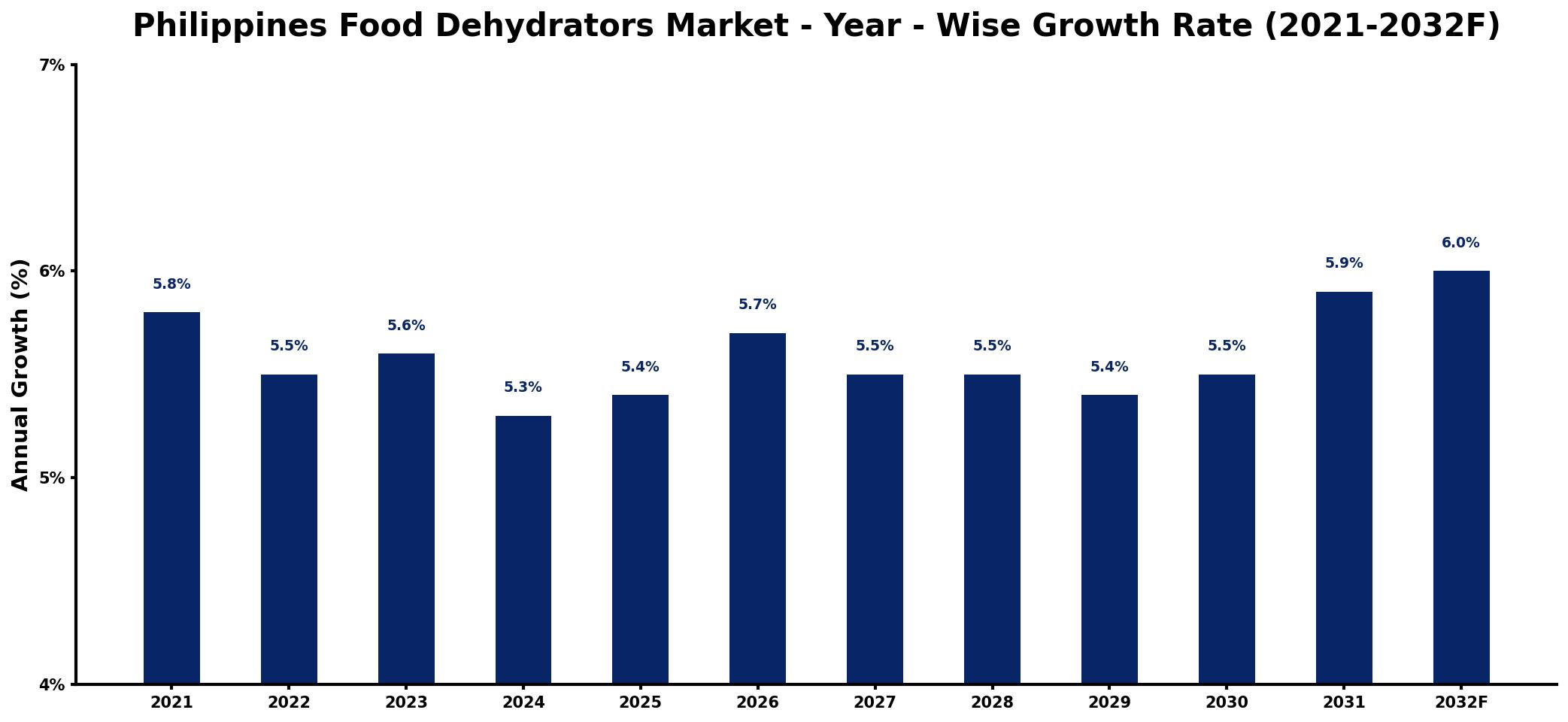
The table below presents the year‑wise growth rates along with the key drivers influencing the market
| Year | Growth Rate | Major Drivers |
| 2021 | 5.8% | Rising health consciousness among consumers |
| 2022 | 5.5% | Increased interest in home preservation |
| 2023 | 5.6% | Growth in plant-based diet adoption |
| 2024 | 5.3% | Surge in online cooking classes |
| 2025 | 5.4% | Expansion of eco-friendly packaging solutions |
| 2026 | 5.7% | Increase in organic farming initiatives |
| 2027 | 5.5% | increased pharmaceutical industry usage |
| 2028 | 5.5% | Rising demand for convenient snacks |
| 2029 | 5.4% | growing automotive sector requirements |
| 2030 | 5.5% | growing downstream application demand |
| 2031 | 5.9% | improved raw material availability |
| 2032 | 6.0% | Rising popularity of sustainable living |
Note: Market size estimations and growth projections presented in this report are based on 6Wresearch's proprietary forecasting methodology, utilizing the latest available industry data, government publications, and primary research inputs.
Philippines Food Dehydrators Market Synopsis
The market for food dehydrators in the Philippines is gaining traction, largely due to the countrys rich agricultural landscape and a growing preference for processed and preserved food. With local fruits and vegetables in high supply, the opportunity for dehydrating these goods for both domestic consumption and export is significant.
Furthermore, the rising trend of health awareness among consumers is encouraging more families to consider food dehydration as a method to enhance food safety and reduce waste. Education on the benefits of dehydrated foods, such as longer shelf life and retained nutrients, is helping to drive market demand.
Philippines Food Dehydrators Market Key Takeaways
- The market is responding positively to shifting consumer preferences towards healthier and more sustainable food options.
- Technological advancements in dehydrator designs are making home drying more efficient and user-friendly.
- Increasing urbanization and busier lifestyles are fueling the demand for convenient food preservation methods.
- The variety of locally sourced produce provides a robust foundation for the dehydrated food sector.
- Partnerships between agricultural producers and dehydrator manufacturers are enhancing market access.
Evaluation of Restraints in Philippines Food Dehydrators Market
Despite the positive outlook for the food dehydrators market in the Philippines, several restraints could impede growth. Chief among these is the lack of consumer knowledge regarding food dehydration techniques and the equipment's potential. Additionally, economic factors can restrict disposable income, thereby limiting potential customers' ability to invest in dehydrators. The initial cost of high-quality dehydrators may deter consumers, especially in a market where more affordable food preservation methods are readily available.
Philippines Food Dehydrators Market Trends
A notable trend within the Philippines Food Dehydrators Market is the increasing integration of smart technologies into dehydrators. Manufacturers are beginning to introduce models that offer precise temperature control and digital interfaces, appealing to tech-savvy consumers. Furthermore, a significant rise in the popularity of homemade snacks and the DIY culture is prompting consumers to explore dehydration as a means to create nutritious and tasty alternatives to traditional snacks.
Philippines Food Dehydrators Market Opportunities
The Philippines Food Dehydrators Market presents various growth opportunities, particularly through educational campaigns that promote the benefits of dehydration. As awareness grows, the market could see an influx of first-time buyers. Furthermore, the potential for dehydrated products to enter the export market presents lucrative avenues for expansion, especially as international demand for healthy, convenient food products increases.
Government Initiatives in the Philippines Food Dehydrators Market
The Philippine government is actively supporting agricultural innovations, including food preservation technologies, through various initiatives. Programs aimed at improving agricultural productivity and sustainability also extend to food processing and preservation. Public spending on agricultural advancements provides a conducive environment for the growth of the food dehydrators market, encouraging collaboration between producers and technology developers.
Future Insights of the Philippines Food Dehydrators Market
Looking towards 2026-2032, the Philippines Food Dehydrators Market is expected to gain momentum as consumer behavior continues to shift towards more health-conscious choices. The focus on home cooking and preservation methods will likely grow, bolstered by the increasing availability of diverse dehydrator models. With enhanced technological features and a strong push for local product promotion, this market will likely play a crucial role in the future of food sustainability in the region.
Philippines Food Dehydrators Market Latest Developments (2025 - 2026)
Recent developments in the Philippines Food Dehydrators Market indicate a noticeable shift towards energy-efficient models, responding to consumer demand for sustainability. There have been concerted efforts from various stakeholders to create awareness about the benefits of food dehydration, particularly among urban consumers. Additionally, the market is witnessing increased collaborations between local farmers and technology companies aimed at enhancing product quality and availability.
Philippines Food Dehydrators Market - Key Attractiveness of the Report
- 10 Years of Market Numbers
- Historical Data Starting from 2022 to 2025
- Base Year: 2025
- Forecast Data until 2032
- Key Performance Indicators Impacting the Market
- Major Upcoming Developments and Projects
Key Highlights of the Report:
- Philippines Food Dehydrators Market Outlook
- Market Size of Philippines Food Dehydrators Market, 2025
- Forecast of Philippines Food Dehydrators Market, 2032
- Historical Data and Forecast of Philippines Food Dehydrators Revenues & Volume for the Period 2022-2032F
- Philippines Food Dehydrators Market Trend Evolution
- Philippines Food Dehydrators Market Drivers and Challenges
- Philippines Food Dehydrators Price Trends
- Philippines Food Dehydrators Porter's Five Forces
- Philippines Food Dehydrators Industry Life Cycle
- Historical Data and Forecast of Philippines Food Dehydrators Market Revenues & Volume By Technology for the Period 2022-2032F
- Historical Data and Forecast of Philippines Food Dehydrators Market Revenues & Volume By Vertical Flow for the Period 2022-2032F
- Historical Data and Forecast of Philippines Food Dehydrators Market Revenues & Volume By Horizontal Flow for the Period 2022-2032F
- Historical Data and Forecast of Philippines Food Dehydrators Market Revenues & Volume By End-Use for the Period 2022-2032F
- Historical Data and Forecast of Philippines Food Dehydrators Market Revenues & Volume By Industrial for the Period 2022-2032F
- Historical Data and Forecast of Philippines Food Dehydrators Market Revenues & Volume By Commercial for the Period 2022-2032F
- Historical Data and Forecast of Philippines Food Dehydrators Market Revenues & Volume By Residential for the Period 2022-2032F
- Historical Data and Forecast of Philippines Food Dehydrators Market Revenues & Volume By Others for the Period 2022-2032F
- Historical Data and Forecast of Philippines Food Dehydrators Market Revenues & Volume By Energy Source for the Period 2022-2032F
- Historical Data and Forecast of Philippines Food Dehydrators Market Revenues & Volume By Electricity for the Period 2022-2032F
- Historical Data and Forecast of Philippines Food Dehydrators Market Revenues & Volume By Biofuel for the Period 2022-2032F
- Historical Data and Forecast of Philippines Food Dehydrators Market Revenues & Volume By Solar for the Period 2022-2032F
- Historical Data and Forecast of Philippines Food Dehydrators Market Revenues & Volume By Others for the Period 2022-2032F
- Philippines Food Dehydrators Import Export Trade Statistics
- Market Opportunity Assessment By Technology
- Market Opportunity Assessment By End-Use
- Market Opportunity Assessment By Energy Source
- Philippines Food Dehydrators Top Companies Market Share
- Philippines Food Dehydrators Competitive Benchmarking By Technical and Operational Parameters
- Philippines Food Dehydrators Company Profiles
- Philippines Food Dehydrators Key Strategic Recommendations






































