Philippines Food Packaging Market Summary
The philippines food packaging market was estimated at USD 191 Million in 2025 and is projected to reach USD 252 Million by 2032, growing at a CAGR of 4.8% from 2026 to 2032.
Philippines Food Packaging Market Year-wise Growth Rate and Key Drivers
This graph highlights how the Philippines Food Packaging Market has steadily grown over the past five years, supported by major growth factors.
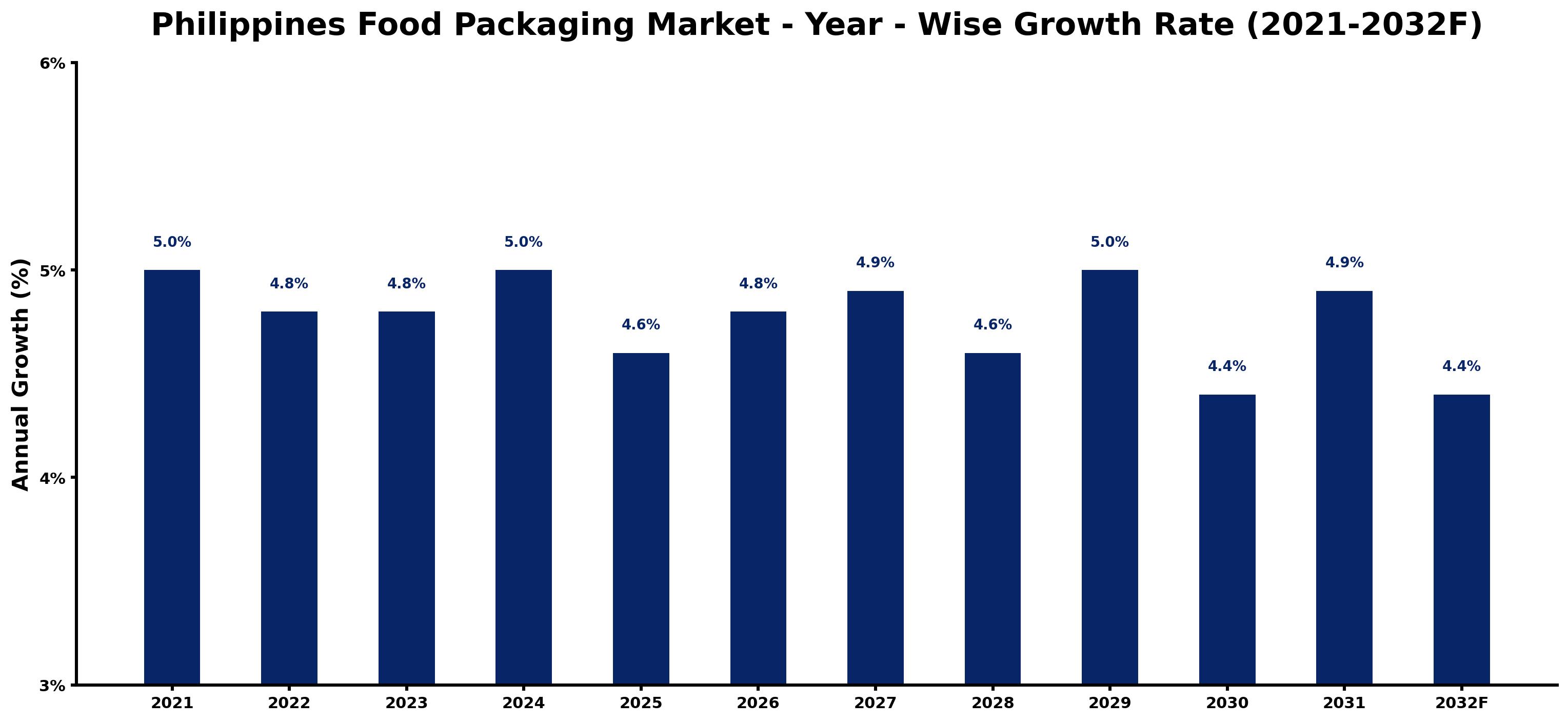
The table below presents the year wise growth rates along with the key drivers influencing the market
| Year | Growth Rate | Major Drivers |
| 2021 | 5.0% | COVID-19 catalyzed a surge in online food delivery and packaging needs. |
| 2022 | 4.8% | Sustainable packaging options gained traction as consumers preferred eco-friendly solutions. |
| 2023 | 4.8% | Local food brands increasingly adopted customized packaging to enhance product visibility. |
| 2024 | 5.0% | Urbanization trends led to higher demand for convenient ready-to-eat meal packaging. |
| 2025 | 4.6% | Investment in cold chain logistics improved food freshness and packaging requirements. |
| 2026 | 4.8% | Emerging e-commerce platforms influenced innovative packaging designs and materials. |
| 2027 | 4.9% | Health-conscious consumers preferred packaging that highlighted nutritional information clearly. |
| 2028 | 4.6% | The vibrant street food culture prompted unique and portable packaging solutions. |
| 2029 | 5.0% | Collaborations between food brands and packaging companies fostered market growth. |
| 2030 | 4.4% | Technological advancements streamlined production processes in the packaging sector. |
| 2031 | 4.9% | Consumer awareness of food safety increased, driving demand for tamper-proof packaging. |
| 2032 | 4.4% | Expansion of export markets required compliance with international packaging standards. |
Note - Market size estimations and growth projections presented in this report are based on 6Wresearch's advanced forecasting approach, validated with industry datasets as of June 2026.
Philippines Food Packaging Market Synopsis
The Philippines Food Packaging Market is projected to reach 4.8% and witness significant growth during the forecast period (2026-2032). A burgeoning demand for packaged food products underpins this growth, driven largely by the convenience and ease of storage they offer. Categories such as ready-to-eat meals, snacks, confectionery items, and dairy products have surged in popularity, aligning with consumers' shifting preferences towards convenience-driven options. This trend is further intensified by rising disposable income levels, particularly in urban areas, where consumers increasingly opt for premium packaging solutions that enhance product appeal.
Philippines Food Packaging Market Growth Drivers
Several key factors are propelling the expansion of the Philippines Food Packaging Market. First, the increasing demand for ready-to-eat meals reflects a lifestyle shift towards convenience, motivating manufacturers to adopt innovative packaging solutions.
- Consumer preferences for packaged convenience foods resonate deeply with the urban population, which is experiencing a cultural shift towards fast-paced living.
- The proliferation of online grocery platforms has made it easier for consumers to access packaged goods, further driving market growth.
- Increased health consciousness among Filipinos is influencing their purchasing decisions, with a preference for nutritious and preservative-free packaged options.
- Flexibility in packaging options, particularly the shift towards flexible plastic pouches, is facilitating the packaging of diverse food types, including condiments and sauces.
- Sustainability is becoming a paramount concern, with consumers favoring eco-friendly packaging materials, thereby pushing the industry towards greener alternatives.
Philippines Food Packaging Market Trends and Opportunities
The Philippines Food Packaging Market is experiencing several notable trends that present both challenges and opportunities. A key trend is the innovative use of biodegradable materials in food packaging, precipitated by a growing consumer preference for sustainability. This shift allows manufacturers to tap into the increasing demand for environmentally responsible products.
- There is a marked inclination towards sophisticated packaging designs that enhance user experience while ensuring product freshness, quality, and safety.
- Health-centric packaging is on the rise, as consumers are actively seeking products that communicate their nutritional benefits through packaging design and labeling.
- Emerging technologies, such as smart packaging solutions equipped with QR codes, are gaining traction, enabling consumers to access product information easily.
- The increasing trend of personalization in packaging allows brands to engage consumers on a deeper level, enhancing brand loyalty and recognition.
- Expansion of retail channels, including e-commerce and specialty food shops, presents significant opportunities for growth in the packaged food sector.
Philippines Food Packaging Market Challenges and Restraints
While the Philippines Food Packaging Market is poised for growth, several challenges may impede its progress. One significant challenge is the stringent regulatory landscape surrounding food safety and packaging materials, which can complicate compliance for manufacturers.
- Fluctuations in raw material prices can impact production costs, thereby affecting profitability in the packaging sector.
- The competitive landscape is intensifying, as numerous players vie for market share, which can lead to price wars and reduced profit margins.
- Challenges in sourcing sustainable materials can hinder manufacturers' efforts to meet the growing demand for eco-friendly packaging solutions.
- Consumer skepticism towards claims of sustainability and health benefits may also pose reputational risks for brands.
- Logistical hurdles related to distribution and supply chain management can pose operational challenges for packaging firms.
Philippines Food Packaging Market Government Investment and Initiatives
The Philippine government has implemented various initiatives to bolster the food packaging industry, emphasizing sustainable practices and innovation. Public investment in infrastructure development supports the logistics and distribution networks necessary for efficient food packaging. Moreover, policies aimed at promoting local production and consumption encourage investment in the food packaging sector, particularly with incentives for businesses that adopt eco-friendly materials. These government initiatives not only seek to enhance market competitiveness but also aim to position the Philippines as a key player in the regional food packaging landscape.
Philippines Food Packaging Market Latest Developments (May 2025 - June 2026)
In the period from May 2025 to June 2026, the Philippines Food Packaging Market has observed several strategic developments orienting towards sustainability and innovation. Manufacturers are increasingly embracing advanced technologies to streamline production processes and enhance product quality. Additionally, there has been a surge in the introduction of eco-friendly packaging solutions, reflecting consumer preferences for sustainable products. The industry also witnessed collaborations between local entrepreneurs and international firms, aimed at enhancing technological capabilities in packaging processes. Regulatory changes promoting transparency in food packaging have prompted brands to adopt clearer labeling practices. This period marks a pivotal moment for the industry, as the focus on health, sustainability, and consumer engagement continues to shape market dynamics.
Philippines Food Packaging Market - Key Attractiveness of the Report
- 10 Years of Market Numbers
- Historical Data Starting from 2022 to 2025
- Base Year: 2025
- Forecast Data until 2032
- Key Performance Indicators Impacting the Market
- Major Upcoming Developments and Projects
Key Highlights of the Report:
- Philippines Food Packaging Market Outlook
- Market Size of Philippines Food Packaging Market, 2025
- Forecast of Philippines Food Packaging Market, 2032F
- Historical Data and Forecast of Philippines Food Packaging Revenues & Volume for the Period 2022-2032F
- Philippines Food Packaging Market Trend Evolution
- Philippines Food Packaging Market Drivers and Challenges
- Philippines Food Packaging Price Trends
- Philippines Food Packaging Porter's Five Forces
- Philippines Food Packaging Industry Life Cycle
- Historical Data and Forecast of Philippines Food Packaging Market Revenues & Volume By Material Types for the Period 2022-2032F
- Historical Data and Forecast of Philippines Food Packaging Market Revenues & Volume By Paper & board for the Period 2022-2032F
- Historical Data and Forecast of Philippines Food Packaging Market Revenues & Volume By Plastic for the Period 2022-2032F
- Historical Data and Forecast of Philippines Food Packaging Market Revenues & Volume By Metal for the Period 2022-2032F
- Historical Data and Forecast of Philippines Food Packaging Market Revenues & Volume By Glass for the Period 2022-2032F
- Historical Data and Forecast of Philippines Food Packaging Market Revenues & Volume By Others for the Period 2022-2032F
- Historical Data and Forecast of Philippines Food Packaging Market Revenues & Volume By Product Types for the Period 2022-2032F
- Historical Data and Forecast of Philippines Food Packaging Market Revenues & Volume By Rigid for the Period 2022-2032F
- Historical Data and Forecast of Philippines Food Packaging Market Revenues & Volume By Semi-Rigid for the Period 2022-2032F
- Historical Data and Forecast of Philippines Food Packaging Market Revenues & Volume By Flexible for the Period 2022-2032F
- Historical Data and Forecast of Philippines Food Packaging Market Revenues & Volume By Applications for the Period 2022-2032F
- Historical Data and Forecast of Philippines Food Packaging Market Revenues & Volume By Bakery & Confectionary for the Period 2022-2032F
- Historical Data and Forecast of Philippines Food Packaging Market Revenues & Volume By Dairy Products for the Period 2022-2032F
- Historical Data and Forecast of Philippines Food Packaging Market Revenues & Volume By Fruits & Vegetables for the Period 2022-2032F
- Historical Data and Forecast of Philippines Food Packaging Market Revenues & Volume By Meat, Poultry, & Seafood for the Period 2022-2032F
- Historical Data and Forecast of Philippines Food Packaging Market Revenues & Volume By Sauces & Dressings for the Period 2022-2032F
- Historical Data and Forecast of Philippines Food Packaging Market Revenues & Volume By Others for the Period 2022-2032F
- Philippines Food Packaging Import Export Trade Statistics
- Market Opportunity Assessment By Material Types
- Market Opportunity Assessment By Product Types
- Market Opportunity Assessment By Applications
- Philippines Food Packaging Top Companies Market Share
- Philippines Food Packaging Competitive Benchmarking By Technical and Operational Parameters
- Philippines Food Packaging Company Profiles
- Philippines Food Packaging Key Strategic Recommendations






































