Philippines Food products machinery Market Summary
The philippines food products machinery market was estimated at USD 346 Million in 2025 and is projected to reach USD 454 Million by 2032, growing at a CAGR of 4.4% from 2026 to 2032.
Philippines Food products machinery Market Year-wise Growth Rate and Key Drivers
This graph highlights how the Philippines Food products machinery Market has steadily grown over the past five years, supported by major growth factors.
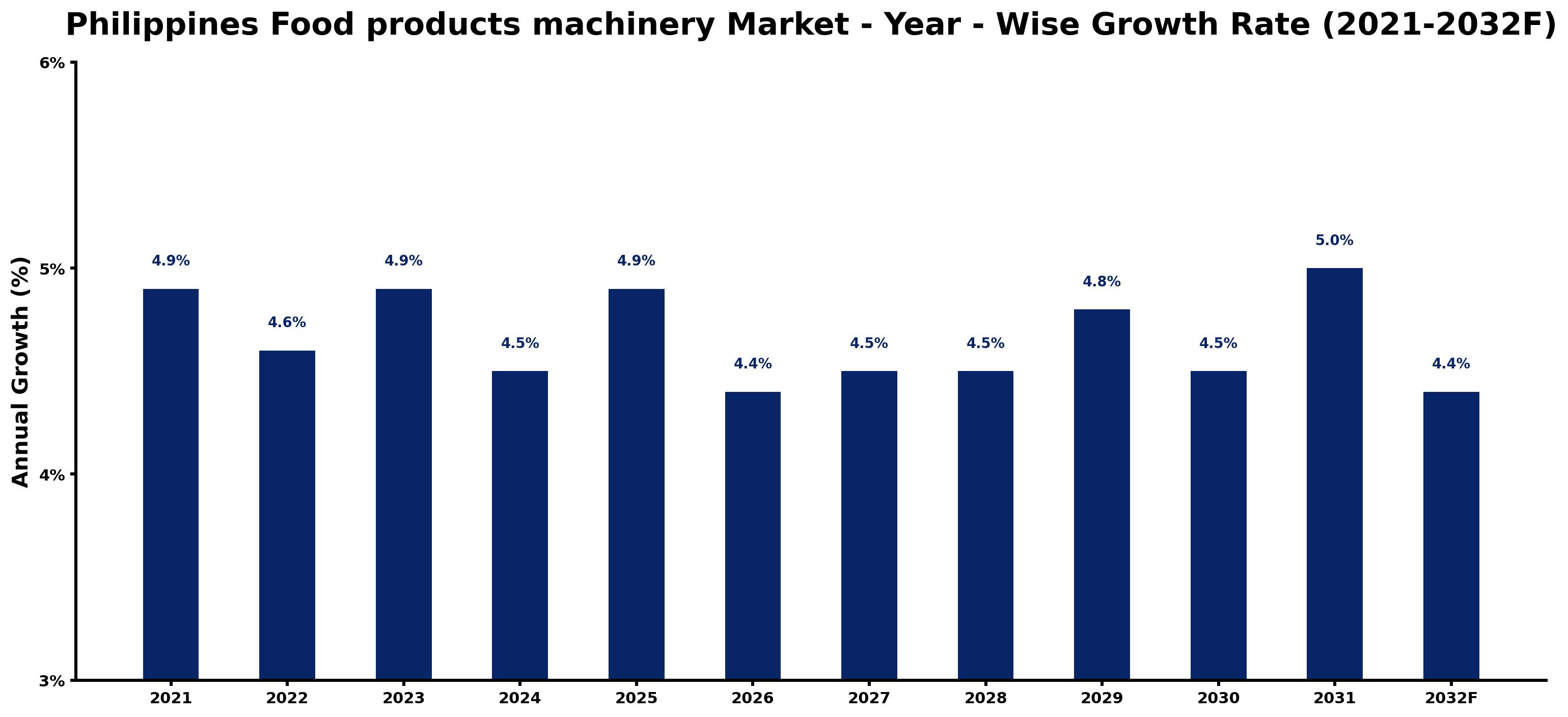
The table below presents the year wise growth rates along with the key drivers influencing the market
| Year | Growth Rate | Major Drivers |
| 2021 | 4.9% | Supply chain disruptions emphasized the need for local food processing machinery. |
| 2022 | 4.6% | Increased focus on sustainability prompted investments in energy-efficient food machinery. |
| 2023 | 4.9% | The e-commerce boom created demand for equipment supporting online food sales. |
| 2024 | 4.5% | Consumer preferences shifted towards healthier options, impacting production machinery features. |
| 2025 | 4.9% | Technological innovations in automation enhanced production efficiency for food manufacturers. |
| 2026 | 4.4% | Export opportunities to Southeast Asia drove machinery upgrades and installations. |
| 2027 | 4.5% | Investment in local food production facilities increased demand for advanced machinery. |
| 2028 | 4.5% | Emerging trends in plant-based products required specialized processing equipment adaptations. |
| 2029 | 4.8% | Rural electrification efforts opened markets for machinery in underserved areas. |
| 2030 | 4.5% | Data analytics integration in machinery improved operational efficiencies and production insights. |
| 2031 | 5.0% | Food safety regulations necessitated upgrades in processing technologies and machinery standards. |
| 2032 | 4.4% | Collaborations between local and global firms initiated the development of innovative machinery. |
Note - Market size estimations and growth projections presented in this report are based on 6Wresearch's advanced forecasting approach, validated with industry datasets as of June 2026.
Philippines Food products machinery Market Synopsis
The Philippines Food products machinery Market is projected to reach 4.4% and witness significant growth during the forecast period (2026-2032). The demand for processed and packaged food is anticipated to escalate, driven by a growing population and an increase in purchasing power among consumers. Technological advancements in the food processing sector also play a crucial role in this market's expansion. Additionally, heightened awareness regarding the health benefits associated with processed and convenience foods is further propelling this market. Rapid urbanization and increasing disposable incomes will create abundant opportunities for manufacturers in the Philippines Food products machinery Market in the upcoming years.
Philippines Food products machinery Market Trends and Opportunities
The Philippine government has initiated several programs to encourage the production and sale of processed and convenience foods. Subsidies on raw materials for production exemplify such initiatives. This trend is influenced by changing lifestyle preferences that prioritize convenience among busy consumers, consequently increasing the demand for advanced processing equipment that efficiently manufactures these products. Several emerging trends are reshaping the market landscape:
- Increased consumption of ready-to-eat meals among consumers is driving demand for high-speed processing machinery.
- Health consciousness, particularly among younger generations, is leading to a surge in organic food production, necessitating specialized machinery.
- A focus on sustainability is prompting manufacturers to seek equipment that minimizes waste and energy consumption during production.
- Customization of food products is becoming increasingly important, urging machinery suppliers to offer tailored solutions based on specific operational needs.
- Integration of smart technologies, such as IoT and automation, is enhancing operational efficiency and product quality in food processing.
Philippines Food products machinery Market Growth Drivers
Several key factors are driving growth within the Philippines Food products machinery Market. The establishment of multinational corporations in the country has led to massive investments in modern production facilities, equipped with state-of-the-art machinery. These factories often employ advanced technologies capable of performing multiple tasks efficiently, significantly boosting productivity and reducing labor costs. The following growth drivers are particularly influential:
- Investment in infrastructure development by large corporations enhances manufacturing capabilities and supply chain efficiency.
- The ongoing shift towards process optimization and automation improves production lines, enabling quicker turnaround times.
- Diversification in food offerings is propelling the demand for versatile machinery adaptable to various food types.
- Rising consumer expectations regarding product quality and safety are pushing manufacturers to procure advanced equipment with stringent quality assurance capabilities.
- The increasing prevalence of e-commerce platforms for food products is stimulating demand for efficient packaging and processing solutions.
Philippines Food products machinery Market Government Investment and Initiatives
The Philippine government is actively investing in the food processing sector through a variety of initiatives aimed at boosting local production. Policies that support the processing of raw agricultural goods into finished products are at the forefront of this investment. Government initiatives, such as infrastructure improvements and financial incentives, encourage businesses to innovate and modernize their operations. By providing subsidies and tax breaks for machinery upgrades and technology adoption, the government aims to create a sustainable ecosystem that promotes local manufacturers and strengthens the supply chain. These efforts are critical in positioning the Philippines as a competitive hub for food production in the Southeast Asian region.
Philippines Food products machinery Market Latest Developments (May 2025 - June 2026)
Recent developments within the Philippines Food products machinery Market indicate a robust trajectory towards modernization and efficiency. During this period, the industry's focus has shifted towards integrating smart technology into food processing equipment, with companies exploring automation solutions that enhance operational efficiency and accuracy. Additionally, environmental sustainability is becoming central to machinery development, with an increasing number of manufacturers prioritizing energy-efficient equipment that minimizes waste. Consumer interest in organic and health-focused food products is further driving investment into specialized machinery capable of meeting stringent quality standards. These ongoing trends signal a transformative phase within the market, underscoring the importance of innovation in maintaining competitive advantage.
Philippines Food products machinery Market - Key Attractiveness of the Report
- 10 Years of Market Numbers
- Historical Data Starting from 2022 to 2025
- Base Year: 2025
- Forecast Data until 2032
- Key Performance Indicators Impacting the Market
- Major Upcoming Developments and Projects
Key Highlights of the Report:
- Philippines Food products machinery Market Outlook
- Market Size of Philippines Food products machinery Market, 2025
- Forecast of Philippines Food products machinery Market, 2032
- Historical Data and Forecast of Philippines Food products machinery Revenues & Volume for the Period 2022-2032F
- Philippines Food products machinery Market Trend Evolution
- Philippines Food products machinery Market Drivers and Challenges
- Philippines Food products machinery Price Trends
- Philippines Food products machinery Porter's Five Forces
- Philippines Food products machinery Industry Life Cycle
- Historical Data and Forecast of Philippines Food products machinery Market Revenues & Volume By Type for the Period 2022-2032F
- Historical Data and Forecast of Philippines Food products machinery Market Revenues & Volume By Dairy Product Plant Machinery and Equipment for the Period 2022-2032F
- Historical Data and Forecast of Philippines Food products machinery Market Revenues & Volume By Bakery Machinery and Equipment for the Period 2022-2032F
- Historical Data and Forecast of Philippines Food products machinery Market Revenues & Volume By Meat and Poultry Processing And Preparation Machinery for the Period 2022-2032F
- Historical Data and Forecast of Philippines Food products machinery Market Revenues & Volume By Other Commercial Food Products Machinery for the Period 2022-2032F
- Historical Data and Forecast of Philippines Food products machinery Market Revenues & Volume By Applications for the Period 2022-2032F
- Historical Data and Forecast of Philippines Food products machinery Market Revenues & Volume By Bakery & Confectionery for the Period 2022-2032F
- Historical Data and Forecast of Philippines Food products machinery Market Revenues & Volume By Meat, Poultry, and Seafood for the Period 2022-2032F
- Historical Data and Forecast of Philippines Food products machinery Market Revenues & Volume By Dairy for the Period 2022-2032F
- Historical Data and Forecast of Philippines Food products machinery Market Revenues & Volume By Beverages for the Period 2022-2032F
- Historical Data and Forecast of Philippines Food products machinery Market Revenues & Volume By Others for the Period 2022-2032F
- Philippines Food products machinery Import Export Trade Statistics
- Market Opportunity Assessment By Type
- Market Opportunity Assessment By Applications
- Philippines Food products machinery Top Companies Market Share
- Philippines Food products machinery Competitive Benchmarking By Technical and Operational Parameters
- Philippines Food products machinery Company Profiles
- Philippines Food products machinery Key Strategic Recommendations






































