Philippines Footwear Manufacturing Machinery Market Size, Share & Growth Rate
The Philippines Footwear Manufacturing Machinery Market was estimated at USD 211 Million in 2025 and is projected to reach USD 283 Million by 2032, growing at a CAGR of 4.3% from 2026 to 2032. This growth trajectory is primarily driven by the increasing demand for advanced manufacturing equipment, as local manufacturers strive to enhance production efficiency and product quality. The rising trend of customized footwear and evolving fashion statements further propels investments in innovative technologies.
Philippines Footwear Manufacturing Machinery Market Year-wise Growth Rate and Key Drivers
This graph highlights how the Philippines Footwear Manufacturing Machinery Market has steadily grown over the years, supported by major growth factors.
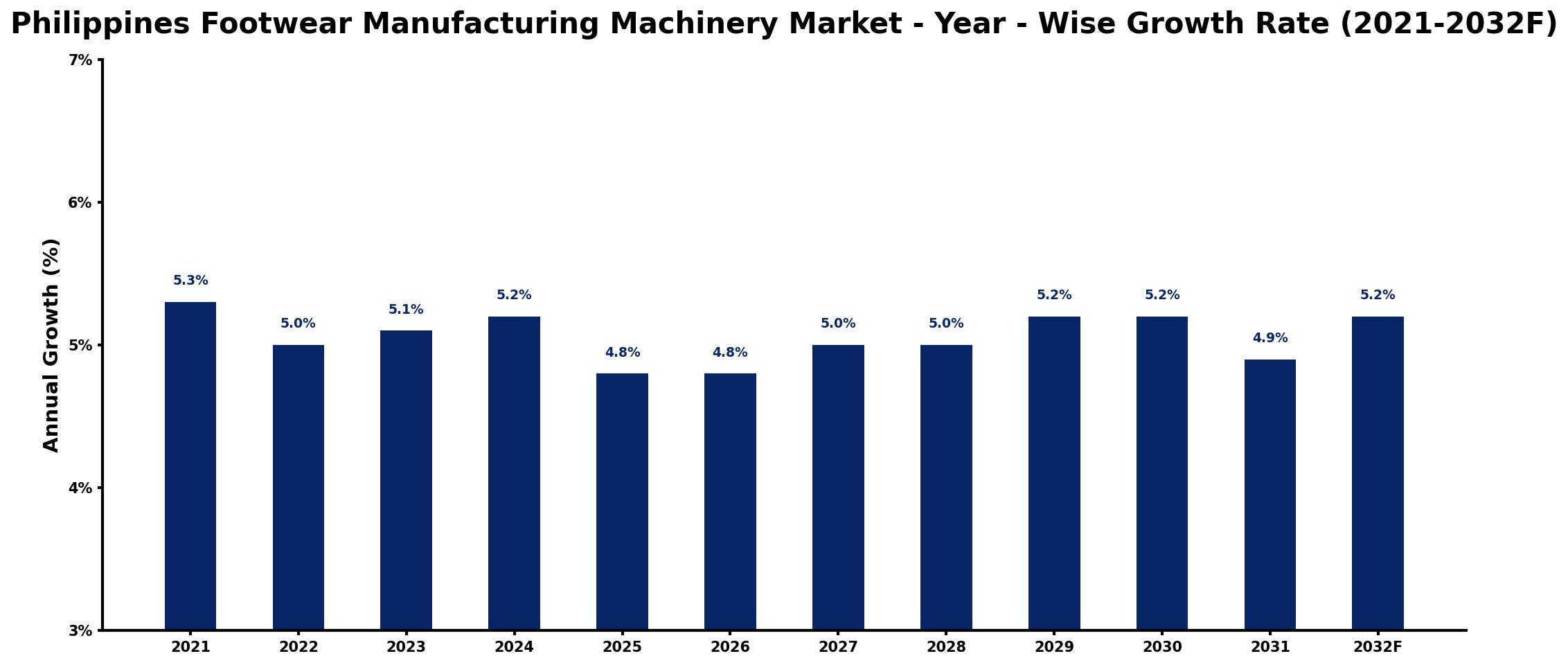
The table below presents the year‑wise growth rates along with the key drivers influencing the market
| Year | Growth Rate | Major Drivers |
| 2021 | 5.3% | Rising consumer spending power |
| 2022 | 5.0% | Increased exports to global markets |
| 2023 | 5.1% | Technological advancements in production |
| 2024 | 5.2% | Growing demand for sustainable materials |
| 2025 | 4.8% | Expansion of retail distribution channels |
| 2026 | 4.8% | Emergence of online shopping platforms |
| 2027 | 5.0% | Increased investment in automation |
| 2028 | 5.0% | Growth in local artisan partnerships |
| 2029 | 5.2% | Enhanced product customization options |
| 2030 | 5.2% | Stronger focus on eco-friendly practices |
| 2031 | 4.9% | Development of innovative design techniques |
| 2032 | 5.2% | Rise in youth fashion trends |
Note: Market size estimations and growth projections presented in this report are based on 6Wresearch's proprietary forecasting methodology, utilizing the latest available industry data, government publications, and primary research inputs.
Philippines Footwear Manufacturing Machinery Market Synopsis
The demand for cutting-edge footwear manufacturing machinery in the Philippines is fueled by the nation's emergence as a key player in global footwear production. With a diverse footwear market ranging from casual to high-end brands, manufacturers are increasingly seeking equipment that can accommodate design complexity and production scalability.
Moreover, local manufacturers are challenged by the need to balance traditional craftsmanship with modern production techniques. This necessitates the integration of advanced machinery, which can streamline operations while maintaining the quality and uniqueness that consumers expect from Filipino-made footwear.
Philippines Footwear Manufacturing Machinery Market Key Takeaways
- Significant growth driven by increased demand for sophisticated manufacturing equipment.
- Technological advancements are reshaping production processes, boosting efficiency and quality.
- A growing emphasis on customization and design variation is influencing machinery investments.
- The footwear industrys expansion positions the Philippines as a competitive manufacturing hub.
- Challenges exist in accessing advanced machinery, impacting global competitiveness.
Evaluation of Restraints in Philippines Footwear Manufacturing Machinery Market
Despite the promising growth outlook, the Philippines Footwear Manufacturing Machinery Market faces notable challenges that restrain its full potential. The lack of access to state-of-the-art machinery and automation technology limits domestic production capabilities. Many local manufacturers still rely on traditional methods, leading to inefficiencies, extended production cycles, and increased costs. Additionally, the industry's innovation landscape is hindered by a scarcity of investment in design and production advancements, further complicating efforts to respond to rapidly changing consumer preferences and market trends.
Philippines Footwear Manufacturing Machinery Market Trends
The market is currently witnessing a shift towards smart manufacturing, with emerging technologies like automation and artificial intelligence starting to reshape production strategies. Manufacturers are increasingly investing in machinery that not only enhances efficiency but also provides the flexibility to adapt to market demands. Furthermore, sustainability is becoming a pivotal trend; equipment that supports eco-friendly production methods is gaining traction, reflecting a broader consumer push towards responsible manufacturing.
Philippines Footwear Manufacturing Machinery Market Opportunities
Opportunities abound in the Philippines Footwear Manufacturing Machinery Market, particularly in sectors focusing on eco-friendly production technologies. As global consumers become more environmentally conscious, there is a significant market for machinery that facilitates sustainable manufacturing practices. Moreover, the rise of e-commerce presents a demand for more agile manufacturing solutions that can quickly adapt to changing consumer preferences, opening avenues for innovative machinery development.
Government Initiatives in the Philippines Footwear Manufacturing Machinery Market
The Philippine government has introduced several initiatives aimed at bolstering the local footwear industry, which includes enhancing access to advanced manufacturing technologies. Public spending on infrastructure improvement is set to benefit the supply chain for machinery imports and exports. Furthermore, there are incentive programs for manufacturers adopting green technologies and innovative production methods, facilitating growth within the sector.
Future Insights of the Philippines Footwear Manufacturing Machinery Market
Looking ahead to 2026-2032, the Philippines Footwear Manufacturing Machinery Market is poised for significant transformation. Continued advancements in technology, combined with a growing emphasis on customization and sustainability, will drive market evolution. As local manufacturers adapt to these trends, the demand for sophisticated machinery that can deliver both efficiency and innovation will remain robust, ensuring the Philippines solidifies its position as a footwear manufacturing hub in the global marketplace.
Philippines Footwear Manufacturing Machinery Market Latest Developments (2025 - 2026)
Recent developments in the Philippines footwear manufacturing machinery sector indicate a steady move towards incorporating automation and AI technologies. Local manufacturers are beginning to adopt machinery that enhances precision and reduces lead times. Furthermore, there has been a marked interest in sustainable practices, with several companies exploring eco-friendly machinery options to meet market demands while also aligning with global trends towards environmental responsibility.
Philippines Footwear Manufacturing Machinery Market - Key Attractiveness of the Report
- 10 Years of Market Numbers
- Historical Data Starting from 2022 to 2025
- Base Year: 2025
- Forecast Data until 2032
- Key Performance Indicators Impacting the Market
- Major Upcoming Developments and Projects
Key Highlights of the Report:
- Philippines Footwear Manufacturing Machinery Market Outlook
- Market Size of Philippines Footwear Manufacturing Machinery Market, 2025
- Forecast of Philippines Footwear Manufacturing Machinery Market, 2032
- Historical Data and Forecast of Philippines Footwear Manufacturing Machinery Revenues & Volume for the Period 2022-2032F
- Philippines Footwear Manufacturing Machinery Market Trend Evolution
- Philippines Footwear Manufacturing Machinery Market Drivers and Challenges
- Philippines Footwear Manufacturing Machinery Price Trends
- Philippines Footwear Manufacturing Machinery Porter's Five Forces
- Philippines Footwear Manufacturing Machinery Industry Life Cycle
- Historical Data and Forecast of Philippines Footwear Manufacturing Machinery Market Revenues & Volume By Type for the Period 2022-2032F
- Historical Data and Forecast of Philippines Footwear Manufacturing Machinery Market Revenues & Volume By Pattern-making for the Period 2022-2032F
- Historical Data and Forecast of Philippines Footwear Manufacturing Machinery Market Revenues & Volume By Cutting for the Period 2022-2032F
- Historical Data and Forecast of Philippines Footwear Manufacturing Machinery Market Revenues & Volume By Finishing for the Period 2022-2032F
- Historical Data and Forecast of Philippines Footwear Manufacturing Machinery Market Revenues & Volume By Molds for the Period 2022-2032F
- Historical Data and Forecast of Philippines Footwear Manufacturing Machinery Market Revenues & Volume By Repair for the Period 2022-2032F
- Historical Data and Forecast of Philippines Footwear Manufacturing Machinery Market Revenues & Volume By Component Preparation for the Period 2022-2032F
- Historical Data and Forecast of Philippines Footwear Manufacturing Machinery Market Revenues & Volume By Stitching Machinery for the Period 2022-2032F
- Historical Data and Forecast of Philippines Pattern-making Footwear Manufacturing Machinery Market Revenues & Volume By Others for the Period 2022-2032F
- Historical Data and Forecast of Philippines Footwear Manufacturing Machinery Market Revenues & Volume By Technology for the Period 2022-2032F
- Historical Data and Forecast of Philippines Footwear Manufacturing Machinery Market Revenues & Volume By Manual for the Period 2022-2032F
- Historical Data and Forecast of Philippines Footwear Manufacturing Machinery Market Revenues & Volume By Semi-Automatic for the Period 2022-2032F
- Historical Data and Forecast of Philippines Footwear Manufacturing Machinery Market Revenues & Volume By Fully-Automatic for the Period 2022-2032F
- Historical Data and Forecast of Philippines Footwear Manufacturing Machinery Market Revenues & Volume By Application for the Period 2022-2032F
- Historical Data and Forecast of Philippines Footwear Manufacturing Machinery Market Revenues & Volume By Athletic for the Period 2022-2032F
- Historical Data and Forecast of Philippines Footwear Manufacturing Machinery Market Revenues & Volume By Casual for the Period 2022-2032F
- Historical Data and Forecast of Philippines Footwear Manufacturing Machinery Market Revenues & Volume By Military for the Period 2022-2032F
- Historical Data and Forecast of Philippines Footwear Manufacturing Machinery Market Revenues & Volume By Others for the Period 2022-2032F
- Philippines Footwear Manufacturing Machinery Import Export Trade Statistics
- Market Opportunity Assessment By Type
- Market Opportunity Assessment By Technology
- Philippines Footwear Manufacturing Machinery Top Companies Market Share
- Philippines Footwear Manufacturing Machinery Competitive Benchmarking By Technical and Operational Parameters
- Philippines Footwear Manufacturing Machinery Company Profiles
- Philippines Footwear Manufacturing Machinery Key Strategic Recommendations






































