Philippines Frozen Processed Meat Market Size, Share & Growth Rate
The Philippines Frozen Processed Meat Market was estimated at USD 222 Million in 2025 and is projected to reach USD 291 Million by 2032, growing at a CAGR of 3.9% from 2026 to 2032. This growth trajectory can be attributed to urbanization trends and changing consumer lifestyles that increasingly favor convenience over traditional cooking methods. The rising demand for ready-to-eat and quick-to-prepare meat products aligns with a busy lifestyle, making frozen processed meat an appealing option for the Filipino consumer.
Philippines Frozen Processed Meat Market Year-wise Growth Rate and Key Drivers
This graph highlights how the Philippines Frozen Processed Meat Market has steadily grown over the years, supported by major growth factors.
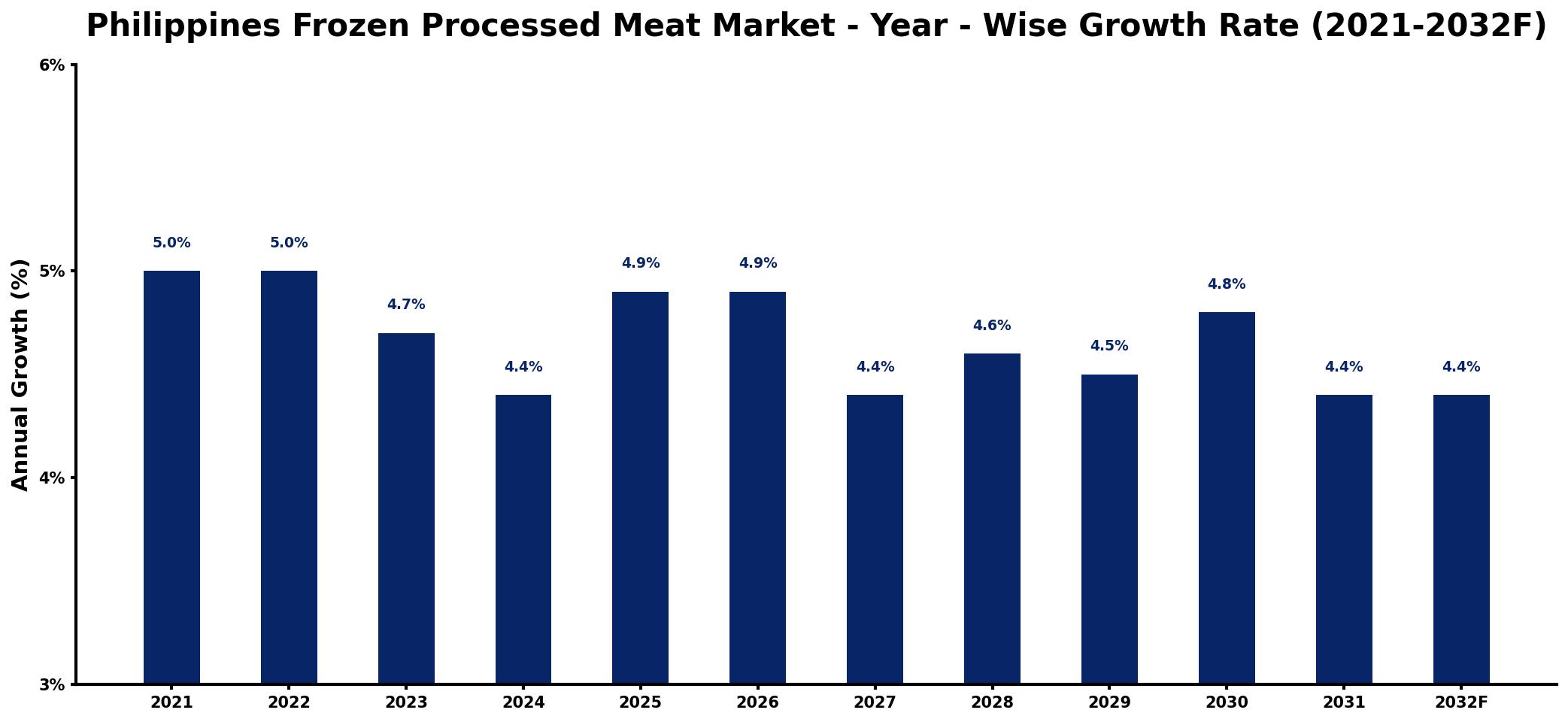
The table below presents the year‑wise growth rates along with the key drivers influencing the market
| Year | Growth Rate | Major Drivers |
| 2021 | 5.0% | Rising consumer convenience preferences |
| 2022 | 5.0% | Increased retail channel expansion |
| 2023 | 4.7% | Growing demand for quick meals |
| 2024 | 4.4% | Higher disposable income levels |
| 2025 | 4.9% | Expansion of online grocery shopping |
| 2026 | 4.9% | Strengthening food service industry |
| 2027 | 4.4% | Increased focus on health trends |
| 2028 | 4.6% | Investment in cold chain logistics |
| 2029 | 4.5% | Emergence of new flavor profiles |
| 2030 | 4.8% | Surge in meal kit popularity |
| 2031 | 4.4% | Growth in export opportunities |
| 2032 | 4.4% | Technological advancements in preservation |
Note: Market size estimations and growth projections presented in this report are based on 6Wresearch's proprietary forecasting methodology, utilizing the latest available industry data, government publications, and primary research inputs.
Philippines Frozen Processed Meat Market Synopsis
In recent years, the Philippines has seen a notable shift in food consumption habits, with an increasing segment of the population opting for frozen processed meats. Products such as sausages and burgers are gaining traction not only for their convenience but also for their taste and perceived quality, which continues to resonate with busy households and working professionals.
The competitive landscape is characterized by various manufacturers striving to ensure food safety while meeting the evolving preferences of consumers. This has led to innovations in preservation technology and packaging, aiming to maintain product freshness while enhancing convenience and variety in the frozen processed meat segment.
Philippines Frozen Processed Meat Market Key Takeaways
- Urbanization and busy lifestyles are fueling demand for frozen processed meat products.
- Quality and safety are critical factors influencing consumer choice in this market.
- Manufacturers are focusing on innovative preservation and packaging techniques.
- Changing dietary preferences present both challenges and opportunities for market players.
- The market is poised for steady growth, supported by a robust demand for convenient food options.
Evaluation of Restraints in Philippines Frozen Processed Meat Market
Despite the promising growth of the frozen processed meat market in the Philippines, several restraints can potentially hinder its development. One major concern is the challenge of maintaining product quality throughout the supply chain. Factors such as temperature fluctuations during storage and distribution, along with issues like freezer burn, pose significant risks to consumer satisfaction. Additionally, evolving consumer preferences for fresher and minimally processed foods could limit growth potential for frozen options unless manufacturers adapt to these trends effectively.
Philippines Frozen Processed Meat Market Trends
A few key trends are emerging in the Philippines Frozen Processed Meat Market. First, there is a heightened focus on health consciousness, pushing manufacturers to explore healthier product formulations with reduced preservatives and additives. Furthermore, the popularity of online grocery shopping is rising, allowing consumers greater access to frozen processed meats. Sustainability also plays a role; consumers are increasingly looking for eco-friendly packaging options and ethically sourced ingredients, prompting brands to align with these values.
Philippines Frozen Processed Meat Market Opportunities
Opportunities for growth in the Philippines Frozen Processed Meat Market are abundant. The increasing adoption of online retail platforms presents a significant avenue for expanding market reach. Additionally, introducing new product lines that cater to health-conscious consumers, such as lean meats and organic options, can capture evolving demand. Partnerships with food delivery services may also enhance visibility and accessibility, appealing to the growing segment of consumers seeking convenience in their meal choices.
Government Initiatives in the Philippines Frozen Processed Meat Market
The Philippine government has been actively promoting initiatives to enhance food safety standards and support local food industries. Programs aimed at improving food processing technology and establishing better regulatory frameworks are ongoing, fostering a more favorable environment for the frozen processed meat sector. Investments in infrastructure and public health campaigns also aim to bolster consumer trust in food safety, which is critical for the market's sustainable growth.
Future Insights of the Philippines Frozen Processed Meat Market
Looking ahead to 2026-2032, the Philippines Frozen Processed Meat Market is set to evolve significantly. As consumer behaviors continue to shift toward convenience and health, manufacturers will likely prioritize innovations that align with these trends. The integration of advanced technology in meat preservation and supply chain management will also be crucial for maintaining product quality. Overall, a balance between convenience and health, paired with a robust marketing strategy, will be vital for sustaining growth in this dynamic market.
Philippines Frozen Processed Meat Market Latest Developments (2025 - 2026)
In the recent months, there has been a noticeable uptick in promotional campaigns focusing on the benefits of frozen processed meats, particularly highlighting safety and convenience during busy seasons. Brands are also diversifying their product portfolios to cater to evolving consumer tastes, with some launching limited-edition flavors that align with local culinary trends. Additionally, initiatives aimed at expanding cold storage facilities are underway, aimed at enhancing product distribution capabilities and ensuring quality preservation.
Philippines Frozen Processed Meat Market - Key Attractiveness of the Report
- 10 Years of Market Numbers
- Historical Data Starting from 2022 to 2025
- Base Year: 2025
- Forecast Data until 2032
- Key Performance Indicators Impacting the Market
- Major Upcoming Developments and Projects
Key Highlights of the Report:
- Philippines Frozen Processed Meat Market Outlook
- Market Size of Philippines Frozen Processed Meat Market, 2025
- Forecast of Philippines Frozen Processed Meat Market, 2032
- Historical Data and Forecast of Philippines Frozen Processed Meat Revenues & Volume for the Period 2022-2032F
- Philippines Frozen Processed Meat Market Trend Evolution
- Philippines Frozen Processed Meat Market Drivers and Challenges
- Philippines Frozen Processed Meat Price Trends
- Philippines Frozen Processed Meat Porter's Five Forces
- Philippines Frozen Processed Meat Industry Life Cycle
- Historical Data and Forecast of Philippines Frozen Processed Meat Market Revenues & Volume By Product Type for the Period 2022-2032F
- Historical Data and Forecast of Philippines Frozen Processed Meat Market Revenues & Volume By Beef for the Period 2022-2032F
- Historical Data and Forecast of Philippines Frozen Processed Meat Market Revenues & Volume By Pork for the Period 2022-2032F
- Historical Data and Forecast of Philippines Frozen Processed Meat Market Revenues & Volume By Chicken for the Period 2022-2032F
- Historical Data and Forecast of Philippines Frozen Processed Meat Market Revenues & Volume By Mutton for the Period 2022-2032F
- Historical Data and Forecast of Philippines Frozen Processed Meat Market Revenues & Volume By Others for the Period 2022-2032F
- Historical Data and Forecast of Philippines Frozen Processed Meat Market Revenues & Volume By Application for the Period 2022-2032F
- Historical Data and Forecast of Philippines Frozen Processed Meat Market Revenues & Volume By Retail Store for the Period 2022-2032F
- Historical Data and Forecast of Philippines Frozen Processed Meat Market Revenues & Volume By Online Sale for the Period 2022-2032F
- Philippines Frozen Processed Meat Import Export Trade Statistics
- Market Opportunity Assessment By Product Type
- Market Opportunity Assessment By Application
- Philippines Frozen Processed Meat Top Companies Market Share
- Philippines Frozen Processed Meat Competitive Benchmarking By Technical and Operational Parameters
- Philippines Frozen Processed Meat Company Profiles
- Philippines Frozen Processed Meat Key Strategic Recommendations






































