Philippines Fruit and Vegetable Processing Market Size, Share & Growth Rate
The Philippines Fruit and Vegetable Processing Market was estimated at USD 328 Million in 2025 and is projected to reach USD 473 Million by 2032, growing at a CAGR of 5.4% from 2026 to 2032. This trajectory is driven by the increasing consumer preference for convenience and quality in processed food products. The market's growth is further fueled by the expanding export potential for high-quality processed fruits and vegetables, alongside government support aimed at enhancing agricultural processing capabilities.
Philippines Fruit and Vegetable Processing Market Growth Rate Analysis (2021-2032)
The Philippines fruit and vegetable processing market has shown stable growth, with rates varying between 6.1% and 6.6% from 2021 to 2032. In 2021, the market grew by 6.5%, driven by increasing consumer demand for convenience and health-focused products. Although growth slightly dipped to 6.1% in 2022, it rebounded to 6.2% in 2023 due to investments in advanced processing technologies and sustainable practices. The upward trend is expected to continue, with projected growth of 6.4% to 6.6% in the latter part of the decade, supported by improved infrastructure and evolving market policies aimed at boosting agricultural productivity.
Philippines Fruit and Vegetable Processing Market Year-wise Growth Rate and Key Drivers
This graph highlights how the Philippines Fruit and Vegetable Processing Market has steadily grown over the past five years, supported by major growth factors.
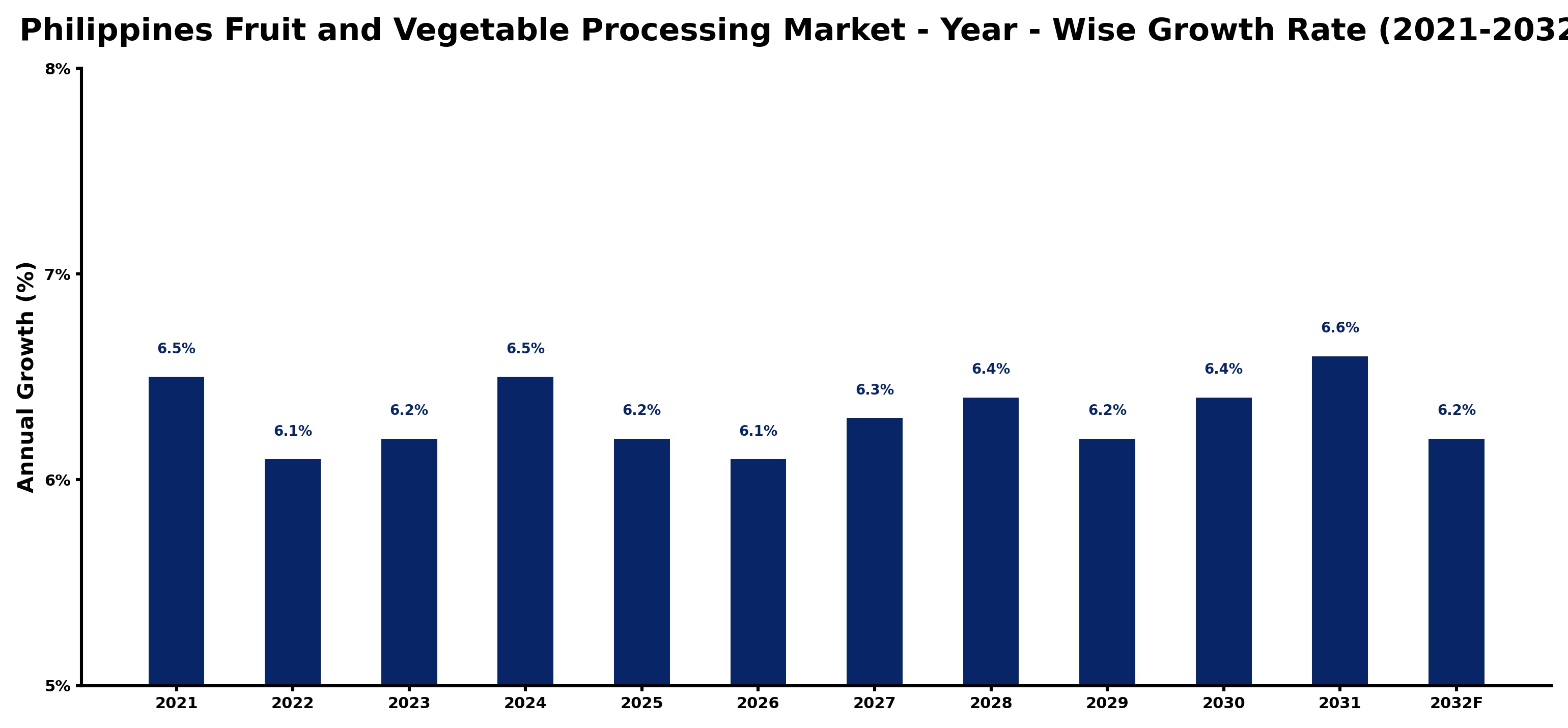
The table below presents the year‑wise growth rates along with the key drivers influencing the market
| Year | Growth Rate | Major Drivers |
| 2021 | 6.5% | Consumer health awareness increased demand |
| 2022 | 6.1% | E-commerce platforms expanded reach |
| 2023 | 6.2% | Local sourcing initiatives gained traction |
| 2024 | 6.5% | Sustainable packaging practices emerged |
| 2025 | 6.2% | Export opportunities opened markets |
| 2026 | 6.1% | Technological advancements improved efficiency |
| 2027 | 6.3% | Organic product popularity surged upward |
| 2028 | 6.4% | Food safety regulations strengthened compliance |
| 2029 | 6.2% | Collaborations with local farmers increased |
| 2030 | 6.4% | Nutritional education programs enhanced awareness |
| 2031 | 6.6% | Investment in processing facilities grew |
| 2032 | 6.2% | Culinary tourism boosted local products |
Note - Market size estimations and growth projections presented in this report are based on 6Wresearch's advanced forecasting approach, validated with industry datasets as of June 2026.
Philippines Fruit and Vegetable Processing Market Synopsis
Recent trends indicate a robust momentum in the Philippines' fruit and vegetable processing sector, characterized by burgeoning domestic consumption and expanding export opportunities. As the focus shifts towards value-added products such as fruit juices, purees, and dehydrated offerings, this segment is poised for substantial growth in the upcoming years.
However, the market is not without its challenges. Despite the promising outlook, there are constraints that need to be addressed, including the need for modern processing infrastructure and improved supply chain management. Addressing these issues will be pivotal in ensuring sustained growth and maximizing the sector's potential.
Philippines Fruit and Vegetable Processing Market Key Takeaways
- Robust growth projected, with a market size increase from USD 328 Million in 2025 to USD 473 Million by 2032.
- Growing consumer demand for processed fruits and vegetables is transforming dietary preferences.
- Government initiatives are fostering agricultural processing, promoting job creation and rural development.
- Challenges related to supply consistency and outdated technology must be overcome to realize full market potential.
- Export opportunities for processed products are creating a competitive landscape for domestic players.
Evaluation of Restraints in Philippines Fruit and Vegetable Processing Market
The Philippines fruit and vegetable processing market faces critical restraints that impede its full development. One of the primary challenges is the inadequate processing infrastructure, which limits operational efficiency and product quality. Furthermore, a lack of technical expertise among workers presents another barrier, particularly in adopting modern processing technologies. Seasonal fluctuations in raw material availability also hinder consistent production, demanding strategic solutions to enhance supply chain resilience. Addressing these limitations will be essential for the market to reach its growth potential.
Philippines Fruit and Vegetable Processing Market Trends
Emerging trends in the Philippines fruit and vegetable processing market reflect a growing consumer inclination towards health-oriented products. This shift has led to an increase in demand for organic and natural processed items. Additionally, innovations in processing techniques, such as cold-press technology for juices and advanced dehydration methods, are gaining traction. The market is also witnessing an uptick in sustainable practices as companies seek to minimize waste and enhance environmental responsibility.
Philippines Fruit and Vegetable Processing Market Opportunities
Genuine growth opportunities in the Philippines fruit and vegetable processing market lie in the development of niche products, particularly those that cater to health-conscious consumers. The burgeoning export market presents another avenue for expansion, as international demand for premium processed products continues to rise. Investments in modernizing processing facilities and enhancing supply chain management will also create opportunities for improved efficiency and product availability throughout the year.
Government Initiatives in the Philippines Fruit and Vegetable Processing Market
The Philippine government is actively promoting agricultural processing as part of its broader economic development agenda. Various initiatives aim to enhance food security and reduce post-harvest losses, encouraging investments in processing facilities. Support programs also focus on providing training and resources for farmers and processors, fostering an environment conducive to value addition and rural employment generation. These initiatives underline the government's commitment to boosting the fruit and vegetable processing sector.
Future Insights of the Philippines Fruit and Vegetable Processing Market
Looking ahead to 2026-2032, the Philippines fruit and vegetable processing market is set to flourish due to rising domestic and international demand for processed foods. Innovations in food technology and sustainable practices will play a pivotal role in shaping the industry. Moreover, as consumer preferences continue to evolve, businesses that adapt quickly to these changing dynamics will likely capture significant market share. The emphasis on quality, convenience, and sustainability will drive the sector's evolution, positioning it for long-term success.
Philippines Fruit and Vegetable Processing Market Latest Developments (May 2025 - June 2026)
Recent developments in the Philippines fruit and vegetable processing market highlight the ongoing efforts to modernize processing techniques and enhance product offerings. Companies are investing in new technologies to improve efficiency and quality while responding to consumer demands for healthier options. Furthermore, initiatives aimed at expanding the export market are being prioritized, as stakeholders recognize the potential for growth on the international stage.
Philippines Fruit and Vegetable Processing Market - Key Attractiveness of the Report
- 10 Years of Market Numbers
- Historical Data Starting from 2022 to 2025
- Base Year: 2025
- Forecast Data until 2032
- Key Performance Indicators Impacting the Market
- Major Upcoming Developments and Projects
Key Highlights of the Report:
- Philippines Fruit and Vegetable Processing Market Outlook
- Market Size of Philippines Fruit and Vegetable Processing Market, 2025
- Forecast of Philippines Fruit and Vegetable Processing Market, 2032F
- Historical Data and Forecast of Philippines Fruit and Vegetable Processing Revenues & Volume for the Period 2022-2032F
- Philippines Fruit and Vegetable Processing Market Trend Evolution
- Philippines Fruit and Vegetable Processing Market Drivers and Challenges
- Philippines Fruit and Vegetable Processing Price Trends
- Philippines Fruit and Vegetable Processing Porter's Five Forces
- Philippines Fruit and Vegetable Processing Industry Life Cycle
- Historical Data and Forecast of Philippines Fruit and Vegetable Processing Market Revenues & Volume By Type for the Period 2022-2032F
- Historical Data and Forecast of Philippines Fruit and Vegetable Processing Market Revenues & Volume By Fruits for the Period 2022-2032F
- Historical Data and Forecast of Philippines Fruit and Vegetable Processing Market Revenues & Volume By Vegetables for the Period 2022-2032F
- Historical Data and Forecast of Philippines Fruit and Vegetable Processing Market Revenues & Volume By Product for the Period 2022-2032F
- Historical Data and Forecast of Philippines Fruit and Vegetable Processing Market Revenues & Volume By Fresh for the Period 2022-2032F
- Historical Data and Forecast of Philippines Fruit and Vegetable Processing Market Revenues & Volume By Fresh-cut for the Period 2022-2032F
- Historical Data and Forecast of Philippines Fruit and Vegetable Processing Market Revenues & Volume By Canned for the Period 2022-2032F
- Historical Data and Forecast of Philippines Fruit and Vegetable Processing Market Revenues & Volume By Frozen for the Period 2022-2032F
- Historical Data and Forecast of Philippines Fruit and Vegetable Processing Market Revenues & Volume By Dried for the Period 2022-2032F
- Historical Data and Forecast of Philippines Fruit and Vegetable Processing Market Revenues & Volume By Processing Equipment for the Period 2022-2032F
- Historical Data and Forecast of Philippines Fruit and Vegetable Processing Market Revenues & Volume By Pre-processing for the Period 2022-2032F
- Historical Data and Forecast of Philippines Fruit and Vegetable Processing Market Revenues & Volume By Processing for the Period 2022-2032F
- Historical Data and Forecast of Philippines Fruit and Vegetable Processing Market Revenues & Volume By Washing for the Period 2022-2032F
- Historical Data and Forecast of Philippines Fruit and Vegetable Processing Market Revenues & Volume By Filling for the Period 2022-2032F
- Historical Data and Forecast of Philippines Fruit and Vegetable Processing Market Revenues & Volume By Seasoning for the Period 2022-2032F
- Historical Data and Forecast of Philippines Fruit and Vegetable Processing Market Revenues & Volume By Packaging for the Period 2022-2032F
- Philippines Fruit and Vegetable Processing Import Export Trade Statistics
- Market Opportunity Assessment By Type
- Market Opportunity Assessment By Product
- Market Opportunity Assessment By Processing Equipment
- Philippines Fruit and Vegetable Processing Top Companies Market Share
- Philippines Fruit and Vegetable Processing Competitive Benchmarking By Technical and Operational Parameters
- Philippines Fruit and Vegetable Processing Company Profiles
- Philippines Fruit and Vegetable Processing Key Strategic Recommendations






































