Philippines Full Grain Leather Market Size, Share & Growth Rate
The Philippines Full Grain Leather Market was estimated at USD 1291 Million in 2025 and is projected to reach USD 2350 Million by 2032, growing at a CAGR of 8.9% from 2026 to 2032. This robust trajectory is propelled by an increasing consumer preference for high-quality leather products that merge traditional craftsmanship with modern aesthetics. As luxury fashion continues to evolve, the demand for full-grain leather, known for its durability and unique texture, is gaining significant momentum across diverse demographic segments.
Philippines Full Grain Leather Market Year-wise Growth Rate and Key Drivers
This graph highlights how the Philippines Full Grain Leather Market has steadily grown over the years, supported by major growth factors.
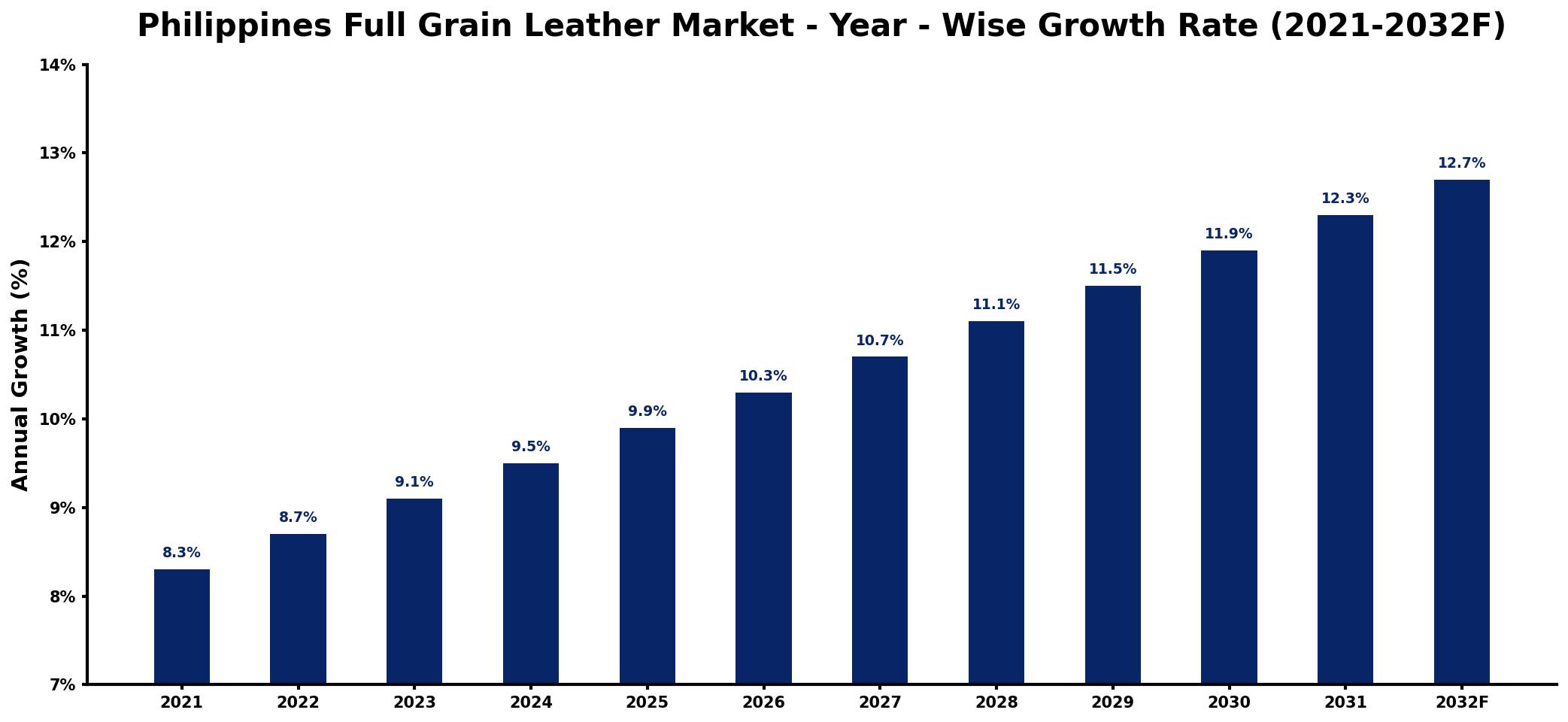
The table below presents the year‑wise growth rates along with the key drivers influencing the market
| Year | Growth Rate | Major Drivers |
| 2021 | 8.3% | Increased demand for luxury goods |
| 2022 | 8.7% | Expansion of fashion retail sector |
| 2023 | 9.1% | Growth in online shopping platforms |
| 2024 | 9.5% | Rise in custom product offerings |
| 2025 | 9.9% | Investment in local manufacturing facilities |
| 2026 | 10.3% | Surge in eco-friendly alternatives |
| 2027 | 10.7% | Growing popularity of artisanal products |
| 2028 | 11.1% | Increase in export opportunities |
| 2029 | 11.5% | Demand for premium accessories rising |
| 2030 | 11.9% | growing downstream application demand |
| 2031 | 12.3% | Emergence of innovative design trends |
| 2032 | 12.7% | Rising consumer spending on quality |
Note: Market size estimations and growth projections presented in this report are based on 6Wresearch's proprietary forecasting methodology, utilizing the latest available industry data, government publications, and primary research inputs.
Philippines Full Grain Leather Market Synopsis
In the Philippines, the full grain leather market is thriving, fueled by a blend of artisanal skill and contemporary design trends. A growing awareness among consumers regarding the sustainability and longevity of leather goods is driving preferences toward premium products that retain their natural characteristics.
As the market progresses, it mirrors the shifts in consumer behavior toward handcrafted items, with a strong emphasis on unique designs and the story behind each product. This has established a vibrant ecosystem for local artisans and manufacturers, enhancing the global appeal of Philippine-made full grain leather goods.
Philippines Full Grain Leather Market Key Takeaways
- Consumer demand for premium, handcrafted leather products is on the rise.
- The market is witnessing a significant shift towards online sales channels, enhancing accessibility.
- Export opportunities are expanding, reflecting increased international interest in Philippine leather craftsmanship.
- Sustainable and ethically produced leather goods are becoming critical to consumer choice.
- Luxury brands are increasingly incorporating full grain leather, driving market growth.
Evaluation of Restraints in Philippines Full Grain Leather Market
Despite the favorable growth trajectory, the Philippines full grain leather market faces hurdles in market perception. There remains a need to educate consumers about the distinct benefits of full grain leather compared to alternatives, particularly synthetic options that may appeal to the budget-conscious demographic. Additionally, the competition from synthetic materials is intensifying, particularly as fashion trends shift rapidly. Ensuring that full grain leather products maintain their unique identity and allure in a crowded marketplace is crucial for sustained growth.
Philippines Full Grain Leather Market Trends
Current trends indicate a heightened interest in sustainability within the full grain leather sector. Consumers are increasingly seeking products that are not only stylish but also ethically produced, leading to a rise in the popularity of eco-friendly leather processing techniques. Moreover, the integration of technology in production is paving the way for innovative designs that cater to modern lifestyles while preserving the rich heritage of traditional craftsmanship. The demand for customizable and bespoke leather items is also trending, as consumers seek individuality in their purchases.
Philippines Full Grain Leather Market Opportunities
The burgeoning demand for high-quality, sustainable leather presents significant opportunities for investment and innovation in the Philippines. Brands that can effectively leverage the countrys artisanal heritage while adopting modern marketing strategies stand to benefit immensely. Expanding e-commerce platforms specifically targeting international markets could further enhance export potential. Additionally, collaborations with fashion designers and brands focused on sustainability can amplify the reach of full grain leather products in the global market.
Government Initiatives in the Philippines Full Grain Leather Market
The Philippine government is actively promoting the local leather industry through various initiatives aimed at enhancing production capabilities and market access. Programs designed to support small and medium enterprises in the leather sector are being prioritized, along with efforts to attract foreign investment. Furthermore, public spending on infrastructure improvements is expected to facilitate better supply chain logistics for the leather market, ultimately aiding local producers in reaching broader consumer bases.
Future Insights of the Philippines Full Grain Leather Market
Looking ahead to the 2026-2032 period, the Philippines full grain leather market is positioned for dynamic growth. As consumer preferences evolve towards sustainable and ethically produced goods, companies that can adapt and innovate will thrive. Continued investment in online retail will be vital for capturing the attention of younger, tech-savvy consumers. Additionally, the emphasis on storytelling and craftsmanship in marketing strategies will resonate strongly with consumers, further reinforcing the market's expansion.
Philippines Full Grain Leather Market Latest Developments (2025 - 2026)
Recently, the full grain leather market in the Philippines has seen a shift towards more digital marketing strategies, allowing local artisans and manufacturers to reach global audiences more effectively. Events showcasing Philippine craftsmanship have gained traction, highlighting the quality and uniqueness of full grain leather products. Additionally, there is a notable increase in partnerships between local manufacturers and international designers, aiming to create exclusive collections that leverage the rich heritage of Philippine leather craftsmanship.
Philippines Full Grain Leather Market - Key Attractiveness of the Report
- 10 Years of Market Numbers
- Historical Data Starting from 2022 to 2025
- Base Year: 2025
- Forecast Data until 2032
- Key Performance Indicators Impacting the Market
- Major Upcoming Developments and Projects
Key Highlights of the Report:
- Philippines Full Grain Leather Market Outlook
- Market Size of Philippines Full Grain Leather Market, 2025
- Forecast of Philippines Full Grain Leather Market, 2032
- Historical Data and Forecast of Philippines Full Grain Leather Revenues & Volume for the Period 2022-2032F
- Philippines Full Grain Leather Market Trend Evolution
- Philippines Full Grain Leather Market Drivers and Challenges
- Philippines Full Grain Leather Price Trends
- Philippines Full Grain Leather Porter's Five Forces
- Philippines Full Grain Leather Industry Life Cycle
- Historical Data and Forecast of Philippines Full Grain Leather Market Revenues & Volume By Type for the Period 2022-2032F
- Historical Data and Forecast of Philippines Full Grain Leather Market Revenues & Volume By Coated for the Period 2022-2032F
- Historical Data and Forecast of Philippines Full Grain Leather Market Revenues & Volume By Non-Coated for the Period 2022-2032F
- Historical Data and Forecast of Philippines Full Grain Leather Market Revenues & Volume By Application for the Period 2022-2032F
- Historical Data and Forecast of Philippines Full Grain Leather Market Revenues & Volume By Automobile for the Period 2022-2032F
- Historical Data and Forecast of Philippines Full Grain Leather Market Revenues & Volume By Consumer Goods for the Period 2022-2032F
- Historical Data and Forecast of Philippines Full Grain Leather Market Revenues & Volume By Furniture for the Period 2022-2032F
- Philippines Full Grain Leather Import Export Trade Statistics
- Market Opportunity Assessment By Type
- Market Opportunity Assessment By Application
- Philippines Full Grain Leather Top Companies Market Share
- Philippines Full Grain Leather Competitive Benchmarking By Technical and Operational Parameters
- Philippines Full Grain Leather Company Profiles
- Philippines Full Grain Leather Key Strategic Recommendations






































