Philippines Gas Equipment Market Size, Share & Growth Rate
The Philippines Gas Equipment Market was estimated at USD 435 Million in 2025 and is projected to reach USD 594 Million by 2032, growing at a CAGR of 4.6% from 2026 to 2032. This upward trajectory can be primarily attributed to a notable rise in natural gas demand across various sectors, especially in power generation and transportation. Moreover, ongoing investments in oil & gas infrastructure and advancements in technology related to natural gas exploration and production are further stimulating growth in this burgeoning market.
Philippines Gas Equipment Market Year-wise Growth Rate and Key Drivers
This graph highlights how the Philippines Gas Equipment Market has steadily grown over the years, supported by major growth factors.
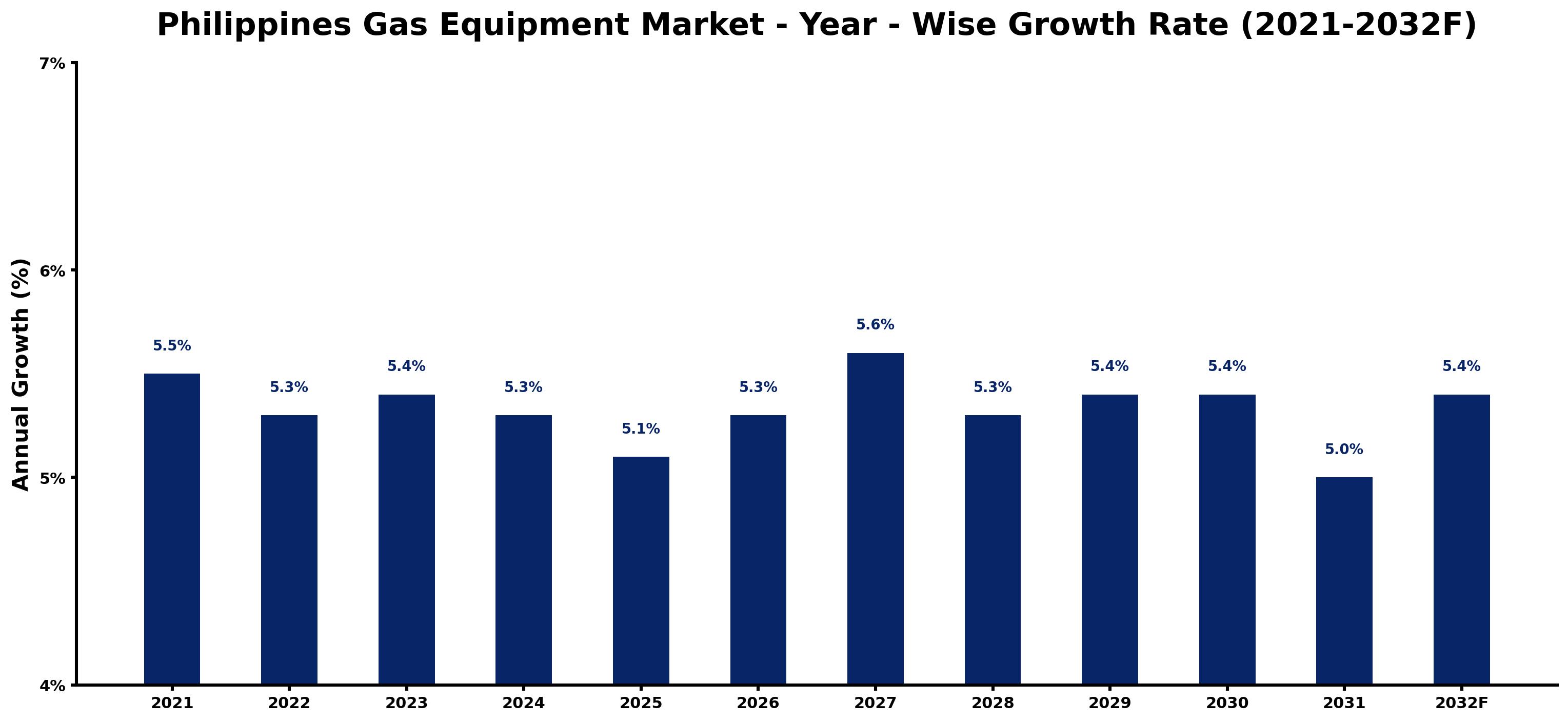
The table below presents the year‑wise growth rates along with the key drivers influencing the market
| Year | Growth Rate | Major Drivers |
| 2021 | 5.5% | Expansion of commercial construction activities |
| 2022 | 5.3% | Rising electricity demand across industries |
| 2023 | 5.4% | Expansion of commercial construction activities |
| 2024 | 5.3% | Expansion of transportation and logistics networks |
| 2025 | 5.1% | Growing urbanization and commercial development |
| 2026 | 5.3% | Rising electricity demand across industries |
| 2027 | 5.6% | Rising electricity demand across industries |
| 2028 | 5.3% | Expansion of transportation and logistics networks |
| 2029 | 5.4% | Expansion of transportation and logistics networks |
| 2030 | 5.4% | Government infrastructure modernization initiatives |
| 2031 | 5.0% | Increasing industrial infrastructure investments |
| 2032 | 5.4% | Growing renewable energy integration projects |
Note - Market size estimations and growth projections presented in this report are based on 6Wresearch's advanced forecasting approach, validated with industry datasets as of June 2026.
Philippines Gas Equipment Market Synopsis
Recent developments in the Philippines gas equipment sector reveal a dynamic market ripe for growth. The ongoing shift towards natural gas due to its cost-effectiveness and environmental benefits has created a strong impetus for investment and innovation.
As businesses and industries increasingly prioritize sustainable practices, the demand for efficient gas equipment has surged. This growing acceptance is contributing significantly to the overall expansion and modernization of the sector, setting the stage for a transformative era in the Philippines gas landscape.
Philippines Gas Equipment Market Key Takeaways
- The market is set to witness a substantial growth rate, driven by increased natural gas adoption.
- Investments in oil & gas infrastructure are expected to bolster technological advancements in exploration.
- Government initiatives are catalyzing increased activity in the upstream gas sector.
- Natural gas's environmental advantages are attracting diverse industry applications.
- Emerging trends indicate a shift toward smart technology integration in gas equipment.
Evaluation of Restraints in Philippines Gas Equipment Market
Despite the robust growth potential, the Philippines gas equipment market faces several real constraints. Fluctuations in crude oil prices contribute to volatility in end-product costs, creating challenges for manufacturers with fixed budgets. Additionally, regulatory compliance issues often impede operational efficiency, as stringent local regulations can slow down product penetration in the market. These factors necessitate a careful navigation of the regulatory landscape for stakeholders aiming to capitalize on emerging opportunities.
Philippines Gas Equipment Market Trends
As the market evolves, several trends are shaping the demand for gas equipment in the Philippines. The integration of smart technologies is one of the most significant trends, enabling enhanced monitoring and efficiency in gas utilization. Moreover, the growing trend toward sustainable energy solutions is driving investment in natural gas as a bridge fuel, significantly impacting equipment demand. Another noteworthy trend is the increasing focus on safety measures, leading to the adoption of advanced safety equipment in the sector.
Philippines Gas Equipment Market Opportunities
The Philippines gas equipment market presents genuine growth and investment opportunities, particularly in the context of government initiatives aimed at enhancing energy security. Investments in green technology and infrastructure projects, including pipelines and storage facilities, offer substantial potential for stakeholders. Additionally, the shift toward cleaner energy solutions creates avenues for innovation in equipment design and functionality, positioning companies to capitalize on both domestic and international markets.
Government Initiatives in the Philippines Gas Equipment Market
The Philippine government has been actively promoting initiatives to enhance the country's energy landscape, particularly through the encouragement of natural gas investments. Policies aimed at incentivizing upstream activities and regulatory reforms are facilitating smoother operations within the sector. These governmental efforts not only aim to bolster domestic production but also to ensure energy security through diversification, creating a more resilient energy infrastructure.
Future Insights of the Philippines Gas Equipment Market
Looking ahead to the period from 2026 to 2032, the Philippines gas equipment market is poised for significant transformation. As demand for natural gas continues to rise, fueled by both industrial and commercial sectors, the market will likely experience robust growth driven by technological advancements and government support. The anticipated shift toward comprehensive energy solutions will also play a crucial role, making the gas equipment sector a central player in the Philippines' energy transition strategy.
Philippines Gas Equipment Market Latest Developments (May 2025 - June 2026)
In recent months, the Philippine gas equipment industry has witnessed notable developments focused on technological advancements and infrastructure upgrades. There have been strategic partnerships aimed at improving efficiency and safety in gas operations. Additionally, discussions surrounding regulatory reforms have gained traction, aiming to streamline operations and enhance investment attractiveness in the sector. As players adapt to these changes, the overall competitive landscape of the market is expected to evolve further.
Philippines Gas Equipment Market - Key Attractiveness of the Report
- 10 Years of Market Numbers
- Historical Data Starting from 2022 to 2025
- Base Year: 2025
- Forecast Data until 2032
- Key Performance Indicators Impacting the Market
- Major Upcoming Developments and Projects
Key Highlights of the Report:
- Philippines Gas Equipment Market Outlook
- Market Size of Philippines Gas Equipment Market, 2025
- Forecast of Philippines Gas Equipment Market, 2032
- Historical Data and Forecast of Philippines Gas Equipment Revenues & Volume for the Period 2022-2032F
- Philippines Gas Equipment Market Trend Evolution
- Philippines Gas Equipment Market Drivers and Challenges
- Philippines Gas Equipment Price Trends
- Philippines Gas Equipment Porter's Five Forces
- Philippines Gas Equipment Industry Life Cycle
- Historical Data and Forecast of Philippines Gas Equipment Market Revenues & Volume By Equipment Type for the Period 2022-2032F
- Historical Data and Forecast of Philippines Gas Equipment Market Revenues & Volume By Gas Delivery Systems for the Period 2022-2032F
- Historical Data and Forecast of Philippines Gas Equipment Market Revenues & Volume By Gas Regulators for the Period 2022-2032F
- Historical Data and Forecast of Philippines Gas Equipment Market Revenues & Volume By Flow Devices for the Period 2022-2032F
- Historical Data and Forecast of Philippines Gas Equipment Market Revenues & Volume By Purifiers & Filters for the Period 2022-2032F
- Historical Data and Forecast of Philippines Gas Equipment Market Revenues & Volume By Gas Generating Systems for the Period 2022-2032F
- Historical Data and Forecast of Philippines Gas Equipment Market Revenues & Volume By Gas Detection Systems for the Period 2022-2032F
- Historical Data and Forecast of Philippines Gas Equipment Market Revenues & Volume By Cryogenic Products for the Period 2022-2032F
- Historical Data and Forecast of Philippines Gas Delivery Systems Gas Equipment Market Revenues & Volume By Accessories for the Period 2022-2032F
- Historical Data and Forecast of Philippines Gas Equipment Market Revenues & Volume By Process for the Period 2022-2032F
- Historical Data and Forecast of Philippines Gas Equipment Market Revenues & Volume By Gas Generation for the Period 2022-2032F
- Historical Data and Forecast of Philippines Gas Equipment Market Revenues & Volume By Gas Storage for the Period 2022-2032F
- Historical Data and Forecast of Philippines Gas Equipment Market Revenues & Volume By Gas Detection for the Period 2022-2032F
- Historical Data and Forecast of Philippines Gas Equipment Market Revenues & Volume By Gas Transportation for the Period 2022-2032F
- Historical Data and Forecast of Philippines Gas Equipment Market Revenues & Volume By End-Gas for the Period 2022-2032F
- Historical Data and Forecast of Philippines Gas Equipment Market Revenues & Volume By Nitrogen for the Period 2022-2032F
- Historical Data and Forecast of Philippines Gas Equipment Market Revenues & Volume By Hydrogen for the Period 2022-2032F
- Historical Data and Forecast of Philippines Gas Equipment Market Revenues & Volume By Helium for the Period 2022-2032F
- Historical Data and Forecast of Philippines Gas Equipment Market Revenues & Volume By Oxygen for the Period 2022-2032F
- Historical Data and Forecast of Philippines Gas Equipment Market Revenues & Volume By Carbon Dioxide for the Period 2022-2032F
- Historical Data and Forecast of Philippines Gas Equipment Market Revenues & Volume By Others for the Period 2022-2032F
- Historical Data and Forecast of Philippines Gas Equipment Market Revenues & Volume By End-Users for the Period 2022-2032F
- Historical Data and Forecast of Philippines Gas Equipment Market Revenues & Volume By Metal Fabrication for the Period 2022-2032F
- Historical Data and Forecast of Philippines Gas Equipment Market Revenues & Volume By Chemicals for the Period 2022-2032F
- Historical Data and Forecast of Philippines Gas Equipment Market Revenues & Volume By Healthcare for the Period 2022-2032F
- Historical Data and Forecast of Philippines Gas Equipment Market Revenues & Volume By Oil and Gas for the Period 2022-2032F
- Historical Data and Forecast of Philippines Gas Equipment Market Revenues & Volume By Food and Beverage for the Period 2022-2032F
- Historical Data and Forecast of Philippines Gas Equipment Market Revenues & Volume By Others for the Period 2022-2032F
- Philippines Gas Equipment Import Export Trade Statistics
- Market Opportunity Assessment By Equipment Type
- Market Opportunity Assessment By Process
- Market Opportunity Assessment By End-Gas
- Market Opportunity Assessment By End-Users
- Philippines Gas Equipment Top Companies Market Share
- Philippines Gas Equipment Competitive Benchmarking By Technical and Operational Parameters
- Philippines Gas Equipment Company Profiles
- Philippines Gas Equipment Key Strategic Recommendations






































