Philippines Glassware Market Top 5 Importing Countries and Market Competition (HHI) Analysis
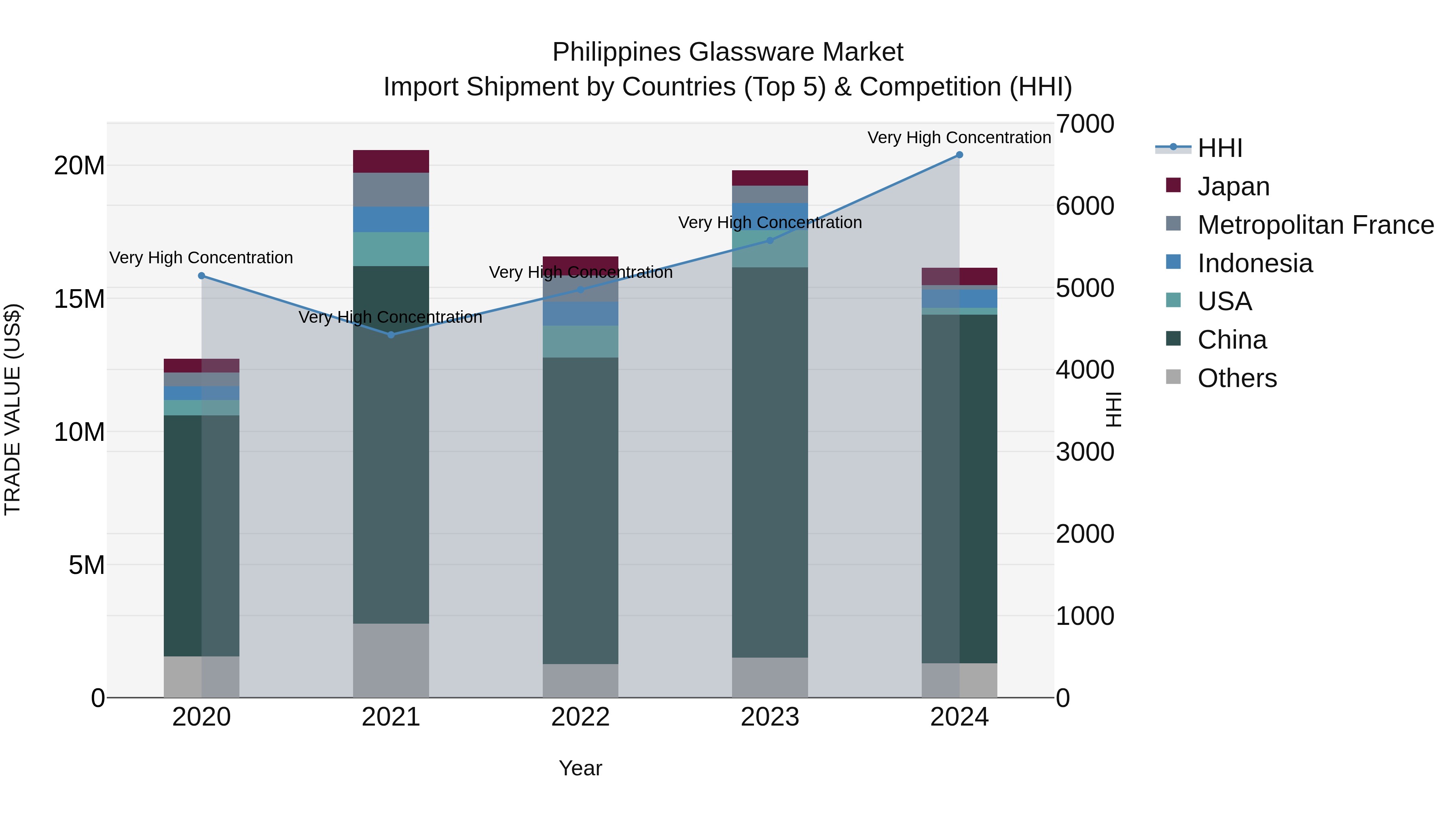
In 2024, the Philippines continued to see significant glassware import shipments, with top suppliers being China, Indonesia, Japan, USA, and South Korea. Despite a high level of market concentration, the industry experienced a steady compound annual growth rate (CAGR) of 6.12% from 2020 to 2024. However, there was a notable decline in growth rate from 2023 to 2024 at -18.48%, indicating potential challenges or shifts in the market dynamics during that period. This data suggests a dynamic and competitive landscape for glassware imports in the Philippines.
Philippines Glassware Market Synopsis
The Philippines glassware market is estimated to reach USD 312.3 million, growing at a CAGR of 5.4% during the forecast period. The growing demand for decorative and ornamental items in households is driving the growth of this market. Additionally, increasing disposable income among Filipino consumers have also contributed to the growth of this market. Moreover, innovations in product designs with incorporation of technology are further expected to fuel its growth in coming years.
Drivers of the market
The Philippines Glassware market has been driven by the food and beverage, hospitality, and home decor sectors. The aesthetic appeal of glassware, its use in presenting food and beverages, and its role in interior design have contributed to its demand.
Challenges of the market
In the Philippines Glassware market, competition from alternative materials and the need for innovative designs are significant challenges. Adapting to changing consumer preferences while maintaining quality and affordability presents a constant struggle. Additionally, addressing concerns related to glass recycling and waste management contributes to the industry`s challenges.
Covid-19 Impact of the market
The Philippines glassware market experienced shifts due to the COVID-19 pandemic. Glassware is used in various applications, including kitchenware, tableware, and home decor. The disruptions in supply chains, reduced consumer spending on non-essential products, and changes in consumer behavior influenced the demand for glassware products. With changes in consumer preferences and temporary closures of certain retail outlets, the market faced fluctuations. However, as consumer behaviors adapt and economic activities improve, the glassware market is expected to recover. The market`s resurgence will be driven by the resumption of diverse industries and the renewed interest in functional and decorative glass products.
Key Players of the market
The Philippines Glassware market, utilized in household and commercial settings, has been significant. Notable participants in this market include GlassCrafters, CrystalVisions, and GlassMakers Inc.
Key Highlights of the Report:
- Philippines Glassware Market Outlook
- Market Size of Philippines Glassware Market, 2023
- Forecast of Philippines Glassware Market, 2030
- Historical Data and Forecast of Philippines Glassware Revenues & Volume for the Period 2020-2030
- Philippines Glassware Market Trend Evolution
- Philippines Glassware Market Drivers and Challenges
- Philippines Glassware Price Trends
- Philippines Glassware Porter's Five Forces
- Philippines Glassware Industry Life Cycle
- Historical Data and Forecast of Philippines Glassware Market Revenues & Volume By Type for the Period 2020-2030
- Historical Data and Forecast of Philippines Glassware Market Revenues & Volume By Soda Lime Glass for the Period 2020-2030
- Historical Data and Forecast of Philippines Glassware Market Revenues & Volume By Lead Glass for the Period 2020-2030
- Historical Data and Forecast of Philippines Glassware Market Revenues & Volume By Heat Resistant Glass for the Period 2020-2030
- Historical Data and Forecast of Philippines Glassware Market Revenues & Volume By Distribution Channel for the Period 2020-2030
- Historical Data and Forecast of Philippines Glassware Market Revenues & Volume By e-Commerce for the Period 2020-2030
- Historical Data and Forecast of Philippines Glassware Market Revenues & Volume By Supermarkets/Hypermarkets for the Period 2020-2030
- Historical Data and Forecast of Philippines Glassware Market Revenues & Volume By Specialized Stores for the Period 2020-2030
- Historical Data and Forecast of Philippines Glassware Market Revenues & Volume By End-user for the Period 2020-2030
- Historical Data and Forecast of Philippines Glassware Market Revenues & Volume By Hotels & Restaurants for the Period 2020-2030
- Historical Data and Forecast of Philippines Glassware Market Revenues & Volume By Corporate Canteens for the Period 2020-2030
- Historical Data and Forecast of Philippines Glassware Market Revenues & Volume By Bars & Caf© for the Period 2020-2030
- Historical Data and Forecast of Philippines Glassware Market Revenues & Volume By Household for the Period 2020-2030
- Historical Data and Forecast of Philippines Glassware Market Revenues & Volume By Others for the Period 2020-2030
- Philippines Glassware Import Export Trade Statistics
- Market Opportunity Assessment By Type
- Market Opportunity Assessment By Distribution Channel
- Market Opportunity Assessment By End-user
- Philippines Glassware Top Companies Market Share
- Philippines Glassware Competitive Benchmarking By Technical and Operational Parameters
- Philippines Glassware Company Profiles
- Philippines Glassware Key Strategic Recommendations






































