Russia Glassware Market Size, Share & Growth Rate
The Russia Glassware Market was estimated at USD 126 Million in 2025 and is projected to reach USD 137 Million by 2032, growing at a CAGR of 1.2% from 2026 to 2032. This growth trajectory is primarily fueled by the rising disposable incomes and a shift towards more luxurious living standards among the population. The increasing urbanization and evolving consumer preferences for unique and high-quality glass products further contribute to this upward trend.
Russia Glassware Market Growth Rate Analysis (2021-2032)
The glassware market in the US, particularly for Russian glassware, has shown notable fluctuations in recent years. After experiencing a decline of 3.8% in 2021, attributed to pandemic-related supply chain disruptions, the market rebounded robustly with growth rates of 4.9% in 2022 and 5.5% in 2023. This revival was fueled by increased consumer demand for quality home goods and a resurgence in dining and entertaining trends. However, growth is projected to moderate, with 0.3% in 2024 and further tapering to around 1.0% by 2027 due to market saturation and rising competition. The long-term prospect through 2032 indicates a gradual, yet steady demand for Russian glassware, closely aligned with evolving consumer preferences and digitalization in retail.
Russia Glassware Market Year-wise Growth Rate and Key Drivers
This graph highlights how the Russia Glassware Market has steadily grown over the past five years, supported by major growth factors.
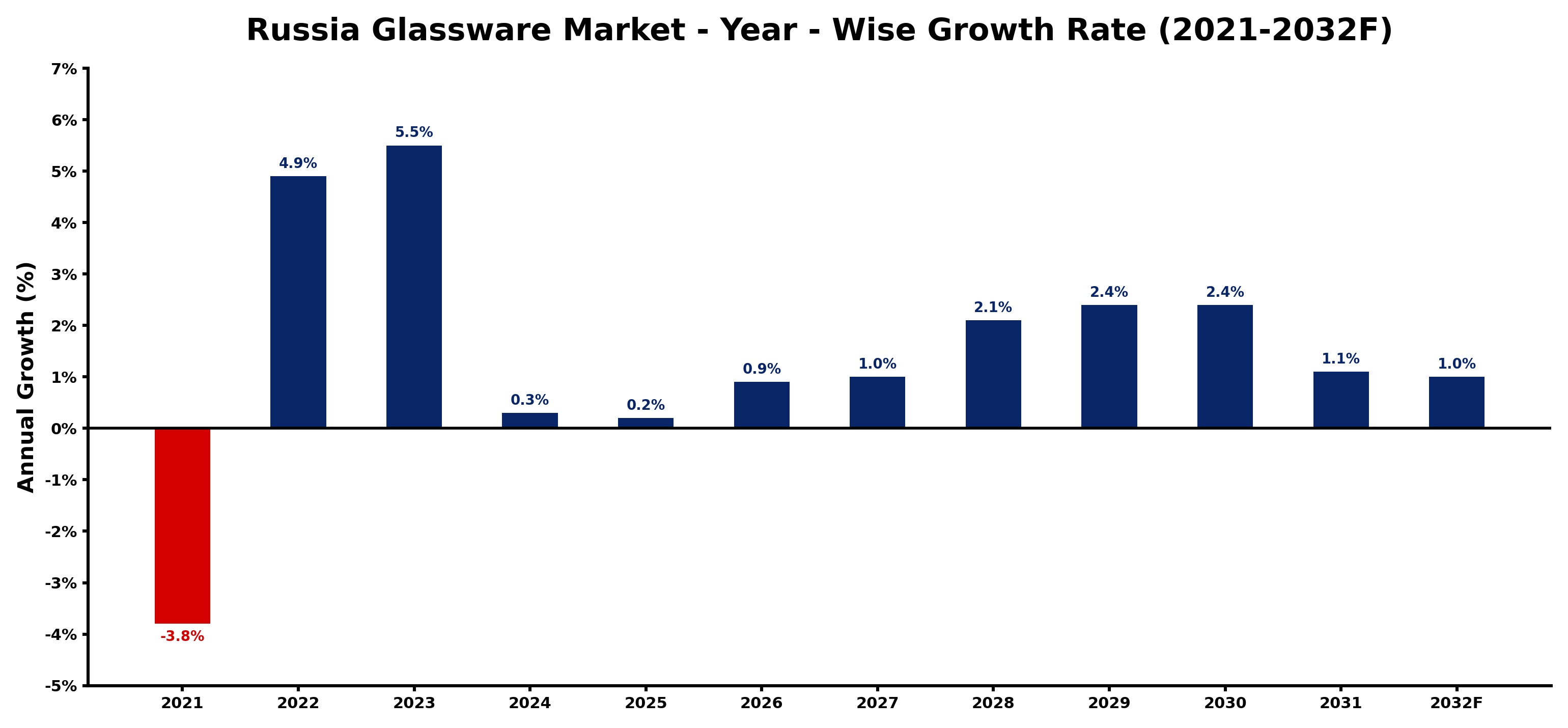
The table below presents the year‑wise growth rates along with the key drivers influencing the market
| Year | Growth Rate | Major Drivers |
| 2021 | -3.8% | Increasing industrial automation investments |
| 2022 | 4.9% | Rising electricity demand across industries |
| 2023 | 5.5% | Increasing adoption of advanced technologies |
| 2024 | 0.3% | Increasing smart city development projects |
| 2025 | 0.2% | Government infrastructure modernization initiatives |
| 2026 | 0.9% | Increasing industrial infrastructure investments |
| 2027 | 1.0% | Expansion of commercial construction activities |
| 2028 | 2.1% | Growing renewable energy integration projects |
| 2029 | 2.4% | Government infrastructure modernization initiatives |
| 2030 | 2.4% | Increasing industrial infrastructure investments |
| 2031 | 1.1% | Rising electricity demand across industries |
| 2032 | 1.0% | Expansion of transportation and logistics networks |
Note - Market size estimations and growth projections presented in this report are based on 6Wresearch’s advanced forecasting approach, validated with industry datasets as of June 2026.
Russia Glassware Market Synopsis
In recent years, the Russia glassware market has experienced robust growth due to a burgeoning middle class and an appetite for premium products. However, the market is now on a path that requires adaptation as economic conditions fluctuate and consumer behavior shifts toward sustainability and innovation.
While the past decade has seen a strong demand for traditional glassware, the future points toward a greater embrace of contemporary designs and environmentally friendly manufacturing processes. The hospitality sector's expansion also presents opportunities for innovative glass products catering to luxury and functionality.
Russia Glassware Market Key Takeaways
- Rising disposable incomes are significantly increasing demand for luxurious and decorative glass products.
- Urbanization is driving the trend towards modern and innovative glassware designs.
- The hospitality sector's growth is opening new avenues for product development and sales.
- Export opportunities are enhancing production capabilities and market competitiveness.
- Technological advancements are leading to improved manufacturing efficiencies and lower prices.
Evaluation of Restraints in Russia Glassware Market
Despite the promising growth prospects, the Russia glassware market faces significant challenges. High raw material costs present a continual hurdle, affecting pricing strategies and profit margins for domestic manufacturers. Additionally, the influx of lower-priced imported goods intensifies competition, making it difficult for local producers to maintain market share. Regulatory hurdles related to safety standards also add complexity to manufacturing processes, requiring companies to navigate stringent compliance measures. Finally, the pandemic has underscored vulnerabilities in supply chains, highlighting the need for more resilient operational strategies.
Russia Glassware Market Trends
Key trends are shaping the Russia glassware market, including an increasing consumer focus on personalization and unique product offerings. This shift is pushing manufacturers to innovate with colored and custom-designed glass items that stand out in the marketplace. Additionally, sustainability practices are gaining traction, prompting companies to explore eco-friendly materials and production methods. The rise in e-commerce also influences consumer buying patterns, with a growing preference for online platforms offering convenience and a wider selection of glassware.
Russia Glassware Market Opportunities
The market is ripe for growth and investment, particularly in segments focused on luxury and artisanal glass products. As consumer preferences evolve, brands that emphasize craftsmanship and unique designs are poised to capture a more affluent demographic. Additionally, enhancing export strategies can help local manufacturers penetrate international markets, leveraging the reputation of Russian glass quality. Finally, advancements in technology can enable firms to streamline operations and reduce costs, thereby expanding accessibility to a broader audience.
Government Initiatives in the Russia Glassware Market
The Russian government has been proactive in supporting the glassware industry through various initiatives aimed at enhancing manufacturing capabilities and encouraging exports. Policies focused on developing domestic production capacity are critical, as they aim to reduce dependency on imports while simultaneously fostering innovation. Public funding for research and development in sustainable materials and efficient manufacturing practices is also crucial, as it aligns with global trends toward eco-friendliness and resource conservation.
Future Insights of the Russia Glassware Market
Looking ahead to 2026-2032, the Russia glassware market is expected to evolve significantly. With a stronger focus on luxury and customization, brands that adapt to changing consumer preferences will thrive. The anticipated recovery from pandemic-related disruptions will likely lead to a resurgence in demand, particularly in the hospitality sector. Moreover, as technological advancements continue to streamline production and enhance quality, the market's competitive landscape may shift, offering exciting prospects for both established and emerging players.
Russia Glassware Market Latest Developments (May 2025 - June 2026)
Recent industry movements indicate a solid recovery in the Russia glassware market post-pandemic, with a notable uptick in domestic production capabilities. Manufacturers are increasingly leveraging digital marketing strategies to reach consumers online, expanding their customer base effectively. Furthermore, collaborative initiatives within the sector are fostering innovation, leading to the introduction of new product lines that cater to evolving consumer tastes.
Russia Glassware Market - Key Attractiveness of the Report
- 10 Years of Market Numbers
- Historical Data Starting from 2022 to 2025
- Base Year: 2025
- Forecast Data until 2032
- Key Performance Indicators Impacting the Market
- Major Upcoming Developments and Projects
Key Highlights of the Report:
- Russia Glassware Market Outlook
- Market Size of Russia Glassware Market, 2025
- Forecast of Russia Glassware Market, 2032
- Historical Data and Forecast of Russia Glassware Revenues & Volume for the Period 2022-2032F
- Russia Glassware Market Trend Evolution
- Russia Glassware Market Drivers and Challenges
- Russia Glassware Price Trends
- Russia Glassware Porter's Five Forces
- Russia Glassware Industry Life Cycle
- Historical Data and Forecast of Russia Glassware Market Revenues & Volume By Type for the Period 2022-2032F
- Historical Data and Forecast of Russia Glassware Market Revenues & Volume By Soda Lime Glass for the Period 2022-2032F
- Historical Data and Forecast of Russia Glassware Market Revenues & Volume By Lead Glass for the Period 2022-2032F
- Historical Data and Forecast of Russia Glassware Market Revenues & Volume By Heat Resistant Glass for the Period 2022-2032F
- Historical Data and Forecast of Russia Glassware Market Revenues & Volume By Distribution Channel for the Period 2022-2032F
- Historical Data and Forecast of Russia Glassware Market Revenues & Volume By e-Commerce for the Period 2022-2032F
- Historical Data and Forecast of Russia Glassware Market Revenues & Volume By Supermarkets/Hypermarkets for the Period 2022-2032F
- Historical Data and Forecast of Russia Glassware Market Revenues & Volume By Specialized Stores for the Period 2022-2032F
- Historical Data and Forecast of Russia Glassware Market Revenues & Volume By End-user for the Period 2022-2032F
- Historical Data and Forecast of Russia Glassware Market Revenues & Volume By Hotels & Restaurants for the Period 2022-2032F
- Historical Data and Forecast of Russia Glassware Market Revenues & Volume By Corporate Canteens for the Period 2022-2032F
- Historical Data and Forecast of Russia Glassware Market Revenues & Volume By Bars & Caf© for the Period 2022-2032F
- Historical Data and Forecast of Russia Glassware Market Revenues & Volume By Household for the Period 2022-2032F
- Historical Data and Forecast of Russia Glassware Market Revenues & Volume By Others for the Period 2022-2032F
- Russia Glassware Import Export Trade Statistics
- Market Opportunity Assessment By Type
- Market Opportunity Assessment By Distribution Channel
- Market Opportunity Assessment By End-user
- Russia Glassware Top Companies Market Share
- Russia Glassware Competitive Benchmarking By Technical and Operational Parameters
- Russia Glassware Company Profiles
- Russia Glassware Key Strategic Recommendations






































