Tajikistan Glassware Market Size, Share & Growth Rate
The Tajikistan Glassware Market was estimated at USD 383 Million in 2025 and is projected to reach USD 530 Million by 2032, growing at a CAGR of 4.7% from 2026 to 2032. This growth trajectory is primarily driven by the increasing consumer demand for high-quality and aesthetically appealing glass products across both residential and commercial sectors. The flourishing hospitality industry, alongside rising disposable incomes and a shift in consumer preferences towards sustainable and unique glassware, plays a crucial role in propelling this market forward.
Tajikistan Glassware Market Year-wise Growth Rate and Key Drivers
This graph highlights how the Tajikistan Glassware Market has steadily grown over the years, supported by major growth factors.
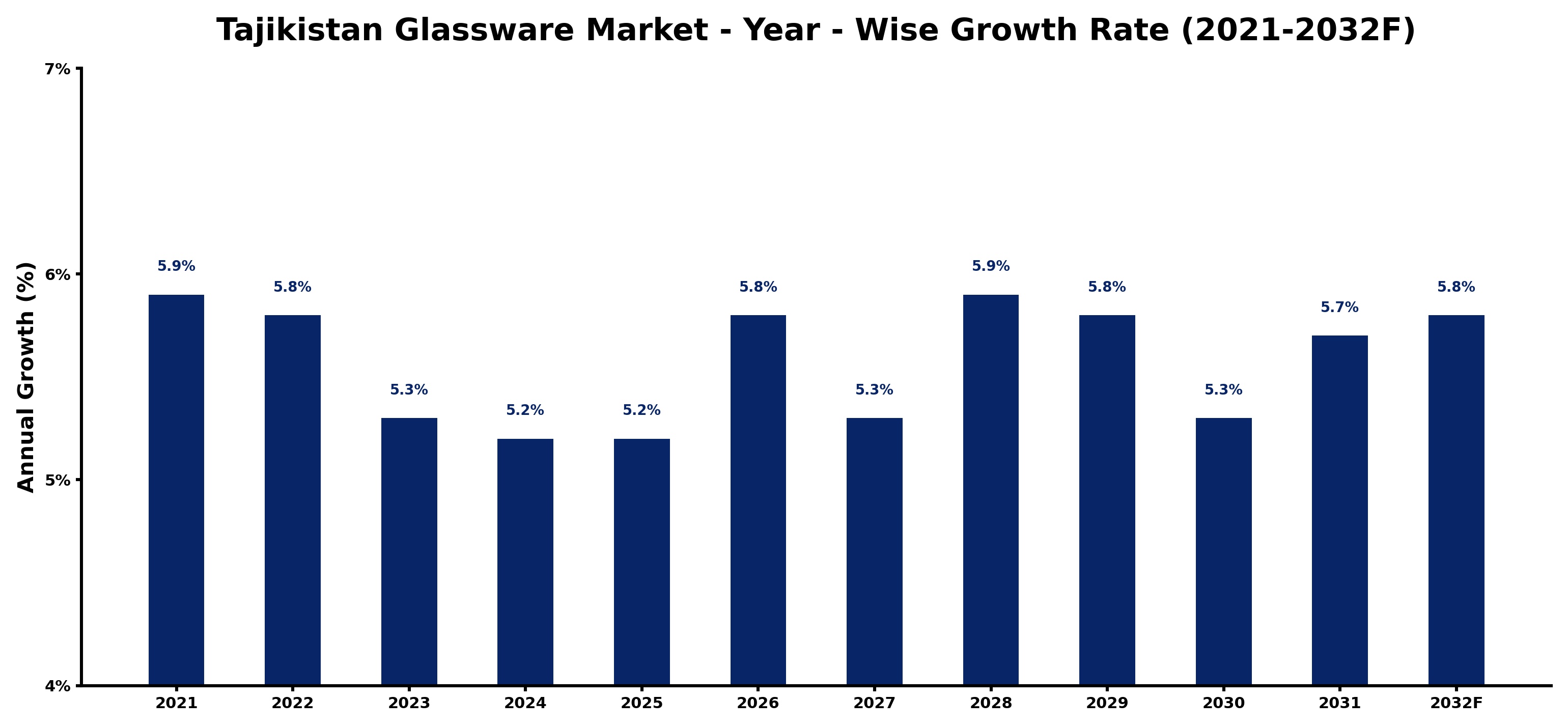
The table below presents the year‑wise growth rates along with the key drivers influencing the market
| Year | Growth Rate | Major Drivers |
| 2021 | 5.9% | Growing urbanization and commercial development |
| 2022 | 5.8% | Expansion of manufacturing activities |
| 2023 | 5.3% | Expansion of commercial construction activities |
| 2024 | 5.2% | Increasing adoption of advanced technologies |
| 2025 | 5.2% | Growing urbanization and commercial development |
| 2026 | 5.8% | Increasing smart city development projects |
| 2027 | 5.3% | Rapid growth in telecom and data center sectors |
| 2028 | 5.9% | Increasing industrial automation investments |
| 2029 | 5.8% | Rising electricity demand across industries |
| 2030 | 5.3% | Expansion of transportation and logistics networks |
| 2031 | 5.7% | Increasing industrial automation investments |
| 2032 | 5.8% | Rapid growth in telecom and data center sectors |
Note - Market size estimations and growth projections presented in this report are based on 6Wresearch’s advanced forecasting approach, validated with industry datasets as of June 2026.
Tajikistan Glassware Market Synopsis
The predominant force shaping the Tajikistan Glassware Market is the growing inclination towards premium glassware products. Consumers are not just looking for functionality; they desire distinctive designs that enhance their living spaces and dining experiences. This shift reflects a broader trend in consumer behavior, where quality and aesthetics are paramount.
Moreover, the market is evolving with a marked interest in sustainability. Eco-conscious consumers increasingly prefer recyclable and eco-friendly glassware, pushing brands to innovate and adapt their product lines. The blend of traditional craftsmanship with modern design is capturing consumer attention, particularly in urban areas.
Tajikistan Glassware Market Key Takeaways
- Strong demand for premium and artisanal glassware is reshaping product offerings.
- Increased consumer spending and rising incomes are driving market growth.
- Sustainability is a key trend, influencing purchasing decisions and product development.
- Online retail channels are gaining traction as consumers seek convenience and variety.
- Government initiatives are supporting local production, fostering industry growth.
Evaluation of Restraints in Tajikistan Glassware Market
Despite the positive growth outlook, the Tajikistan Glassware Market faces several significant challenges. The limited domestic production capacity leads to a reliance on imported glassware, making the market vulnerable to fluctuations in international trade regulations and currency exchange rates. Additionally, competition from cheaper alternatives such as plastic and ceramic products threatens market expansion. Infrastructure constraints, particularly in remote areas, hamper efficient distribution, which can adversely impact sales. Moreover, low consumer awareness regarding the benefits of glassware products can curtail demand, alongside a general lack of disposable income in certain demographics.
Tajikistan Glassware Market Trends
Current trends within the Tajikistan Glassware Market indicate a robust shift towards premium products that emphasize both quality and design. A marked increase in interest in handcrafted and artisanal glassware is evident, as consumers seek unique items that reflect personal style and enhance home aesthetics. Sustainability remains a powerful driver, with more customers opting for eco-friendly glassware options. Furthermore, the rise of e-commerce is altering traditional purchasing behaviors, enabling customers to explore a broader range of glassware options than ever before.
Tajikistan Glassware Market Opportunities
The Tajikistan glassware market presents numerous opportunities for growth and investment. With increasing disposable incomes and evolving consumer preferences, manufacturers can tap into the demand for innovative and sustainably produced glassware. Collaborating with local artisans to create authentic, culturally resonant products may provide a competitive edge. Additionally, expanding distribution channels, particularly online, can enhance market reach and convenience for consumers seeking premium glassware.
Government Initiatives in the Tajikistan Glassware Market
Government policies in Tajikistan are increasingly focused on fostering local glassware production to reduce reliance on imports. Initiatives include the implementation of tariffs on imported glassware, alongside financial incentives and subsidies aimed at supporting domestic manufacturers. Efforts to enhance production quality and capacity, often in collaboration with international partners, are helping to bolster the local glassware industry's competitiveness and sustainability.
Future Insights of the Tajikistan Glassware Market
Looking ahead to the years 2026-2032, the Tajikistan Glassware Market appears set for continued growth driven by urbanization and an expanding middle class. As consumer preferences evolve towards higher-quality home products, the demand for glassware is likely to increase. The ongoing expansion of the hospitality sector will also create additional opportunities for glassware suppliers. In line with global trends, a focus on sustainability and environmentally friendly products will be critical for future market players seeking to capture the attention of conscientious consumers.
Tajikistan Glassware Market Latest Developments (May 2025 - June 2026)
Recent developments in the Tajikistan glassware sector indicate a shift towards greater innovation and sustainability. Industry stakeholders are increasingly investing in technology that enhances production efficiency while meeting consumer demands for eco-friendly products. Moreover, there has been a noticeable rise in partnerships between local artisans and manufacturers aimed at producing culturally inspired glassware. Additionally, online retail platforms are expanding their offerings, allowing consumers to access a diverse range of glassware products more conveniently.
Tajikistan Glassware Market - Key Attractiveness of the Report
- 10 Years of Market Numbers
- Historical Data Starting from 2022 to 2025
- Base Year: 2025
- Forecast Data until 2032
- Key Performance Indicators Impacting the Market
- Major Upcoming Developments and Projects
Key Highlights of the Report:
- Tajikistan Glassware Market Outlook
- Market Size of Tajikistan Glassware Market, 2025
- Forecast of Tajikistan Glassware Market, 2032
- Historical Data and Forecast of Tajikistan Glassware Revenues & Volume for the Period 2022-2032F
- Tajikistan Glassware Market Trend Evolution
- Tajikistan Glassware Market Drivers and Challenges
- Tajikistan Glassware Price Trends
- Tajikistan Glassware Porter's Five Forces
- Tajikistan Glassware Industry Life Cycle
- Historical Data and Forecast of Tajikistan Glassware Market Revenues & Volume By Type for the Period 2022-2032F
- Historical Data and Forecast of Tajikistan Glassware Market Revenues & Volume By Soda Lime Glass for the Period 2022-2032F
- Historical Data and Forecast of Tajikistan Glassware Market Revenues & Volume By Lead Glass for the Period 2022-2032F
- Historical Data and Forecast of Tajikistan Glassware Market Revenues & Volume By Heat Resistant Glass for the Period 2022-2032F
- Historical Data and Forecast of Tajikistan Glassware Market Revenues & Volume By Distribution Channel for the Period 2022-2032F
- Historical Data and Forecast of Tajikistan Glassware Market Revenues & Volume By e-Commerce for the Period 2022-2032F
- Historical Data and Forecast of Tajikistan Glassware Market Revenues & Volume By Supermarkets/Hypermarkets for the Period 2022-2032F
- Historical Data and Forecast of Tajikistan Glassware Market Revenues & Volume By Specialized Stores for the Period 2022-2032F
- Historical Data and Forecast of Tajikistan Glassware Market Revenues & Volume By End-user for the Period 2022-2032F
- Historical Data and Forecast of Tajikistan Glassware Market Revenues & Volume By Hotels & Restaurants for the Period 2022-2032F
- Historical Data and Forecast of Tajikistan Glassware Market Revenues & Volume By Corporate Canteens for the Period 2022-2032F
- Historical Data and Forecast of Tajikistan Glassware Market Revenues & Volume By Bars & Caf for the Period 2022-2032F
- Historical Data and Forecast of Tajikistan Glassware Market Revenues & Volume By Household for the Period 2022-2032F
- Historical Data and Forecast of Tajikistan Glassware Market Revenues & Volume By Others for the Period 2022-2032F
- Tajikistan Glassware Import Export Trade Statistics
- Market Opportunity Assessment By Type
- Market Opportunity Assessment By Distribution Channel
- Market Opportunity Assessment By End-user
- Tajikistan Glassware Top Companies Market Share
- Tajikistan Glassware Competitive Benchmarking By Technical and Operational Parameters
- Tajikistan Glassware Company Profiles
- Tajikistan Glassware Key Strategic Recommendations






































