Ghana Glassware Market Size, Share & Growth Rate
The Ghana Glassware Market was estimated at USD 296 Million in 2025 and is projected to reach USD 419 Million by 2032, growing at a CAGR of 5.1% from 2026 to 2032. This upward trajectory is driven by an increasing consumer appetite for elegant and functional glassware across various settings, including households, restaurants, and hotels. The rising trend of home entertaining and dining out has further accelerated demand for high-quality glass products, propelling local manufacturers to innovate and enhance product offerings.
Ghana Glassware Market Year-wise Growth Rate and Key Drivers
This graph highlights how the Ghana Glassware Market has steadily grown over the years, supported by major growth factors.
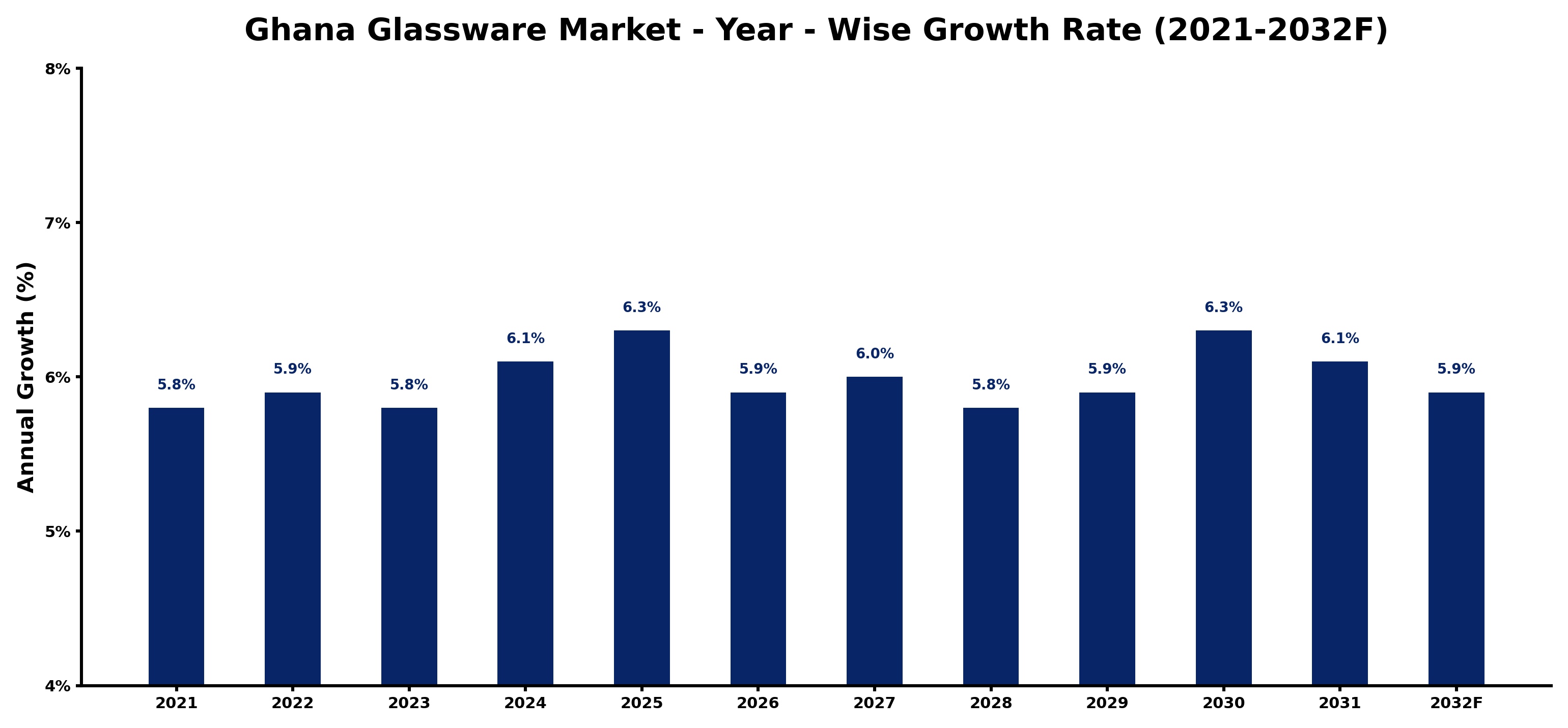
The table below presents the year‑wise growth rates along with the key drivers influencing the market
| Year | Growth Rate | Major Drivers |
| 2021 | 5.8% | Increasing industrial automation investments |
| 2022 | 5.9% | Increasing industrial automation investments |
| 2023 | 5.8% | Growing renewable energy integration projects |
| 2024 | 6.1% | Increasing industrial infrastructure investments |
| 2025 | 6.3% | Government infrastructure modernization initiatives |
| 2026 | 5.9% | Growing renewable energy integration projects |
| 2027 | 6.0% | Increasing smart city development projects |
| 2028 | 5.8% | Rising electricity demand across industries |
| 2029 | 5.9% | Expansion of transportation and logistics networks |
| 2030 | 6.3% | Growing renewable energy integration projects |
| 2031 | 6.1% | Increasing industrial automation investments |
| 2032 | 5.9% | Growing renewable energy integration projects |
Note - Market size estimations and growth projections presented in this report are based on 6Wresearch's advanced forecasting approach, validated with industry datasets as of June 2026.
Ghana Glassware Market Synopsis
Despite recent growth, the Ghana glassware market is at a pivotal juncture, with promising prospects fueled by evolving consumer preferences. As consumers shift towards stylish, artisanal options for both daily use and special occasions, the market is expected to thrive, leveraging the blend of local craftsmanship and international design influences.
Looking ahead, the market is poised to experience substantial advancements in manufacturing techniques and design innovations. As Ghana continues to embrace a culture of home entertaining and aesthetic home décor, the glassware market will likely expand to accommodate these evolving trends.
Ghana Glassware Market Key Takeaways
- The market is expected to grow significantly, driven by consumer demand for both decorative and functional glassware.
- Local craftsmanship and international design are merging, enhancing the appeal of glass products.
- Technological advancements are revolutionizing glass manufacturing and customization options.
- Increasing competition from alternative materials necessitates innovation and sustainability in glassware production.
- Government policies are fostering local production, ensuring quality standards, and promoting market growth.
Evaluation of Restraints in Ghana Glassware Market
The Ghana glassware market encounters significant challenges, primarily from the rising popularity of alternative materials such as plastic and stainless steel. These substitutes are often perceived as more durable and cost-effective, prompting glassware manufacturers to rethink their market strategies. Additionally, consumer preferences are shifting towards eco-friendly products, making it imperative for manufacturers to adapt and innovate. As sustainability becomes a focal point in consumer choices, glassware producers face pressure to meet these evolving expectations, which may strain traditional production methods.
Ghana Glassware Market Trends
Current trends in the Ghana glassware market reflect a growing preference for artisanal products that offer unique designs and storytelling elements. Consumers are gravitating towards handmade glassware, which conveys a sense of personal connection and cultural significance. Furthermore, there is a noticeable shift towards multifunctional glassware that serves both aesthetic and practical purposes, appealing to the modern lifestyle. The rise of e-commerce platforms is also reshaping distribution channels, enabling consumers to access a broader range of glassware products.
Ghana Glassware Market Opportunities
The potential for growth in the Ghana glassware market lies in the increasing interest in sustainable and eco-friendly products. Manufacturers who can pioneer innovative designs that minimize environmental impact while maximizing functionality will be well-positioned to capture a larger share of the market. Additionally, developing partnerships with local artisans to blend traditional techniques with modern aesthetics could attract a discerning clientele. The ongoing urbanization and expanding middle class also present significant opportunities for market expansion.
Government Initiatives in the Ghana Glassware Market
The government of Ghana has recognized the significance of the glassware market in supporting the local economy. Various initiatives have been implemented to bolster local production, including investment incentives for glass manufacturing technologies. Additionally, the government is promoting standards and regulations that ensure product quality and safety, which are crucial for fostering consumer confidence in locally produced glassware. These efforts aim not only to enhance market competitiveness but also to encourage sustainable practices within the industry.
Future Insights of the Ghana Glassware Market
Looking towards 2026-2032, the Ghana glassware market is expected to experience a transformation driven by technological innovations and shifting consumer behaviors. The focus on sustainability will likely dominate product development, compelling manufacturers to innovate in materials and processes. As home entertaining continues to gain popularity, the demand for aesthetically pleasing and functional glassware will rise. Additionally, increasing foreign investment in local production will foster competitiveness and further expand market opportunities.
Ghana Glassware Market Latest Developments (May 2025 - June 2026)
In recent months, the Ghana glassware market has seen a notable push towards enhancing local craftsmanship. Initiatives focused on skills training for artisans are becoming increasingly popular, aimed at enriching the quality and diversity of glassware products. Furthermore, manufacturers are leveraging technology to improve production efficiency and product customization, catering to a more discerning consumer base that seeks unique, personalized options. Overall, the direction of the industry indicates a commitment to innovation and quality as it looks toward future growth.
Ghana Glassware Market - Key Attractiveness of the Report
- 10 Years of Market Numbers
- Historical Data Starting from 2022 to 2025
- Base Year: 2025
- Forecast Data until 2032
- Key Performance Indicators Impacting the Market
- Major Upcoming Developments and Projects
Key Highlights of the Report:
- Ghana Glassware Market Outlook
- Market Size of Ghana Glassware Market, 2025
- Forecast of Ghana Glassware Market, 2032
- Historical Data and Forecast of Ghana Glassware Revenues & Volume for the Period 2022-2032F
- Ghana Glassware Market Trend Evolution
- Ghana Glassware Market Drivers and Challenges
- Ghana Glassware Price Trends
- Ghana Glassware Porter's Five Forces
- Ghana Glassware Industry Life Cycle
- Historical Data and Forecast of Ghana Glassware Market Revenues & Volume By Type for the Period 2022-2032F
- Historical Data and Forecast of Ghana Glassware Market Revenues & Volume By Soda Lime Glass for the Period 2022-2032F
- Historical Data and Forecast of Ghana Glassware Market Revenues & Volume By Lead Glass for the Period 2022-2032F
- Historical Data and Forecast of Ghana Glassware Market Revenues & Volume By Heat Resistant Glass for the Period 2022-2032F
- Historical Data and Forecast of Ghana Glassware Market Revenues & Volume By Distribution Channel for the Period 2022-2032F
- Historical Data and Forecast of Ghana Glassware Market Revenues & Volume By e-Commerce for the Period 2022-2032F
- Historical Data and Forecast of Ghana Glassware Market Revenues & Volume By Supermarkets/Hypermarkets for the Period 2022-2032F
- Historical Data and Forecast of Ghana Glassware Market Revenues & Volume By Specialized Stores for the Period 2022-2032F
- Historical Data and Forecast of Ghana Glassware Market Revenues & Volume By End-user for the Period 2022-2032F
- Historical Data and Forecast of Ghana Glassware Market Revenues & Volume By Hotels & Restaurants for the Period 2022-2032F
- Historical Data and Forecast of Ghana Glassware Market Revenues & Volume By Corporate Canteens for the Period 2022-2032F
- Historical Data and Forecast of Ghana Glassware Market Revenues & Volume By Bars & Caf for the Period 2022-2032F
- Historical Data and Forecast of Ghana Glassware Market Revenues & Volume By Household for the Period 2022-2032F
- Historical Data and Forecast of Ghana Glassware Market Revenues & Volume By Others for the Period 2022-2032F
- Ghana Glassware Import Export Trade Statistics
- Market Opportunity Assessment By Type
- Market Opportunity Assessment By Distribution Channel
- Market Opportunity Assessment By End-user
- Ghana Glassware Top Companies Market Share
- Ghana Glassware Competitive Benchmarking By Technical and Operational Parameters
- Ghana Glassware Company Profiles
- Ghana Glassware Key Strategic Recommendations






































