Philippines Greenhouse Horticulture Market Size, Share & Growth Rate
The Philippines Greenhouse Horticulture Market was estimated at USD 188 Million in 2025 and is projected to reach USD 207 Million by 2032, growing at a CAGR of 1.4% from 2026 to 2032. This growth is primarily fueled by the increasing need for controlled environment agriculture to enhance yield and ensure year-round crop production. As local agricultural practices adopt modern greenhouse technologies, they are better equipped to tackle challenges posed by climate change and population growth.
Philippines Greenhouse Horticulture Market Year-wise Growth Rate and Key Drivers
This graph highlights how the Philippines Greenhouse Horticulture Market has steadily grown over the years, supported by major growth factors.
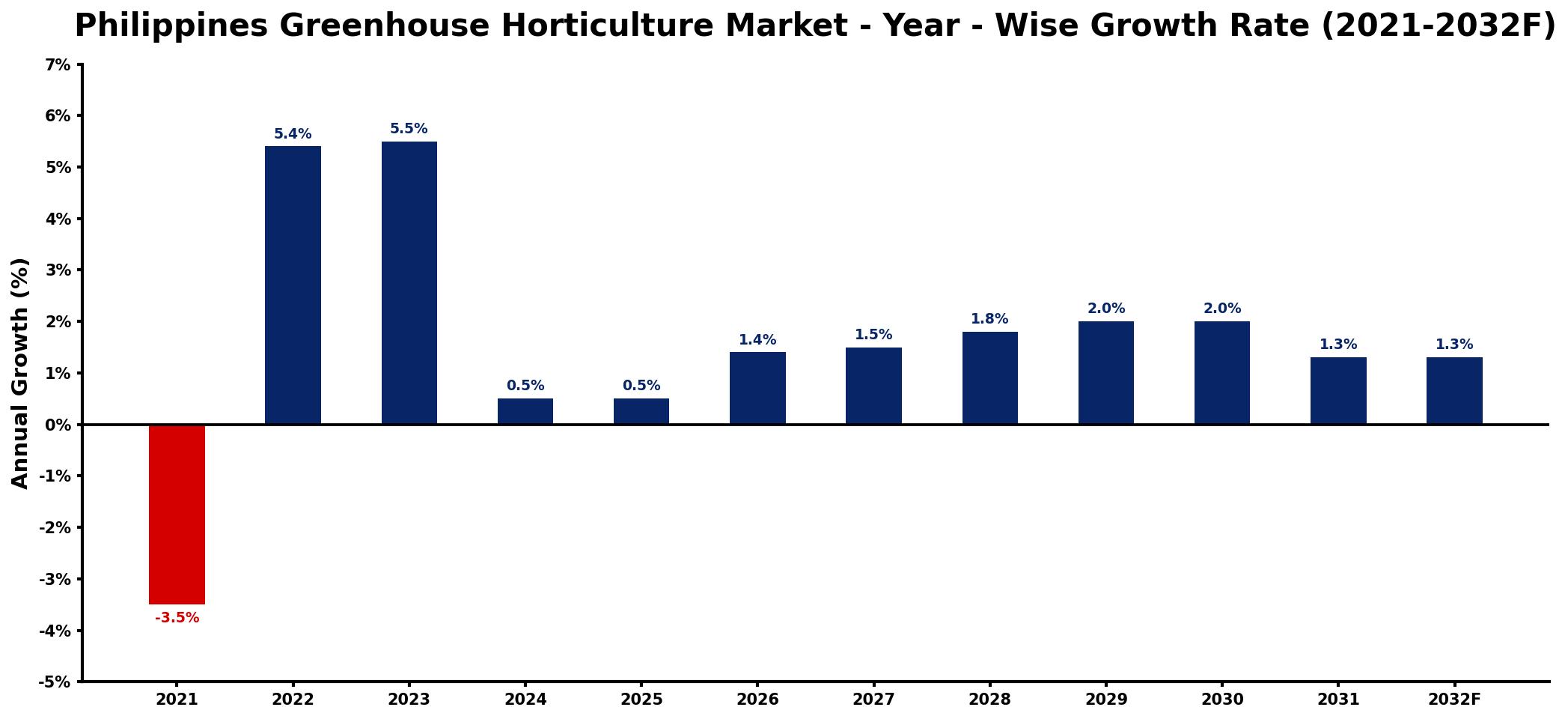
The table below presents the year‑wise growth rates along with the key drivers influencing the market
| Year | Growth Rate | Major Drivers |
| 2021 | -3.5% | reduced consumer interest in agriculture |
| 2022 | 5.4% | increased investment in technology |
| 2023 | 5.5% | growing popularity of organic produce |
| 2024 | 0.5% | expansion of export markets |
| 2025 | 0.5% | rising demand for local produce |
| 2026 | 1.4% | enhanced agricultural research initiatives |
| 2027 | 1.5% | greater focus on sustainability practices |
| 2028 | 1.8% | improved distribution channels efficiency |
| 2029 | 2.0% | expanding urban farming initiatives |
| 2030 | 2.0% | increased government funding programs |
| 2031 | 1.3% | growing consumer awareness on nutrition |
| 2032 | 1.3% | rising popularity of eco-friendly practices |
Note: Market size estimations and growth projections presented in this report are based on 6Wresearch's proprietary forecasting methodology, utilizing the latest available industry data, government publications, and primary research inputs.
Philippines Greenhouse Horticulture Market Synopsis
A significant driver of the Philippines greenhouse horticulture market is the government's focus on food security. With the national population projected to continue rising, the demand for locally produced, sustainable food sources is becoming more critical. Greenhouses provide an effective solution, allowing farmers to cultivate high-yield crops throughout the year.
Despite the exciting potential, the market remains relatively underdeveloped compared to regional counterparts like Thailand and Vietnam. Nonetheless, the area under greenhouse cultivation in the Philippines is gradually expanding, currently estimated at 4 square kilometers with a production capacity of approximately 9 tons per day.
Philippines Greenhouse Horticulture Market Key Takeaways
- Greenhouse technology is essential for maximizing agricultural yields and providing a reliable food supply.
- Government initiatives focusing on crop intensification are paving the way for market growth.
- Investment in technology and infrastructure is crucial to overcoming initial capital challenges.
- Consumer demand for sustainable produce continues to rise, further driving market potential.
- The COVID-19 pandemic has stimulated renewed interest in local food production and home gardening.
Evaluation of Restraints in Philippines Greenhouse Horticulture Market
The growth of the Philippines greenhouse horticulture market faces several significant restraints. A primary limitation is the high initial investment needed to establish greenhouse infrastructure, which can deter potential investors and farmers. Additionally, energy consumption optimization within these structures remains a challenge, impacting operational costs. Training and skill development for farmers are also essential, as many lack the necessary knowledge to manage controlled environments effectively. These issues can slow the markets overall advancement and adoption of advanced greenhouse practices.
Philippines Greenhouse Horticulture Market Trends
Several trends are currently shaping the Philippines greenhouse horticulture market. The rising popularity of organic and sustainable produce has led to increased consumer awareness and demand for greenhouse-grown vegetables and fruits. Additionally, advancements in greenhouse technology, such as automated systems for climate control and irrigation, are enhancing productivity and resource efficiency. The integration of smart farming practices is becoming more prevalent, allowing farmers to monitor and manage their crops remotely.
Philippines Greenhouse Horticulture Market Opportunities
The potential for growth in the Philippines greenhouse horticulture market is substantial. Investors can explore opportunities in niche markets, such as organic farming, which aligns with consumer preferences for sustainable products. Collaborations with technology firms to develop advanced agricultural solutions could also prove beneficial. Moreover, as the local population increases, the demand for fresh produce will likely expand, creating further openings for greenhouse operations to thrive.
Government Initiatives in the Philippines Greenhouse Horticulture Market
The Philippine government has recognized the significance of greenhouse horticulture in achieving food security and is implementing several initiatives to promote this sector. Policies aimed at supporting agricultural technology adoption and offering incentives for greenhouse establishment are in place. Various programs are being launched to facilitate farmer training and skill development, which is crucial for the effective management of greenhouse operations. These initiatives collectively serve to bolster the market and attract investment.
Future Insights of the Philippines Greenhouse Horticulture Market
Looking ahead to 2026-2032, the Philippines greenhouse horticulture market is poised for steady growth as various factors converge to create a more favorable environment for investment. With continued emphasis on food security, coupled with an evolving consumer landscape that favors local and sustainable produce, the sector is likely to witness increased activity. Furthermore, advancements in technology and increased government support will facilitate the adoption of innovative practices among farmers, ensuring a sustainable trajectory for the market.
Philippines Greenhouse Horticulture Market Latest Developments (2025 - 2026)
Recent developments in the Philippines greenhouse horticulture market indicate a growing enthusiasm for greenhouse technology among local farmers. Initiatives aimed at educating farmers about the benefits of greenhouse cultivation have gained traction, leading to an uptick in new greenhouse installations. Additionally, collaborations between government agencies and private entities are being established to enhance infrastructure and technology dissemination, further strengthening the sector's foundation.
Philippines Greenhouse Horticulture Market - Key Attractiveness of the Report
- 10 Years of Market Numbers
- Historical Data Starting from 2022 to 2025
- Base Year: 2025
- Forecast Data until 2032
- Key Performance Indicators Impacting the Market
- Major Upcoming Developments and Projects
Key Highlights of the Report:
- Philippines Greenhouse Horticulture Market Outlook
- Market Size of Philippines Greenhouse Horticulture Market, 2025
- Forecast of Philippines Greenhouse Horticulture Market, 2032
- Historical Data and Forecast of Philippines Greenhouse Horticulture Revenues & Volume for the Period 2022-2032F
- Philippines Greenhouse Horticulture Market Trend Evolution
- Philippines Greenhouse Horticulture Market Drivers and Challenges
- Philippines Greenhouse Horticulture Price Trends
- Philippines Greenhouse Horticulture Porter's Five Forces
- Philippines Greenhouse Horticulture Industry Life Cycle
- Historical Data and Forecast of Philippines Greenhouse Horticulture Market Revenues & Volume By Material Type for the Period 2022-2032F
- Historical Data and Forecast of Philippines Greenhouse Horticulture Market Revenues & Volume By Glass for the Period 2022-2032F
- Historical Data and Forecast of Philippines Greenhouse Horticulture Market Revenues & Volume By Plastic for the Period 2022-2032F
- Historical Data and Forecast of Philippines Greenhouse Horticulture Market Revenues & Volume By Crop Type for the Period 2022-2032F
- Historical Data and Forecast of Philippines Greenhouse Horticulture Market Revenues & Volume By Fruits and Vegetables for the Period 2022-2032F
- Historical Data and Forecast of Philippines Greenhouse Horticulture Market Revenues & Volume By Flowers and Ornamentals for the Period 2022-2032F
- Historical Data and Forecast of Philippines Greenhouse Horticulture Market Revenues & Volume By Nursery Crops for the Period 2022-2032F
- Historical Data and Forecast of Philippines Greenhouse Horticulture Market Revenues & Volume By Others for the Period 2022-2032F
- Historical Data and Forecast of Philippines Greenhouse Horticulture Market Revenues & Volume By Technology for the Period 2022-2032F
- Historical Data and Forecast of Philippines Greenhouse Horticulture Market Revenues & Volume By Heating System for the Period 2022-2032F
- Historical Data and Forecast of Philippines Greenhouse Horticulture Market Revenues & Volume By Cooling System for the Period 2022-2032F
- Philippines Greenhouse Horticulture Import Export Trade Statistics
- Market Opportunity Assessment By Material Type
- Market Opportunity Assessment By Crop Type
- Market Opportunity Assessment By Technology
- Philippines Greenhouse Horticulture Top Companies Market Share
- Philippines Greenhouse Horticulture Competitive Benchmarking By Technical and Operational Parameters
- Philippines Greenhouse Horticulture Company Profiles
- Philippines Greenhouse Horticulture Key Strategic Recommendations






































