Philippines Hafnium Market Size, Share & Growth Rate
The Philippines Hafnium Market was estimated at USD 446 Million in 2025 and is projected to reach USD 584 Million by 2032, growing at a CAGR of 3.9% from 2026 to 2032. This upward trajectory is primarily driven by the increasing demand for hafnium in high-tech sectors, notably aerospace and electronics. As industries continue to focus on innovative materials that exhibit superior performance, the role of hafnium as a critical component is expected to gain prominence in various applications.
Philippines Hafnium Market Year-wise Growth Rate and Key Drivers
This graph highlights how the Philippines Hafnium Market has steadily grown over the years, supported by major growth factors.
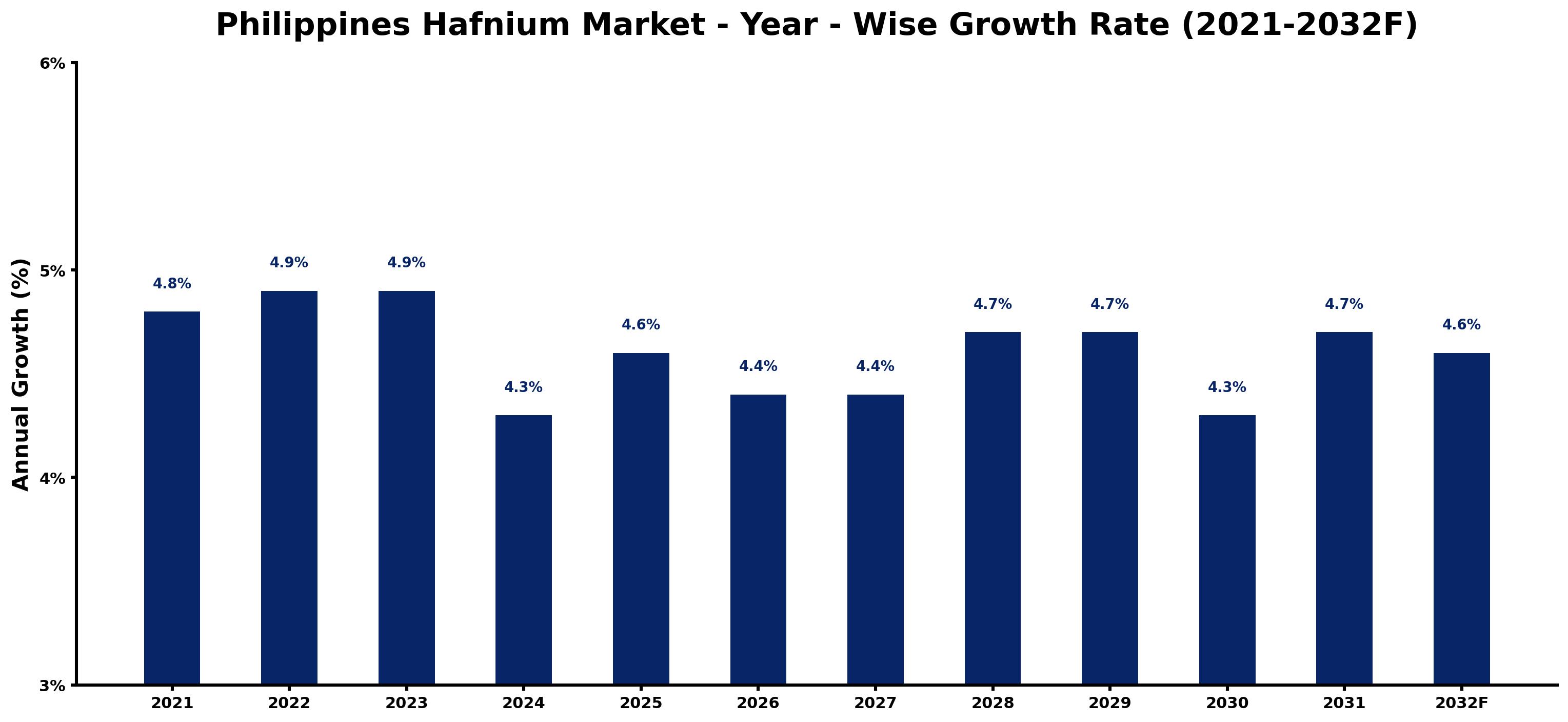
The table below presents the year‑wise growth rates along with the key drivers influencing the market
| Year | Growth Rate | Major Drivers |
| 2021 | 4.8% | Rising aerospace manufacturing investments |
| 2022 | 4.9% | Increased demand for electronics components |
| 2023 | 4.9% | Growth in renewable energy projects |
| 2024 | 4.3% | Expansion of defense sector applications |
| 2025 | 4.6% | Surge in semiconductor production needs |
| 2026 | 4.4% | Innovations in nuclear energy technologies |
| 2027 | 4.4% | Higher demand from automotive industry |
| 2028 | 4.7% | increased domestic production output |
| 2029 | 4.7% | Increased use in medical devices |
| 2030 | 4.3% | Rising investments in clean technologies |
| 2031 | 4.7% | expanding industrial usage applications |
| 2032 | 4.6% | rising demand from electronics |
Note: Market size estimations and growth projections presented in this report are based on 6Wresearch's proprietary forecasting methodology, utilizing the latest available industry data, government publications, and primary research inputs.
Philippines Hafnium Market Synopsis
In recent years, the hafnium market in the Philippines has witnessed a modest yet notable momentum, reflecting an emerging interest in its applications across several industries. Despite this growth, the market remains relatively small in size, primarily reliant on imports from China and Germany, which underscores the need for enhanced local sourcing strategies.
Looking ahead, the outlook for the Philippines hafnium market appears promising as industrial sectors recover from pandemic-related disruptions. With a growing emphasis on high-temperature alloys and neutron-absorbing materials, hafnium is well-positioned to cater to the evolving demands of the aerospace and nuclear energy industries, thereby driving sustained growth in the coming years.
Philippines Hafnium Market Key Takeaways
- The hafnium market in the Philippines is seeing significant growth due to its applications in aerospace and nuclear reactors.
- China and Germany are the leading sources of hafnium imports, highlighting the market's reliance on foreign supply.
- Hafniums unique properties make it indispensable for high-tech applications, particularly in electronics and alloying elements.
- The industry is facing challenges related to resource scarcity and complex extraction processes, which could impact growth.
- As post-pandemic recovery progresses, demand for hafnium is expected to rise, especially within technology-driven sectors.
Evaluation of Restraints in Philippines Hafnium Market
The Philippines hafnium market faces significant restraints that hinder its growth potential. One of the primary challenges is the limited availability of hafnium resources, as it is often extracted as a byproduct of zirconium minerals. This complex extraction process not only complicates supply but also escalates production costs, leading to market volatility. Furthermore, while hafnium has essential applications in high-tech industries, the overall global demand remains restricted primarily to specialized sectors, which could limit broader market expansion. These factors present notable challenges that require strategic management to navigate effectively.
Philippines Hafnium Market Trends
Current trends in the Philippines hafnium market reflect a growing alignment with global technological advancements. There is an increasing focus on the use of hafnium in cutting-edge electronics and advanced alloys, which are key to aerospace applications. Furthermore, research and development in the nuclear sector is intensifying, spurring demand for hafniums unique properties. Concurrently, sustainability initiatives are prompting industries to evaluate the lifecycle of materials, leading to greater interest in hafniums efficient performance at high temperatures. These trends are reshaping how hafnium is viewed within the manufacturing landscape.
Philippines Hafnium Market Opportunities
Opportunities in the Philippines hafnium market are increasingly visible, particularly in the aerospace and electronics sectors. As global demand for high-performance materials continues to rise, companies are likely to seek local partnerships to bolster supply chains and reduce reliance on imports. Furthermore, government initiatives aimed at promoting technological innovation could create favorable conditions for the development of local hafnium extraction and processing capabilities. By investing in research and leveraging hafniums advantages, stakeholders can explore avenues for expansion and long-term sustainability.
Government Initiatives in the Philippines Hafnium Market
The Philippine government has recognized the importance of strategic metals, including hafnium, in supporting economic growth. Through various initiatives aimed at enhancing industrial competitiveness, there is an increased focus on fostering partnerships between public and private sectors. Programs to encourage research and development in advanced materials science are being promoted, while incentives for sustainable practices in metal extraction and processing are gaining traction. These governmental efforts are vital in establishing a resilient hafnium market and ensuring that local industries benefit from emerging technological trends.
Future Insights of the Philippines Hafnium Market
The outlook for the Philippines hafnium market from 2026 to 2032 suggests a phase of gradual recovery and growth. As industries resume full operations post-pandemic, there is likely to be a significant uptick in demand driven by advancements in aerospace and nuclear technologies. Moreover, ongoing investments in research will likely unveil new applications for hafnium, further broadening its market potential. By positioning itself as a crucial resource for high-tech applications, the hafnium market in the Philippines is set to evolve, fostering a competitive edge for domestic players.
Philippines Hafnium Market Latest Developments (2025 - 2026)
In the recent months leading up to mid-2026, the Philippines hafnium market has witnessed strategic developments focused on enhancing local processing capabilities. New initiatives promoting collaboration between technology firms and research institutions are underway, aiming to innovate hafnium applications in the electronics sector. Additionally, industry stakeholders are assessing potential enhancements to supply chains to mitigate reliance on imported materials, thereby increasing local resilience. These shifts indicate a proactive approach towards positioning hafnium as a vital component in emerging technologies.
Philippines Hafnium Market - Key Attractiveness of the Report
- 10 Years of Market Numbers
- Historical Data Starting from 2022 to 2025
- Base Year: 2025
- Forecast Data until 2032
- Key Performance Indicators Impacting the Market
- Major Upcoming Developments and Projects
Key Highlights of the Report:
- Philippines Hafnium Market Outlook
- Market Size of Philippines Hafnium Market, 2025
- Forecast of Philippines Hafnium Market, 2032
- Historical Data and Forecast of Philippines Hafnium Revenues & Volume for the Period 2022-2032F
- Philippines Hafnium Market Trend Evolution
- Philippines Hafnium Market Drivers and Challenges
- Philippines Hafnium Price Trends
- Philippines Hafnium Porter's Five Forces
- Philippines Hafnium Industry Life Cycle
- Historical Data and Forecast of Philippines Hafnium Market Revenues & Volume By Type for the Period 2022-2032F
- Historical Data and Forecast of Philippines Hafnium Market Revenues & Volume By Hafnium Oxide for the Period 2022-2032F
- Historical Data and Forecast of Philippines Hafnium Market Revenues & Volume By Hafnium Carbide for the Period 2022-2032F
- Historical Data and Forecast of Philippines Hafnium Market Revenues & Volume By Other for the Period 2022-2032F
- Historical Data and Forecast of Philippines Hafnium Market Revenues & Volume By Application for the Period 2022-2032F
- Historical Data and Forecast of Philippines Hafnium Market Revenues & Volume By Super Alloy for the Period 2022-2032F
- Historical Data and Forecast of Philippines Hafnium Market Revenues & Volume By Optical Coating for the Period 2022-2032F
- Historical Data and Forecast of Philippines Hafnium Market Revenues & Volume By Nuclear for the Period 2022-2032F
- Historical Data and Forecast of Philippines Hafnium Market Revenues & Volume By Plasma Cutting for the Period 2022-2032F
- Historical Data and Forecast of Philippines Hafnium Market Revenues & Volume By Other for the Period 2022-2032F
- Philippines Hafnium Import Export Trade Statistics
- Market Opportunity Assessment By Type
- Market Opportunity Assessment By Application
- Philippines Hafnium Top Companies Market Share
- Philippines Hafnium Competitive Benchmarking By Technical and Operational Parameters
- Philippines Hafnium Company Profiles
- Philippines Hafnium Key Strategic Recommendations






































