Philippines Hair Accessories Market Top 5 Importing Countries and Market Competition (HHI) Analysis
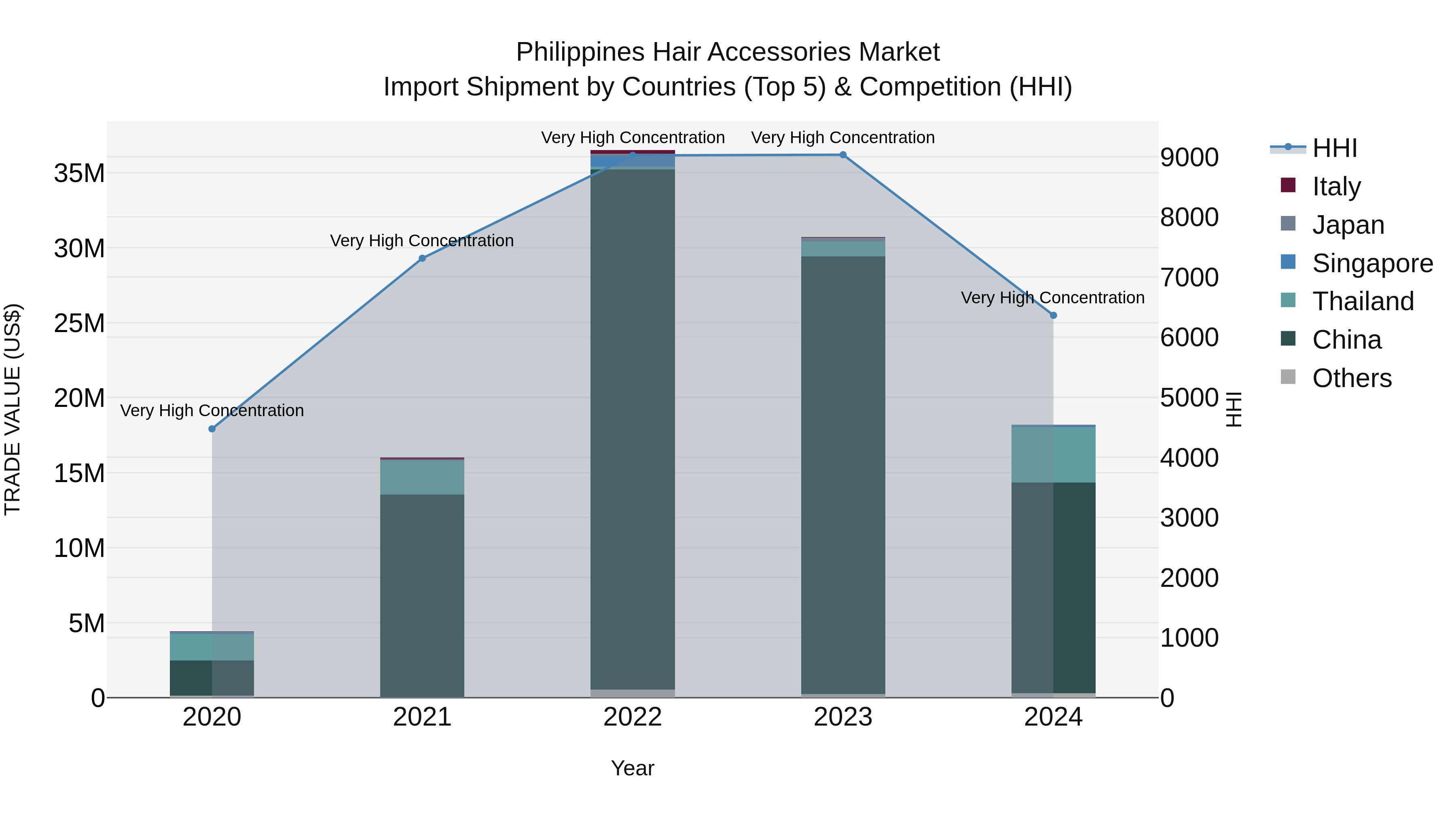
In 2024, the Philippines saw a significant influx of hair accessories import shipments, with top exporting countries being China, Thailand, Hong Kong, Singapore, and Japan. Despite the high Herfindahl-Hirschman Index (HHI) indicating market concentration, the industry experienced remarkable growth with a Compound Annual Growth Rate (CAGR) of 42.5% from 2020 to 2024. However, there was a sharp decline in growth rate from 2023 to 2024 at -40.7%, suggesting a potential shift in market dynamics or external factors impacting the industry. Monitoring these trends will be crucial for businesses operating in the hair accessories import sector in the Philippines.
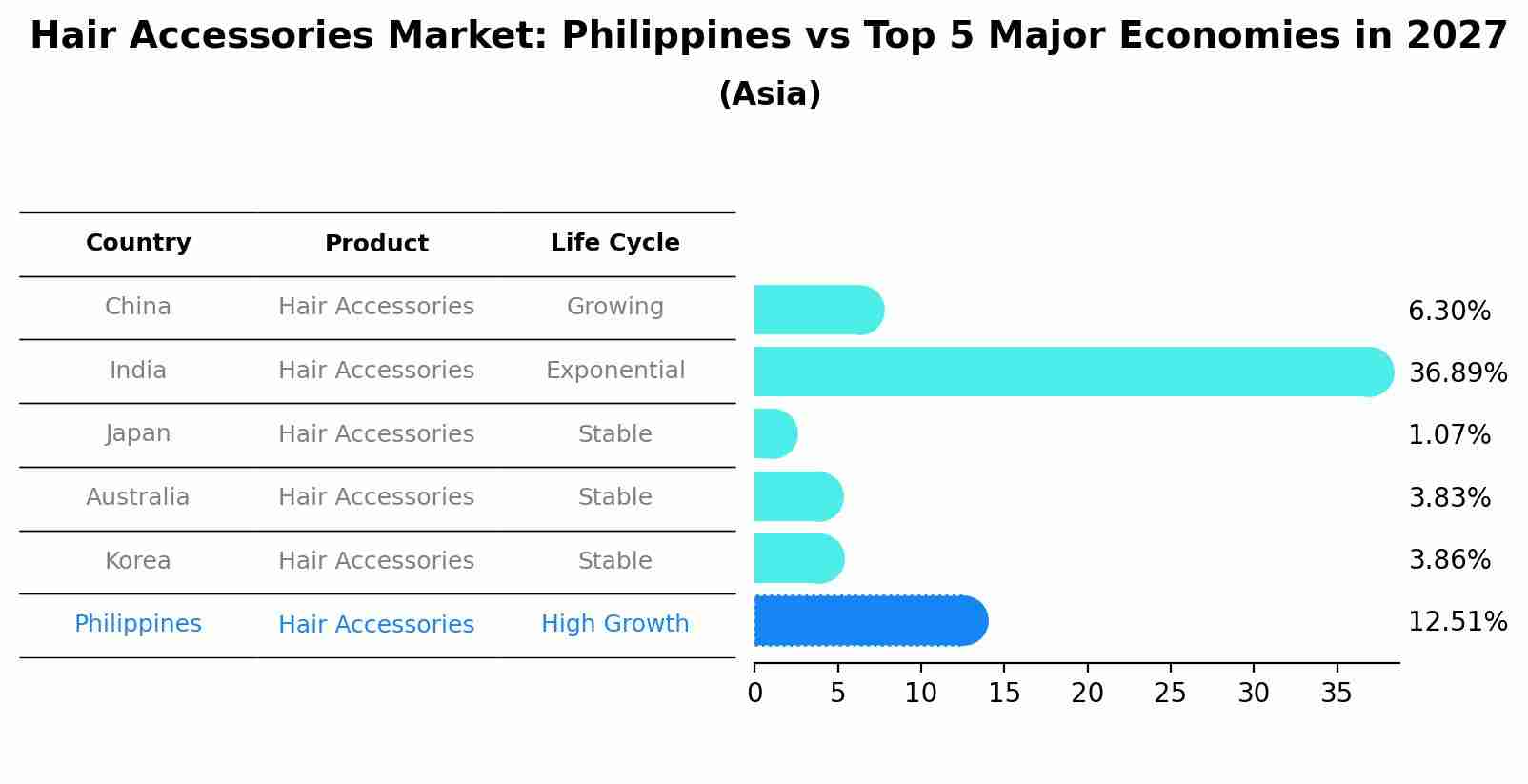
Hair Accessories Market: Philippines vs Top 5 Major Economies in 2027 (Asia)
Philippines's Hair Accessories market is anticipated to experience a high growth rate of 12.51% by 2027, reflecting trends observed in the largest economy China, followed by India, Japan, Australia and South Korea.
Philippines Hair Accessories Market Synopsis
The Philippines hair accessories market is estimated to be worth USD 2.6 billion, with an expected compound annual growth rate of 7%. The rising trend of wearing fashionable hair accessories such as headbands, clips, hats, and scarves among the youth has been driving the demand for these products in the country. Additionally, growing online retailing platforms offering a wide range of fashionable options have also contributed to the growth of this industry.
Drivers of the market
Fashion trends and personal grooming habits have driven the growth of the Hair Accessories market in the Philippines. The market caters to a wide range of products, including hairpins, headbands, and clips, reflecting the population`s inclination towards hairstyling and self-expression.
Challenges of the market
The Philippines Hair Accessories market contends with rapidly changing fashion trends and consumer demands. Staying ahead of the curve and consistently offering appealing and innovative hair accessory designs is vital to remain relevant in this fast-paced sector.
Covid-19 Impact of the market
The Hair Accessories market in the Philippines, valued at approximately [specific market size data needed], has shown consistent demand driven by fashion trends and personal grooming. The pandemic altered consumer behavior, with less focus on cosmetic products due to remote work and limited social interactions. As lifestyles gradually normalize, the market is anticipated to regain momentum.
Key Players of the market
In the Philippines, the Hair Accessories market is thriving, with key players like ChicTresses Accessories, HairGlam Creations, and StyleSense Ph. These companies offer a wide range of hair accessories, including hairpins, headbands, and scrunchies, catering to various styles and trends. The market growth is attributed to the fashion-conscious population and the desire to adorn hairstyles with trendy and stylish accessories.
Key Highlights of the Report:
- Philippines Hair Accessories Market Outlook
- Market Size of Philippines Hair Accessories Market, 2024
- Forecast of Philippines Hair Accessories Market, 2031
- Historical Data and Forecast of Philippines Hair Accessories Revenues & Volume for the Period 2021-2031
- Philippines Hair Accessories Market Trend Evolution
- Philippines Hair Accessories Market Drivers and Challenges
- Philippines Hair Accessories Price Trends
- Philippines Hair Accessories Porter's Five Forces
- Philippines Hair Accessories Industry Life Cycle
- Historical Data and Forecast of Philippines Hair Accessories Market Revenues & Volume By Product Type for the Period 2021-2031
- Historical Data and Forecast of Philippines Hair Accessories Market Revenues & Volume By Clips & Pins for the Period 2021-2031
- Historical Data and Forecast of Philippines Hair Accessories Market Revenues & Volume By Head Bands for the Period 2021-2031
- Historical Data and Forecast of Philippines Hair Accessories Market Revenues & Volume By Wigs & Extensions for the Period 2021-2031
- Historical Data and Forecast of Philippines Hair Accessories Market Revenues & Volume By Elastics & Ties for the Period 2021-2031
- Historical Data and Forecast of Philippines Hair Accessories Market Revenues & Volume By Others for the Period 2021-2031
- Historical Data and Forecast of Philippines Hair Accessories Market Revenues & Volume By Distribution Channel for the Period 2021-2031
- Historical Data and Forecast of Philippines Hair Accessories Market Revenues & Volume By Supermarkets & Hypermarkets for the Period 2021-2031
- Historical Data and Forecast of Philippines Hair Accessories Market Revenues & Volume By General Stores for the Period 2021-2031
- Historical Data and Forecast of Philippines Hair Accessories Market Revenues & Volume By Online for the Period 2021-2031
- Philippines Hair Accessories Import Export Trade Statistics
- Market Opportunity Assessment By Product Type
- Market Opportunity Assessment By Distribution Channel
- Philippines Hair Accessories Top Companies Market Share
- Philippines Hair Accessories Competitive Benchmarking By Technical and Operational Parameters
- Philippines Hair Accessories Company Profiles
- Philippines Hair Accessories Key Strategic Recommendations






































