Philippines Hair Curlers Market Size, Share & Growth Rate
The Philippines Hair Curlers Market was estimated at USD 662 Million in 2025 and is projected to reach USD 1172 Million by 2032, growing at a CAGR of 8.5% from 2026 to 2032. This robust growth trajectory is largely driven by the increasing consumer preference for non-damaging hairstyling methods, alongside a notable shift in fashion trends that favor voluminous and textured hairstyles. As more Filipinos embrace versatile styling options, hair curlers have solidified their place in daily grooming routines, ensuring sustained demand.
Philippines Hair Curlers Market Year-wise Growth Rate and Key Drivers
This graph highlights how the Philippines Hair Curlers Market has steadily grown over the years, supported by major growth factors.
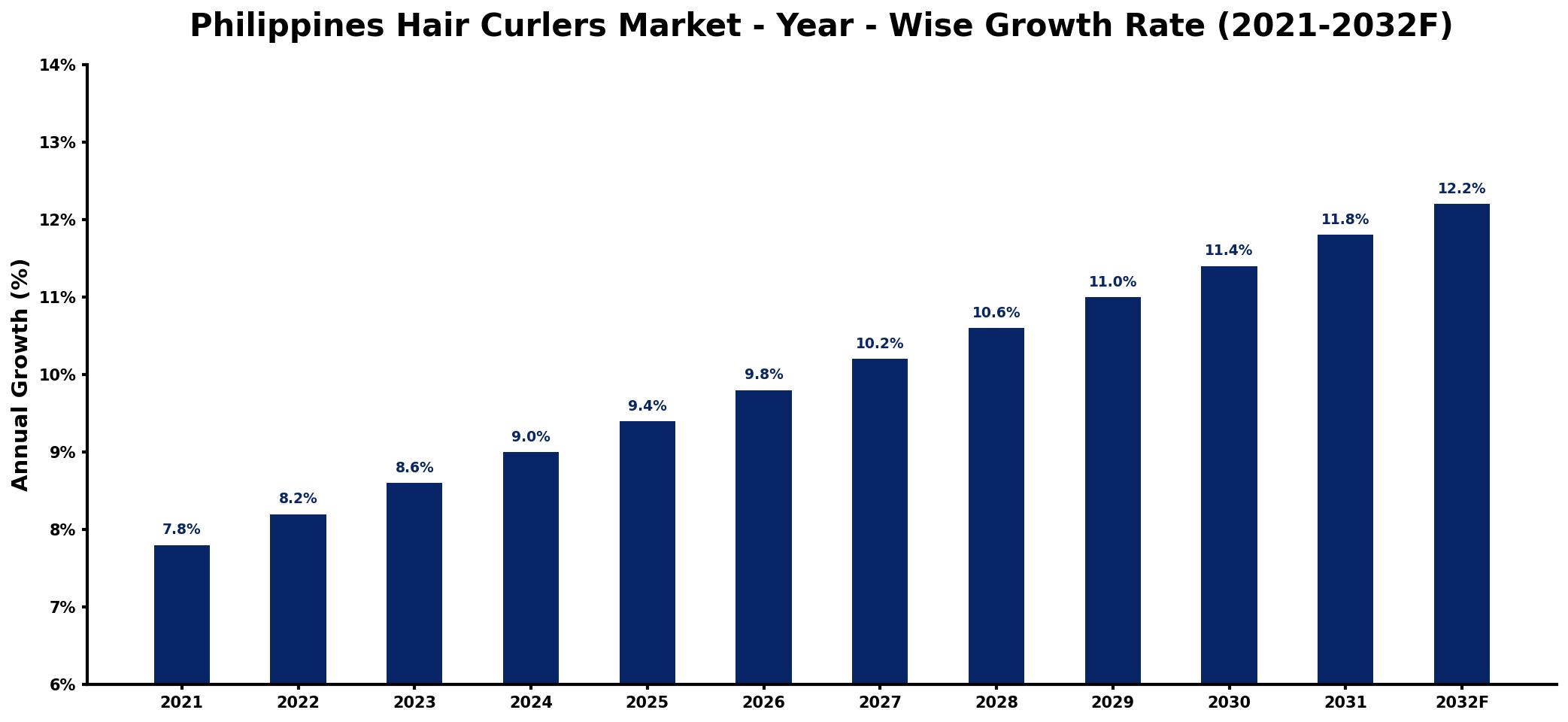
The table below presents the year‑wise growth rates along with the key drivers influencing the market
| Year | Growth Rate | Major Drivers |
| 2021 | 7.8% | Rising consumer beauty consciousness |
| 2022 | 8.2% | Increase in disposable income levels |
| 2023 | 8.6% | Growing online retail platforms |
| 2024 | 9.0% | Expansion of beauty salons industry |
| 2025 | 9.4% | Introduction of innovative styling tools |
| 2026 | 9.8% | Surge in influencer marketing strategies |
| 2027 | 10.2% | Heightened focus on personal grooming |
| 2028 | 10.6% | Diversification of beauty product offerings |
| 2029 | 11.0% | Emergence of eco-friendly alternatives |
| 2030 | 11.4% | Increased brand collaborations and partnerships |
| 2031 | 11.8% | Growth in beauty subscription services |
| 2032 | 12.2% | Strengthened distribution network channels |
Note: Market size estimations and growth projections presented in this report are based on 6Wresearch's proprietary forecasting methodology, utilizing the latest available industry data, government publications, and primary research inputs.
Philippines Hair Curlers Market Synopsis
The landscape of the Philippines Hair Curlers Market is characterized by a blend of tradition and innovation. Over the years, the market has shown a consistent growth rate of 4% annually, reflecting the enduring popularity of hair rollers amidst evolving hairstyling trends. Consumers are increasingly valuing tools that offer the ability to create beautiful curls without risking heat damage.
Additionally, hair curlers cater to a diverse range of hair types and styles, making them accessible to a wide audience. The rise of social media influencers showcasing creative hairstyling techniques has also amplified interest in effective curling solutions. As a result, hair curlers are expected to remain integral to personal grooming and styling choices in the Philippines.
Philippines Hair Curlers Market Key Takeaways
- Gradual growth is driven by a consistent demand for safe and effective hairstyling tools.
- The market is seeing a shift towards versatile hair curling solutions suitable for various hair types.
- Emerging trends emphasize fashion-forward hairstyling that promotes volume and texture.
- Education on proper usage can enhance consumer experience and market acceptance.
- Increasing social media influence is driving demand for innovative styling techniques.
Evaluation of Restraints in Philippines Hair Curlers Market
While the Philippines Hair Curlers Market shows promise, it faces certain constraints that could limit its growth. The rise of advanced hairstyling devices, such as automatic curlers and flat irons, presents competition, often overshadowing traditional hair rollers. Furthermore, many consumers may lack familiarity with the proper techniques for using curlers, which can lead to dissatisfaction and potential hair damage. Companies must address these educational gaps and position hair curlers as a straightforward and safe option amidst the evolving landscape of hairstyling tools.
Philippines Hair Curlers Market Trends
Current trends in the Philippines Hair Curlers Market reflect a growing inclination towards user-friendly and time-efficient products. There is an increasing demand for heated rollers that not only expedite the curling process but also incorporate features to minimize heat damage. Additionally, eco-friendly materials and sustainable manufacturing practices are gaining traction, appealing to environmentally conscious consumers. The integration of technology, such as smart rollers with temperature control, also signifies a shift towards innovation in hairstyling tools.
Philippines Hair Curlers Market Opportunities
The market presents numerous growth and investment opportunities, particularly in expanding product lines that cater to specific consumer needs. Developing curlers tailored for diverse hair types, especially textured and coily hair, can capture a wider audience. Additionally, partnerships with beauty influencers for product demonstrations can enhance visibility and encourage adoption among younger demographics. The increasing prevalence of online retail channels also offers a significant avenue for reaching consumers directly, paving the way for enhanced market penetration.
Government Initiatives in the Philippines Hair Curlers Market
The Philippine government has been proactive in promoting the local beauty industry through various initiatives. Public spending on programs supporting small and medium enterprises (SMEs) has allowed local manufacturers of hair curling products to thrive. Additionally, efforts to enhance export capabilities for locally produced beauty tools could open up international markets for Filipino brands. These initiatives aim to not only boost the economy but also elevate the reputation of Filipino beauty products on a global scale.
Future Insights of the Philippines Hair Curlers Market
Looking ahead to the period from 2026 to 2032, the Philippines Hair Curlers Market is expected to evolve significantly. As consumer preferences continue to lean toward heat-free styling methods, hair curlers will likely benefit from this trend. The convergence of fashion and beauty will drive innovations, making hair curlers an essential component in the personal grooming toolkit. Furthermore, the integration of AI and smart technologies into hairstyling tools could reshape consumer interactions, enhancing convenience and efficacy.
Philippines Hair Curlers Market Latest Developments (2025 - 2026)
Recent developments in the Philippines Hair Curlers Market indicate a strong focus on product innovation. Companies are launching new roller designs that prioritize user experience while integrating features that promote hair health. Additionally, heightened marketing efforts via social media platforms have bolstered consumer engagement, making it easier for customers to discover and learn about various curling techniques. As brands continue to adapt to consumer preferences, the market is well-positioned for further growth.
Philippines Hair Curlers Market - Key Attractiveness of the Report
- 10 Years of Market Numbers
- Historical Data Starting from 2022 to 2025
- Base Year: 2025
- Forecast Data until 2032
- Key Performance Indicators Impacting the Market
- Major Upcoming Developments and Projects
Key Highlights of the Report:
- Philippines Hair Curlers Market Outlook
- Market Size of Philippines Hair Curlers Market, 2025
- Forecast of Philippines Hair Curlers Market, 2032
- Historical Data and Forecast of Philippines Hair Curlers Revenues & Volume for the Period 2022-2032F
- Philippines Hair Curlers Market Trend Evolution
- Philippines Hair Curlers Market Drivers and Challenges
- Philippines Hair Curlers Price Trends
- Philippines Hair Curlers Porter's Five Forces
- Philippines Hair Curlers Industry Life Cycle
- Historical Data and Forecast of Philippines Hair Curlers Market Revenues & Volume By Product for the Period 2022-2032F
- Historical Data and Forecast of Philippines Hair Curlers Market Revenues & Volume By Spiral Iron for the Period 2022-2032F
- Historical Data and Forecast of Philippines Hair Curlers Market Revenues & Volume By Hair Wand for the Period 2022-2032F
- Historical Data and Forecast of Philippines Hair Curlers Market Revenues & Volume By Standard Curling Iron for the Period 2022-2032F
- Historical Data and Forecast of Philippines Hair Curlers Market Revenues & Volume By Hair Tongs for the Period 2022-2032F
- Historical Data and Forecast of Philippines Hair Curlers Market Revenues & Volume By Curling Iron with Brush Attachment for the Period 2022-2032F
- Historical Data and Forecast of Philippines Hair Curlers Market Revenues & Volume By Applications for the Period 2022-2032F
- Historical Data and Forecast of Philippines Hair Curlers Market Revenues & Volume By Personal Use for the Period 2022-2032F
- Historical Data and Forecast of Philippines Hair Curlers Market Revenues & Volume By Barber Shops for the Period 2022-2032F
- Philippines Hair Curlers Import Export Trade Statistics
- Market Opportunity Assessment By Product
- Market Opportunity Assessment By Applications
- Philippines Hair Curlers Top Companies Market Share
- Philippines Hair Curlers Competitive Benchmarking By Technical and Operational Parameters
- Philippines Hair Curlers Company Profiles
- Philippines Hair Curlers Key Strategic Recommendations






































