Philippines Herbal Soap Market Size, Share & Growth Rate
The Philippines Herbal Soap Market was estimated at USD 296 Million in 2025 and is projected to reach USD 400 Million by 2032, growing at a CAGR of 4.4% from 2026 to 2032. This impressive trajectory is fueled by a growing consumer preference for natural and chemical-free personal care products, which resonates strongly with health-conscious Filipino consumers. As skin allergies and sensitivities become more prevalent, many are turning to herbal soaps, which are often perceived as safer and gentler alternatives to traditional soaps.
Philippines Herbal Soap Market Year-wise Growth Rate and Key Drivers
This graph highlights how the Philippines Herbal Soap Market has steadily grown over the years, supported by major growth factors.
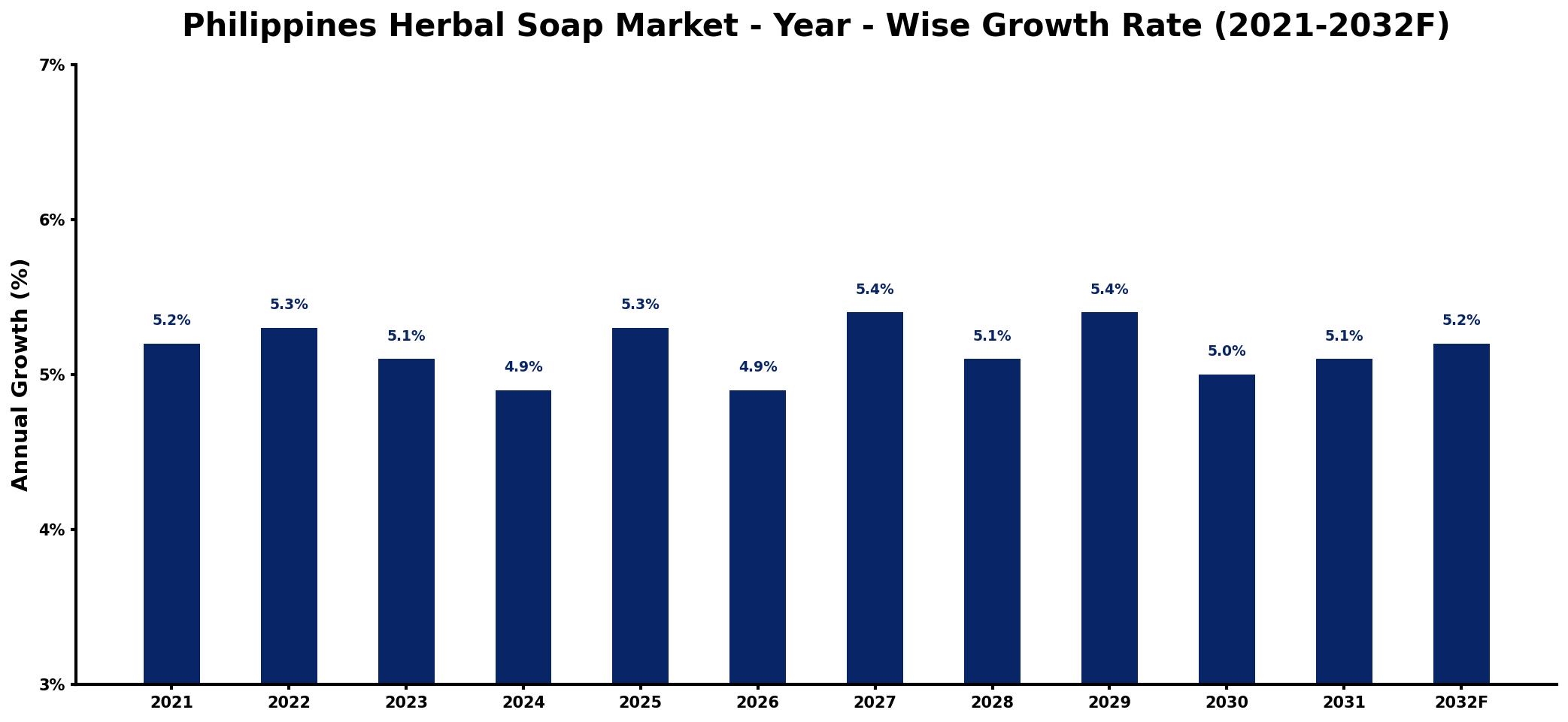
The table below presents the year‑wise growth rates along with the key drivers influencing the market
| Year | Growth Rate | Major Drivers |
| 2021 | 5.2% | Rising consumer health awareness |
| 2022 | 5.3% | Sustainable ingredient sourcing trends |
| 2023 | 5.1% | Growing demand for natural products |
| 2024 | 4.9% | Increased disposable income levels |
| 2025 | 5.3% | Expansion of e-commerce platforms |
| 2026 | 4.9% | Investment in local manufacturing facilities |
| 2027 | 5.4% | Surge in eco-friendly packaging |
| 2028 | 5.1% | Emergence of wellness lifestyle trends |
| 2029 | 5.4% | Collaboration with local artisans |
| 2030 | 5.0% | Focus on holistic skincare solutions |
| 2031 | 5.1% | Strengthening marketing strategies online |
| 2032 | 5.2% | Rising popularity of organic ingredients |
Note: Market size estimations and growth projections presented in this report are based on 6Wresearch's proprietary forecasting methodology, utilizing the latest available industry data, government publications, and primary research inputs.
Philippines Herbal Soap Market Synopsis
The Philippines Herbal Soap Market is currently witnessing a robust expansion driven by an increasing demand for organic and natural personal care solutions. With the population becoming more health-conscious, consumers are increasingly rejecting products laden with chemicals, seeking out herbal alternatives that align with their values of sustainability and wellness.
In addition to rising consumer awareness, there is a significant cultural shift towards traditional practices that favor the use of local herbs and botanicals. As such, herbal soaps are not merely seen as products but as part of a broader lifestyle choice that emphasizes natural beauty and self-care.
Philippines Herbal Soap Market Key Takeaways
- The market is witnessing steady growth, driven by a transition towards chemical-free personal care products.
- Increased awareness of skin health and allergies is propelling the demand for herbal soaps.
- There is a strong cultural preference for local herbal ingredients among consumers.
- Manufacturers face challenges in sourcing consistent quality herbal materials.
- Regulatory compliance and consumer education on herbal benefits are key focus areas.
Evaluation of Restraints in Philippines Herbal Soap Market
Despite its promising growth, the Philippines Herbal Soap Market encounters notable restraints. One significant challenge is the ongoing need for consumer education regarding the advantages of herbal ingredients compared to conventional soaps. Many consumers remain unfamiliar with the specific benefits of herbal products, which can hinder their purchasing decisions. Additionally, sourcing high-quality, consistent herbal materials poses a logistical challenge for manufacturers, potentially affecting product efficacy and consumer satisfaction. Regulatory standards are also an important consideration, as companies must navigate compliance and labeling requirements to substantiate their claims effectively.
Philippines Herbal Soap Market Trends
Current trends in the Philippines Herbal Soap Market are predominantly characterized by a shift towards eco-friendly packaging and sustainable sourcing. Consumers increasingly favor brands that prioritize environmentally friendly practices, including biodegradable packaging and ethical ingredient sourcing. Additionally, the rise of online shopping platforms has expanded the accessibility of herbal soaps, allowing smaller manufacturers to reach a wider audience. Influencer marketing and social media campaigns are also significantly impacting consumer perceptions, driving interest in herbal products.
Philippines Herbal Soap Market Opportunities
The Philippines Herbal Soap Market presents ample growth opportunities, particularly in the realm of product innovation. With the potential to blend various herbal ingredients tailored to specific skin types or concerns, brands can create niche products that attract targeted demographics. Collaborations with local farmers and herbalists can enhance product authenticity and quality, building brand trust. Additionally, expanding into export markets, particularly in regions with a growing demand for herbal and natural products, offers an avenue for revenue growth.
Government Initiatives in the Philippines Herbal Soap Market
The Philippine government is increasingly supportive of the herbal products industry, recognizing its potential for economic growth and health benefits. Initiatives aimed at promoting local agriculture and sustainable practices are encouraging the cultivation of herbal plants, which can be utilized in soap production. Furthermore, public awareness campaigns about the benefits of using natural products have been rolled out, potentially boosting consumer interest in herbal soaps. These government measures create a conducive environment for the growth of the herbal soap market.
Future Insights of the Philippines Herbal Soap Market
Looking ahead to 2026-2032, the Philippines Herbal Soap Market is poised for continued expansion. With an ever-increasing demand for natural alternatives, manufacturers that can innovate and adapt to consumer preferences will thrive. The ongoing shift towards clean beauty trends and the sustainability movement will likely fortify consumer loyalty towards brands that align with their values. As education on the benefits of herbal ingredients increases, we anticipate a gradual but steady shift in purchasing habits, favoring herbal soaps over synthetic options.
Philippines Herbal Soap Market Latest Developments (2025 - 2026)
Recent developments in the Philippines Herbal Soap Market indicate a marked increase in new product launches, with brands exploring innovative formulations and combinations of local herbs. Many companies are enhancing their marketing strategies to emphasize the health benefits of herbal ingredients, leveraging social media to engage with a broader audience. Additionally, partnerships with wellness influencers have become commonplace, further driving consumer interest and brand visibility in a competitive landscape.
Philippines Herbal Soap Market - Key Attractiveness of the Report
- 10 Years of Market Numbers
- Historical Data Starting from 2022 to 2025
- Base Year: 2025
- Forecast Data until 2032
- Key Performance Indicators Impacting the Market
- Major Upcoming Developments and Projects
Key Highlights of the Report:
- Philippines Herbal Soap Market Outlook
- Market Size of Philippines Herbal Soap Market, 2025
- Forecast of Philippines Herbal Soap Market, 2032
- Historical Data and Forecast of Philippines Herbal Soap Revenues & Volume for the Period 2022-2032F
- Philippines Herbal Soap Market Trend Evolution
- Philippines Herbal Soap Market Drivers and Challenges
- Philippines Herbal Soap Price Trends
- Philippines Herbal Soap Porter's Five Forces
- Philippines Herbal Soap Industry Life Cycle
- Historical Data and Forecast of Philippines Herbal Soap Market Revenues & Volume By Type for the Period 2022-2032F
- Historical Data and Forecast of Philippines Herbal Soap Market Revenues & Volume By Industrial for the Period 2022-2032F
- Historical Data and Forecast of Philippines Herbal Soap Market Revenues & Volume By Handmade for the Period 2022-2032F
- Historical Data and Forecast of Philippines Herbal Soap Market Revenues & Volume By Application for the Period 2022-2032F
- Historical Data and Forecast of Philippines Herbal Soap Market Revenues & Volume By Hospital & Clinic for the Period 2022-2032F
- Historical Data and Forecast of Philippines Herbal Soap Market Revenues & Volume By Home for the Period 2022-2032F
- Historical Data and Forecast of Philippines Herbal Soap Market Revenues & Volume By Others for the Period 2022-2032F
- Historical Data and Forecast of Philippines Herbal Soap Market Revenues & Volume By Industry Vertical for the Period 2022-2032F
- Historical Data and Forecast of Philippines Herbal Soap Market Revenues & Volume By Household for the Period 2022-2032F
- Historical Data and Forecast of Philippines Herbal Soap Market Revenues & Volume By Commercial for the Period 2022-2032F
- Philippines Herbal Soap Import Export Trade Statistics
- Market Opportunity Assessment By Type
- Market Opportunity Assessment By Application
- Market Opportunity Assessment By Industry Vertical
- Philippines Herbal Soap Top Companies Market Share
- Philippines Herbal Soap Competitive Benchmarking By Technical and Operational Parameters
- Philippines Herbal Soap Company Profiles
- Philippines Herbal Soap Key Strategic Recommendations






































