Philippines Hoists Market Summary
The philippines hoists market was estimated at USD 184 Million in 2025 and is projected to reach USD 261 Million by 2032, growing at a CAGR of 6.0% from 2026 to 2032.
Philippines Hoists Market Year-wise Growth Rate and Key Drivers
This graph highlights how the Philippines Hoists Market has steadily grown over the past five years, supported by major growth factors.
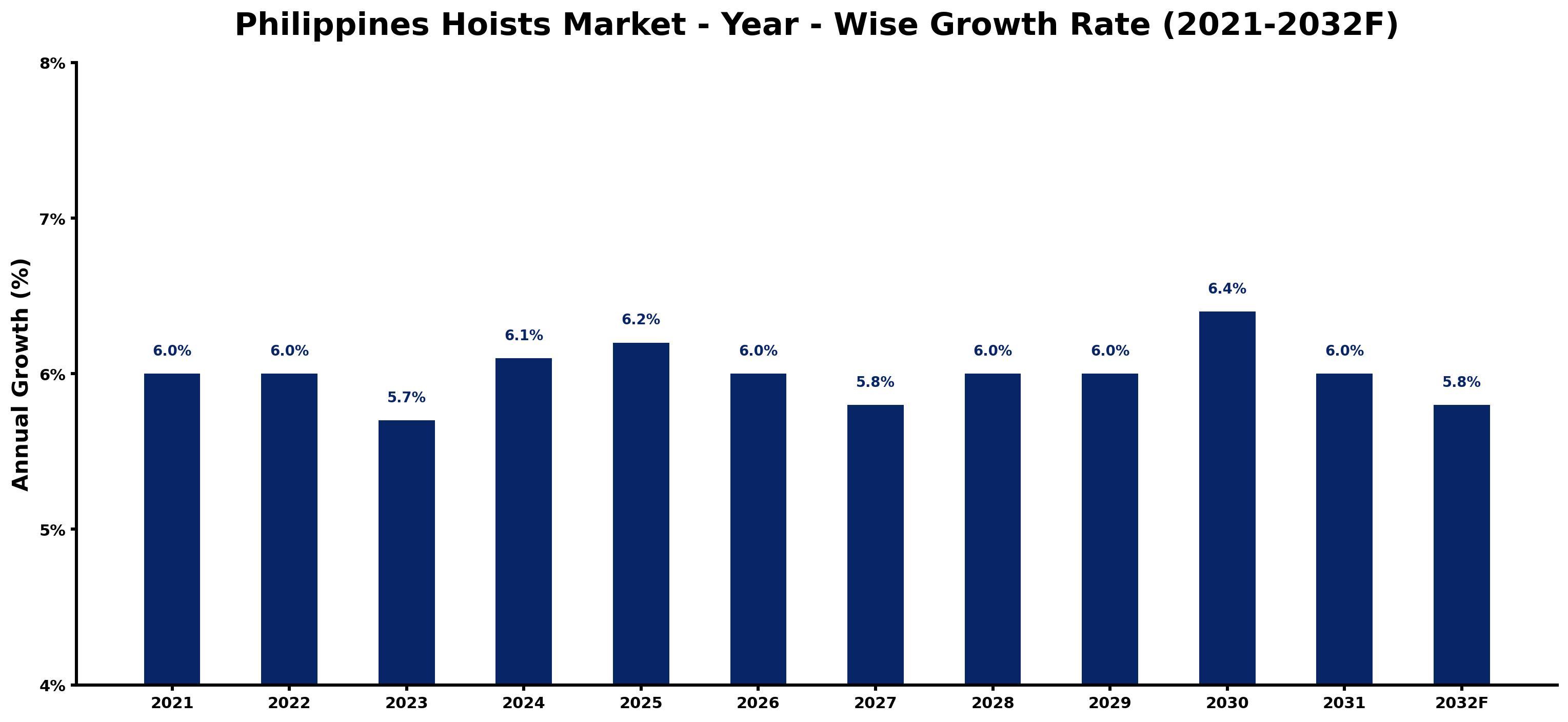
The table below presents the year wise growth rates along with the key drivers influencing the market
| Year | Growth Rate | Major Drivers |
| 2021 | 6.0% | Manufacturing and construction sectors began recovering, spurring hoist equipment investments. |
| 2022 | 6.0% | Increased infrastructure projects in urban areas highlighted the need for efficient lifting solutions. |
| 2023 | 5.7% | Local manufacturers introduced innovative hoist technologies to meet market demand effectively. |
| 2024 | 6.1% | Rising urbanization in cities necessitates the installation of advanced material handling systems. |
| 2025 | 6.2% | Strong economic growth forecasts attracted foreign investments in construction and logistics. |
| 2026 | 6.0% | Emerging industries explored automation, enhancing the importance of reliable hoist systems. |
| 2027 | 5.8% | Corporate sustainability initiatives prompted shifts towards energy-efficient hoist technologies. |
| 2028 | 6.0% | Local regulations emphasized safety standards, driving demand for modern hoisting solutions. |
| 2029 | 6.0% | Collaboration between manufacturers and construction firms improved product offerings and market reach. |
| 2030 | 6.4% | Technological integration in supply chains made advanced hoists increasingly attractive to businesses. |
| 2031 | 6.0% | Growing workforce challenges led to automation solutions, increasing hoist market demands rapidly. |
| 2032 | 5.8% | Digital transformation initiatives in logistics and manufacturing sectors highlighted hoist efficiency benefits. |
Note - Market size estimations and growth projections presented in this report are based on 6Wresearch's advanced forecasting approach, validated with industry datasets as of June 2026.
Philippines Hoists Market Synopsis
The Philippines Hoists Market is projected to reach 6.0% and witness significant growth during the forecast period (2026-2032). This growth trajectory can primarily be attributed to the robust expansion of the construction industry, coupled with increasing investments in infrastructure projects across the region. Rapid urbanization and industrial developments have further accelerated the demand for hoisting equipment, positioning the market for sustained growth.
Philippines Hoists Market Growth Drivers
Several factors are propelling the growth of the Philippines Hoists Market. Firstly, government initiatives aimed at enhancing public infrastructure are vital in driving demand for hoisting systems. In addition, the booming residential and commercial real estate sectors significantly contribute to the construction industry's expansion. As a result, the following key drivers can be identified:
- Government investment in large-scale construction projects leads to increased requirement for hoisting equipment, thereby bolstering market growth.
- Urbanization is driving the construction of high-rise buildings and commercial complexes, necessitating the use of advanced hoisting solutions.
- Technological advancements in hoisting systems are enhancing operational efficiency and safety, attracting more users to invest in these solutions.
- The proliferation of automated lifting solutions caters to the increasing demand for efficiency and safety in handling heavy loads.
- Rising construction standards and safety regulations compel operators to upgrade from traditional hoisting systems to modern, compliant alternatives.
Philippines Hoists Market Trends and Opportunities
The Philippines Hoists Market is characterized by evolving product offerings that feature innovative technologies designed to enhance performance and user experience. Key trends shaping the market include:
- Manufacturers are increasingly introducing lightweight electric hoists that offer portability and ease of use, attracting a broader customer base.
- Adjustable speed motors are becoming common in new hoist models, allowing operators to control lifting speeds and enhance safety.
- Robust designs that withstand harsh working conditions are gaining traction, ensuring longevity and reliability of hoisting equipment.
- Automation technologies in hoisting systems, such as sensor-driven controls and motion tracking, are reducing the risk of human error.
- Growing environmental consciousness is leading to the development of energy-efficient hoisting solutions, further appealing to businesses aiming for sustainability.
Philippines Hoists Market Challenges and Restraints
Despite the positive outlook, the Philippines Hoists Market faces several challenges that could impede growth. Key challenges include:
- High initial investment costs associated with advanced hoisting systems can deter potential buyers, particularly small and medium-sized enterprises.
- The availability of cheaper, less reliable alternatives may disadvantage manufacturers focused on quality and innovation.
- Workforce skill gaps in operating advanced hoisting technology can pose a barrier to the adoption of new systems.
- Compliance with stringent safety regulations necessitates additional costs and can slow the decision-making process for procurement.
- Economic fluctuations and uncertainties may affect investment patterns in construction and infrastructure development, impacting overall market growth.
Philippines Hoists Market Government Investment and Initiatives
The Philippine government has launched several initiatives directed at bolstering infrastructure development, which is critical for the advancement of the hoists market. Funding allocated for public works projects plays a pivotal role in stimulating demand for hoisting equipment. Key governmental strategies include:
- Implementation of the "Build, Build, Build" program, which aims to construct and improve key infrastructures, providing substantial opportunities for hoisting equipment usage.
- Establishment of public-private partnerships (PPPs) to encourage investment in large-scale projects, ensuring that hoisting solutions are increasingly required.
- Promotion of regulatory frameworks that simplify processes related to construction permits, thereby accelerating project timelines and enhancing market dynamics.
- Support for technological advancements through grants and incentives for companies focusing on innovative hoisting solutions.
- Development of training programs aimed at improving the skills of the workforce in handling advanced hoisting systems reliably and safely.
Philippines Hoists Market Latest Developments (May 2025 - June 2026)
From May 2025 to June 2026, the Philippines Hoists Market has witnessed significant advancements aligned with emerging industry trends. Companies are increasingly focusing on the development of energy-efficient hoisting solutions in response to growing environmental concerns. Notably, automation is gaining momentum, with several providers launching systems that utilize cutting-edge technology for enhanced operational efficiency. Furthermore, there has been a marked rise in the integration of safety mechanisms within hoisting equipment, improving user confidence and compliance with safety standards. The competitive landscape is becoming more dynamic, with ongoing investments in product innovation aimed at meeting the evolving demands of construction and manufacturing sectors.
Philippines Hoists Market - Key Attractiveness of the Report
- 10 Years of Market Numbers
- Historical Data Starting from 2022 to 2025
- Base Year: 2025
- Forecast Data until 2032
- Key Performance Indicators Impacting the Market
- Major Upcoming Developments and Projects
Key Highlights of the Report:
- Philippines Hoists Market Outlook
- Market Size of Philippines Hoists Market, 2025
- Forecast of Philippines Hoists Market, 2032
- Historical Data and Forecast of Philippines Hoists Revenues & Volume for the Period 2022-2032F
- Philippines Hoists Market Trend Evolution
- Philippines Hoists Market Drivers and Challenges
- Philippines Hoists Price Trends
- Philippines Hoists Porter's Five Forces
- Philippines Hoists Industry Life Cycle
- Historical Data and Forecast of Philippines Hoists Market Revenues & Volume By Product Type for the Period 2022-2032F
- Historical Data and Forecast of Philippines Hoists Market Revenues & Volume By Manual Hoists for the Period 2022-2032F
- Historical Data and Forecast of Philippines Hoists Market Revenues & Volume By Electric Hoists for the Period 2022-2032F
- Historical Data and Forecast of Philippines Hoists Market Revenues & Volume By Air Hoists for the Period 2022-2032F
- Historical Data and Forecast of Philippines Hoists Market Revenues & Volume By Hydraulic Hoists for the Period 2022-2032F
- Historical Data and Forecast of Philippines Hoists Market Revenues & Volume By End-users for the Period 2022-2032F
- Historical Data and Forecast of Philippines Hoists Market Revenues & Volume By Marinas and Shipyards for the Period 2022-2032F
- Historical Data and Forecast of Philippines Hoists Market Revenues & Volume By Construction Sites for the Period 2022-2032F
- Historical Data and Forecast of Philippines Hoists Market Revenues & Volume By Factories for the Period 2022-2032F
- Philippines Hoists Import Export Trade Statistics
- Market Opportunity Assessment By Product Type
- Market Opportunity Assessment By End-users
- Philippines Hoists Top Companies Market Share
- Philippines Hoists Competitive Benchmarking By Technical and Operational Parameters
- Philippines Hoists Company Profiles
- Philippines Hoists Key Strategic Recommendations






































