Philippines Holographic Display Market Top 5 Importing Countries and Market Competition (HHI) Analysis
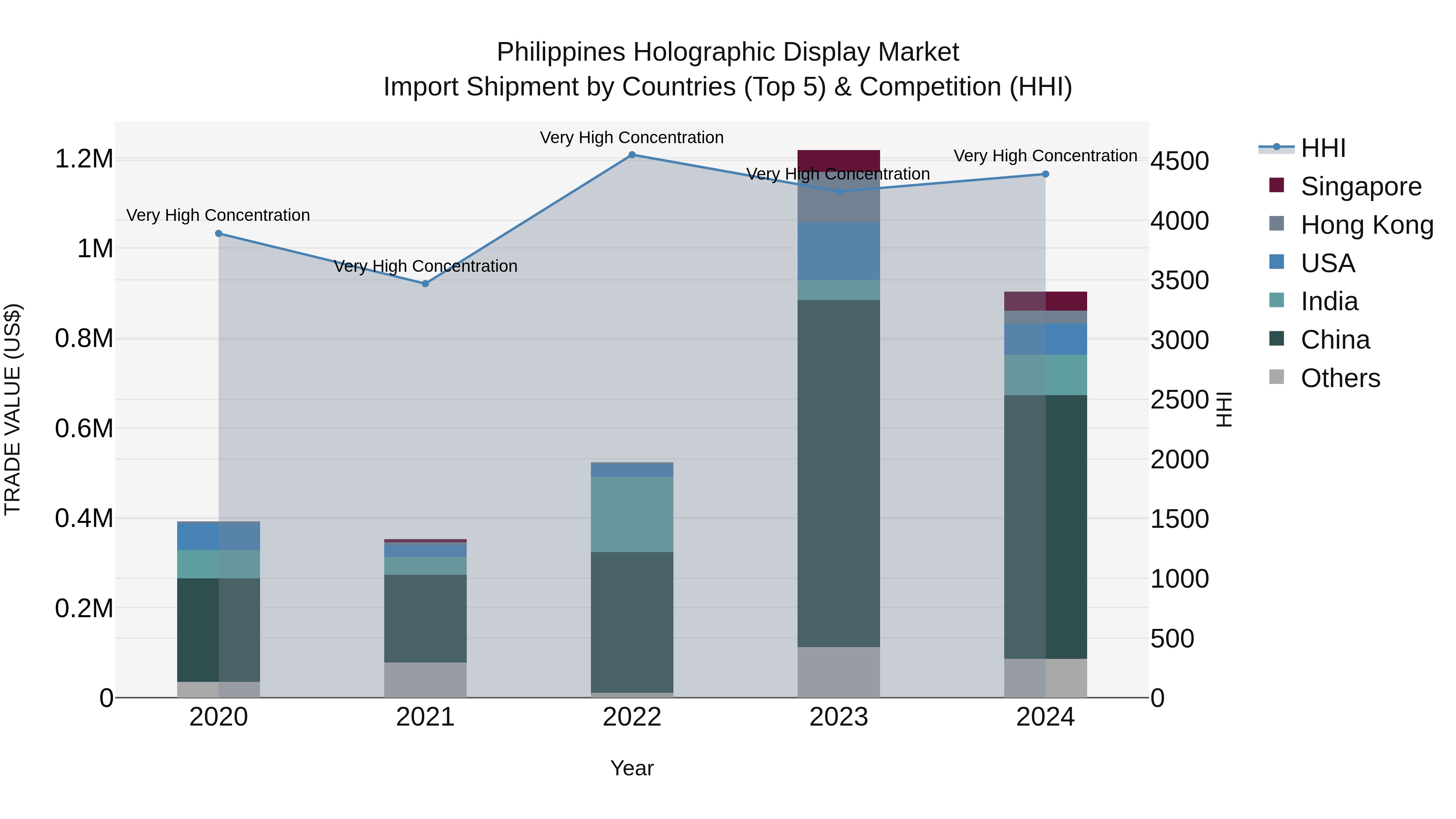
In 2024, the Philippines continued to see a high concentration of holographic display import shipments, with top exporting countries being China, India, USA, Canada, and Singapore. The market experienced a strong compound annual growth rate (CAGR) of 23.18% from 2020 to 2024. However, there was a significant decline in growth rate from 2023 to 2024 at -25.81%. This suggests a potential shift or temporary slowdown in the holographic display market dynamics in the Philippines, warranting further analysis to understand the underlying factors impacting the industry.
Philippines Holographic Display Market Overview
The holographic display market in the Philippines is gradually growing, driven by advancements in display technologies and increasing demand for immersive visual experiences. Sectors such as entertainment, retail, and education are investing in holographic displays for marketing, product presentations, and educational tools, making the market increasingly viable for future growth.
Trends of the market
The holographic display market in the Philippines is growing, driven by advancements in display technology and the increasing interest in augmented and virtual reality applications. Holographic displays offer immersive experiences, making them popular in industries such as entertainment, advertising, and retail. As the demand for cutting-edge visual technologies rises, the holographic display market in the Philippines is expected to expand, with applications in both consumer and business sectors.
Challenges of the market
The holographic display market faces high hardware costs, low consumer and business awareness, and a lack of skilled professionals to operate and maintain such systems. Limited local content creation for holographic formats further hampers its appeal in advertising and entertainment sectors.
Investment opportunities in the Market
The Philippines Holographic Display Market is gaining attention due to advancements in augmented reality and interactive digital displays. Investment opportunities in this market include the development of holographic display technologies for applications in retail, advertising, education, and entertainment. As consumer interest in immersive experiences grows, creating affordable and scalable holographic display systems for mass adoption in various sectors could offer significant market potential.
Government Policy of the market
This emerging tech market is supported by DICT through digital innovation grants and startup incubation. DOST fosters research in visual computing, while trade liberalization policies ease import of hardware components necessary for holographic display systems.
Key Highlights of the Report:
- Philippines Holographic Display Market Outlook
- Market Size of Philippines Holographic Display Market, 2024
- Forecast of Philippines Holographic Display Market, 2031
- Historical Data and Forecast of Philippines Holographic Display Revenues & Volume for the Period 2021- 2031
- Philippines Holographic Display Market Trend Evolution
- Philippines Holographic Display Market Drivers and Challenges
- Philippines Holographic Display Price Trends
- Philippines Holographic Display Porter's Five Forces
- Philippines Holographic Display Industry Life Cycle
- Historical Data and Forecast of Philippines Holographic Display Market Revenues & Volume By Type for the Period 2021- 2031
- Historical Data and Forecast of Philippines Holographic Display Market Revenues & Volume By Semitransparent Type for the Period 2021- 2031
- Historical Data and Forecast of Philippines Holographic Display Market Revenues & Volume By Touchable Type for the Period 2021- 2031
- Historical Data and Forecast of Philippines Holographic Display Market Revenues & Volume By Laser Type for the Period 2021- 2031
- Historical Data and Forecast of Philippines Holographic Display Market Revenues & Volume By Others for the Period 2021- 2031
- Historical Data and Forecast of Philippines Holographic Display Market Revenues & Volume By Application for the Period 2021- 2031
- Historical Data and Forecast of Philippines Holographic Display Market Revenues & Volume By Retail for the Period 2021- 2031
- Historical Data and Forecast of Philippines Holographic Display Market Revenues & Volume By Education for the Period 2021- 2031
- Historical Data and Forecast of Philippines Holographic Display Market Revenues & Volume By Brand Activations for the Period 2021- 2031
- Historical Data and Forecast of Philippines Holographic Display Market Revenues & Volume By Others for the Period 2021- 2031
- Philippines Holographic Display Import Export Trade Statistics
- Market Opportunity Assessment By Type
- Market Opportunity Assessment By Application
- Philippines Holographic Display Top Companies Market Share
- Philippines Holographic Display Competitive Benchmarking By Technical and Operational Parameters
- Philippines Holographic Display Company Profiles
- Philippines Holographic Display Key Strategic Recommendations






































