Philippines Hydrophobic and Superhydrophobic Materials Market Size, Share & Growth Rate
The Philippines Hydrophobic and Superhydrophobic Materials Market was estimated at USD 727 Million in 2025 and is projected to reach USD 1058 Million by 2032, growing at a CAGR of 5.5% from 2026 to 2032. This growth trajectory is primarily driven by the increasing demand for water-resistant products across diverse end-user industries, including automotive and consumer goods. Furthermore, the rising interest in innovative applications of nanomaterials in coatings is set to further enhance the market landscape in the coming years.
Philippines Hydrophobic and Superhydrophobic Materials Market Year-wise Growth Rate and Key Drivers
This graph highlights how the Philippines Hydrophobic and Superhydrophobic Materials Market has steadily grown over the years, supported by major growth factors.
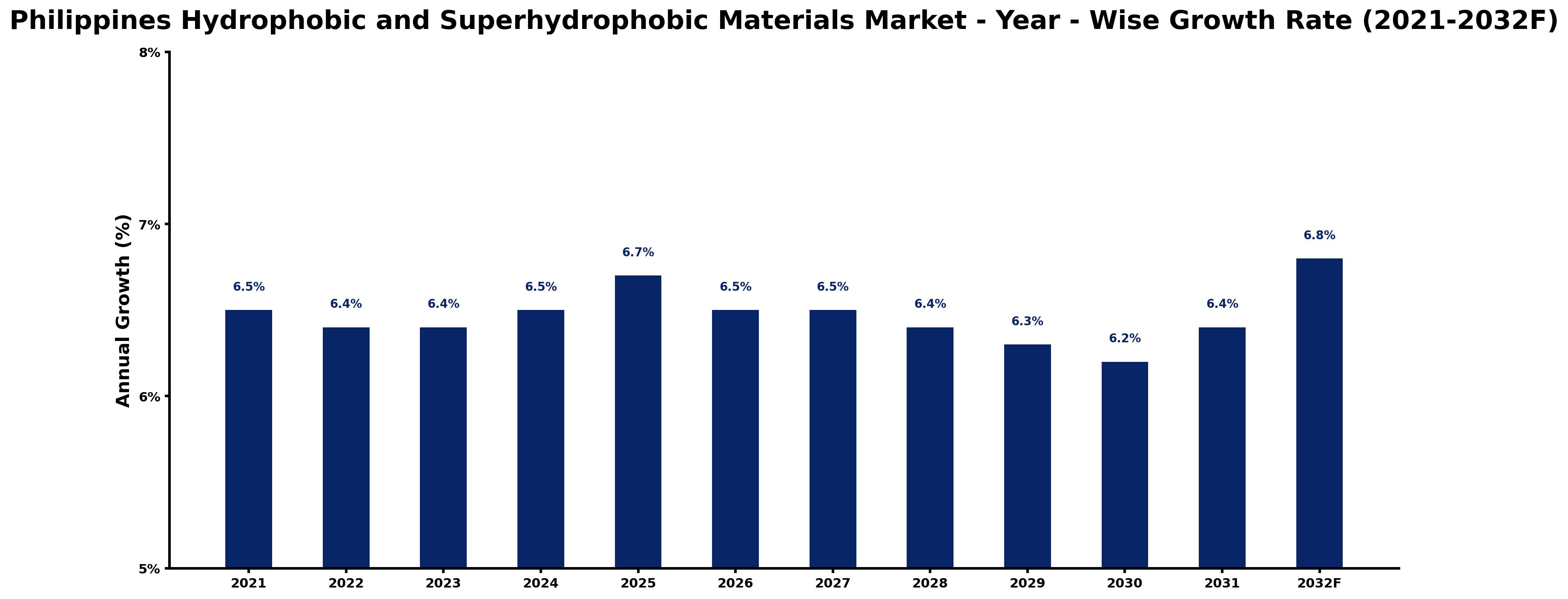
The table below presents the year‑wise growth rates along with the key drivers influencing the market
| Year | Growth Rate | Major Drivers |
| 2021 | 6.5% | Government infrastructure modernization initiatives |
| 2022 | 6.4% | Rapid growth in telecom and data center sectors |
| 2023 | 6.4% | Increasing adoption of advanced technologies |
| 2024 | 6.5% | Increasing industrial automation investments |
| 2025 | 6.7% | Growing urbanization and commercial development |
| 2026 | 6.5% | Rising electricity demand across industries |
| 2027 | 6.5% | Rapid growth in telecom and data center sectors |
| 2028 | 6.4% | Expansion of commercial construction activities |
| 2029 | 6.3% | Increasing adoption of advanced technologies |
| 2030 | 6.2% | Government infrastructure modernization initiatives |
| 2031 | 6.4% | Government infrastructure modernization initiatives |
| 2032 | 6.8% | Increasing smart city development projects |
Note - Market size estimations and growth projections presented in this report are based on 6Wresearch’s advanced forecasting approach, validated with industry datasets as of June 2026.
Philippines Hydrophobic and Superhydrophobic Materials Market Synopsis
The burgeoning interest in hydrophobic and superhydrophobic materials is significantly shaping the market, driven by advancements in nanotechnology and its applications. Industries are leveraging these materials to enhance product performance, particularly in demanding environments where water resistance is paramount.
Additionally, government initiatives aimed at promoting research and development in nanotechnology are creating a supportive ecosystem for innovation. As sectors such as electronics and aerospace increasingly adopt these advanced materials, the overall market is poised for robust expansion.
Philippines Hydrophobic and Superhydrophobic Materials Market Key Takeaways
- The market is experiencing steady growth, driven by enhanced demand for water-resistant solutions.
- Adoption of nanomaterials in coatings applications is increasing due to their superior properties.
- Government support for research initiatives is expected to further bolster market growth.
- Increased application potential in solar cell technology is a key growth area.
- Market challenges include the high costs associated with product development.
Evaluation of Restraints in Philippines Hydrophobic and Superhydrophobic Materials Market
Despite the promising growth outlook, the market is not without its challenges. The significant costs associated with the development of hydrophobic and superhydrophobic materials pose a major restraint. These expenses can limit accessibility for smaller firms and slow down broader industry adoption. However, ongoing research activities focused on nano-coating technologies offer hope for overcoming these financial barriers, potentially leading to cost-effective solutions in the future.
Philippines Hydrophobic and Superhydrophobic Materials Market Trends
Current trends in the Philippines market include an increased focus on sustainable materials and manufacturing processes. The drive toward eco-friendly products is pushing companies to explore hydrophobic and superhydrophobic materials that not only offer functional benefits but are also environmentally benign. Moreover, advancements in chemical vapor deposition techniques are paving the way for more complex structures, enhancing the market's potential for innovation.
Philippines Hydrophobic and Superhydrophobic Materials Market Opportunities
There is substantial opportunity for growth in sectors such as automotive and medical devices, where performance requirements necessitate advanced material properties. Furthermore, the integration of hydrophobic materials into emerging technologies like solar cells provides significant avenues for market expansion. With a growing emphasis on research and development, manufacturers stand to benefit from investments in innovative product lines that cater to the evolving needs of diverse industries.
Government Initiatives in the Philippines Hydrophobic and Superhydrophobic Materials Market
The Philippine government has implemented various initiatives aimed at fostering innovation within the field of nanotechnology. These efforts include funding for research projects and partnerships with educational institutions to promote technological advancement. By focusing on supporting R&D, the government is encouraging local firms to invest in the development of new materials, thereby enhancing the competitive landscape of the hydrophobic and superhydrophobic materials market.
Future Insights of the Philippines Hydrophobic and Superhydrophobic Materials Market
Looking ahead to the period between 2026 and 2032, the Philippines hydrophobic and superhydrophobic materials market is expected to continue its upward trajectory. The anticipated increase in demand across various sectors will likely be complemented by ongoing technological advancements. The confluence of government support, innovative applications, and rising consumer preferences for durable and water-resistant products positions the market for sustainable growth in the future.
Philippines Hydrophobic and Superhydrophobic Materials Market Latest Developments (May 2025 - June 2026)
Recent developments in the market indicate a trend toward more sophisticated applications of hydrophobic materials. Companies are increasingly exploring partnerships with research institutions to accelerate product innovation. This collaborative approach is set to enhance the development of next-generation coatings with improved functionalities, catering to the evolving demands of various industrial sectors.
Philippines Hydrophobic and Superhydrophobic Materials Market - Key Attractiveness of the Report
- 10 Years of Market Numbers
- Historical Data Starting from 2022 to 2025
- Base Year: 2025
- Forecast Data until 2032
- Key Performance Indicators Impacting the Market
- Major Upcoming Developments and Projects
Key Highlights of the Report:
- Philippines Hydrophobic and Superhydrophobic Materials Market Outlook
- Market Size of Philippines Hydrophobic and Superhydrophobic Materials Market, 2025
- Forecast of Philippines Hydrophobic and Superhydrophobic Materials Market, 2032
- Historical Data and Forecast of Philippines Hydrophobic and Superhydrophobic Materials Revenues & Volume for the Period 2022-2032F
- Philippines Hydrophobic and Superhydrophobic Materials Market Trend Evolution
- Philippines Hydrophobic and Superhydrophobic Materials Market Drivers and Challenges
- Philippines Hydrophobic and Superhydrophobic Materials Price Trends
- Philippines Hydrophobic and Superhydrophobic Materials Porter's Five Forces
- Philippines Hydrophobic and Superhydrophobic Materials Industry Life Cycle
- Historical Data and Forecast of Philippines Hydrophobic and Superhydrophobic Materials Market Revenues & Volume By Product for the Period 2022-2032F
- Historical Data and Forecast of Philippines Hydrophobic and Superhydrophobic Materials Market Revenues & Volume By Anti-corrosion for the Period 2022-2032F
- Historical Data and Forecast of Philippines Hydrophobic and Superhydrophobic Materials Market Revenues & Volume By Anti-wetting for the Period 2022-2032F
- Historical Data and Forecast of Philippines Hydrophobic and Superhydrophobic Materials Market Revenues & Volume By Anti-icing for the Period 2022-2032F
- Historical Data and Forecast of Philippines Hydrophobic and Superhydrophobic Materials Market Revenues & Volume By Self-cleaning for the Period 2022-2032F
- Historical Data and Forecast of Philippines Hydrophobic and Superhydrophobic Materials Market Revenues & Volume By End user for the Period 2022-2032F
- Historical Data and Forecast of Philippines Hydrophobic and Superhydrophobic Materials Market Revenues & Volume By Steel & Metal for the Period 2022-2032F
- Historical Data and Forecast of Philippines Hydrophobic and Superhydrophobic Materials Market Revenues & Volume By Building & Construction for the Period 2022-2032F
- Historical Data and Forecast of Philippines Hydrophobic and Superhydrophobic Materials Market Revenues & Volume By Automotive for the Period 2022-2032F
- Historical Data and Forecast of Philippines Hydrophobic and Superhydrophobic Materials Market Revenues & Volume By Textile & Fabric for the Period 2022-2032F
- Historical Data and Forecast of Philippines Hydrophobic and Superhydrophobic Materials Market Revenues & Volume By Others for the Period 2022-2032F
- Philippines Hydrophobic and Superhydrophobic Materials Import Export Trade Statistics
- Market Opportunity Assessment By Product
- Market Opportunity Assessment By End user
- Philippines Hydrophobic and Superhydrophobic Materials Top Companies Market Share
- Philippines Hydrophobic and Superhydrophobic Materials Competitive Benchmarking By Technical and Operational Parameters
- Philippines Hydrophobic and Superhydrophobic Materials Company Profiles
- Philippines Hydrophobic and Superhydrophobic Materials Key Strategic Recommendations






































