Philippines Identity and Access Management Market Size & Growth Rate (2026-2032)
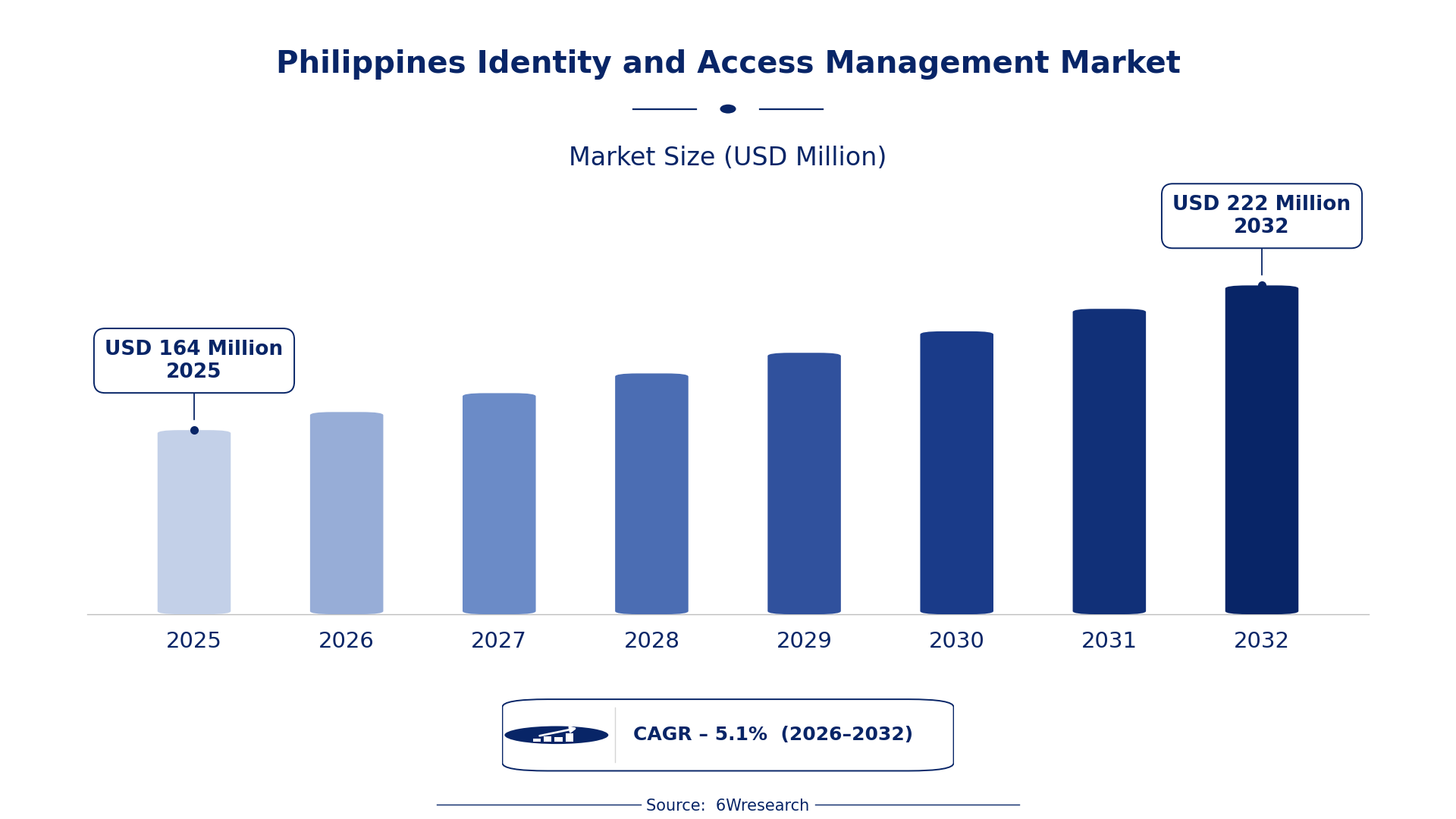
The Philippines Identity and Access Management Market was estimated at USD 164 Million in 2025 and is projected to reach USD 222 Million by 2032, growing at a CAGR of 5.1% from 2026 to 2032.
Philippines Identity and Access Management Market Synopsis
The Philippines Identity and Access Management market is at a pivotal moment, marked by a surge in demand driven by heightened awareness of cybersecurity risks and the necessity for digital identity verification. As enterprises and governmental institutions increasingly digitize their operations, the pressure to implement effective IAM solutions has never been greater.
Looking ahead, the market is expected to evolve, focusing on integrating advanced technologies such as biometrics and AI-driven analytics. This evolution aims not only to enhance security but also to improve user experience, a balancing act that will define success in the coming years.
Philippines Identity and Access Management Market Year-wise Growth Rate and Key Drivers
This graph illustrates the annual growth rates of the Philippines Identity and Access Management Market from 2021 to 2032, highlighting a steady upward trajectory and projected expansion over the forecast period.
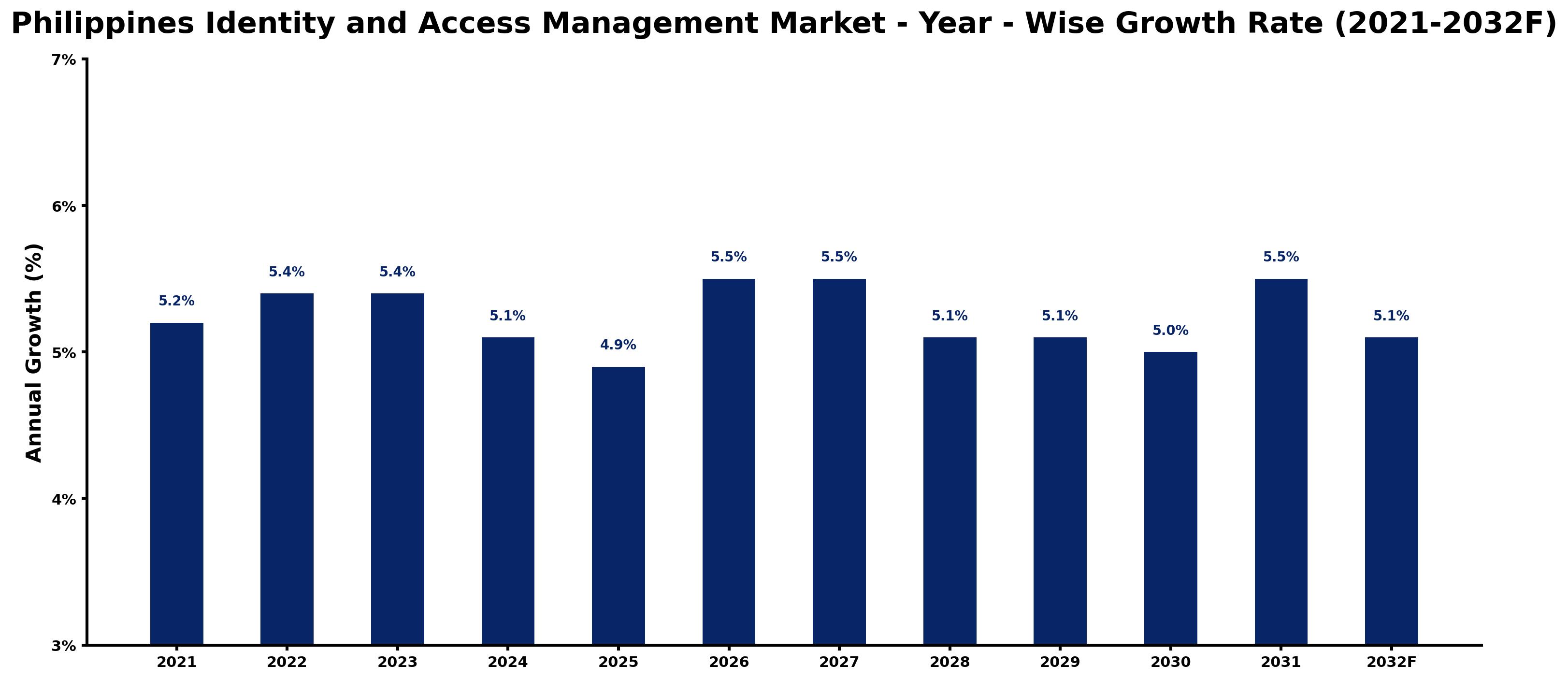
The table below presents the year‑wise growth rates along with the key drivers influencing the market
| Year | Growth Rate | Major Drivers |
| 2021 | 5.2% | Philippine Identification System Act implementation boosts digital ID adoption. |
| 2022 | 5.4% | Rise in cybersecurity threats increases demand for IAM solutions. |
| 2023 | 5.4% | Government initiatives enhance public-sector digital identity security. |
| 2024 | 5.1% | Growing online transactions drive need for secure access management. |
| 2025 | 4.9% | Regulatory compliance mandates necessitate robust identity frameworks. |
| 2026 | 5.5% | Increase in fintech startups demands advanced identity solutions. |
| 2027 | 5.5% | E-Government services expansion enhances demand for secure access. |
| 2028 | 5.1% | Improved internet connectivity fosters online identity verification needs. |
| 2029 | 5.1% | Data privacy concerns prompt businesses to upgrade IAM systems. |
| 2030 | 5.0% | Adoption of remote work increases identity access complexities. |
| 2031 | 5.5% | Emergence of biometric technologies enhances identity verification processes. |
| 2032 | 5.1% | Local enterprises prioritize IAM for regulatory compliance adherence. |
Note: Market size estimations and growth projections presented in this report are based on 6Wresearch's proprietary forecasting methodology, utilizing the latest available industry data, government publications, and primary research inputs.
Philippines Identity and Access Management Market Key Takeaways
Below are some of the specific key takeaways from the market, including:
- The increasing frequency of cyber threats is driving demand for sophisticated IAM solutions.
- Businesses prioritize seamless user access while ensuring stringent security measures.
- Adoption of cloud-based IAM solutions is gaining traction across various sectors.
- Regulatory frameworks are compelling organizations to implement stronger identity management protocols.
- The rise of remote work has necessitated a reevaluation of IAM strategies.
Evaluation of Restraints in Philippines Identity and Access Management Market
Despite its growth, the IAM market faces notable restraints. One major issue is the persistent challenge of achieving the right balance between security and user convenience. Organizations struggle to implement strong security protocols without compromising the user experience. This delicate equilibrium often hampers the rapid adoption of IAM technologies. Additionally, the integration of these solutions into existing IT infrastructure can prove complex and resource-intensive, deterring smaller businesses from embracing necessary upgrades.
Philippines Identity and Access Management Market Trends
Several trends are currently shaping the Philippines IAM market. A notable increase in the adoption of biometric authentication methods is evident, driven by a demand for more secure and user-friendly verification processes. Simultaneously, the transition to cloud-based services is not only enhancing accessibility but also reducing costs associated with on-premises solutions. Furthermore, as organizations face mounting regulatory pressures, compliance-driven investments in IAM technologies are expected to rise.
Philippines Identity and Access Management Market Opportunities
The future presents numerous growth opportunities in the IAM sector. Companies that can innovate to offer user-friendly, integrated IAM solutions stand to gain a competitive edge. The expansion of e-governance initiatives also paves the way for enhanced public sector adoption of IAM technologies, ensuring secure access to digital services for citizens. Additionally, the growing cybersecurity awareness among businesses highlights a pressing need for comprehensive IAM solutions tailored to specific sector requirements.
Government Initiatives in the Philippines Identity and Access Management Market
Government involvement is increasingly shaping the IAM market in the Philippines. With a focus on digital transformation and security, policy measures are being enacted to enhance identity verification standards across both public and private sectors. As regulatory frameworks tighten, compliance will become paramount, making government initiatives critical for market growth.
- A national digital infrastructure upgrade programme launched in early 2025 aims to bolster cybersecurity frameworks across government agencies.
- The Department of Information and Communications Technology is currently implementing guidelines for biometric authentication in government services.
- A regulatory framework introduced in 2026 mandates all businesses to adopt IAM solutions for access control to sensitive data.
- Ongoing collaborations between government agencies and tech firms are developing IAM standards to enhance public trust in digital services.
- A planned public-private initiative expected to enhance IAM technology adoption in SMEs is slated to launch by mid-2027.
Future Insights of the Philippines Identity and Access Management Market
From 2026 to 2032, the Philippines IAM market is anticipated to experience a significant transformation as organizations increasingly prioritize digital security. The integration of artificial intelligence and machine learning will streamline identity verification processes, enabling businesses to better anticipate and respond to threats. As regulatory pressures continue to mount, the demand for compliant, efficient IAM solutions will only intensify. Companies that position themselves as innovators in the IAM space will likely emerge as leaders in this burgeoning market.
Philippines Identity and Access Management Market Latest Developments
Recent activity in the Philippines IAM market reflects a growing commitment to advanced identity management solutions. Organizations are responding to the urgent need for improved security measures, particularly in light of increasing cyber threats. The push for digital transformation is driving the adoption of cutting-edge technologies.
- A major technology vendor launched an enhanced IAM solution in early 2025, integrating AI-driven analytics for better risk assessment.
- In mid-2025, a leading regional operator began a pilot programme to implement biometric authentication across select government platforms.
- A partnership announced in late 2025 between tech companies aims to develop industry-specific IAM frameworks for financial services.
- A rollout of cloud-based IAM solutions is currently underway, targeting enterprises looking to modernize their security infrastructure.
- By 2026, a new initiative to support digital identity verification for the healthcare sector is planned to commence.
Philippines Identity and Access Management Market - Key Attractiveness of the Report
- 10 Years of Market Numbers
- Historical Data Starting from 2022 to 2025
- Base Year: 2025
- Forecast Data until 2032
- Key Performance Indicators Impacting the Market
- Major Upcoming Developments and Projects
Key Highlights of the Report:
- Philippines Identity and Access Management Market Outlook
- Market Size of Philippines Identity and Access Management Market, 2025
- Forecast of Philippines Identity and Access Management Market, 2032
- Historical Data and Forecast of Philippines Identity and Access Management Revenues & Volume for the Period 2022-2032F
- Philippines Identity and Access Management Market Trend Evolution
- Philippines Identity and Access Management Market Drivers and Challenges
- Philippines Identity and Access Management Price Trends
- Philippines Identity and Access Management Porter's Five Forces
- Philippines Identity and Access Management Industry Life Cycle
- Historical Data and Forecast of Philippines Identity and Access Management Market Revenues & Volume By Component for the Period 2022-2032F
- Historical Data and Forecast of Philippines Identity and Access Management Market Revenues & Volume By Solutions for the Period 2022-2032F
- Historical Data and Forecast of Philippines Identity and Access Management Market Revenues & Volume By Services for the Period 2022-2032F
- Historical Data and Forecast of Philippines Identity and Access Management Market Revenues & Volume By Solution for the Period 2022-2032F
- Historical Data and Forecast of Philippines Identity and Access Management Market Revenues & Volume By Data Directory for the Period 2022-2032F
- Historical Data and Forecast of Philippines Identity and Access Management Market Revenues & Volume By Identity Lifecycle Management for the Period 2022-2032F
- Historical Data and Forecast of Philippines Identity and Access Management Market Revenues & Volume By Deployment Mode for the Period 2022-2032F
- Historical Data and Forecast of Philippines Identity and Access Management Market Revenues & Volume By Cloud for the Period 2022-2032F
- Historical Data and Forecast of Philippines Identity and Access Management Market Revenues & Volume By On-premises for the Period 2022-2032F
- Historical Data and Forecast of Philippines Identity and Access Management Market Revenues & Volume By Organization Size for the Period 2022-2032F
- Historical Data and Forecast of Philippines Identity and Access Management Market Revenues & Volume By SMEs for the Period 2022-2032F
- Historical Data and Forecast of Philippines Identity and Access Management Market Revenues & Volume By Large Enterprises for the Period 2022-2032F
- Historical Data and Forecast of Philippines Identity and Access Management Market Revenues & Volume By Vertical for the Period 2022-2032F
- Historical Data and Forecast of Philippines Identity and Access Management Market Revenues & Volume By BFSI for the Period 2022-2032F
- Historical Data and Forecast of Philippines Identity and Access Management Market Revenues & Volume By Travel and Hospitality for the Period 2022-2032F
- Historical Data and Forecast of Philippines Identity and Access Management Market Revenues & Volume By Healthcare for the Period 2022-2032F
- Historical Data and Forecast of Philippines Identity and Access Management Market Revenues & Volume By Retail and eCommerce for the Period 2022-2032F
- Historical Data and Forecast of Philippines Identity and Access Management Market Revenues & Volume By IT and ITeS for the Period 2022-2032F
- Historical Data and Forecast of Philippines Identity and Access Management Market Revenues & Volume By Education for the Period 2022-2032F
- Historical Data and Forecast of Philippines Identity and Access Management Market Revenues & Volume By Others (Energy and Utilities, Telecommunication, Other Citizen Services) for the Period 2022-2032F
- Philippines Identity and Access Management Import Export Trade Statistics
- Market Opportunity Assessment By Component
- Market Opportunity Assessment By Solution
- Market Opportunity Assessment By Deployment Mode
- Market Opportunity Assessment By Organization Size
- Market Opportunity Assessment By Vertical
- Philippines Identity and Access Management Top Companies Market Share
- Philippines Identity and Access Management Competitive Benchmarking By Technical and Operational Parameters
- Philippines Identity and Access Management Company Profiles
- Philippines Identity and Access Management Key Strategic Recommendations






































