Philippines Image Recognition Market Size & Growth Rate (2026-2032)
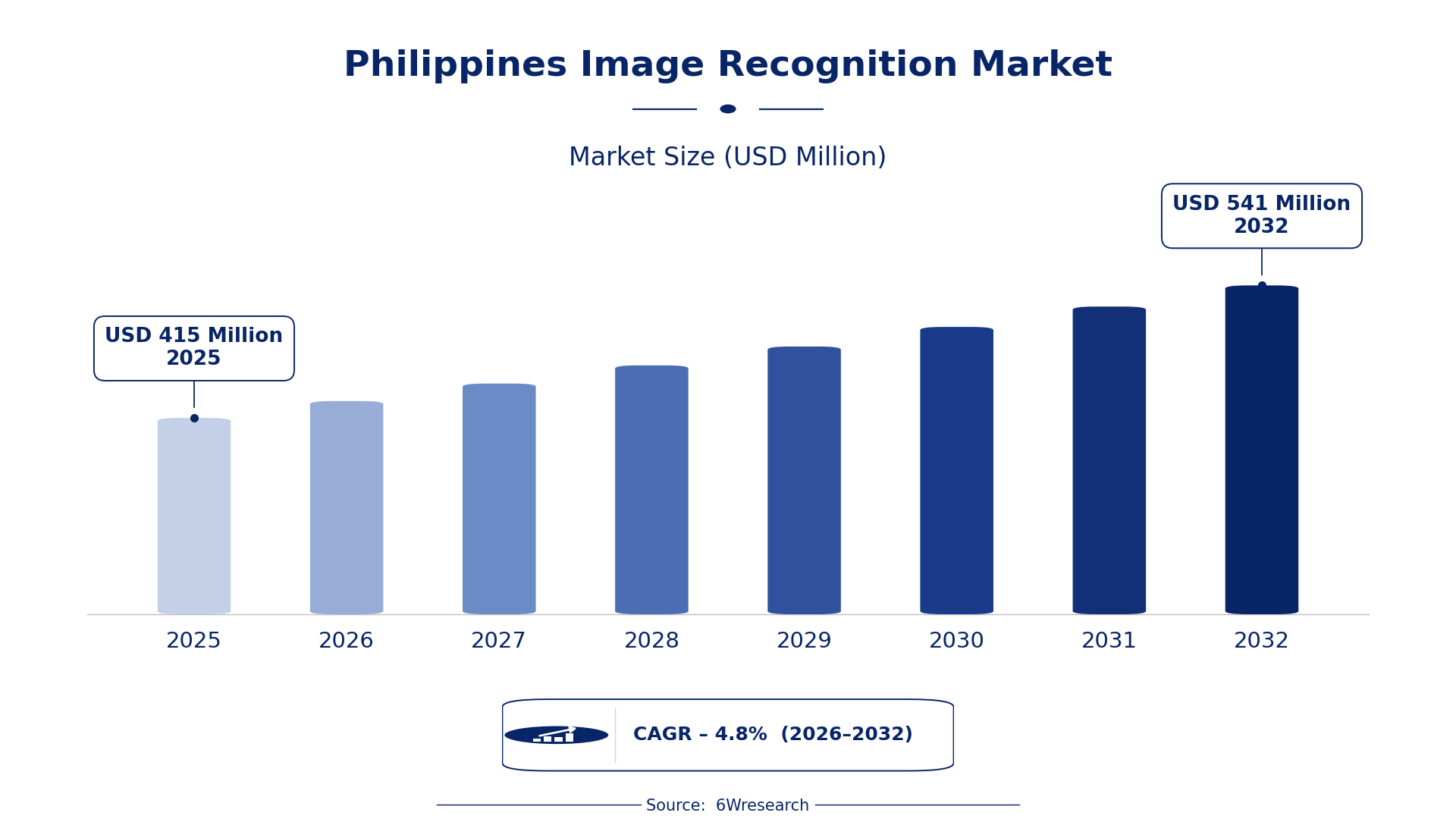
The Philippines Image Recognition Market was estimated at USD 415 Million in 2025 and is projected to reach USD 541 Million by 2032, growing at a CAGR of 4.8% from 2026 to 2032.
Philippines Image Recognition Market Synopsis
The surge in digital transformation across industries is the strongest force currently shaping the Philippines Image Recognition Market. Companies are increasingly adopting this technology to streamline operations, enhance customer experiences, and improve security measures.
Applications are diverse, ranging from facial recognition in security systems to product identification in retail. As the pandemic accelerated the shift toward contactless solutions, businesses are now more inclined to integrate image recognition technology into their operations.
Philippines Image Recognition Market Year-wise Growth Rate and Key Drivers
This graph illustrates the annual growth rates of the Philippines Image Recognition Market from 2021 to 2032, highlighting a steady upward trajectory and projected expansion over the forecast period.
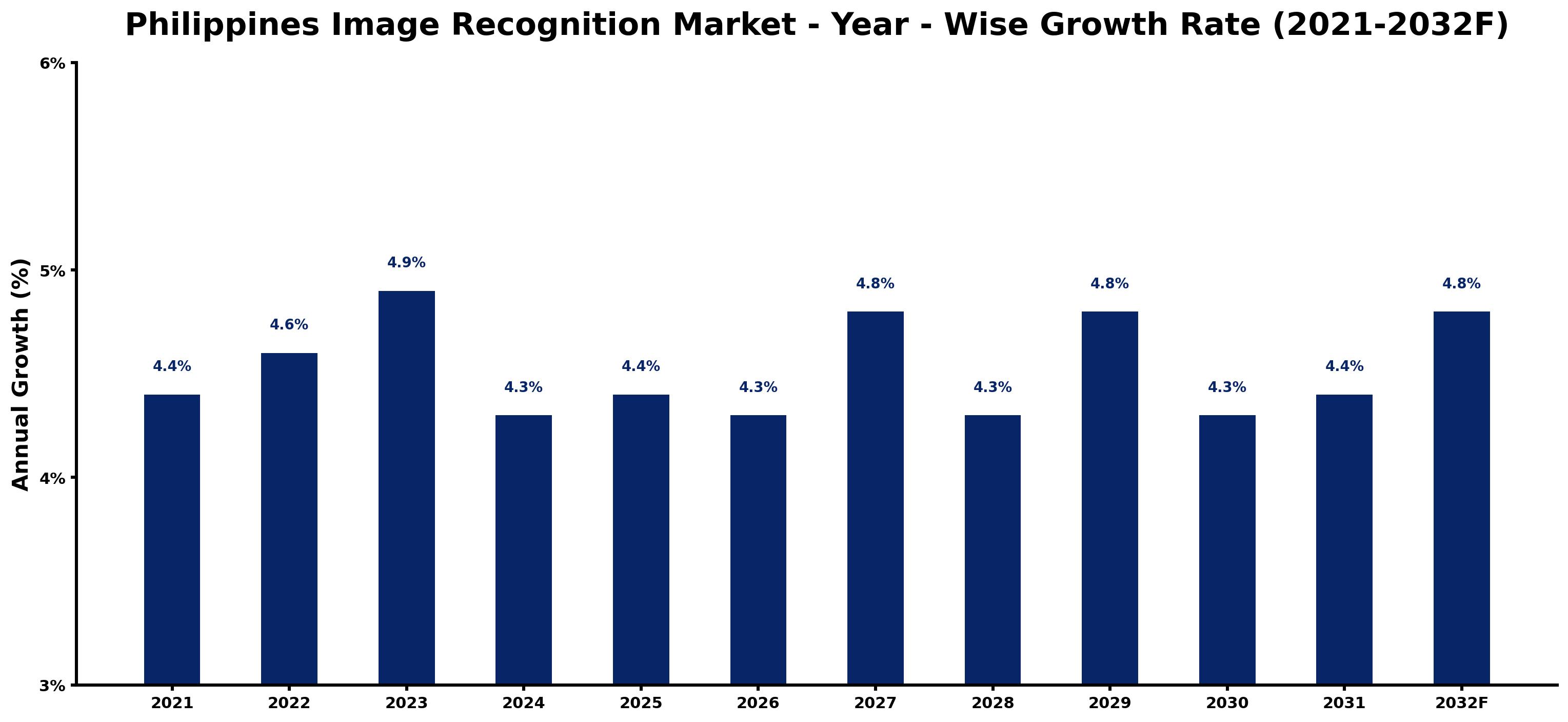
The table below presents the year‑wise growth rates along with the key drivers influencing the market
| Year | Growth Rate | Major Drivers |
| 2021 | 4.4% | Government support for AI technology integration initiatives. |
| 2022 | 4.6% | Local retailers adopting facial recognition for customer insights. |
| 2023 | 4.9% | Rising eCommerce trends driving visual search technologies. |
| 2024 | 4.3% | Increased smartphone penetration enhancing mobile image usage. |
| 2025 | 4.4% | Security sector adoption of surveillance image analytics. |
| 2026 | 4.3% | Growth in remote learning utilizing image-based assessments. |
| 2027 | 4.8% | Local startups innovating in augmented reality applications. |
| 2028 | 4.3% | CCTV upgrade mandates improving image processing capabilities. |
| 2029 | 4.8% | Popularity of social media driving user-generated image analysis. |
| 2030 | 4.3% | Healthcare sector leveraging image recognition for diagnostics. |
| 2031 | 4.4% | Tourism industry employing facial recognition for efficiency. |
| 2032 | 4.8% | Increased automation in manufacturing using visual quality control. |
Note: Market size estimations and growth projections presented in this report are based on 6Wresearch's proprietary forecasting methodology, utilizing the latest available industry data, government publications, and primary research inputs.
Philippines Image Recognition Market Key Takeaways
Below are some of the specific key takeaways from the market, including:
- The market is driven by increased investments in security and e-commerce applications.
- Technological advancements in artificial intelligence and machine learning are improving accuracy.
- Data privacy and security concerns remain critical challenges for stakeholders.
- Healthcare applications are growing, particularly in diagnostics and patient management.
- Government initiatives are fostering a favorable regulatory environment for innovation.
Evaluation of Restraints in Philippines Image Recognition Market
Despite the promising outlook, the Philippines Image Recognition Market faces several restraints. One of the main challenges is the need for highly sophisticated algorithms that can perform accurately across varied environments. Additionally, concerns surrounding data privacy and security pose significant hurdles for organizations looking to adopt these technologies. Without addressing these challenges, widespread implementation could be hindered.
Philippines Image Recognition Market Trends
The trend towards automation is gaining traction, with more businesses utilizing image recognition to reduce manual processes. Contactless solutions, especially in retail and healthcare, are increasingly popular as consumer preferences shift. Enhanced collaboration between tech firms and local businesses is also emerging, fostering innovation and tailored solutions specific to the Philippine market.
Philippines Image Recognition Market Opportunities
The growth of e-commerce presents a lucrative opportunity for image recognition technologies, particularly in visual search capabilities. Additionally, the healthcare sector is ripe for investment, as image recognition can significantly enhance diagnostic accuracy and patient management. As local governments push for smart city initiatives, the demand for security applications will likely increase, offering further avenues for growth.
Government Initiatives in the Philippines Image Recognition Market
The Philippine government is actively shaping the Image Recognition Market through various initiatives aimed at fostering innovation and ensuring regulatory compliance. This proactive approach is essential for addressing both consumer concerns and technological advancements. Policymakers are prioritizing frameworks that encourage investment while safeguarding data privacy.
- A regulatory framework introduced in 2025 mandating data protection measures for image recognition applications.
- Current initiatives focus on enhancing digital infrastructure to support technology adoption across sectors.
- A national program aimed at integrating image recognition technology in public safety operations is underway.
- Plans to launch a public-private partnership by 2026 to promote research and development in AI and image recognition.
Future Insights of the Philippines Image Recognition Market
Looking ahead to 2026-2032, the Philippines Image Recognition Market is set for steady growth driven by technological advancements and increased adoption across various sectors. As businesses continue to prioritize efficiency and security, the integration of AI and machine learning will enhance the capabilities of image recognition systems. The alignment of regulatory policies with market needs will further facilitate growth, creating a conducive environment for innovation.
Philippines Image Recognition Market Latest Developments
Recent developments in the Philippines Image Recognition Market indicate a dynamic and rapidly evolving sector. Over the past year, key initiatives and partnerships have emerged, highlighting the growing interest and investment in this technology.
- A major technology vendor announced a partnership with local retailers in early 2025 to implement image recognition for inventory management.
- Ongoing trials for facial recognition systems in public transportation aimed at enhancing security measures are expected to conclude by mid-2026.
- A new product line focusing on healthcare image analysis was launched in Q1 2025, targeting hospitals across the country.
- An initiative that began in late 2025 to integrate AI-based surveillance systems in urban areas is currently underway.
Philippines Image Recognition Market - Key Attractiveness of the Report
- 10 Years of Market Numbers
- Historical Data Starting from 2022 to 2025
- Base Year: 2025
- Forecast Data until 2032
- Key Performance Indicators Impacting the Market
- Major Upcoming Developments and Projects
Key Highlights of the Report:
- Philippines Image Recognition Market Outlook
- Market Size of Philippines Image Recognition Market, 2025
- Forecast of Philippines Image Recognition Market, 2032
- Historical Data and Forecast of Philippines Image Recognition Revenues & Volume for the Period 2022-2032F
- Philippines Image Recognition Market Trend Evolution
- Philippines Image Recognition Market Drivers and Challenges
- Philippines Image Recognition Price Trends
- Philippines Image Recognition Porter's Five Forces
- Philippines Image Recognition Industry Life Cycle
- Historical Data and Forecast of Philippines Image Recognition Market Revenues & Volume By Technology for the Period 2022-2032F
- Historical Data and Forecast of Philippines Image Recognition Market Revenues & Volume By Digital Image Processing for the Period 2022-2032F
- Historical Data and Forecast of Philippines Image Recognition Market Revenues & Volume By Facial Recognition for the Period 2022-2032F
- Historical Data and Forecast of Philippines Image Recognition Market Revenues & Volume By Pattern Recognition for the Period 2022-2032F
- Historical Data and Forecast of Philippines Image Recognition Market Revenues & Volume By Deployment Mode for the Period 2022-2032F
- Historical Data and Forecast of Philippines Image Recognition Market Revenues & Volume By On-premises for the Period 2022-2032F
- Historical Data and Forecast of Philippines Image Recognition Market Revenues & Volume By Cloud for the Period 2022-2032F
- Historical Data and Forecast of Philippines Image Recognition Market Revenues & Volume By Component for the Period 2022-2032F
- Historical Data and Forecast of Philippines Image Recognition Market Revenues & Volume By Hardware for the Period 2022-2032F
- Historical Data and Forecast of Philippines Image Recognition Market Revenues & Volume By Software for the Period 2022-2032F
- Historical Data and Forecast of Philippines Image Recognition Market Revenues & Volume By Services for the Period 2022-2032F
- Historical Data and Forecast of Philippines Image Recognition Market Revenues & Volume By Application for the Period 2022-2032F
- Historical Data and Forecast of Philippines Image Recognition Market Revenues & Volume By Scanning and Imaging for the Period 2022-2032F
- Historical Data and Forecast of Philippines Image Recognition Market Revenues & Volume By Security and Surveillance for the Period 2022-2032F
- Historical Data and Forecast of Philippines Image Recognition Market Revenues & Volume By Image Search for the Period 2022-2032F
- Historical Data and Forecast of Philippines Image Recognition Market Revenues & Volume By Augmented Reality for the Period 2022-2032F
- Historical Data and Forecast of Philippines Image Recognition Market Revenues & Volume By Marketing and Advertising for the Period 2022-2032F
- Philippines Image Recognition Import Export Trade Statistics
- Market Opportunity Assessment By Technology
- Market Opportunity Assessment By Deployment Mode
- Market Opportunity Assessment By Component
- Market Opportunity Assessment By Application
- Philippines Image Recognition Top Companies Market Share
- Philippines Image Recognition Competitive Benchmarking By Technical and Operational Parameters
- Philippines Image Recognition Company Profiles
- Philippines Image Recognition Key Strategic Recommendations






































