Philippines Immunology Market Size, Share & Growth Rate
The Philippines Immunology Market was estimated at USD 209 Million in 2025 and is projected to reach USD 295 Million by 2032, growing at a CAGR of 5.0% from 2026 to 2032. This growth trajectory is primarily fueled by the increasing incidence of autoimmune diseases and the advancements in biotechnology, which are paving the way for innovative drug development. Furthermore, the rising availability and adoption of targeted immunotherapy treatments are transforming patient care and driving demand across various segments of the market.
Philippines Immunology Market Year-wise Growth Rate and Key Drivers
This graph highlights how the Philippines Immunology Market has steadily grown over the years, supported by major growth factors.
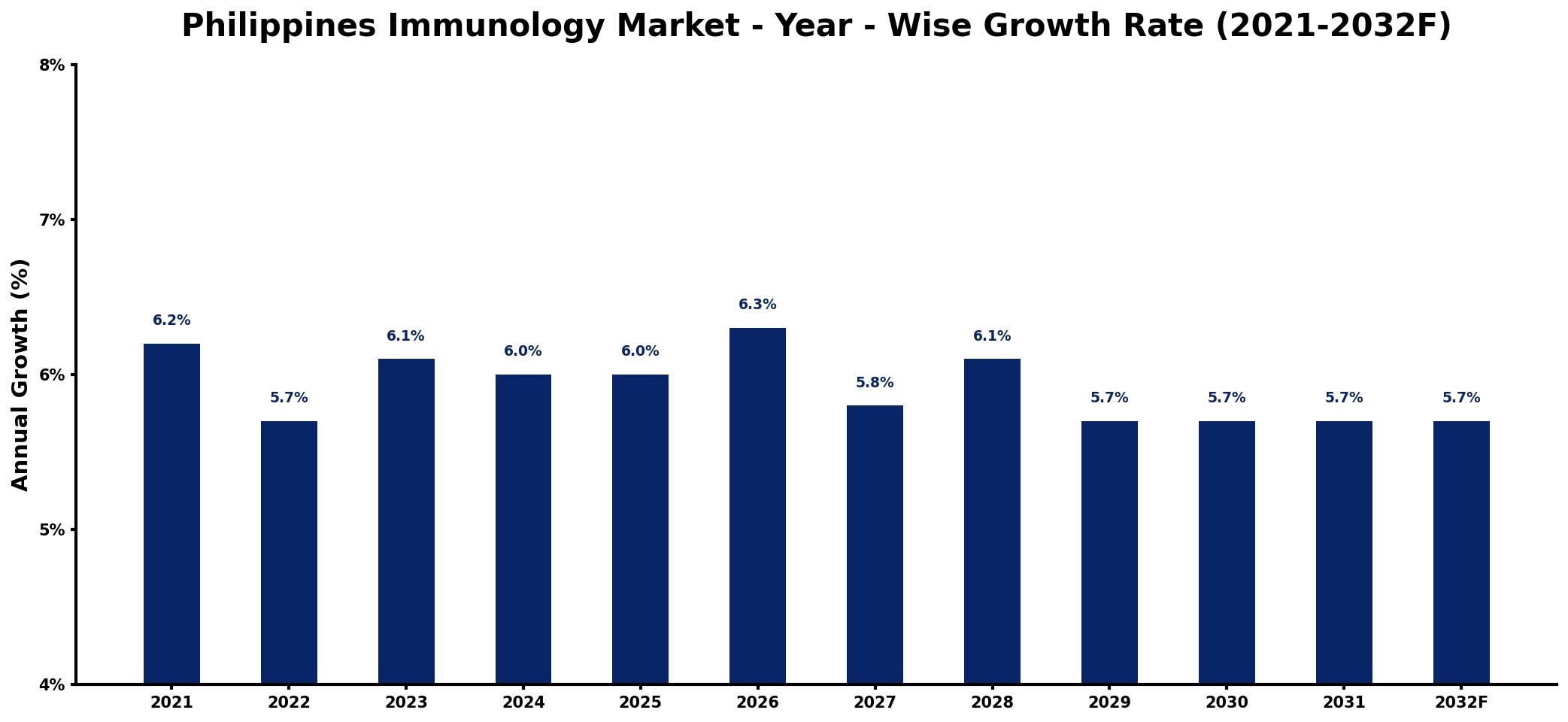
The table below presents the year‑wise growth rates along with the key drivers influencing the market
| Year | Growth Rate | Major Drivers |
| 2021 | 6.2% | Rising disease prevalence drives investment |
| 2022 | 5.7% | Increased healthcare funding supports growth |
| 2023 | 6.1% | Technological advancements enhance diagnostics |
| 2024 | 6.0% | Growing awareness boosts patient demand |
| 2025 | 6.0% | Expanding healthcare infrastructure supports access |
| 2026 | 6.3% | Research initiatives foster innovative therapies |
| 2027 | 5.8% | rising export shipment volumes |
| 2028 | 6.1% | Collaborations enhance research funding opportunities |
| 2029 | 5.7% | Emerging markets attract foreign investments |
| 2030 | 5.7% | increased overall sector activity |
| 2031 | 5.7% | Regulatory support encourages new entrants |
| 2032 | 5.7% | Healthcare partnerships enhance service delivery |
Note: Market size estimations and growth projections presented in this report are based on 6Wresearch's proprietary forecasting methodology, utilizing the latest available industry data, government publications, and primary research inputs.
Philippines Immunology Market Synopsis
The foremost force shaping the immunology market in the Philippines is the rising prevalence of autoimmune diseases, which has heightened awareness and urgency for effective treatment options. As healthcare providers and patients seek advanced therapies, the focus on immunological research has intensified, leading to significant investments in drug development.
In addition to increasing awareness, the market is also experiencing a paradigm shift due to advancements in biotechnology. As pharmaceutical companies continue to innovate and develop targeted therapies, the landscape of immunotherapy is evolving, offering new hope for patients with previously hard-to-treat conditions.
Philippines Immunology Market Key Takeaways
- The market is projected to grow significantly, reaching USD 295 Million by 2032.
- Awareness of autoimmune diseases and the need for effective treatments are driving demand.
- Advancements in biotechnology are leading to innovative drug development.
- Access to cutting-edge treatments remains a critical challenge in addressing patient needs.
- COVID-19 has shifted research priorities, impacting some areas of immunology.
Evaluation of Restraints in Philippines Immunology Market
The Philippines immunology market faces significant restraints primarily due to economic disparities that limit access to advanced treatments. While cutting-edge therapies hold immense potential, their affordability often excludes a substantial portion of the population. This discrepancy hinders the ability of the market to cater to a wider patient base, which could otherwise benefit from these innovations. The ongoing challenges in the healthcare infrastructure, including resource allocation and training for healthcare professionals, further complicate the landscape. As a result, the market's growth is tempered by these structural limitations, necessitating targeted initiatives to address accessibility and cost-related barriers.
Philippines Immunology Market Trends
Key trends in the Philippines immunology market include the increasing integration of digital technologies in healthcare, which enhances patient monitoring and data collection. Additionally, there is a growing emphasis on personalized medicine, enabling tailored therapies based on individual patient profiles. This trend is further supported by advancements in genetic and biomarker research, allowing for more precise targeting of immunotherapies. Collaborative efforts between public and private sectors to foster research and development are also becoming more prevalent, signaling a robust ecosystem for innovation.
Philippines Immunology Market Opportunities
The Philippines immunology market presents numerous growth and investment opportunities, particularly in the fields of biotechnology and personalized medicine. The increasing recognition of autoimmune diseases, coupled with rising healthcare expenditure, creates a fertile ground for developing new treatment options. Furthermore, the ongoing push for improved healthcare infrastructure offers avenues for investments in diagnostic tools and biomanufacturing capabilities. Engaging in strategic partnerships and collaborations can enhance research output and expedite the commercialization of innovative therapies, thus leveraging the current momentum in the sector.
Government Initiatives in the Philippines Immunology Market
The Philippine government is actively promoting initiatives to enhance healthcare access and innovation within the immunology sector. Policies aimed at increasing public health awareness about autoimmune diseases and the benefits of early diagnosis are being implemented. Moreover, public spending on healthcare infrastructure is gradually increasing, focusing on improving access to cutting-edge treatments. Collaborative programs with international research organizations are also being encouraged, aiming to boost local research capabilities and attract foreign investment in the biotechnology space.
Future Insights of the Philippines Immunology Market
Looking ahead to 2026-2032, the Philippines immunology market is set to undergo a notable transformation driven by sustained advancements in research and technology. With the recovery from the COVID-19 pandemic, the focus will likely shift back toward broad immunological research and treatment options. As patients increasingly seek innovative solutions for their health challenges, the market will benefit from enhanced drug pipelines and more effective therapies. Furthermore, the establishment of integrated healthcare systems is expected to facilitate better access to treatments, ensuring that the market can address the diverse needs of the population effectively.
Philippines Immunology Market Latest Developments (2025 - 2026)
Recent developments in the Philippines immunology market indicate a strong push towards innovative research and collaboration among stakeholders. The government is facilitating partnerships between universities and the private sector to enhance the local drug development landscape. Additionally, there has been a notable increase in clinical trials for new immunotherapies, reflecting growing interest from global pharmaceutical companies. As healthcare institutions begin to invest in advanced diagnostic technologies, the overall landscape of the market is evolving towards more personalized and effective patient care.
Philippines Immunology Market - Key Attractiveness of the Report
- 10 Years of Market Numbers
- Historical Data Starting from 2022 to 2025
- Base Year: 2025
- Forecast Data until 2032
- Key Performance Indicators Impacting the Market
- Major Upcoming Developments and Projects
Key Highlights of the Report:
- Philippines Immunology Market Outlook
- Market Size of Philippines Immunology Market, 2025
- Forecast of Philippines Immunology Market, 2032
- Historical Data and Forecast of Philippines Immunology Revenues & Volume for the Period 2022-2032F
- Philippines Immunology Market Trend Evolution
- Philippines Immunology Market Drivers and Challenges
- Philippines Immunology Price Trends
- Philippines Immunology Porter's Five Forces
- Philippines Immunology Industry Life Cycle
- Historical Data and Forecast of Philippines Immunology Market Revenues & Volume By Drug Class for the Period 2022-2032F
- Historical Data and Forecast of Philippines Immunology Market Revenues & Volume By Monoclonal Antibody (mAb) for the Period 2022-2032F
- Historical Data and Forecast of Philippines Immunology Market Revenues & Volume By Fusion Proteins for the Period 2022-2032F
- Historical Data and Forecast of Philippines Immunology Market Revenues & Volume By Immunosuppressants for the Period 2022-2032F
- Historical Data and Forecast of Philippines Immunology Market Revenues & Volume By Polyclonal Antibody (pAb) for the Period 2022-2032F
- Historical Data and Forecast of Philippines Immunology Market Revenues & Volume By Others for the Period 2022-2032F
- Historical Data and Forecast of Philippines Immunology Market Revenues & Volume By Disease Indication for the Period 2022-2032F
- Historical Data and Forecast of Philippines Immunology Market Revenues & Volume By Rheumatoid Arthritis for the Period 2022-2032F
- Historical Data and Forecast of Philippines Immunology Market Revenues & Volume By Psoriatic Arthritis for the Period 2022-2032F
- Historical Data and Forecast of Philippines Immunology Market Revenues & Volume By Plaque Psoriasis for the Period 2022-2032F
- Historical Data and Forecast of Philippines Immunology Market Revenues & Volume By Ankylosing Spondylitis for the Period 2022-2032F
- Historical Data and Forecast of Philippines Immunology Market Revenues & Volume By Inflammatory Bowel Disease for the Period 2022-2032F
- Historical Data and Forecast of Philippines Immunology Market Revenues & Volume By Prophylaxis of Organ Rejection for the Period 2022-2032F
- Historical Data and Forecast of Philippines Immunology Market Revenues & Volume By Others for the Period 2022-2032F
- Historical Data and Forecast of Philippines Immunology Market Revenues & Volume By Distribution Channel for the Period 2022-2032F
- Historical Data and Forecast of Philippines Immunology Market Revenues & Volume By Hospital Pharmacies for the Period 2022-2032F
- Historical Data and Forecast of Philippines Immunology Market Revenues & Volume By Retail Pharmacies for the Period 2022-2032F
- Historical Data and Forecast of Philippines Immunology Market Revenues & Volume By Online Pharmacies for the Period 2022-2032F
- Philippines Immunology Import Export Trade Statistics
- Market Opportunity Assessment By Drug Class
- Market Opportunity Assessment By Disease Indication
- Market Opportunity Assessment By Distribution Channel
- Philippines Immunology Top Companies Market Share
- Philippines Immunology Competitive Benchmarking By Technical and Operational Parameters
- Philippines Immunology Company Profiles
- Philippines Immunology Key Strategic Recommendations






































