Philippines Industrial Dryers for Agricultural Products Market Size, Share & Growth Rate
The Philippines Industrial Dryers for Agricultural Products Market was estimated at USD 115 Million in 2025 and is projected to reach USD 126 Million by 2032, growing at a CAGR of 1.3% from 2026 to 2032. This growth trajectory reflects the country's ongoing reliance on agriculture and the pressing need for efficient post-harvest management solutions. The expansion of agricultural production, combined with a focus on reducing post-harvest losses, is driving demand for advanced drying technologies, which are becoming essential in maintaining product quality and ensuring food security.
Philippines Industrial Dryers for Agricultural Products Market Year-wise Growth Rate and Key Drivers
This graph highlights how the Philippines Industrial Dryers for Agricultural Products Market has steadily grown over the years, supported by major growth factors.
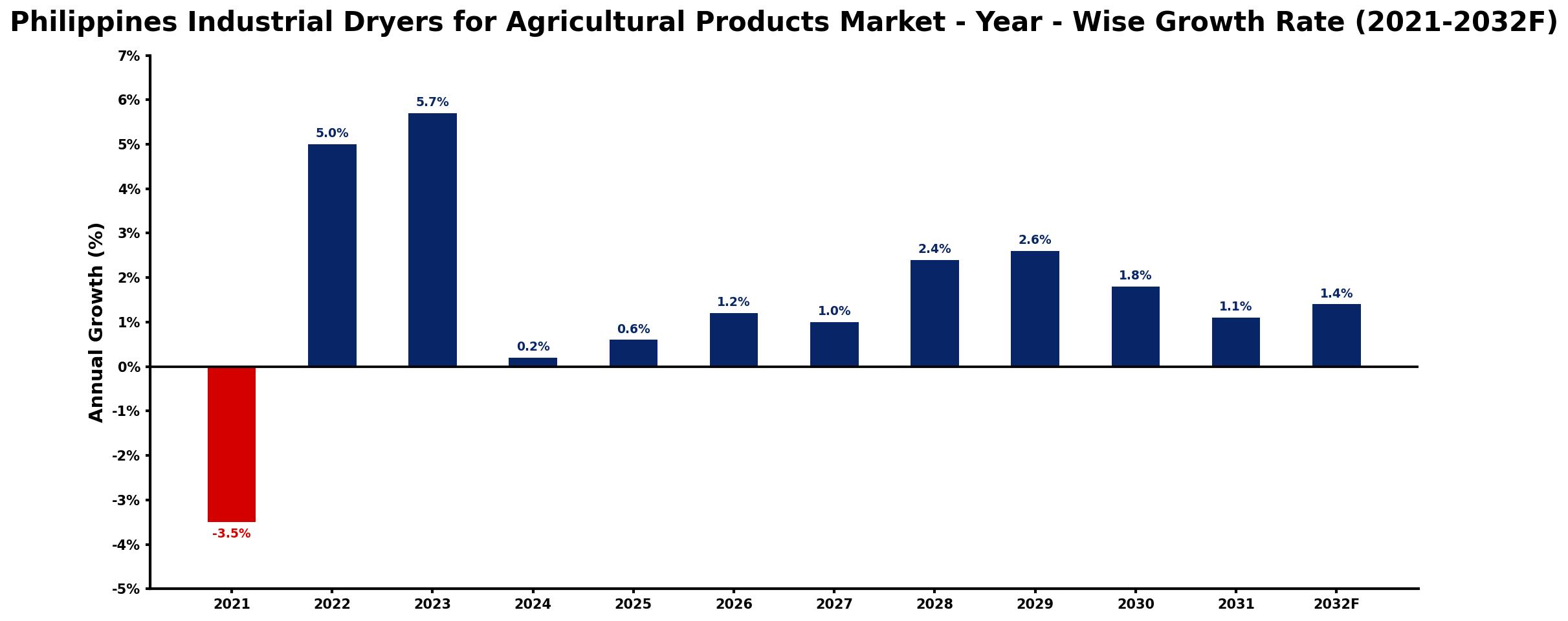
The table below presents the year‑wise growth rates along with the key drivers influencing the market
| Year | Growth Rate | Major Drivers |
| 2021 | -3.5% | decreased demand from local farmers |
| 2022 | 5.0% | increased investment in technology |
| 2023 | 5.7% | growing interest in sustainable practices |
| 2024 | 0.2% | expansion of processing facilities |
| 2025 | 0.6% | rising exports of local goods |
| 2026 | 1.2% | enhanced supply chain efficiencies |
| 2027 | 1.0% | growing consumer health awareness |
| 2028 | 2.4% | increased government support programs |
| 2029 | 2.6% | development of new market segments |
| 2030 | 1.8% | rising demand for quality standards |
| 2031 | 1.1% | improved processing technologies adoption |
| 2032 | 1.4% | increased collaboration among stakeholders |
Note: Market size estimations and growth projections presented in this report are based on 6Wresearch's proprietary forecasting methodology, utilizing the latest available industry data, government publications, and primary research inputs.
Philippines Industrial Dryers for Agricultural Products Market Synopsis
In the Philippines, industrial dryers serve a pivotal role in post-harvest processing, particularly for staple crops such as rice, as well as fruits and vegetables. The integration of drying technology is crucial in preventing spoilage, thereby enhancing the overall quality of agricultural products and aligning with the country's goals for sustainable food production.
Over the years, the market has seen a robust annual growth rate of 7%, largely propelled by increasing agricultural productivity and the implementation of modern drying solutions. Government initiatives aimed at upgrading agricultural practices and minimizing food wastage further underpin the market's expansion.
Philippines Industrial Dryers for Agricultural Products Market Key Takeaways
- The market is expected to grow steadily, with increasing agricultural production driving demand for drying equipment.
- Modernization efforts in agriculture are crucial for reducing post-harvest losses and ensuring high-quality products.
- The need for energy-efficient drying solutions presents both a challenge and an opportunity for technological advancements.
- Government support and policies aimed at enhancing food security are key contributors to market growth.
- Recovery from COVID-19 disruptions has spurred renewed focus on improving supply chain efficiency in the agricultural sector.
Evaluation of Restraints in Philippines Industrial Dryers for Agricultural Products Market
Despite the promising outlook, the Philippines Industrial Dryers for Agricultural Products market faces significant challenges, particularly concerning energy efficiency. The delicate balance between effectively removing moisture and preserving the nutritional value of agricultural products necessitates advanced technologies and precise control mechanisms. Additionally, variations in crop types and moisture content complicate standardization, leading to potential inefficiencies in drying processes. Addressing these challenges will require innovative solutions and investment in research and development to enhance system capabilities.
Philippines Industrial Dryers for Agricultural Products Market Trends
Key trends are shaping the Philippines Industrial Dryers for Agricultural Products market, including the rise of solar drying technologies as a sustainable alternative. As the agricultural community increasingly prioritizes eco-friendly methods, solar dryers are gaining traction due to their low operational costs and reduced environmental impact. Furthermore, automation and smart drying solutions, which integrate IoT technologies, are emerging to improve operational efficiency, enabling real-time monitoring and control of the drying process.
Philippines Industrial Dryers for Agricultural Products Market Opportunities
Opportunities in the market are plentiful, particularly in the development of customized drying solutions tailored to specific crops. Innovations such as hybrid drying systems that combine solar and traditional energy sources could provide farmers with versatile, cost-effective options. Additionally, partnerships with agricultural cooperatives could facilitate the adoption of advanced drying technologies, enhancing productivity and reducing losses across the supply chain.
Government Initiatives in the Philippines Industrial Dryers for Agricultural Products Market
The Philippine government has been proactive in fostering agricultural sustainability through various initiatives aimed at modernizing farming practices. Public investments in infrastructure, coupled with programs designed to educate farmers about post-harvest technologies, contribute to improving food security. Additionally, policies supporting the adoption of energy-efficient equipment are likely to drive further growth in the industrial dryers market, reinforcing the commitment to enhancing agricultural productivity and minimizing waste.
Future Insights of the Philippines Industrial Dryers for Agricultural Products Market
Looking ahead to 2026-2032, the Philippines Industrial Dryers for Agricultural Products market is poised for steady growth, primarily due to sustained agricultural development and government initiatives focused on modernization. As technology continues to evolve, we expect to see a greater emphasis on energy-efficient drying solutions and the increasing adoption of automated systems. This evolution will not only enhance productivity but also contribute to long-term sustainability in the sector.
Philippines Industrial Dryers for Agricultural Products Market Latest Developments (2025 - 2026)
Recent developments in the industrial dryers market indicate a growing shift towards smart drying technologies that leverage automation and real-time data analytics. Moreover, collaborations between manufacturers and research institutions have led to innovative drying techniques that promise to enhance efficiency and reduce waste. As the agricultural sector recovers from pandemic-related disruptions, the focus remains on improving supply chain processes and enhancing product quality through advanced drying solutions.
Philippines Industrial Dryers for Agricultural Products Market - Key Attractiveness of the Report
- 10 Years of Market Numbers
- Historical Data Starting from 2022 to 2025
- Base Year: 2025
- Forecast Data until 2032
- Key Performance Indicators Impacting the Market
- Major Upcoming Developments and Projects
Key Highlights of the Report:
- Philippines Industrial Dryers for Agricultural Products Market Outlook
- Market Size of Philippines Industrial Dryers for Agricultural Products Market, 2025
- Forecast of Philippines Industrial Dryers for Agricultural Products Market, 2032
- Historical Data and Forecast of Philippines Industrial Dryers for Agricultural Products Revenues & Volume for the Period 2022-2032F
- Philippines Industrial Dryers for Agricultural Products Market Trend Evolution
- Philippines Industrial Dryers for Agricultural Products Market Drivers and Challenges
- Philippines Industrial Dryers for Agricultural Products Price Trends
- Philippines Industrial Dryers for Agricultural Products Porter's Five Forces
- Philippines Industrial Dryers for Agricultural Products Industry Life Cycle
- Historical Data and Forecast of Philippines Industrial Dryers for Agricultural Products Market Revenues & Volume By Type for the Period 2022-2032F
- Historical Data and Forecast of Philippines Industrial Dryers for Agricultural Products Market Revenues & Volume By Hot Air Drying Equipment for the Period 2022-2032F
- Historical Data and Forecast of Philippines Industrial Dryers for Agricultural Products Market Revenues & Volume By Heated Surface Drying Equipment for the Period 2022-2032F
- Historical Data and Forecast of Philippines Industrial Dryers for Agricultural Products Market Revenues & Volume By Application for the Period 2022-2032F
- Historical Data and Forecast of Philippines Industrial Dryers for Agricultural Products Market Revenues & Volume By Conveyer Drying Equipment for the Period 2022-2032F
- Historical Data and Forecast of Philippines Industrial Dryers for Agricultural Products Market Revenues & Volume By Cabinet Drying Equipment for the Period 2022-2032F
- Philippines Industrial Dryers for Agricultural Products Import Export Trade Statistics
- Market Opportunity Assessment By Type
- Market Opportunity Assessment By Application
- Philippines Industrial Dryers for Agricultural Products Top Companies Market Share
- Philippines Industrial Dryers for Agricultural Products Competitive Benchmarking By Technical and Operational Parameters
- Philippines Industrial Dryers for Agricultural Products Company Profiles
- Philippines Industrial Dryers for Agricultural Products Key Strategic Recommendations






































