Philippines Industrial Furnace Market Size, Share & Growth Rate
The Philippines Industrial Furnace Market was estimated at USD 94 Million in 2025 and is projected to reach USD 102 Million by 2032, growing at a CAGR of 1.2% from 2026 to 2032. This growth trajectory is driven primarily by increasing investments in manufacturing sectors, notably steel and nonferrous metals, which are vital for the nation's industrial progression. Moreover, the automotive industry's rising demand for efficient heating solutions further propels the need for modern industrial furnaces, as companies seek to enhance productivity while adhering to sustainability practices.
Philippines Industrial Furnace Market Year-wise Growth Rate and Key Drivers
This graph highlights how the Philippines Industrial Furnace Market has steadily grown over the years, supported by major growth factors.
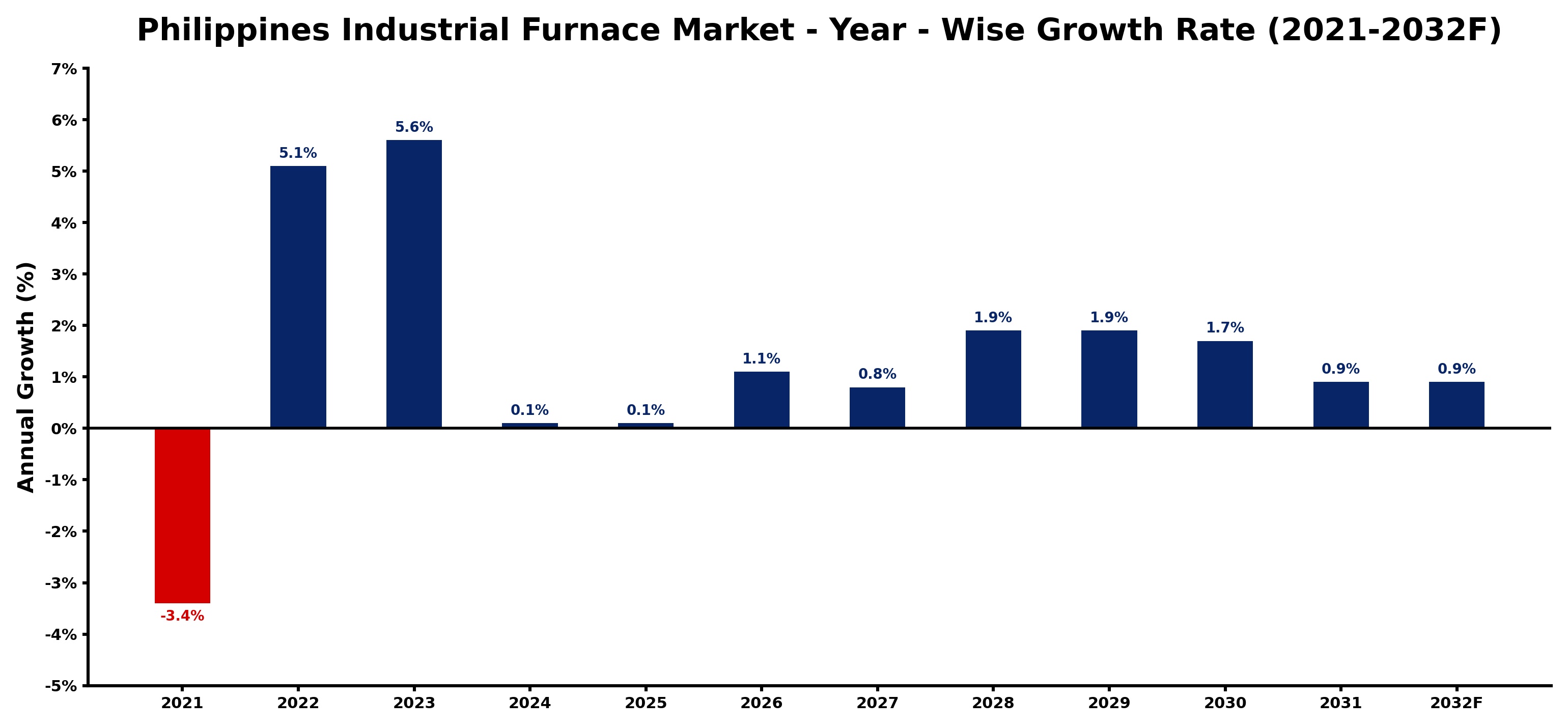
The table below presents the year‑wise growth rates along with the key drivers influencing the market
| Year | Growth Rate | Major Drivers |
| 2021 | -3.4% | Export disruptions hindered industrial furnace procurement across sectors |
| 2022 | 5.1% | Optimized smelting operations drove demand for refractory materials supply |
| 2023 | 5.6% | Local manufacturers invest in advanced furnace technology upgrades |
| 2024 | 0.1% | Increased construction projects stimulate refractory materials demand growth |
| 2025 | 0.1% | Local semiconductor manufacturing facilities boost furnace demand for processing |
| 2026 | 1.1% | Technology upgrades in smelting processes boost metal production efficiency |
| 2027 | 0.8% | New furnace installations boost steel production capacity across regions |
| 2028 | 1.9% | Investment in energy efficient furnaces drives manufacturing sector productivity |
| 2029 | 1.9% | Advanced furnace technology adoption boosts steel production efficiency |
| 2030 | 1.7% | Manufacturing investments in renewable energy systems boost furnace demand |
| 2031 | 0.9% | Manufacturing sector recovery boosts industrial furnace sales in Luzon |
| 2032 | 0.9% | Domestic manufacturing investments boost high temperature furnace demand and utilization |
Note - Market size estimations and growth projections presented in this report are based on 6Wresearch's advanced forecasting approach, validated with industry datasets as of June 2026.
Philippines Industrial Furnace Market Synopsis
The demand for industrial furnaces in the Philippines is underscored by the burgeoning manufacturing sector, which requires reliable heating solutions for various processes such as metal smelting and heat treatment. With the government's focus on modernizing industrial capabilities, there is a pronounced need for high-quality furnaces that can meet industry standards while promoting energy efficiency.
This market plays a crucial role in supporting diverse industries, including automotive, electronics, and construction materials. However, the adoption of advanced furnace technologies is essential for manufacturers seeking to optimize their production processes and minimize environmental impact, necessitating continuous innovation and investment in state-of-the-art furnace systems.
Philippines Industrial Furnace Market Key Takeaways
- The market is projected to grow from USD 94 Million in 2025 to USD 102 Million by 2032.
- Investment in green technologies and energy-efficient solutions is driving modernization in the industrial sector.
- Key industries such as automotive and steel production are major consumers of industrial furnaces.
- Government initiatives are increasingly focusing on enhancing manufacturing capabilities and environmental sustainability.
- Technological advancements are crucial to overcoming existing operational inefficiencies.
Evaluation of Restraints in Philippines Industrial Furnace Market
While the Philippines Industrial Furnace Market shows promising growth potential, several restraints hinder its progress. A significant barrier is the prevalence of outdated furnace technologies still being utilized across industries, which limits operational efficiency and increases energy consumption. Additionally, there is a shortage of skilled manpower adept at operating and maintaining advanced furnace systems, creating challenges for manufacturers looking to adopt modern solutions. Financial constraints also come into play as companies weigh the initial investment costs against the long-term benefits of transitioning to cleaner, more efficient furnace technologies.
Philippines Industrial Furnace Market Trends
The Philippines Industrial Furnace Market is witnessing several trends that are shaping its future. The shift towards energy-efficient technologies is at the forefront, as manufacturers prioritize sustainability to comply with stricter regulations and reduce operational costs. Additionally, there is a growing preference for automation and smart technologies in furnace operations, enhancing precision and reducing human error. Furthermore, the integration of renewable energy sources in furnace operations is gaining traction, aligning with global efforts to combat climate change.
Philippines Industrial Furnace Market Opportunities
Emerging growth opportunities in the Philippines Industrial Furnace Market are plentiful. The government's initiatives aimed at fostering industrial growth create favorable conditions for investment in modern furnace technologies. Companies looking to upgrade their facilities will find a robust market for high-efficiency and eco-friendly furnaces that meet the evolving needs of the manufacturing landscape. Additionally, as global demand for sustainable practices escalates, manufacturers in the Philippines can capitalize on exporting innovative furnace technologies to international markets.
Government Initiatives in the Philippines Industrial Furnace Market
The Philippine government is implementing various initiatives to bolster the industrial sector and promote sustainable manufacturing practices. Public spending on infrastructure development and modernization of existing facilities is aimed at enhancing production capacities. Incentives for companies investing in green technology solutions are becoming increasingly prevalent, encouraging the transition towards energy-efficient furnace systems. These initiatives not only support local manufacturing but also position the Philippines as a competitive player in the regional industrial landscape.
Future Insights of the Philippines Industrial Furnace Market
Looking ahead to the period from 2026 to 2032, the Philippines Industrial Furnace Market is poised for steady growth driven by a robust manufacturing sector. As industries adapt to new technologies and environmental standards, the demand for advanced industrial furnaces will continue to rise. The integration of innovative technologies, coupled with government support for sustainable practices, will facilitate the adoption of efficient furnace solutions. The market's ability to evolve in response to global demands for sustainability will ultimately shape its future trajectory.
Philippines Industrial Furnace Market Latest Developments (May 2025 - June 2026)
Recent developments in the Philippines Industrial Furnace Market indicate a growing emphasis on modernizing existing furnace technologies. Companies are increasingly collaborating with technology providers to enhance their operational efficiencies. Additionally, pilot projects focusing on renewable energy integration into furnace operations are gaining attention, reflecting a collective move towards sustainability. Industry stakeholders are also exploring innovative financing models to facilitate investments in advanced industrial furnace systems.
Philippines Industrial Furnace Market - Key Attractiveness of the Report
- 10 Years of Market Numbers
- Historical Data Starting from 2022 to 2025
- Base Year: 2025
- Forecast Data until 2032
- Key Performance Indicators Impacting the Market
- Major Upcoming Developments and Projects
Key Highlights of the Report:
- Philippines Industrial Furnace Market Outlook
- Market Size of Philippines Industrial Furnace Market, 2025
- Forecast of Philippines Industrial Furnace Market, 2032
- Historical Data and Forecast of Philippines Industrial Furnace Revenues & Volume for the Period 2022-2032F
- Philippines Industrial Furnace Market Trend Evolution
- Philippines Industrial Furnace Market Drivers and Challenges
- Philippines Industrial Furnace Price Trends
- Philippines Industrial Furnace Porter's Five Forces
- Philippines Industrial Furnace Industry Life Cycle
- Historical Data and Forecast of Philippines Industrial Furnace Market Revenues & Volume By Furnace Type for the Period 2022-2032F
- Historical Data and Forecast of Philippines Industrial Furnace Market Revenues & Volume By Gas/fuel Operated Industrial Furnace for the Period 2022-2032F
- Historical Data and Forecast of Philippines Industrial Furnace Market Revenues & Volume By Electrically Operated Industrial Furnace for the Period 2022-2032F
- Historical Data and Forecast of Philippines Industrial Furnace Market Revenues & Volume By Arrangement for the Period 2022-2032F
- Historical Data and Forecast of Philippines Industrial Furnace Market Revenues & Volume By Tube or Clamshell Type for the Period 2022-2032F
- Historical Data and Forecast of Philippines Industrial Furnace Market Revenues & Volume By Box Type for the Period 2022-2032F
- Historical Data and Forecast of Philippines Industrial Furnace Market Revenues & Volume By Bottom Loading & Car Bottom Furnace for the Period 2022-2032F
- Historical Data and Forecast of Philippines Industrial Furnace Market Revenues & Volume By Top Loading Furnace for the Period 2022-2032F
- Historical Data and Forecast of Philippines Industrial Furnace Market Revenues & Volume By Others for the Period 2022-2032F
- Historical Data and Forecast of Philippines Industrial Furnace Market Revenues & Volume By End-User for the Period 2022-2032F
- Historical Data and Forecast of Philippines Industrial Furnace Market Revenues & Volume By Metals & Mining for the Period 2022-2032F
- Historical Data and Forecast of Philippines Industrial Furnace Market Revenues & Volume By Transportation for the Period 2022-2032F
- Historical Data and Forecast of Philippines Industrial Furnace Market Revenues & Volume By Oil & Gas for the Period 2022-2032F
- Historical Data and Forecast of Philippines Industrial Furnace Market Revenues & Volume By Chemicals for the Period 2022-2032F
- Historical Data and Forecast of Philippines Industrial Furnace Market Revenues & Volume By Others for the Period 2022-2032F
- Philippines Industrial Furnace Import Export Trade Statistics
- Market Opportunity Assessment By Furnace Type
- Market Opportunity Assessment By Arrangement
- Market Opportunity Assessment By End-User
- Philippines Industrial Furnace Top Companies Market Share
- Philippines Industrial Furnace Competitive Benchmarking By Technical and Operational Parameters
- Philippines Industrial Furnace Company Profiles
- Philippines Industrial Furnace Key Strategic Recommendations






































