Philippines Industrial machinery and equipment Market Summary
The philippines industrial machinery and equipment market was estimated at USD 131 Million in 2025 and is projected to reach USD 143 Million by 2032, growing at a CAGR of 1.0% from 2026 to 2032.
Philippines Industrial machinery and equipment Market Year-wise Growth Rate and Key Drivers
This graph highlights how the Philippines Industrial machinery and equipment Market has steadily grown over the past five years, supported by major growth factors.
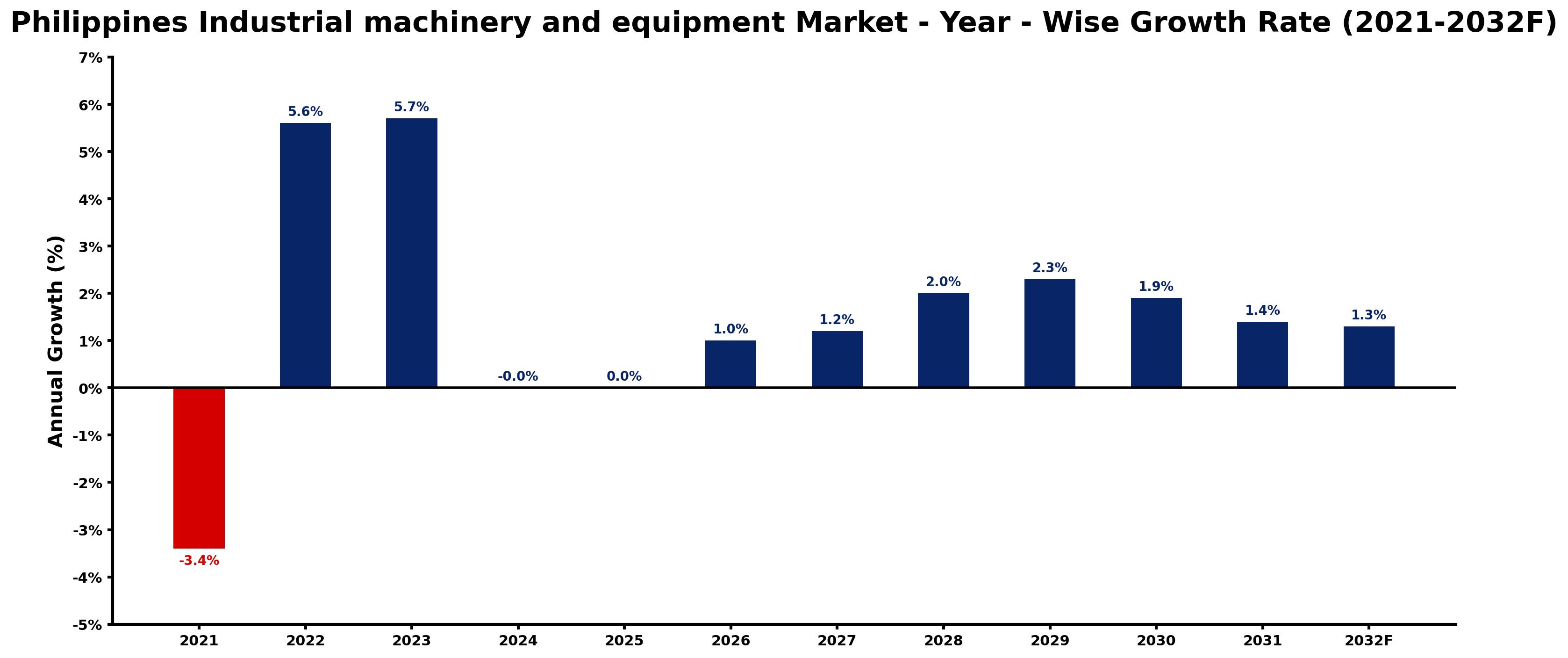
The table below presents the year wise growth rates along with the key drivers influencing the market
| Year | Growth Rate | Major Drivers |
| 2021 | -3.4% | Supply chain disruptions undermined manufacturing capabilities, significantly hampering machinery and equipment delivery timelines. |
| 2022 | 5.6% | Technological upgrades in local industries enhance operational efficiencies and productivity. |
| 2023 | 5.7% | Increased foreign investments signal confidence in the Philippines' industrial potential and growth. |
| 2024 | -0.0% | Emerging sectors like renewable energy create new opportunities for specialized equipment. |
| 2025 | 0.0% | Infrastructure projects drive the need for heavy machinery in construction and logistics. |
| 2026 | 1.0% | Local manufacturing initiatives focus on reducing import dependence and boosting machinery sales. |
| 2027 | 1.2% | Smart factory concepts attract significant interest, pushing automation technologies forward. |
| 2028 | 2.0% | Urbanization trends increase demand for efficient industrial solutions across metropolitan areas. |
| 2029 | 2.3% | Sustainability concerns prompt investments in eco-friendly machinery and equipment alternatives. |
| 2030 | 1.9% | Access to skilled labor improves, facilitating growth in complex industrial machinery operations. |
| 2031 | 1.4% | Digital transformation initiatives enhance data-driven decision-making in machinery procurement. |
| 2032 | 1.3% | Global supply chain shifts lead to a renewed focus on local machinery manufacturers. |
Note - Market size estimations and growth projections presented in this report are based on 6Wresearch's advanced forecasting approach, validated with industry datasets as of June 2026.
Philippines Industrial machinery and equipment Market Synopsis
The Philippines Industrial machinery and equipment Market is projected to reach 1.0% and witness significant growth during the forecast period (2026-2032). This anticipated expansion is largely driven by a combination of increased investments in infrastructure projects, a rise in manufacturing activities, and the overall strengthening of the domestic economy. The government's commitment to driving economic progress through initiatives such as the 'Build Build Build' program and the influx of foreign direct investment (FDI) further catalyzes the growth potential of this sector.
Philippines Industrial machinery and equipment Market Growth Drivers
A variety of factors contribute to the robust growth of the Philippines Industrial machinery and equipment Market. These include:
- The sustained economic growth of the Philippines has resulted in an increase in business operations and commercial activities, thereby spurring the demand for industrial machinery and equipment.
- Infrastructure development, supported by both public and private investments, necessitates advanced machinery and equipment to enhance productivity and efficiency in construction and manufacturing.
- Rising manufacturing activities across various sectors have created a strong demand for specialized machinery, facilitating increased production capabilities.
- The government's proactive initiatives, such as tax incentives for foreign investments, aim to attract more players into the industrial machinery sector.
- There is a growing emphasis on technological advancements within the industry, pushing companies to upgrade machinery for better performance and sustainability.
Philippines Industrial machinery and equipment Market Trends and Opportunities
Several emerging trends present noteworthy opportunities in the Philippines Industrial machinery and equipment Market:
- The ongoing shift toward automation and digitalization in manufacturing processes is driving demand for advanced industrial machinery equipped with smart technology.
- There is a rising need for energy-efficient machinery as industries strive to meet environmental standards and reduce operational costs.
- Growing sectors such as renewable energy are creating opportunities for specialized machinery tailored to support sustainable production methods.
- The implementation of Industry 4.0 principles is pushing manufacturers to invest in high-tech equipment that integrates IoT (Internet of Things) capabilities for enhanced operational efficiency.
- Increased focus on local production in response to global supply chain challenges is anticipated to boost the demand for domestic industrial machinery and equipment.
Philippines Industrial machinery and equipment Market Challenges and Restraints
While the market presents several growth opportunities, it also faces certain challenges and constraints:
- The high initial investment costs associated with advanced machinery can be a barrier for smaller enterprises seeking to compete.
- Supply chain disruptions, exacerbated by global events, can delay project timelines and increase costs for manufacturers.
- The lack of skilled labor to operate and maintain advanced machinery poses a significant challenge to maximizing production efficiency.
- Regulatory hurdles and compliance with safety standards may impede the speed of market entry for some industrial machinery providers.
- The growing competition from imported machinery may impact domestic manufacturers, challenging their market share.
Philippines Industrial machinery and equipment Market Government Investment and Initiatives
The Philippine government has embarked on several initiatives aimed at boosting the country's industrial machinery and equipment sector:
- The 'Build Build Build' program has prioritized infrastructure development, leading to increased demand for heavy machinery used in construction projects.
- Public sector investments are directed towards enhancing transportation and logistics infrastructure, which indirectly supports the growth of industrial machinery.
- Government incentives, such as tax breaks and subsidies for local manufacturers, aim to foster competitiveness within the industry.
- Collaborations with private sectors to promote research and development initiatives are being encouraged to enhance local technology capabilities.
- Support for vocational training programs aimed at developing a skilled workforce capable of handling advanced industrial machinery is being prioritized.
Philippines Industrial machinery and equipment Market Latest Developments (May 2025 - June 2026)
Recent developments in the Philippines Industrial machinery and equipment Market are indicative of evolving industry trends. The period from May 2025 to June 2026 has seen several significant shifts:
- Growing interest in automation technologies has led companies to integrate robotics into their manufacturing processes, enhancing operational efficiencies.
- Investment in sustainability measures has intensified, encouraging the adoption of eco-friendly machinery options among manufacturers.
- Increased collaboration between public and private sectors has facilitated the sharing of technology and resources for industrial development.
- Ongoing training programs and workshops have been launched to address the skills gap in operating sophisticated industrial machinery.
- The overall sentiment in the market reflects optimism owing to supportive governmental policies and initiatives, which continue to bolster investment in the sector.
Philippines Industrial machinery and equipment Market - Key Attractiveness of the Report
- 10 Years of Market Numbers
- Historical Data Starting from 2022 to 2025
- Base Year: 2025
- Forecast Data until 2032
- Key Performance Indicators Impacting the Market
- Major Upcoming Developments and Projects
Key Highlights of the Report:
- Philippines Industrial machinery and equipment Market Outlook
- Market Size of Philippines Industrial machinery and equipment Market, 2025
- Forecast of Philippines Industrial machinery and equipment Market, 2032
- Historical Data and Forecast of Philippines Industrial machinery and equipment Revenues & Volume for the Period 2022-2032F
- Philippines Industrial machinery and equipment Market Trend Evolution
- Philippines Industrial machinery and equipment Market Drivers and Challenges
- Philippines Industrial machinery and equipment Price Trends
- Philippines Industrial machinery and equipment Porter's Five Forces
- Philippines Industrial machinery and equipment Industry Life Cycle
- Historical Data and Forecast of Philippines Industrial machinery and equipment Market Revenues & Volume By Types for the Period 2022-2032F
- Historical Data and Forecast of Philippines Industrial machinery and equipment Market Revenues & Volume By Packaging Machinery for the Period 2022-2032F
- Historical Data and Forecast of Philippines Industrial machinery and equipment Market Revenues & Volume By Food Processing Equipment for the Period 2022-2032F
- Historical Data and Forecast of Philippines Industrial machinery and equipment Market Revenues & Volume By Plastics Processing Machinery for the Period 2022-2032F
- Historical Data and Forecast of Philippines Industrial machinery and equipment Market Revenues & Volume By Metal Forming Machine Tools for the Period 2022-2032F
- Historical Data and Forecast of Philippines Industrial machinery and equipment Market Revenues & Volume By Woodworking Machinery for the Period 2022-2032F
- Historical Data and Forecast of Philippines Industrial machinery and equipment Market Revenues & Volume By Application for the Period 2022-2032F
- Historical Data and Forecast of Philippines Industrial machinery and equipment Market Revenues & Volume By Agriculture for the Period 2022-2032F
- Historical Data and Forecast of Philippines Industrial machinery and equipment Market Revenues & Volume By Construction for the Period 2022-2032F
- Historical Data and Forecast of Philippines Industrial machinery and equipment Market Revenues & Volume By Packaging for the Period 2022-2032F
- Historical Data and Forecast of Philippines Industrial machinery and equipment Market Revenues & Volume By Food processing for the Period 2022-2032F
- Historical Data and Forecast of Philippines Industrial machinery and equipment Market Revenues & Volume By Mining for the Period 2022-2032F
- Historical Data and Forecast of Philippines Industrial machinery and equipment Market Revenues & Volume By Others for the Period 2022-2032F
- Philippines Industrial machinery and equipment Import Export Trade Statistics
- Market Opportunity Assessment By Types
- Market Opportunity Assessment By Application
- Philippines Industrial machinery and equipment Top Companies Market Share
- Philippines Industrial machinery and equipment Competitive Benchmarking By Technical and Operational Parameters
- Philippines Industrial machinery and equipment Company Profiles
- Philippines Industrial machinery and equipment Key Strategic Recommendations






































